In our study, 43.6% of patients were anemic upon admission. We found a significantly higher prevalence of anemia in females. In a multi-center study on children with SARS-CoV-2 in Oman, 38% of patients were anemic; anemia was also significantly more prevalent in children who required ICU admission (
18). The prevalence of anemia is well-studied in adult patients with COVID-19 and is reported to range from 49.3% to 77% in ICU-admitted patients (
19-
21). This relatively wide range may be attributed to differences in demographics, comorbidities, and cut-offs used to define anemia. Saba et al. studied the prevalence of anemia among hospitalized children (
22). They found that 72.79% of children were anemic, with a male-to-female ratio of 1.4:1. Our finding contrasts with other studies. It may be explained by nutritional, genetic, or environmental differences, which should be studied further. We showed that a remarkable number of patients had significant prehospital comorbidities, and anemia was significantly more common among them. This was expected, as anemia of chronic disease is among the most common causes of anemia in children (
23). Iron deficiency anemia may also play a role in our patients with comorbidities. However, the type of anemia was not addressed in our study. In a multicenter study from Latin American countries on children with COVID-19, comorbidities were associated with an increased risk for hospital admission, ICU admission, and supplementary oxygen use (
24). The distribution pattern of comorbidities in our region is almost similar to others (
24,
25). The most common symptoms were fever, respiratory problems, and gastrointestinal symptoms, consistent with other studies (
18,
24,
26,
27). Most of our participants were underweight. There was no significant difference between anemic and non-anemic patients regarding anthropometric data. Abdolsalehi et al. found that obesity was not associated with COVID-19 outcomes in children, but being underweight in the presence of comorbidities predicted a poor prognosis (
28). In the study conducted in Latin American countries, 11.6% were underweight. The percentage of malnutrition was higher in our study. It may be explained by the high rate of comorbidities in our patients, which significantly affect nutritional indices (
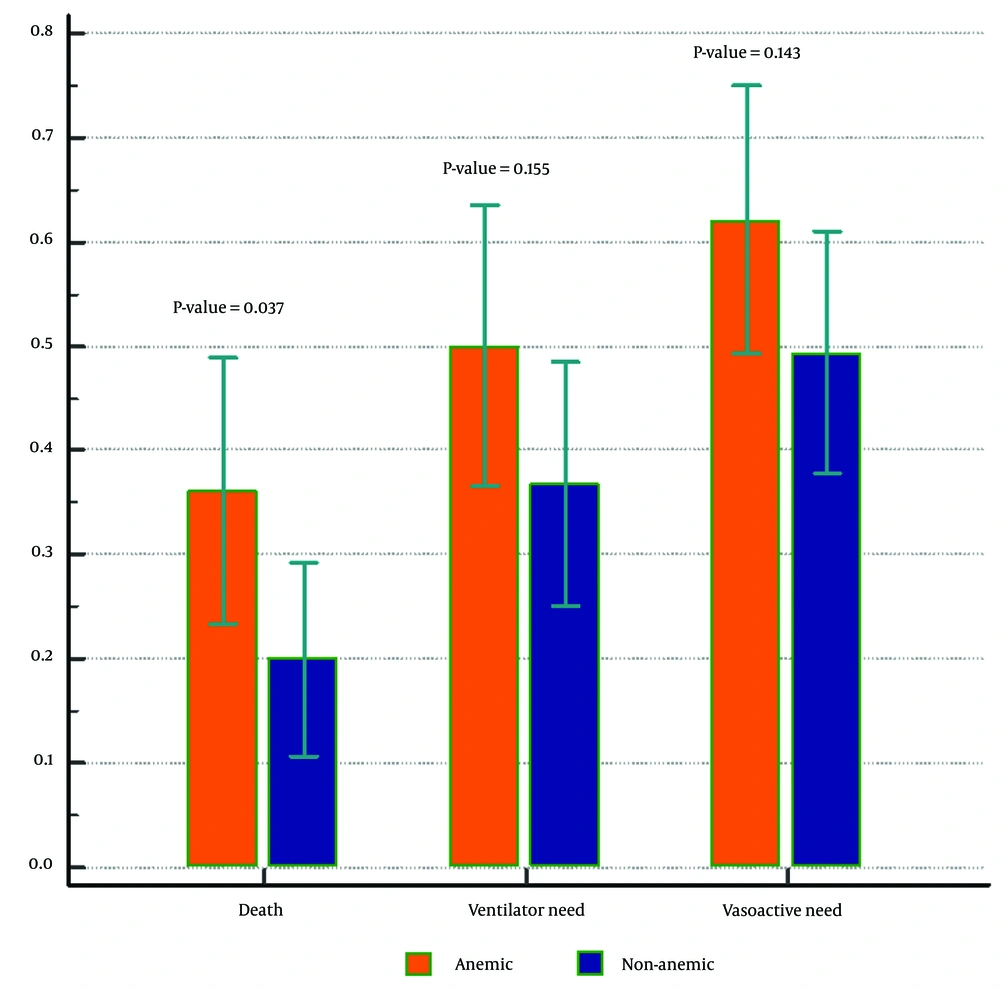
29). In our survey, 72.9% of patients survived, and 27.1% succumbed to COVID-19. Through univariate analysis, we found that death was significantly more common in the anemic group compared to children with normal Hb levels, with an OR of 2.27. We utilized logistic regression to adjust for potential confounders. This analysis revealed that death occurred 1.77 times more frequently in anemic patients versus non-anemic patients adjusted for comorbidity (95% CI: 0.79, 3.98, P-value: 0.162), and 1.82 times more often when adjusted for both comorbidity and sex (95% CI: 0.80, 4.12, P-value: 0.152) (
Table 2). Despite the wide CIs and non-significant P-values indicating the low power of the study, mainly due to the small sample size, a small effect relationship between anemia and mortality is still evident in both analyses. Many studies considered anemia as a risk factor for mortality in adults with COVID-19 (
30-
32). Infancy, presence of comorbidities, severe illness, and mechanical ventilation (MV) were defined as predictors of mortality in pediatric populations (
33). The overall mortality rate of our study was 27.1%. The mortality rate of COVID-19 was reported to be lower in other studies (
25,
26). This can be explained by the fact that our survey was conducted on critically ill patients admitted to PICU. Mamishi et al. reported a mortality rate of 10% in our center in 2022, which shows that our hospital's overall mortality rate is close to other national and international reports (
34). They also found that 93% of deaths occurred in our ICUs, which was a significant finding. Furthermore, our study was carried out in a tertiary referral hospital where more than three-quarters of patients had significant pre-hospital comorbidities, which is a major predictor of death among children with COVID-19. Variability in inclusion criteria, sample size, and ethnicity may also play a role in this finding. We found that more than half of the patients needed vasoactive agents, and half of them were anemic. 42.7% of children were intubated, while others were treated with non-invasive ventilation or supplemental oxygen. There was no remarkable difference between anemic and non-anemic patients considering vasoactive need and respiratory support level. Our result aligns with a survey done in Turkey in 2020 (
21). In the study done in India, MV and hemodynamic support were needed in 28.3% and 37% of children with COVID-19, respectively (
25). Although anemia decreases oxygen delivery to organs, adversely impacts the heart, and activates compensatory cardiovascular responses, particularly during critical illness, our result did not show an increase in hemodynamic and respiratory support (
35,
36). It may be related to the severity of anemia, which was not studied. We also did not study the ventilator days and the inotropes scores in the survey, which will also affect the results. The mean PICU and hospital LOS were studied. These durations were shorter in patients with normal Hb levels compared to anemic children. However, the differences were not statistically significant. The studies done in Austria and Turkey support our findings (
21,
30). We follow the TAXI protocol for PC transfusion in our division (
37). We found more transfusion needs in children who succumbed to COVID-19. The first and final Hb levels of survivors were also significantly higher than non-survivors. Our results are close to Ozmen Suner et al’s findings (
21). The mean of the first and highest ferritin levels in our study did not differ between patients with low and normal Hb levels. Literature has identified that elevated ferritin levels could be associated with adverse outcomes in patients with SARS-CoV-2 and serve as a severity and prognostic factor (
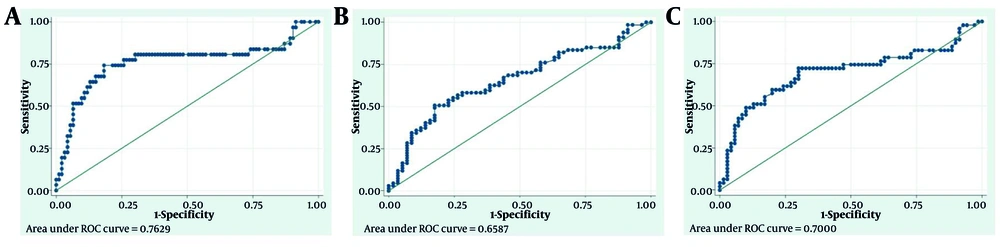
38,
39). We found a cut-off point of 392 ng/mL for ferritin level, with 74% sensitivity and 82% specificity for predicting death. We also detected a cut-off point of 206.5 ng/mL for ferritin level, with 72% sensitivity and 70% specificity for predicting ventilator need. We also found that ferritin with a cut-off point of 330.5 ng/mL will predict vasoactive need, with 51% sensitivity and 82% specificity. Further study should be done to confirm our cutoff points. In a study done by Para et al. in Italy on 200 adult patients with COVID-19, ferritin > 3000 ng/mL was correlated with unfavorable outcomes with a sensitivity of 34% and specificity of 96% (
39). Considering this cutoff, 15 of our cases had ferritin > 3000 ng/mL. Among them, 80% required vasoactive agents, 87% underwent MV, and 73% expired. The present study has some limitations. The most important one is the small sample size. We did not address the severity or type of anemia (normocytic vs microcytic) or post-admission anemia. Additionally, we did not utilize severity scoring systems to predict PICU outcomes, such as the Pediatric Index of Mortality (PIM) or Pediatric Risk of Mortality (PRISM). We suggest that pediatricians screen for anemia and address it if needed, particularly in children with comorbidities, to potentially prevent severe outcomes associated with both anemia and severe COVID-19. Further prospective studies are encouraged to assess the relationship between anemia and severe outcomes of COVID-19 considering the type and severity of anemia.