


1. Introduction
Influenza is a common viral infection that typically presents with upper respiratory tract symptoms, such as sneezing and coughing, as well as fever and myalgia (1). Influenza is generally self-limited, and most patients do not require antiviral therapy. However, antiviral agents, such as oseltamivir, can reduce the duration of illness and prevent viral transmission (2). Influenza can also cause a spectrum of complications, ranging from mild conditions, such as parotitis and bronchitis, to severe manifestations, including pneumonia and potentially fatal complications, such as myocarditis. The disease may also involve the central nervous system, presenting as meningoencephalitis, transverse myelitis, or cerebrovascular accidents. Acute kidney injury and septic shock have also been associated with influenza infection (2).
Most cases of influenza do not present with dermatologic manifestations; however, previous case reports have described rare skin conditions associated with influenza virus infection. Gianotti-Crosti syndrome with papular and bullous lesions on the extremities and trunk in a 15-month-old girl, as well as macular eruptions on the extremities in a 28-year-old man, have been reported as presenting signs of influenza (3). Eosinophilic cellulitis has also been reported in association with influenza vaccination (4).
In this case report, we describe a patient who presented with a measles-like maculopapular rash and fever and subsequently developed bicytopenia during hospitalization.
2. Case Presentation
The patient was a nine-year-old girl with no significant past medical history who was referred to our pediatric infectious diseases center with a chief complaint of a 10-day history of fever and a pruritic rash that began one day before admission. She denied symptoms of an upper respiratory tract infection and had not taken any medications before presentation. She reported no sick contacts, recent travel, or consumption of new foods. She also had no history of allergic or atopic disease.
On admission, she was febrile (38.6°C) and mildly tachycardic, with a heart rate of 100 - 110 beats per minute. She appeared relatively well, and there were no signs of respiratory distress. Lung and heart sounds were normal, with no additional sounds. Oropharyngeal examination was unremarkable, and no cervical lymphadenopathy or enanthem was noted. Meningeal signs were negative, and no focal neurological deficits were identified.
The only abnormal finding on physical examination was a diffuse, confluent maculopapular rash that initially appeared on the trunk and subsequently involved the face and extremities. The nasolabial folds were also affected. The palms and soles were also involved. The rash was blanchable and pruritic (Figure 1).
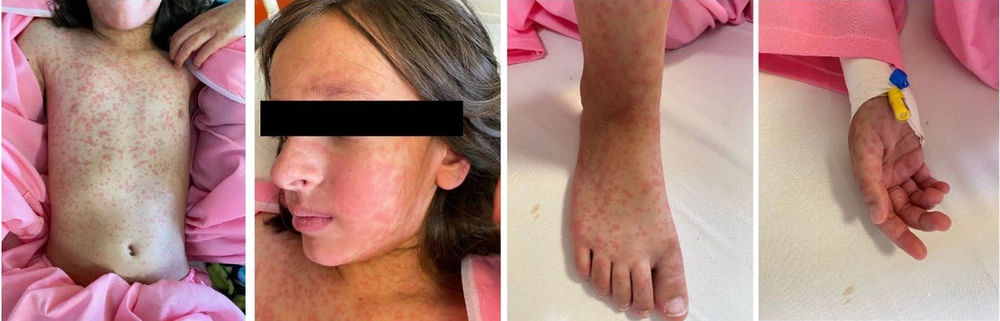
Figure 1.
Dermatologic manifestation of the patient
Paraclinical investigations revealed bicytopenia, with decreased hemoglobin and leukocyte counts. Peripheral blood smear demonstrated moderate polymorphonuclear-predominant leukopenia (PMNs 55%, lymphocytes 41%, monocytes 4%) with hypochromic microcytic anemia. The erythrocyte sedimentation rate was elevated.
Given the prolonged fever, a complete sepsis workup, including chest radiography and urine and blood cultures, was performed; all results were negative. Transthoracic echocardiography showed no evidence of vegetations or other findings suggestive of infective endocarditis, multisystem inflammatory syndrome in children, or Kawasaki disease.
Given the presence of bicytopenia and prolonged fever, bone marrow aspiration and biopsy were performed to rule out underlying hematologic malignancy. The biopsy revealed mildly hypocellular marrow with a left shift in myeloid maturation and approximately 2.5% immature CD34+ and/or CD117+ cells.
Given the suspicion of viral infection, serologic testing for Epstein-Barr virus and measles was performed, and the results were negative. To evaluate for secondary syphilis, a pelvic examination was conducted and was normal, and the VDRL test was negative. The patient had mildly elevated antinuclear antibodies and anti-double-stranded DNA levels, which normalized after 10 days.
Nasopharyngeal samples were obtained for SARS-CoV-2 and influenza testing; the results were positive for influenza type B. PCR testing for parvovirus B19 and adenovirus was requested but was not available.
The patient received only acetaminophen for fever and antihistamines for pruritus, without antibacterial or antiviral therapy. Two days after admission, her fever resolved, and one day later, the rash completely disappeared. She was discharged with a recommendation to repeat a complete blood count after 10 days. At follow-up, her laboratory results were normal, and she had no dermatologic or respiratory symptoms. Table 1 summarizes the patient’s paraclinical findings.
Table 1.Paraclinical Findings of the Patient During Admission and Follow-Up
| Variables | First Day | Second Day | Third Day | Follow-up |
|---|---|---|---|---|
| WBC (/µL) | 1,800 | - | - | 5,300 |
| Hb (g/dL) | 10.6 | - | - | 11.6 |
| MCV (fL) | 69.0 | - | - | 74.1 |
| Platelets (/µL) | 320,000 | - | - | 429,000 |
| CRP (mg/L) | - | 2 | - | - |
| ESR (mm/h) | - | 56 | - | - |
| BUN (mg/dL) | 14 | - | - | - |
| Creatinine (mg/dL) | 0.61 | - | - | - |
| Sodium (mEq/L) | 142 | - | - | - |
| BUN (mg/dL) | 4.3 | - | - | - |
| LDH (U/L) | 420 | - | - | - |
| Uric acid (mg/dL) | - | 2.7 | - | - |
| Blood culture | Negative | - | - | - |
| EBV IgM | - | Negative | - | - |
| Measles IgM | - | Negative | - | - |
| ANA (index) | - | - | 2.94 (positive > 1.2) | 1.12 |
| Anti-dsDNA (IU/mL) | - | - | 111.3 (negative < 100) | 85.7 |
| VDRL | - | Negative | - | - |
| Echocardiography | - | Normal | - | - |
| Peripheral blood smear | - | Mild leukopenia, PMN dominant, hypochromic microcytic anemia, < 1% fragmented RBCs, adequate platelets | - | - |
| Bone marrow aspiration and biopsy | - | - | Mild hypocellular marrow with a left shift in myeloid maturation, with approximately 2.5% immature CD34+/CD117+ cells | - |
Notably, the patient’s cousin, who had close contact with her, developed mild respiratory symptoms two days after the index case and tested positive for influenza by PCR. This finding further supports influenza type B infection as the underlying cause of the patient’s clinical presentation.
3. Discussion
In this case report, we described a patient who presented with fever and an erythematous maculopapular rash without respiratory symptoms and who had negative PCR and serologic testing for Epstein-Barr virus and measles. Further evaluation revealed influenza type B infection, for which cutaneous manifestations are rare. The rash and other symptoms resolved within three days without antiviral or antibiotic therapy.
The patient presented with prolonged fever and was evaluated for inflammatory diseases, including Kawasaki disease and multisystem inflammatory syndrome in children (MIS-C); autoimmune disorders, including systemic lupus erythematosus (SLE); hematologic malignancies; and infectious agents, including viral and bacterial causes. She did not fulfill the diagnostic criteria for Kawasaki disease and had normal echocardiographic findings, as well as negative PCR and serology for SARS-CoV-2, thereby excluding Kawasaki disease and MIS-C.
The patient exhibited bicytopenia, including leukopenia and anemia. Bone marrow examination revealed mildly hypocellular marrow with a left shift in myeloid maturation and approximately 2.5% immature CD34+/CD117+ cells. Flow cytometry findings were consistent with transient leukopenia and were not suggestive of a malignant condition. Furthermore, the bicytopenia resolved one week after hospital discharge; therefore, bone marrow biopsy was not repeated because blood cell counts had normalized.
Although the patient had mildly positive autoantibodies, including antinuclear antibodies and anti-double-stranded DNA, during hospitalization, she did not demonstrate other clinical features suggestive of SLE. Moreover, involvement of the nasolabial folds in our patient argues against SLE, in which these areas are typically spared. Given the suspicion of SLE, autoantibody testing was repeated at follow-up and yielded normal results, indicating transient virus-induced autoantibody production.
Despite the prolonged fever, antiviral treatment with oseltamivir was not initiated because the patient was not considered at high risk for complications and did not appear severely ill. Additionally, by the time the diagnostic test results became available, the rash had already begun to resolve; therefore, antiviral therapy was not started.
The exact etiology of influenza-associated rashes remains unclear; however, some studies have proposed an immune-mediated mechanism (5). Other possible explanations include a fever-related rash, vasculitis, drug reactions, or secondary infections. The transiently positive antinuclear antibodies and anti-dsDNA in our patient further support a possible immune-mediated pathogenesis.
The first reported cases of dermatologic manifestations of influenza A were described by Silva et al. in 1999. In their report, the patient developed petechial exanthems after taking trimethoprim-sulfamethoxazole for cough and rhinorrhea. The patient also had mild thrombocytopenia at admission. The petechial rash and recent antibiotic use raised suspicion of a drug-induced reaction, such as Stevens-Johnson syndrome (6).
Rosenberg et al. reported a case of a confluent maculopapular rash in a 44-year-old man during the 2009 H1N1 pandemic. In their case, the face, palms, and soles were spared, unlike in our patient, in whom these regions were involved. The rash in their report lasted 48 hours, and the patient received oseltamivir 75 mg twice daily; all symptoms resolved within 10 days (7).
In a case series by Fretzayas et al., approximately 6% of children hospitalized with H1N1 infection during the pandemic exhibited dermatologic manifestations. Most of these patients had purpuric lesions, whereas others presented with macular rashes. Because many patients with influenza A are managed in outpatient settings, the reported rate in hospitalized cohorts may be overestimated (8). Moreover, during large epidemics, rare manifestations of infectious diseases may be observed more frequently; however, recognition of such atypical presentations in non-epidemic settings requires a high index of clinical suspicion.
Regarding influenza type B, Anukumar and Peter reported a pediatric case presenting with a rash (9). Skowronski et al. subsequently described six school-aged patients with similar findings. In their report, none of the patients had involvement of the palms or soles; however, in our case, these areas were affected. Given the limited differential diagnosis of maculopapular rashes involving the palms and soles, the diagnosis of influenza was unexpected (10).
In a review article by Korman et al. on virus-induced exanthems, the authors stated that influenza virus may cause morbilliform maculopapular rashes accompanying classic influenza symptoms, such as myalgia, fever, and headache. However, definitive evidence establishing direct viral causality is lacking (11). Since similar rashes have been observed following influenza vaccination, an immunologic reaction, rather than direct viral cytopathic effects, may play a significant role in the pathophysiology of these dermatologic manifestations.
3.1. Conclusions
Influenza virus infection can present with a maculopapular rash that may be mistaken for other conditions, such as measles or rubella. These lesions are self-limited, and only symptomatic treatment is recommended.
