


1. Background
Helicobacter pylori causes the most common infection in human beings. The infection is widespread worldwide and affects all age groups. On the other hand, it is estimated that 50% of the world population are contaminated with H. pylori. In developed countries like United States, it is unusual to see infections in children, and usually adults are affected by H. pylori. But most of the children in developing countries are contaminated before 10, and 10% of people are contaminated before the age of 50 (1, 2). It has been reported that the prevalence of H. pylori in Iranian children is approximately 82-92% (3).
As one of its particular characteristics, Helicobacter pylori has a large amount of urease enzyme (six percent of total proteins produced by H. pylori) with intense activity. This enzyme degrades plasma urea secreted through stomach wall to ammonium ion that protects bacteria from the destructive effect of stomach acid by neutralization. There is a distinction between urease produced by H. pylori and other bacteria. Urease of H. pylori has two subunits with approximately 33 and 66 kDa molecular weight in contrast to other bacteria which have three subunits. UreA, and UreB code two subunits of urease made by H. pylori (1, 2). The pH increment of stomach’s lumen facilitates passing through stomach’s acid environment easily for some protozoa (4). Giardia spp. is a flagellated protozoan observed on the mucosa of duodenum, first section of jejunum, ileum, rarely on stomach’s wall, and colon (4). The prevalence of Giardia spp. in the world and industrialized societies is 20-60% and 2-7%, respectively (5). Of course the prevalence rate varies in different countries, and depends on the hygiene level.
On the other hand, the studies have shown that under unsuitable situations, primarily when the acidity of stomach is reduced because of H. pylori infection, development of giardiasis related gastritis will be probable. Reduction of stomach’s acidity due to urease of H. pylori is the risk factor for infection by Giardia spp. (6).
2. Objectives
The current study aimed to evaluate the prevalence of parasitic infections (giardiasis) in children with Helicobacter pylori infection in Ilam city.
3. Patients and Methods
This is a descriptive study. We followed all children who referred to laboratory with abdominal pain during 2012-2013. Children who were positive for H. pylori antigen in stool samples examined by enzyme-linked immunosorbent assay (ELISA) method entered the study. Sensitivity and specificity of this method are 83% and 92%, respectively. Stool specimens were examined via light microscope with 40× magnification power as direct examination of the parasite trophozoites. Also in sedimentation method fifty grams of feces was mixed with approximately 100 mL of tap water and sieved through 2 mL mesh sieve. Afterward, it was washed with 50 mL water and then pressed with a spatula to recover the water as much as possible. After 40 min, the supernatant was decanted to remain 50 mL of that. The beaker was refilled with tap water to final volume of 200 mL and then the suspension was allowed standing. After 40 min, the supernatant was decanted to save 30 mL, and 1 mL of that was examined (in approximately 200 μL aliquots) via light microscope with 100X magnification power to survey the presence of the parasite ova. Ziehl-Neelsen staining was performed to look for acid-fast protozoa (Isospora belli, Cyclosporacayetanensis, and Cryptosporidium parvum).
4. Results
In this study, 37 children out of total 68 children with abdominal pain were infected with H. pylori. Children without H. pylori infection were not included in the study. In the direct examination, trophozoite and cyst of Giardia lamblia were observed in 11 (29.7%) and 7 (18.9%) subjects, respectively. Nevertheless, we only evaluated children who had excreted trophozoite of Giardia lamblia, because the presence of trophozoite is the sign of acute Giardiasis. Cyst of Entamoeba histolytica/dispar was observed in 4 (10.8%) of 37 subjects. In sedimentation method, ova of parasites were never observed. At last, in Ziehl-Neelsen staining, acid-fast parasites were never observed in patients infected with H. pylori.
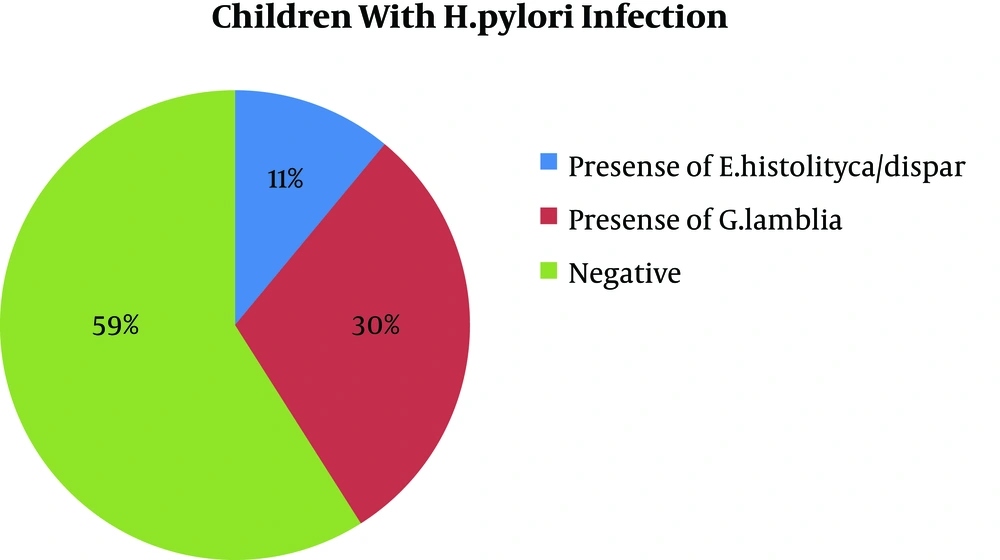
Figure 1.
Proportion of Parasitic Infections in Patients Infected With H. pylori.
5. Discussion
H. pylori is the main cause of chronic stomach inflammation, peptic ulcer, duodenal ulcer, non-ulcerous dyspepsia, gastric cancer, and gastric mucosa associated lymphoid tissue lymphoma (7, 8). Urease of the bacteria can convert the urea of stomach wall to ammoniac. This would result the increment of stomach environment’s pH (1, 9). Acidity of stomach is an innate immune system barrier against pathogens, therefore the diminished acidity will allow pathogens to break this barrier and go across it. Giardiasis, a parasitic infection of small intestine in most of the vertebrates and human beings, which has global prevalence, is the result of contamination by a flagellated protozoan called Giardia lamblia (10, 11). Giardia lamblia can be transmitted from affected person to others. Its transmission can occur through ingestion of contaminated water and food. It is the main cause of diarrhea in children, passengers, and homosexuals (12). Also, many factors like population density, weather situation, economic condition, and hygiene level would facilitate the situation for contamination by Giardia lamblia (10, 14). The prevalence of Giardia spp. in the world and the industrialized societies is 20-60% and 2-7%, respectively (5). Of course the prevalence rate varies in different countries, and depends on the hygiene level. On one hand according to a local epidemiological study on the prevalence of enteric parasites done in 2013, prevalence of G. lamblia in children was 11.7% in Ilam (15). On the other hand, the current study demonstrated that prevalence of G. lamblia in the H. pylori infected children of Ilam was approximately 50% (trophozoite and cyst). Considering these two facts it is not vague that H. pylori infection has affected the rate of parasitic infection in H. pylori infected children. The importance of polymicrobial infections has gained tremendous impact in recent years, and some synergistic infections have been identified (15). In synergistic polymicrobial infections, one microbe creates a favorable environment in order for another one to more easily colonize a specific niche of their common host (16). H. pylori has been linked to co-infections earlier, e.g. the fluke Schistosoma japonicum is associated with an alteration in the antibody response to H. pylori during co-infections (17). Another interesting example is co-infections of H. pylori and Salmonella typhimurium in mice (18). In another study, Maria PD et al. did not find an association between H. pylori and pediatric asthma (19). Johan A et al. found a significantly higher frequency of Giardia spp. infection in cases where infected children also harbored the bacterial pathogen H. pylori (20).
Moreira ED Jr et al. found an association between H. pylori infection and the presence of G. lamblia in feces (21). Isaeva G et al. showed that 100% of H. pylori-infection combined with iardiasis (9). Abou El-Hoda MM et al. found a significant increase in urease activity in the group with combined infection (Giardiasis and H.pylori) compared to the group infected with G. lamblia alone (22). The large amount of co-infections in our study is possibly due to an elevated risk of Giardia spp. colonization upon the presence of H. pylori in human patients or, alternatively, H. pylori colonization may be facilitated by a previous establishment of Giardia spp.
In this study, parasitic contamination was surveyed in children contaminated by H. pylori. Rate of parasitic contamination in H. pylori infected children was remarkable (active infection and carriers of Giardia spp. approximately were 50%). According to the Simultaneous study, the prevalence of G. lamblia in the children was 11.7% in Ilam (15), therefore there was a significant correlation between the contamination to Giardia lamblia and H. pylori infections in children.
Considering all the facts, it is obvious that acidity of stomach can be important. Also, pH increment would be concentrated on as a risk factor for contraction to parasites, especially those that can transmit through digestive tract like Giardia lamblia. More studies are suggested to get vigorous results, and validate the relevance between H. pylori infection and contamination to parasites.

