In this study, the density incidence of acute diarrhea was 26.7 per 1,000 children per month, according to the measurement of incidence density used, or 298 per 1,000 children, according to the cumulative incidence. Therefore, there was a high incidence rate of the disease in the study population compared with data from the state of Santa Catarina, where the estimated incidence was 93.9 per 1,000 population for children aged under 1 year old, in the 2000 - 2012 period, according to the Department of Epidemiological Surveillance. A cohort study in Northeast Brazil followed up 250 children under 1 year of age for 2 years. In the first year of follow-up, researchers found an incidence rate less significant than that observed in this study (8.4 and 8.7 cases of diarrhea per 1,000 children vaccinated and not vaccinated against rotavirus, respectively) (
13).
A systematic review that investigated the incidence of diarrhea in children aged 0 - 59 months in middle and low-income economies included 11 studies conducted in Brazil, which represented approximately 50% of Latin American Studies in the area. This review presented an estimate incidence rate of 4.1 episodes of diarrhea per child aged 0 - 5 months per year for 2010 and 6.2 episodes of diarrhea per child aged 6 - 11 months per year in the Americas for the same year (
14). In fact, when compared with the data of the present study, the number of the episodes of diarrhea among children older than 6 months was larger (70.2%) than that among those aged 0 - 5 months (29.8%). A cross-sectional study conducted in Guarulhos, Sao Paulo, showed that infants aged between 4 and 9 months and 10 months or older had a higher risk of diarrhea than other age groups (
15).
There has been a slight decline in the incidence of diarrhea in Brazil over the past 20 years (
14), as identified by a systematic review (
16), which also studied the incidence of infant morbidity and mortality from diarrhea. The systematic review showed an estimated incidence of 3.2 cases per child aged 0 - 5 years per year in developing countries, based on studies published between 1990 and 2000. The authors of that study emphasized that the morbidity rate did not show the same reduction in mortality rates, and they hypothesized that the population growth concentrated in economically disadvantaged regions was a reason for that fact (
14,
16).
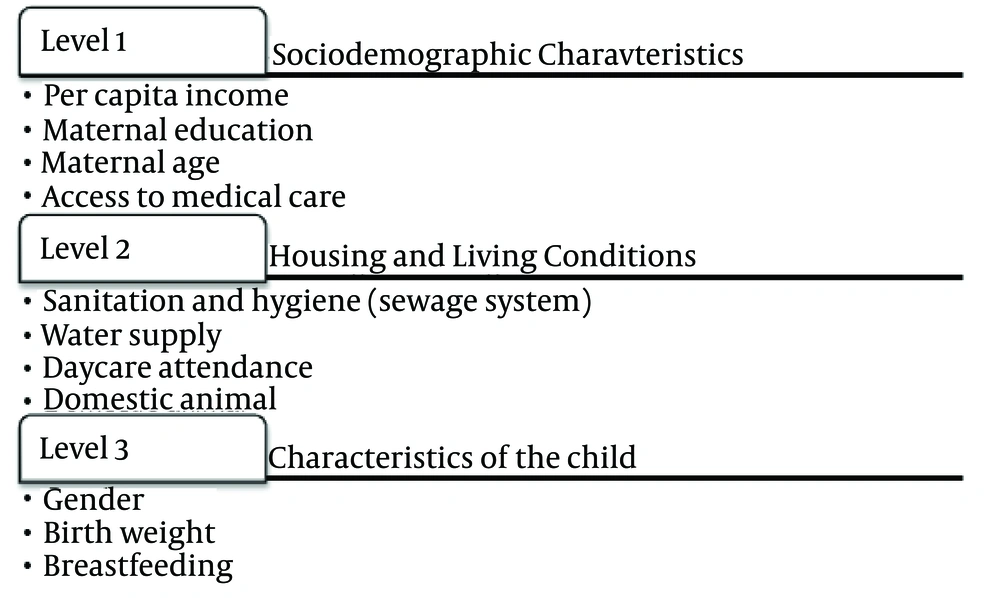
Based on the literature review, it is possible to understand that many variables are not directly responsible for the occurrence of diarrhea, but they favor the exposure to determinant agents (
17). The sociodemographic pattern of the family establishes the child’s housing conditions, influences the mother’s ability to care for the child, and defines the access to health care. Whereas the environment is responsible for the child’s exposure to pathogens, maternal care and access to health care influence the nutritional conditions and severity of diarrhea. Such reasoning permeated the ranking of independent variables in this study, which shows similar suggestions to those made by other authors (
12,
18).
In this cohort study, maternal age was considered an independent risk factor for the occurrence of the outcome, given that the children of younger mothers had a higher frequency of acute diarrhea than the children of older mothers. This fact can be attributed to the greater ability of older mothers to identify exposure situations or even to perceive signs and symptoms of diarrhea and anticipate the necessary care compared with younger mothers, either by previous experience or by better education. Vanderlei and Silva supported this hypothesis with a case-control study conducted at the Instituto Materno Infantil of Pernambuco. The authors demonstrated that there was an association between infant hospitalization for diarrhea and maternal knowledge about the management of children with this injury (
10). In the same study, no association was found with maternal age, although the results were unexpected for the authors, based on the literature review that they had performed (
18).
There was a high prevalence of mothers who reported that they could not afford to pay for private health care and depended on the public health system, the National Public Health System (SUS). It should be noted that, in this study, income was not considered a risk factor for diarrhea; however, the type of health care access was shown to be an independent risk factor for the occurrence of the outcome, which shows that the children who depended on the SUS had a higher incidence of the disease. A study conducted at Hospital Nossa Senhora da Conceicao, located in the same city where this cohort study was conducted, supports the findings presented here, showing that 73.7% of the hospitalizations for the diarrhea of a presumed infectious origin in children up to 5 years of age were paid by the SUS (
19). Another study conducted in Pelotas, Rio Grande do Sul, compared 3 cohorts from 3 consecutive decades and demonstrated that children from poorer families had higher rates of hospitalization for diarrhea than their counterparts (
20). Indeed, low-income families have low access to health care plans, whereas high-income families can pay for their private health care plans. Therefore, to a certain extent, access to quality health care services depends on per capita income (
17).
In the present study, few children were exclusively breastfed for at least 6 months, as recommended by the Brazilian Ministry of Health and by the WHO, which interferes with the assessment of their immune protection (
21). Exclusive breastfeeding for fewer than 6 months resulted in doubling the chance of diarrhea incidence (
8). A recent study evaluated the influence of breastfeeding on 4,164 infants and showed that exclusive breastfeeding for at least 4 months and partial breastfeeding after this period resulted in low risk for gastrointestinal tract infections, with an odds ratio of 0.41. The same study stated that partial breastfeeding did not provide significant protection, even if it lasted for at least 6 months (
22). However, in the current study, breastfeeding was not a statistically significant protection against the occurrence of diarrhea.
There were limitations to this study regarding the development of the proposed methodology. Keeping in touch with the mothers was a major challenge, especially with those who opted to see pediatricians not affiliated with this cohort. Another limitation was the lack of laboratory tests to identify the etiologic agent of acute diarrhea in order to control the transmission mode, and consequently, the risk factors related to the outcome. In addition, the sample showed a homogeneous sociodemographic profile, considering that there was another maternity hospital for patients who had private health insurance. Some mothers with high-income levels refused to participate in the study, which may have influenced the results of our data analysis. Despite these limitations, the study design helped identify causative factors and allowed the estimation of the incidence density of diarrhea. Given that the estimation of incidence density includes the follow-up period in its calculation, it enjoys high accuracy when compared with cumulative incidence, which is one of the advantages of a cohort study.
Based on the results, this study concluded that the incidence of acute diarrhea in children aged 0 - 1 years was 26.7 cases per 1,000 children per month, and the independent risk factors for the occurrence of diarrhea were maternal age under 20 years and health care services provided by the SUS.