


1. Background
Methicillin-resistant Staphylococcus aureus (MRSA) strains have long been recognized as one of the major human pathogens responsible for a wide range of infections. Even presently, beta-lactams, such as penicillins, have fundamental roles in the treatment of staphylococcal infections. However, one of the most important causes of the penicillin resistance in S. aureus is the expression of the mecA gene. The mecA gene is encoded inside a mec operon, which is carried by the staphylococcal cassette chromosome, SCCmec (1). In addition to the mecA gene, all MRSA strains have other genes such as mecR1, ccr AB, ccr C, and j connective regions in SCCmec regions. Two essential parts in the SCCmec elements of staphylococci are the ccr and mec gene complexes. Furthermore, antibiotic resistance genes may possibly be present in the SCCmec region. Thus, ccr typing is a suitable method to determine the presence of SCCmec genes (2). The SCCmec chromosome cassette is divided into 8 different types (I-VIII). Generally types IV, V, VII are named as community acquired MRSA (CA-MRSA), and types I, II, III, VI, and VIII are called hospital acquired MRSA or HA-MRSA (2-5).
With most studies focusing on the evolutionary relationships between different MRSA strains (6-11), various molecular typing techniques were used for the epidemiological study of MRSA. Several studies have been conducted globally to determine the prevalence of various SCCmec types in different regions of the world (12-14). However, to the best of our knowledge, no comprehensive investigations have been performed regarding MRSA strain typing in Northwest Iran.
2. Objectives
The present study was designed and carried out in Tabriz hospitals to evaluate the prevalence of different SCCmec types in MRSA isolates over time (from April 2005 to September 2012). Furthermore, antimicrobial susceptibility patterns of the MRSA isolates were also determined. Such monitoring can determine the conditions of MRSA distribution in hospital communities.
3. Materials and Methods
In the present study, the sample population consisted of 151 non-duplicate S. aureus strains that were selected randomly from stock isolated during eight years from April 2005 to September 2012 in five educational hospitals of the Tabriz University of Medical Sciences, Iran. The isolates were collected from the various clinical specimens including, wounds, blood, urine, sputum, synovial and other body fluids of patients. All S. aureus isolates were identified with previously described standard morphological and biochemical methods such as growth on mannitol salt agar, colony morphology, gram staining, catalase, slide, or tube coagulase, and DNase tests (15).
3.1. Antimicrobial Susceptibility Tests
All S. aureus isolates were tested against 14 antibiotics using disc agar diffusion including: penicillin (10 U), oxacillin (1 µg), gentamicin (10 µg), trimethoprim-sulfamethoxazole (25 µg), rifampin (5 µg), vancomycin (30 µg), linezolid (30 µg), ceftriaxone (30 µg), ciprofloxacin (5 µg), ofloxacin (5 µg), imipenem (10 µg), meropenem (10 µg), teicoplanin (30 µg), and azithromycin (15 µg) (10). S. aureus ATCC 29213 was used as a control strain for the antibacterial susceptibility testing (16).
3.2. DNA Extraction
The extraction was carried out by applying the DNG kit (CinnaGen Co.) with a slight modification. Initially, each strain was incubated for 24 hours in LB broth medium and then transferred to a microtube and centrifuged at 8,000 rpm. Supernatant was discarded and the pellet was re-suspended in 100 µl of TE buffer, and heated to 95°C for 10 minutes. Next, 400 µl of CinnaGen DNG extraction solution was added, vortexed, and then 600 µl of isopropanol was added. It was then frozen at -20°C for 30 minutes, and centrifuged at 12,000 g. The supernatant was discarded, and the product was washed twice using 75% ethanol. Ultimately, the final product was re-suspended in 50 µl of TE buffer.
3.3. Amplification of nuc, mec, SCCmec, and ccr Complex Genes
3.3.1. Detection of nuc and mecA Genes
To confirm the identity of S. aureus isolates and methicillin resistance, polymerase chain reaction (PCR) assay was performed using the primers for the nuc and mecA genes. Table 1 shows and describes the process.
Table 1. Set of Primers Used In This Study a
| Primer | Sequence (5’→3’) | Amplicon size, bp | Target gene | References |
|---|---|---|---|---|
| Type I | 613 | SCCmec I | (10) | |
| F | GCTTTAAAGAGTGTCGTTACAGG | |||
| R | CGAAATCAATGGTTAATGGACC | |||
| Type II | 398 | SCCmec II | (10) | |
| F | CGTTGAAGATGATGAAGCG | |||
| R | CGAAATCAATGGTTAATGGACC | |||
| Type III | 280 | SCCmec III | (10) | |
| F | CCATATTGTGTACGATGCG | |||
| R | CCTTAGTTGTCGTAACAGATCG | |||
| Type IVa | 776 | SCCmec IVa | (10) | |
| F | GCCTTATTCGAAGAAACCG | |||
| R | CTACTCTTCTGAAAAGCGTCG | |||
| Type IVb | 493 | SCCmec IVb | (10) | |
| F | TCTGGAATTACTTCAGCTGC | |||
| R | AAACAATATTGCTCTCCCTC | |||
| Type IVc | 200 | SCCmec IVc | (10) | |
| F | ACAATATTTGTATTATCGGAGAGC | |||
| R | TTGGTATGAGGTATTGCTGG | |||
| Type IVd | 881 | SCCmec IVd | (10) | |
| F5 | CTCAAAATACGGACCCCAATACA | |||
| R6 | TGCTCCAGTAATTGCTAAAG | |||
| Type V | 325 | SCCmec V | (10) | |
| F | GAACATTGTTACTTAAATGAGCG | |||
| R | TGAAAGTTGTACCCTTGACACC | |||
| nuc | 279 | nuc | (15) | |
| F | GCGATTGATGGTGATACGGTT | |||
| R | AGCCAAGCCTTGACGAACTAAAGC | |||
| MecA147 | 147 | mecA | (10) | |
| F | GTGAAGATATACCAAGTGATT | |||
| R | ATGCGCTATAGATTGAAAGGAT | |||
| ccrAB-β2 | ATTGCCTTGATAATAGCCITCT | (16) | ||
| ccrAB-α2 | AACCTATATCATCAATCAGTACGT | 700 | Type 1 ccr | (16) |
| ccrAB-α3 | TAAAGGCATCAATGCACAAACACT | 1000 | Type 2 ccr | (16) |
| ccrAB-α4 | AGCTCAAAAGCAAGCAATAGAAT | 1600 | Type 3 ccr | (16) |
a Abbreviations: F, forward; R, reverse.
3.3.2. Amplification of SCCmec and the ccr Complex
SCCmec typing was performed by multiplex PCR using eight set of primers as previously described (Table 1). The PCR thermal cycling conditions included initial denaturation at 94°C for 5 minutes, followed by 10 cycles at 94°C for 45 seconds, 65°C for 45 seconds, and 72°C for 1.5 minutes, and another 25 cycles at 94°C for 45 seconds, 55°C for 45 seconds, and 72°C for 1.5 minutes, ending with a final extension step at 72°C for 10 minutes, followed by a hold at 4°C.
4. Results
4.1. Bacterial Isolation
A total of 151 S. aureus isolates collected over eight years were processed for their typing by SCCmec and ccr. From these, 53 S. aureus were confirmed as MRSA by PCR. Isolates were cultured from blood, wounds, urine, dialysis samples, sputum, pleural and synovial fluids, catheters, tracheal, abscesses, and bile aspirates.
4.2. MRSA Typing
As shown in Table 2, and Figures 1 and 2, four types of SCCmec and three different types of ccr complex were identified among the studied isolates. Accordingly, SCCmec III was the most prevalent, followed by type IVc, type Via, and type I. Nine (17%) of the MRSA isolates could not be typed in this manner. On ccr typing, the ccr -complex III was recognized as the dominant type, followed by type II and type I, while 6 MRSA isolates were non-typable by ccr region polymorphism.
Table 2. Frequency of Distinguished SCCmec With Their ccr Elements a
| SCCmec type | ccr type | Number of Isolates | MRSA type |
|---|---|---|---|
| I | 1 | 1 (1.9%) | HA-MRSA |
| III | 1 | 2 (3.8%) | HA-MRSA |
| III | 2 | 5 (9.4%) | HA-MRSA |
| III | 3 | 30 (56.6%) | CA-MRSA |
| IVa | 2 | 2 (3.8%) | CA-MRSA |
| IVc | 2 | 4 (7.5%) | CA-MRSA |
| - | 1 | 1 (1.9%) | Non-typable |
| - | 3 | 2 (3.8%) | Non-typable |
| - | - | 6 (11.3%) | Non-typable |
| Total = 53 (100) |
a Values are presented as No. (%).
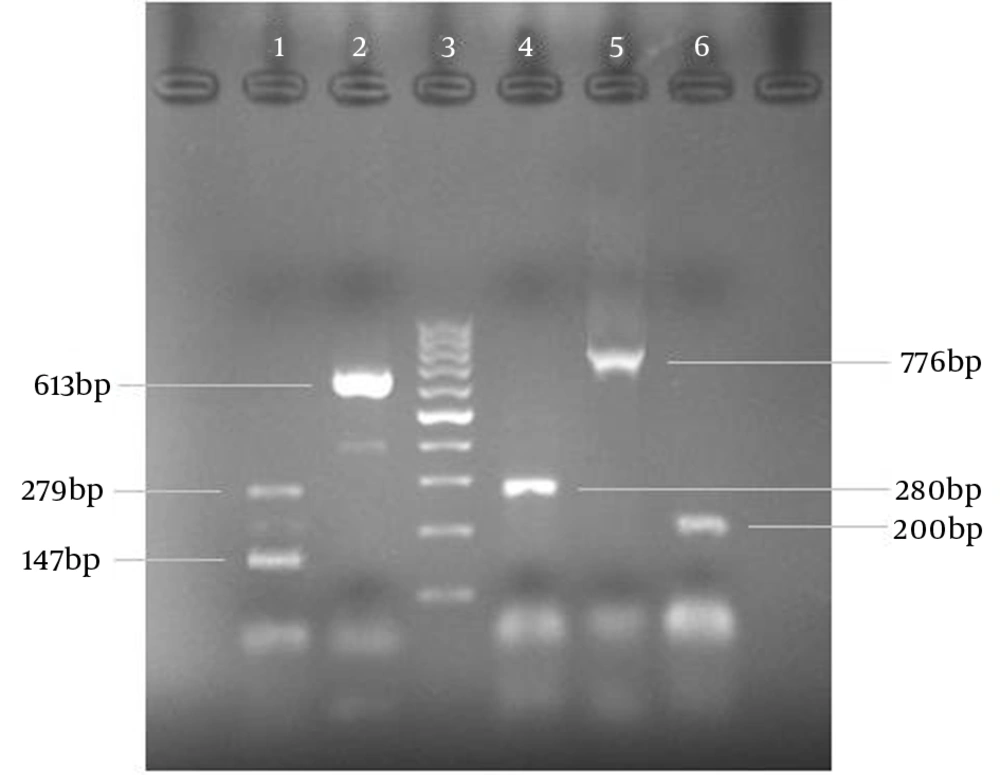
Figure 1.
Lane 3: 100 bp ladder (Fermentas); lane 1: mecA (147 bp) and nuc gene (279 bp); lane 2: SCCmec I (613 bp); lane 4: SCCmec III (280 bp); lane 5: SCCmec IVa (776 bp); lane 6: SCCmec IVc (200 bp).
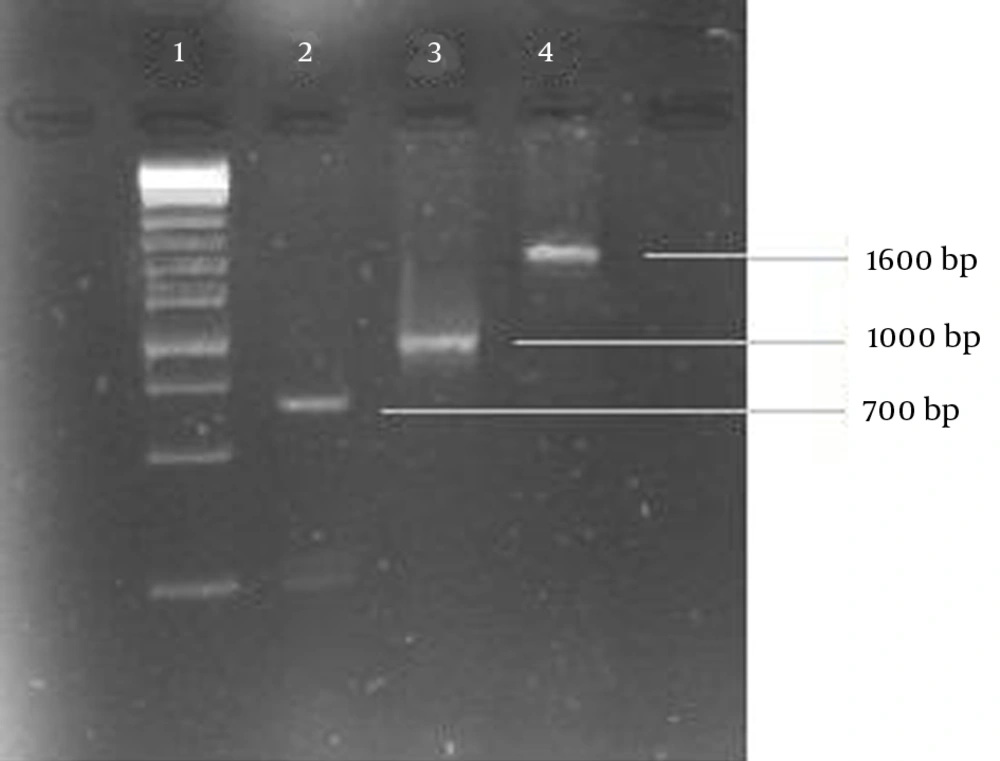
Figure 2.
Lane 1: 1 kbp ladder (Fermentas); lane 2: ccr type 1 (700 kbp); lane 3: ccr type 2 (1000 kbp), lane 4: ccr type 3 (1600 kbp).
4.3. Antimicrobial Resistance
Table 3 briefly explains the antimicrobial resistant profiles of the MRSA isolates. As shown, there was complete susceptibility to teicoplanin and vancomycin in all 53 investigated MRSA isolates. Our results were showed a reduced gradient of MRSA susceptibility to ofloxacin, ceftriaxone, cotrimoxazole, gentamicin, azithromycin, rifampicin, ciprofloxacin, and linezolid. All strains were resistant to penicillin; however, only less than 10% were resistant to meropenem and rifampicin.
Table 3. Antimicrobial Resistance Profiles of MRSA Isolates
| Antibiotic | Resistant | Intermediate | Sensitive |
|---|---|---|---|
| Ciprofloxacin | 15 (28.3%) | 20 (37.7%) | 18 (34%) |
| Azithromycin | 30 (56.6%) | 2 (3.8%) | 21 (39.6%) |
| Meropenem | 5 (9.4%) | - | 48 (90.6%) |
| Teicoplanin | - | - | 53 (100%) |
| Imipenem | 6 (11.3%) | 1 (1.9%) | 46 (86.8%) |
| Ofloxacin | 7 (13.2%) | 1 (1.9%) | 45 (84.9%) |
| Ceftriaxone | 35 (66%) | - | 18 (34%) |
| Cotrimoxazole | 26 (49.1%) | - | 27 (50.9%) |
| Gentamicin | 28 (52.8%) | - | 25 (47.2%) |
| Linezolid | 6 (11.3%) | - | 47 (88.7%) |
| Oxacillin | 53 (100%) | - | - |
| Penicillin | 53 (100%) | - | - |
| Rifampicin | 3 (5.7%) | - | 50 (94.3%) |
| Vancomycin | - | - | 53 (100%) |
5. Discussion
SCCmec is the most important factor defining the origin and source of MRSA infections in society. If we could determine HA-MRSA or CA-MRSA, then we could manage MRSA infections and select the best treatment protocol (1). Each type of SCCmec has unique genetic elements. Eight types of SCCmec and 3 types of ccr genes were investigated in this research (12-19). We were recognized 4 types of SCCmec and among them, type III was the most prevalent in our isolates.
Recently, MRSA infections have raised global concerns. Therefore, its prevalence in most countries has been highlighted (20-23) because the determination of MRSA prevalence or spread through transmission within communities may influence how this problem will be addressed.
In the present investigation, the rate of methicillin resistance among S. aureus isolates was 33.8%, which is lower than the prevalence of MRSA in previous studies from Shahid Beheshti Hospital in Kashan, and Imam Hussein Hospital in Tehran (24, 25). This could be from the correct usage of antibiotic in our province. The prevalence of MRSA in Greece, Italy, France, and Turkey was similar to our results, but in Germany, Poland, Spain, Sweden, and Switzerland the prevalence of these isolates was lower than our results (26). This could be a result of their developed health systems. Regarding Table 3, the antibiotic susceptibility test revealed that all samples were sensitive to teicoplanin and vancomycin. Resistances to rifampin and meropenem were less than 10%, and resistances to cotrimoxazole, azithromycin, gentamicin, ceftriaxone, penicillin, oxacillin, clindamycin, and erythromycin were between 50% and 100%. However, some antibiotics, such as rifampicin, imipenem, meropenem, ofloxacin, and linezolid, were still effective against MRSA in this work; indicating that these agents may be applicable in the treatment of MRSA infections. SCCmec analysis identified 69.8% of MRSA isolates as type III, suggesting that most of the MRSA isolates in the present study may have originated from HA-MRSA or clonal diversion of MRSA. These results were consistent with previous reports about the predominance of SCCmec III in most Asian countries (27), and in Iranian cities. The next predominant type was SCCmec IVc (7.5%) followed by type IVa (3.8%), which was also confirmed by the present study and is supported by other research (13). However, we could investigate other genes correlated with SCCmec to determine more types of SCCmec, and this could be a limitation of the current research.
Obtained data showed that in the Iranian East-Azerbaijan Province, SCCmec III was the predominant SCCi type. As a result, multidrug-resistance in our province could be high. Furthermore, typing of isolates using ccr-complex verified our data about SCCmec.
The data indicate that multidrug-resistant MRSA in our isolates has caused serious problems that result from the inappropriate use of antibiotics. Therefore, physicians should prescribe suitable antibiotics based on their effectiveness, price, and accessibility.


