


1. Background
2. Methods
2.1. Ethical Aspects
2.2. Study Population and Samples Collection
2.3. DNA Extraction
2.4. Polymerase Chain Reaction
2.5. Nested Polymerase Chain Reaction
| Sequence | Primer Name | Primer |
|---|---|---|
| 5’ GCT-ACC-TCG-AAC-AGG-AAC-AC 3’ | SAG2.F4 | Forward primer 1 |
| 5’ GCA-TCA-ACA-GTC-TTC-GTT-GC 3’ | SAG2.R4 | Forward primer 2 |
| 5’ GAA-ATG-TTT-CAG-GTT-GCT-GC 3’ | SAG2.F | Forward internal primer 1 |
| 5’ GCA-AGA-GCG-AAC-TTG-AAC-AC 3’ | SAG2.R2 | Forward internal primer 2 |
| 5’ TCT-GTT-CTC-CGA-AGT-GAC-TCC 3’ | SAG2.F3 | Revers primer 1 |
| 5’ TCA-AAG-CGT-GCA-TTA-TCG-C 3’ | SAG2.R3 | Revers primer 2 |
| 5’ ATT-CTC-ATG-CCT-CCG-CTT-C 3’ | SAG2.F2 | Revers internal primer 1 |
| 5’ AAC-GTT-TCA-CGA-AGG-CAC-AC 3’ | SAG2.R | Revers internal primer 2 |
2.6. Restriction Fragment Length Polymorphism and Genotyping
3. Results
3.1. Demographic Characters of the Patients
| Malignancy | Frequency (N) | Percentage |
|---|---|---|
| Acute lymphocytic leukemia (ALL) | 116 | 68.2 |
| Lymphoma | 24 | 14.1 |
| Osteosarcoma | 11 | 6.5 |
| Retinoblastoma | 7 | 4.1 |
| Glioblastoma | 10 | 5.9 |
| Colorectal cancer | 1 | 0.6 |
| Peritoneal carcinoma | 1 | 0.6 |
| Total | 170 | 100 |
3.2. Polymerase Chain Reaction Results
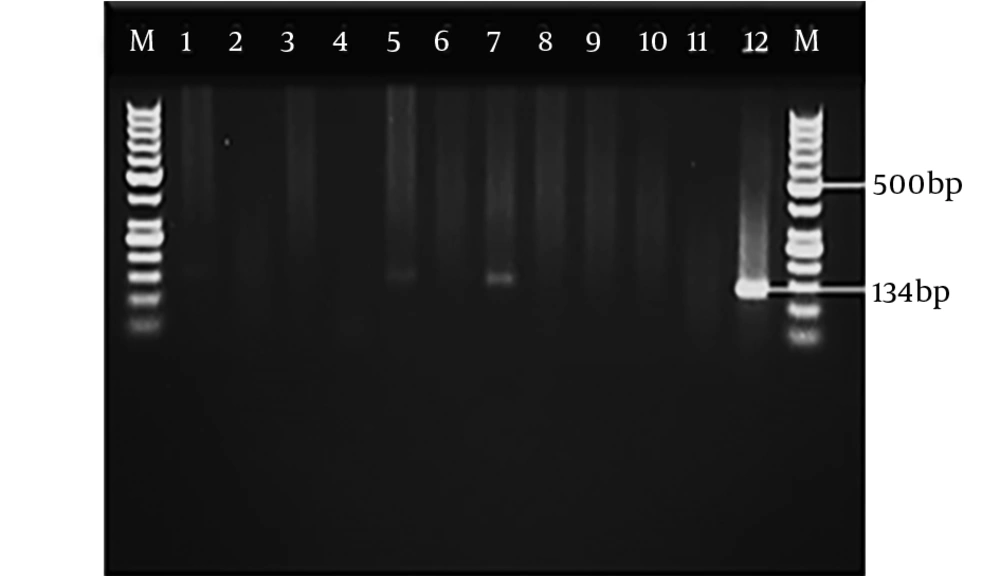
Electrophoresis of PCR products related to blood samples. M: Marker 50 bp, samples 1, 5, 7: Positive samples, samples 2, 3, 4, 6, 8, 9, 10: Negative samples, sample 11: negative control, sample 12: Positive control.
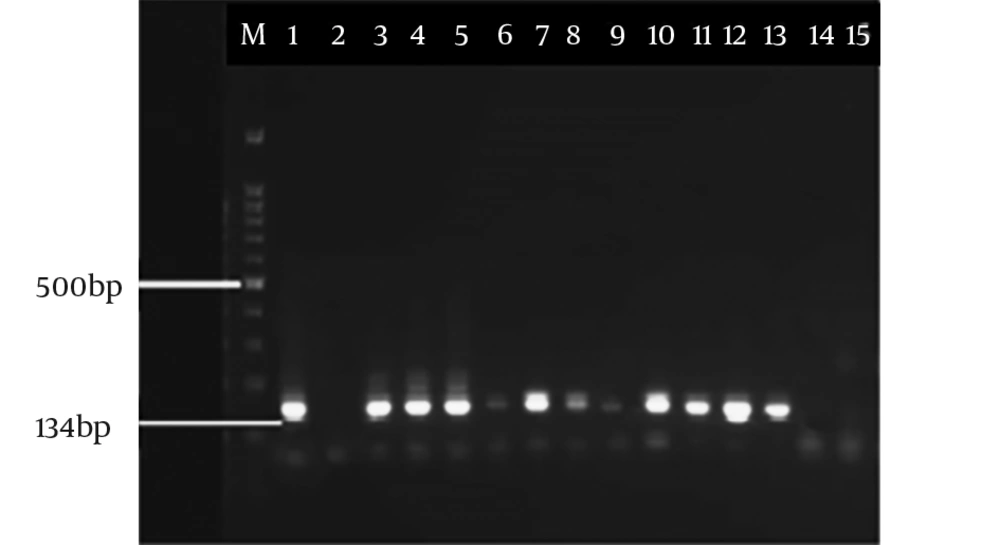
Electrophoresis of PCR products related to CSF samples. M: Marker 100 bp, sample 1: Positive control, sample 2: Negative control, samples 3 - 13: Positive samples, samples 14 and 15: Negative samples.
| No. | Gender | Age | Type of Cancer | Blood Samples | CSF Samples | Genotype |
|---|---|---|---|---|---|---|
| 1 | Female | 3 | All | + | + | II |
| 2 | Female | 3 | All | + | + | II |
| 3 | Male | 8 | All | + | + | II |
| 4 | Male | 8 | All | + | + | II |
| 5 | Male | 9 | All | + | + | II |
| 6 | Female | 8 | All | + | + | II |
| 7 | Male | 13 | Lymphoma | + | + | Mix of II and III |
| 8 | Female | 2 | All | - | + | II |
| 9 | Female | 4 | Retinoblastoma | - | + | II |
| 10 | Male | 4 | All | - | + | II |
| 11 | Male | 3 | All | - | + | II |
| 12 | Female | 5 | All | - | + | II |
| 13 | Male | 6 | Lymphoma | - | + | II |
| 14 | Male | 8 | All | - | + | II |
| 15 | Female | 11 | Lymphoma | - | + | II |
| 16 | Female | 2 | All | - | + | II |
3.3. Nested Polymerase Chain Reaction Results
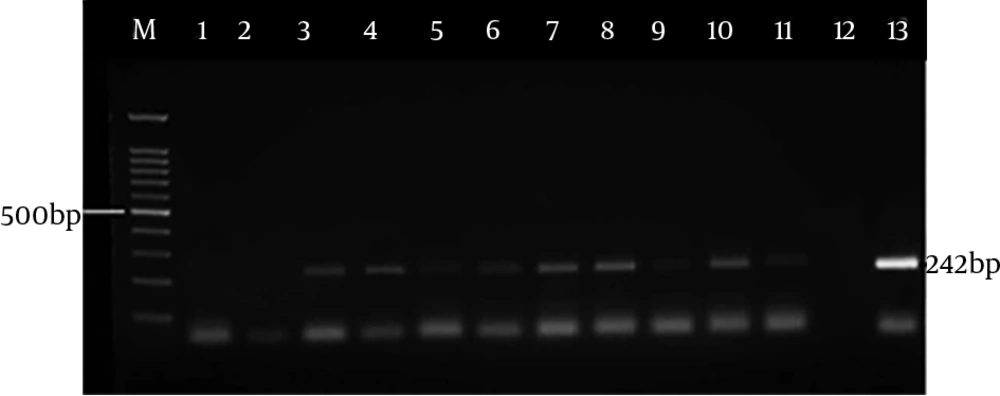
Electrophoresis of NESTED PCR products (242 bp) related to SAG2 locus in forward direction (5’). M: Marker 100 bp, samples 1 and 2: Negative samples, samples 3 - 11: Positive samples, sample 12: Negative control, sample 13: Positive control.
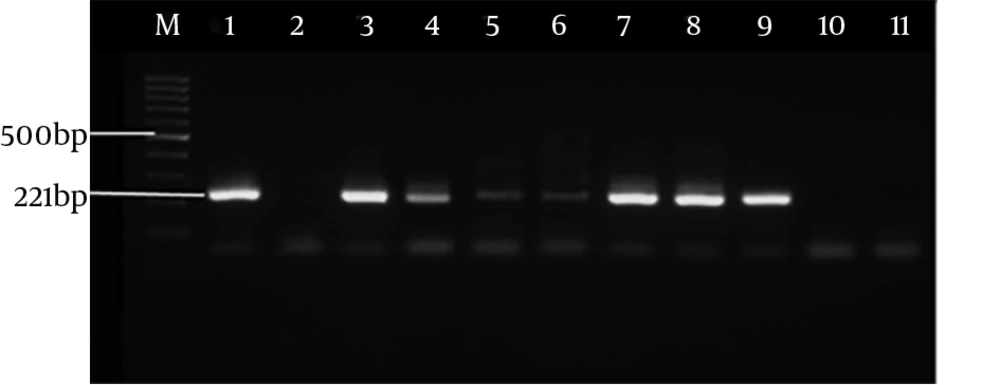
Electrophoresis of nested PCR products (221 bp) related to SAG2 locus in reverse direction (3’). M: Marker 100 bp, sample 1: Positive control, sample 2: Negative control, samples 3 - 9: Positive samples, samples 10 and 11: Negative samples.
3.4. Genotyping Results
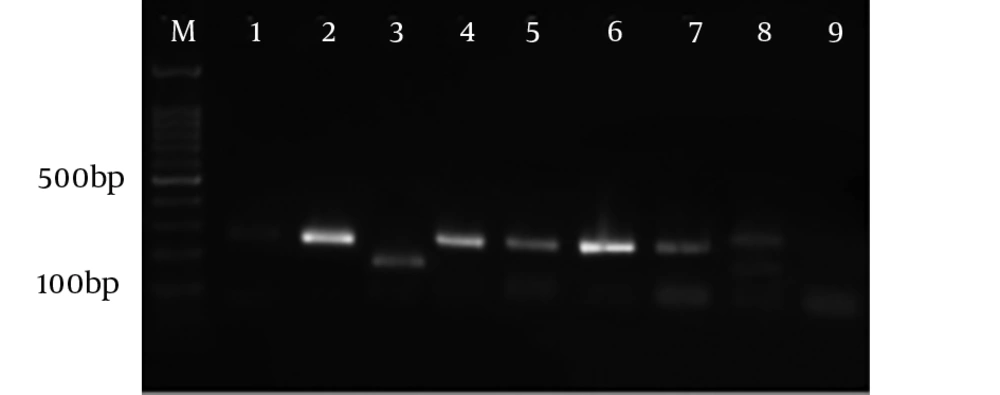
Electrophoresis of RFLP samples using Sau3A I enzyme in forward direction (5’). M: Marker 100 bp, samples 1, 2, and 3 are the positive control of I, II, and III genotypes. Sample 3 is genotype III according to cutting pattern and sample 8 is mix of genotype II and III.
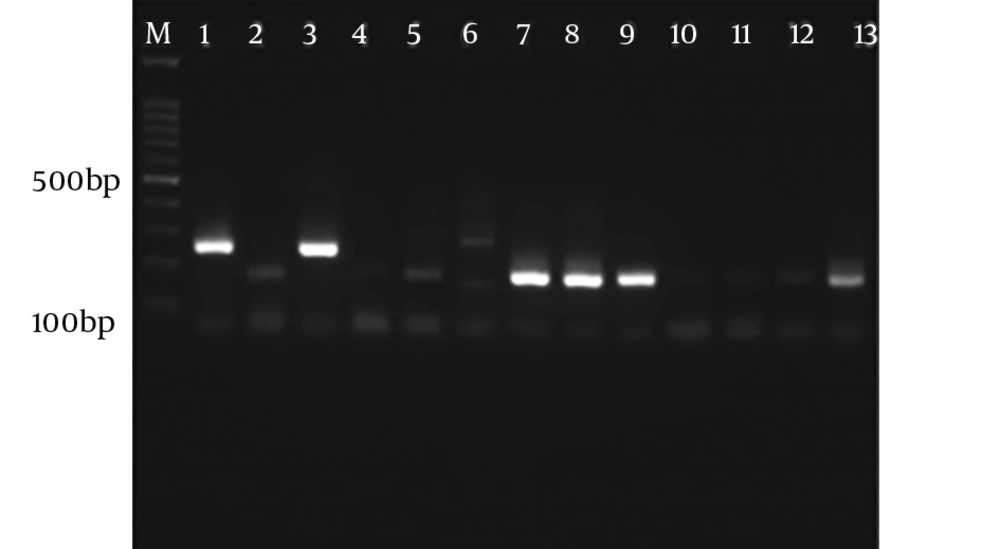
Electrophoresis of RFLP samples using Hha I enzyme in reverse direction (3’). M: Marker 100 bp, sample 1: Positive control of genotype I, sample 2: Positive control of genotype II and sample 3: Positive controls of genotype III, the 4 - 13 samples are genotype II according to cutting pattern.




