Human rotavirus infection is associated with severe diarrhea in children and accounts for 39% of hospitalizations. Children below the age of two years are most commonly affected (
1).
The viral VP4 and VP7 proteins are the determinants of the serotype specificity of group A rotaviruses. VP4 protein is a non-glycosylated protease-sensitive protein and is thus designated P, whereas VP7 protein is a glycoprotein that determines the G-type of the virus (
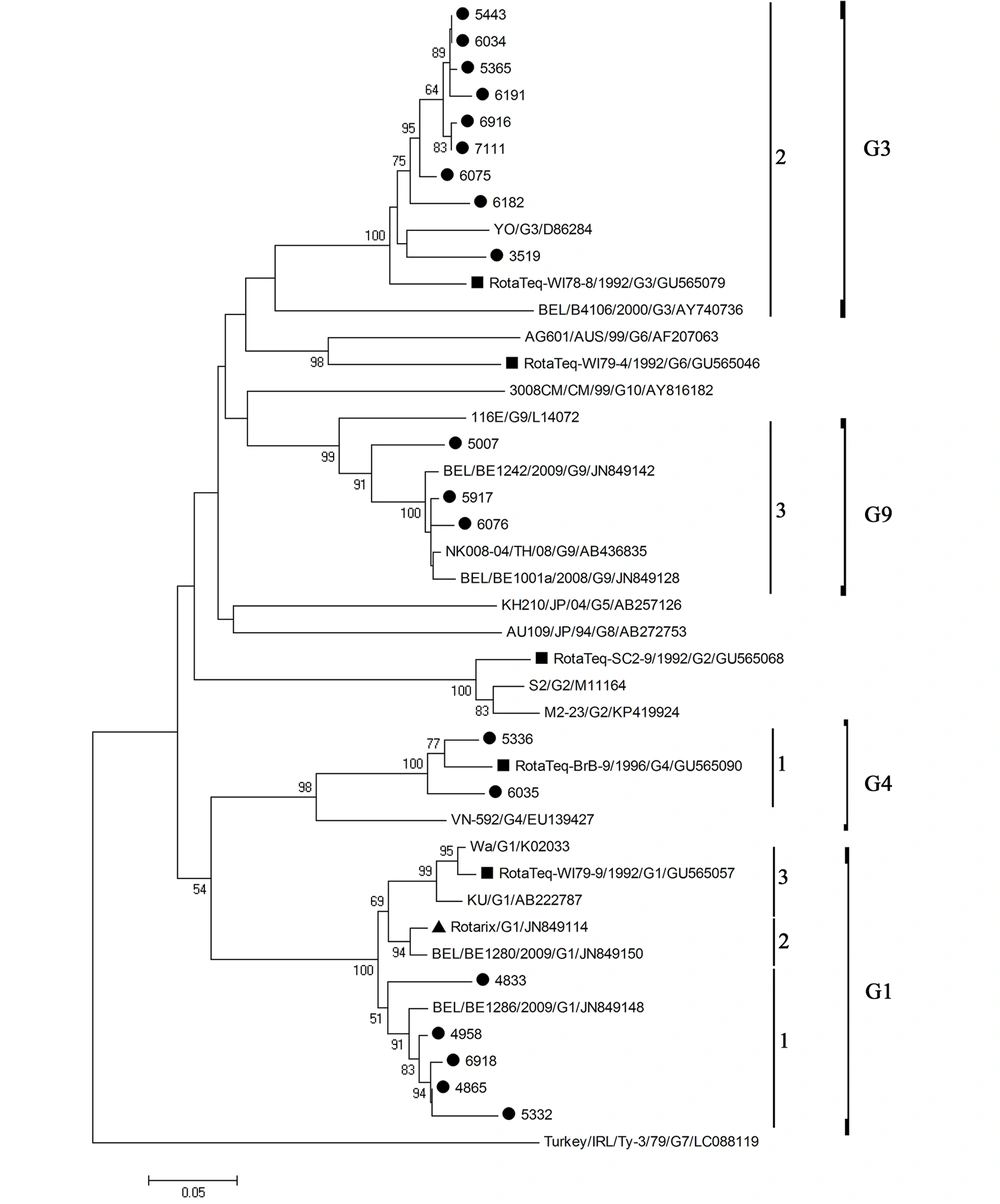
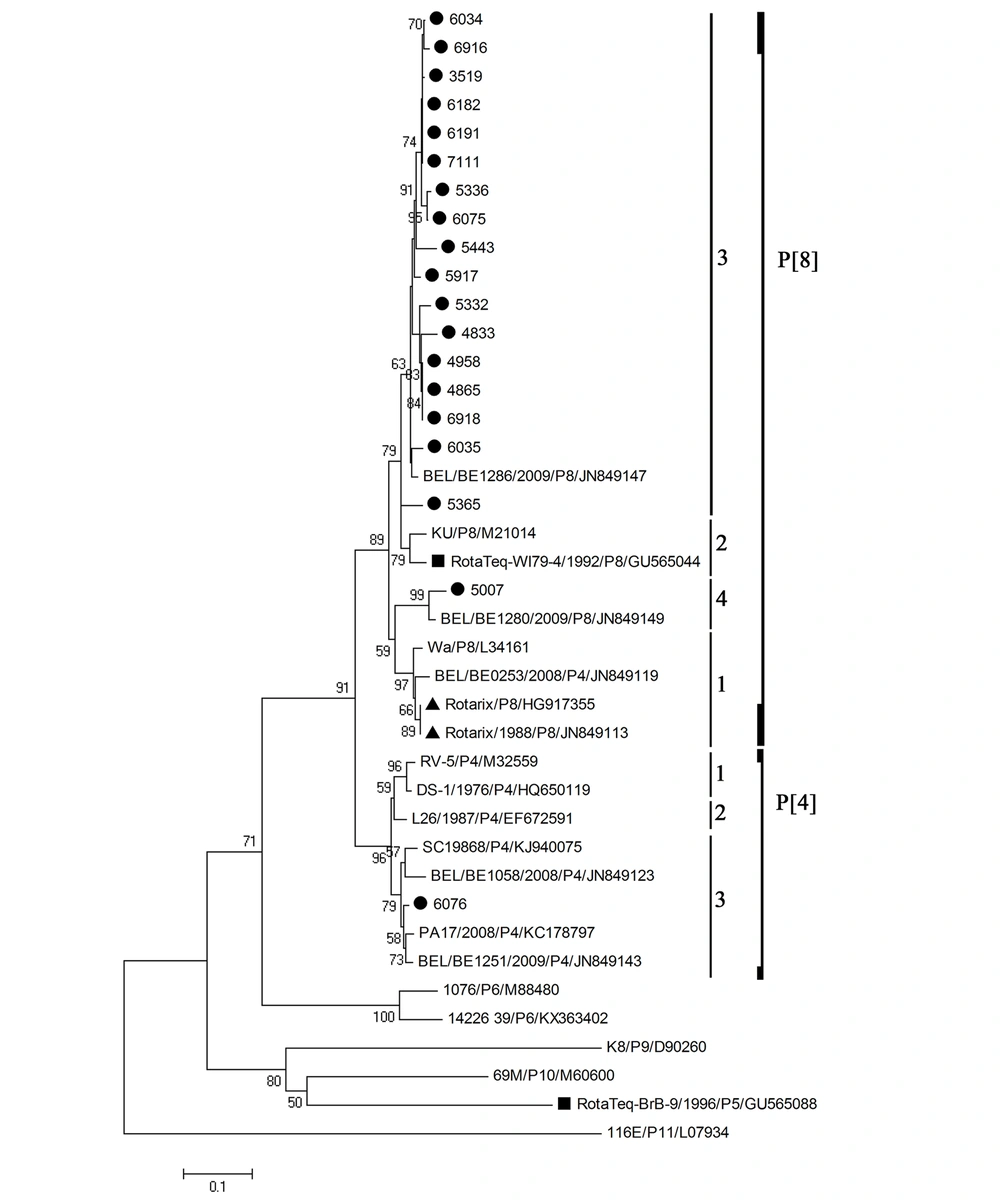
2). Human genotypes G1P[8], G2P[4], G3P[8], G4P[8], G9P[6], and G9P[8] are responsible for most rotavirus infections among children less than five years of age worldwide (
3,
4).
There are two live attenuated oral rotavirus vaccines, the monovalent Rotarix vaccine (GlaxoSmithKline Biologicals, Belgium) with a monovalent G1P[8] strain (
5), and the pentavalent human-bovine reassortant RotaTeq vaccine (Merck Co., Inc., United States) that contains rotavirus types of VP7 of G1, G2, G3 and G4, and VP4 of P[8] (
6). Both vaccines have been proven to decrease hospitalizations due to severe rotavirus-associated gastroenteritis (
7,
8). However, the protection provided by either vaccine may be compromised by infection with rotavirus of G and P types that are not included in the vaccine (
9,
10). Moreover, VP4 and VP7 proteins of rotavirus strains that belong to the same G and P serotypes, may display antigenic variations, which define new viral subgenomic lineages or variants that may escape immunity induced by the vaccine (
4,
11-
13). Evidence was also reported on intergenotypic recombination in VP4- and VP7-coding genes that may play a role in immune evasion (
14).
To understand a potential shifting trend following vaccine introduction, rotavirus types circulating before the implementation of rotavirus vaccination program should be identified. A study conducted in India on more than 7,000 rotavirus-positive stool samples collected before the introduction of the oral rotavirus vaccines, ROTAVAC and ROTASIIL, reported the circulation of more than 15 different genotypes, including G1P[8] (38.7%), G2P[4] (12.3%), G9P[4] (5.8%), G12P[6] (4.2%), G9P[8] (4%), G12P[8] (2.4%), and G3P[3] (1.9%) (
15).
The last epidemiological study in Kuwait on rotavirus infection dated back to 2005 - 2006, showing the predominance of rotavirus VP7 G1 type (63.8%) in 69 children with severe diarrhea admitted to three major tertiary referral hospitals in Kuwait (
16). Rotavirus genotypes G2, G3, G4, and G9 could be detected in 7.3, 4.4, 7.3, and 10.2% of children, respectively. VP4 P[8] was the most prevalent type (89%), followed by P[4] (9%), and P[6] (2%). G1P[8] was the most frequent combination detected in around 63% of patients (
16). At that period, the rotavirus vaccine was not available in Kuwait.