
1. Background
SARS and MERS-CoV are 2 members of the coronavirus family, causing 2 large-scale pandemics in the last 2 decades (1). Four other coronaviruses are also associated with human respiratory diseases (2). SARS resulted in more than 8000 cases in 26 countries in 2003, and the last threatening member of this family, MERS-CoV, has caused 866 deaths out of 2519 patients since September 2012 (3, 4). On 12 December 2019, the first infected patient with a new member of the coronavirus family (COVID-19) was hospitalized in China (5). It was suggested that the outbreak was associated with a seafood market in Wuhan (6). As of March 5, 2020, COVID-19 has resulted in 95 609 human infections and 3287 deaths in China and 85 other countries and territories (7).
COVID-19 is still evolving, and it is too early to predict the outcome of this outbreak. It was shown that 2 features, including low pathogenic and high transmissibility (about 2%-3% fatality rate), make this new virus distinct from other members of its family (8, 9). Iran is one of the countries that has encountered increasing cases over the outbreak and subsequently more mortality. As of March 5, 2020, COVID-19 has caused 2922 human infections and 92 deaths in Iran (7).
This news can induce significant psychological stress, which may lead to unfavorable effects on psychological health (7). Some studies have investigated the consequences of stress in the aftermath of MERS (10-12), but few studies have been conducted on the stress in such concerning events, especially in this pandemic (13). Otherwise, assessing the knowledge and behavior of the public is a valuable approach for handling such critical situations, as well as providing baseline data for scientists to manage disease notifications and further interventions (14, 15).
2. Objectives
The aim of this study was to evaluate the knowledge of the Iranian community and explore the degree of their stress or anxiety levels during the current COVID-19 pandemic in Iran.
3. Methods
3.1. Study Design and Data Collection
Because of the quarantine measures, the possibility of disease transmission through paper questionnaires, and the inability to distribute the questionnaire throughout the country, a web-based electronic questionnaire was designed using online software and made available to the public through social media (WhatsApp and Instagram). The participants included all people of different ages and educations. Data were compiled over 60 hours (1 March 2020 to 4 March 2020) during the outbreak of COVID-19 in Iran. Participation in this study was voluntary, and the identification of participants was not recorded anywhere on the questionnaire.
3.2. Questionnaire and Data Processing
At the beginning of our questionnaire, the purpose of the study was explained completely. The term “corona” was used instead of “COVID-19” and the term “coronavirus” instead of “COVID-19” because of their common use for this infection in the local community. This questionnaire was available online for 1 month.
This questionnaire had 3 different parts. The first part of the survey was the demographic data of the participants, including sex, age, education level, province of residence, income class, and the history of high-risk diseases. Also, we asked them 3 questions about their history of COVID-19 infection (16).
The second part of the survey consisted of anxiety and stress questions. We asked 3 questions about participants’ stress, and then we provided the Generalized Anxiety Disorder 7-Item Scale (GAD-7) (17). Each item was coded (0-3), showing different kinds of anxiety, and the responses were summited to calculate the total score. The GAD-7 scores were categorized originally (i.e., 0 - 4 = minimal anxiety, 5 - 9 = mild anxiety, 10 - 14 = moderate anxiety, and > 14 = severe anxiety) (18). We asked 1 question about participants’ habit changes.
In the third part of the questionnaire, the previously published studies about MERS were partially used, and then the questions were adapted according to the information and recommendations of the World Health Organization (WHO) about virus transmission, symptoms, signs, prognosis, and treatment (19, 20). The questionnaire included 13 “yes/no” or “I don’t know questions” and 5 multiple-choice questions, followed by 3 questions about their previous knowledge, source of information, and the level of their knowledge regarding the coronavirus. Knowledge scores ranged from 0 to 33 and (cutoff < 22, acceptable knowledge and ≥ 22, good knowledge) (19). The questions, both in Farsi and English versions, are attached in the appendix (as simple tables).
3.3. Data Analysis
Coded data were analyzed using SPSS version 22, and forms with considerable missing data were excluded. Descriptive statistics were used to describe the quantitative and categorical variables. Continuous variables were expressed as mean ± SD, and the results were analyzed by t-test at the significant level of P ≤ 0.05 to compare different factors in different groups.
4. Results
4.1. Demographic Characteristics of Participants
Initial data showed that 3130 people viewed the questionnaire and 1627 answered the questions completely (we only consider complete forms). The mean time to answer the questions was 7.23 minutes (data not shown). The demographic characteristics showed that 595 (36.57%) participants were males and 1032 (63.43%) were female (Table 1). Table 1 also illustrates that most of the participants were aged 20 - 40 years old (68.35%), and 49.78% of them had associate and bachelor’s degrees. The income information showed that most of the participants were middle class (1121 subjects [68.90%]).
Table 1.
Demographic Characteristics of Participants
| Variables | No. (%) |
|---|---|
| Sex (n = 1627) | |
| Male | 595 (36.57) |
| Female | 1032 (63.43) |
| Age (n = 1627) | |
| 10 - 20 | 67 (4.12) |
| 20 - 40 | 1112 (68.35) |
| 40 - 60 | 370 (22.74) |
| > 60 | 78 (4.79) |
| Education level (n = 1627) | |
| High school diploma & less | 417 (25.63) |
| Associate & bachelor’s degrees | 810 (49.78) |
| Master’s degree & more | 400 (24.59) |
| Income class (n = 1627) | |
| Lower | 471 (28.95) |
| Middle | 1121 (68.90) |
| Upper | 35 (2.15) |
There were only 343 patients with high-risk diseases (eg, immune deficiency diseases [2.70%], cardiovascular diseases [4.0%], renal diseases [2.33%], pulmonary diseases [4.17%], cancers (1.04%), and diabetic diseases [3.0%]). Information about the province of residence showed that most of the participants were from Fars Province (n = 953; 58.53%), followed by Tehran (9.88%), Esfahan (4.80%), and West Azerbaijan (2.95%) provinces (data not shown).
Moreover, only 0.43% of our participants had COVID-19, and only 14.28% of them had diagnostic tests. Overall, 30 cases (1.84%) had laboratory tests, and 23 cases (1.41%) were in contact with a COVID-19–infected case (Table 2).
Table 2.
Number and Present of COVID-19 Distribution (n = 1627) a
| Yes | No | |
|---|---|---|
| Affected by the virus | 7 (0.43) | 1620 (99.57) |
| Had diagnostic tests | 30 (1.84) | 1597 (98.16) |
| Contact with a COVID-19-infected case | 23 (1.41) | 1604 (98.59) |
a Values are expressed as No. (%).
4.2. Anxiety Levels of Participants
According to participants’ self-reporting results, 5.28 ± 2.74 expressed concern about the infection (the total score was 10, the least score was 9 [4.72%], and the highest score was 5 [20.51%]). In addition, their worry about family infection was 6.71 ± 2.84 out of 10 (the least score was 2 (3.4%), and the highest score was 10 [26.6%]; Figure 1). GAD-7 showed that the mean GAD-7 score was 8.22 ± 4.82 (total score = 21), and 39.6% of respondents reported mild anxiety (score = 5 - 9), 19.7% stated moderate anxiety (score = 10-14), and 14.7% reported severe anxiety (score > 14; Figure 1). The results of the comparison between different groups showed that younger people were more worried about getting COVID-19 (P < 0.0001), while their GAD-7 scores did not show any significant difference with older people. Women were more concerned than men (this difference was not significant), and changing their habits was more tangible than men (P < 0.003). Participants with high-risk diseases showed higher levels of anxiety (GAD-7) than healthy controls (P < 0.0001).
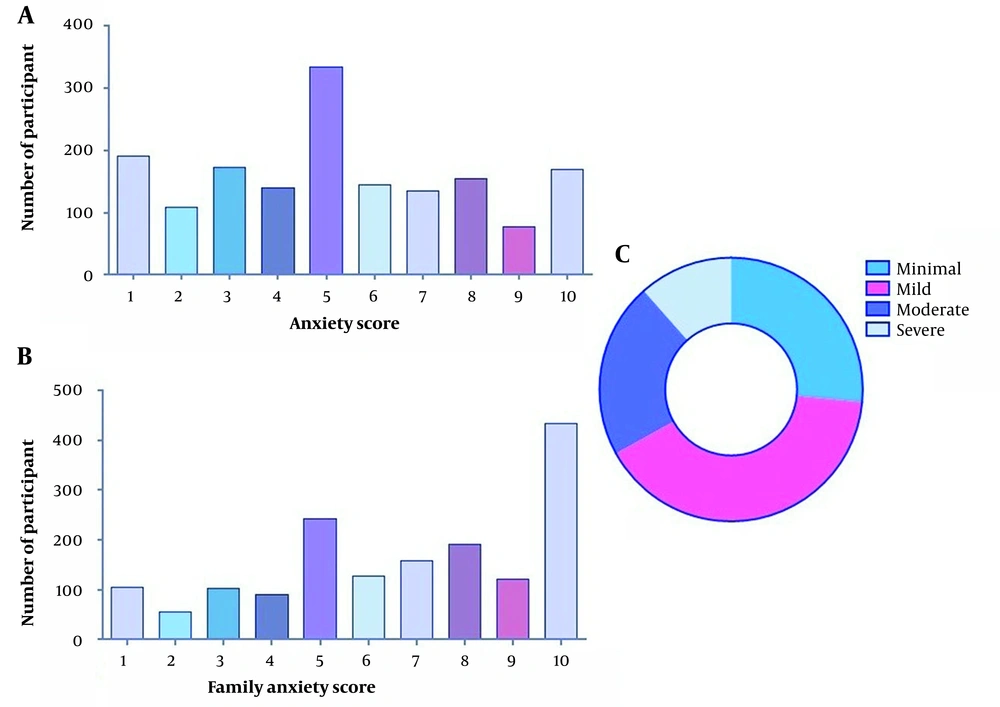
Figure 1.
COVID-19–induced anxiety data. (A) The level of anxiety for self-infection. (B) The level of anxiety for family infection. (C) Generalized Anxiety Disorder 7-Item Scale anxiety level.
4.3. Knowledge Levels of Participants
Participants’ previous knowledge about the coronavirus family was high, and the result showed that only 0.5% of them did not know this virus before its outbreak in Iran. The main sources of their knowledge were social application (61.9%), social media (41.67%), the Ministry of Health and the World Health Organization (WHO; 41.18%), other information sources (18.44%), and colleagues (16.53%; Figure 2).
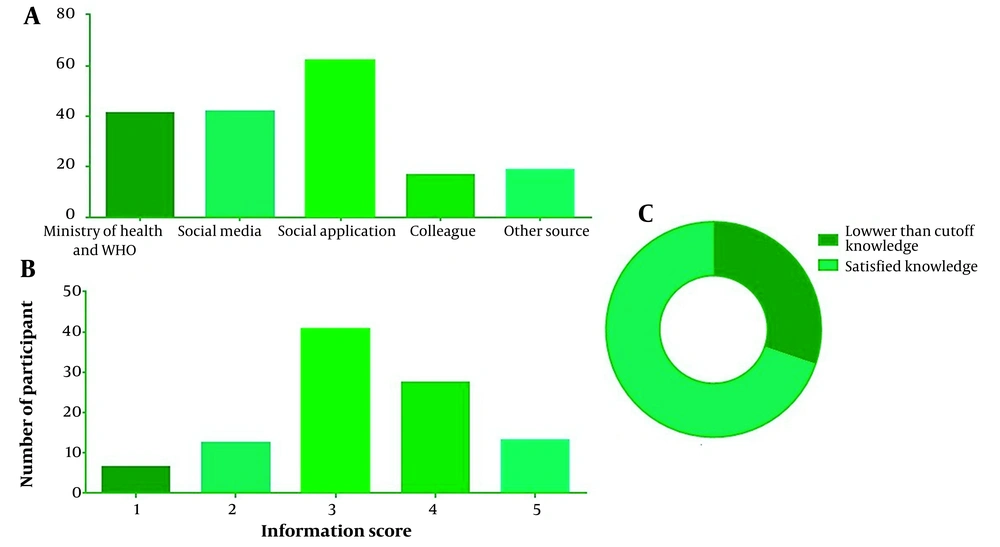
Figure 2.
Findings about COVID-19 information. (A) Information accessed resources. (B) The level of self-reporting about information. (C) Knowledge score.
Participants’ self-reporting results showed that their information level was about 3.28 ± 1.05 (total score = 5); assessing the 33 score questionnaire showed that the mean of knowledge was 22.84 ± 3.92; 69.76% (24.87 ± 2.01) of them had good knowledge (more than the cutoff point) and 30.17% (18.14 ± 3.16) of them had a knowledge level of lower than the cutoff point (Figure 2). The results of the comparison at the 0.05 significant level between different groups showed that sex and age did not affect participants’ knowledge (as the P-value of the Levene test is greater than 0.05), but higher education increased the knowledge level (Table 3).
Table 3.
Correlation Between Information and Knowledge Level About COVID-19 with Demographic Characteristics
| Variables | Self-reporting About Information (1 - 5) (Mean ± SD) | Knowledge Score (0 - 33) (Mean ± SD) |
|---|---|---|
| Sex | ||
| Male | 3.30 ± 1.09 | 22.70 ± 3.99 |
| Female | 3.27 ± 1.02 | 22.91 ± 3.88 |
| Age (y) | ||
| 10 - 20 & 20 - 40 | 3.29 ± 1.03 | 22.77 ± 3.98 |
| 40 - 60 & > 60 | 3.27 ± 1.10 | 23.00 ± 3.76 |
| Education level | ||
| High school, diploma, & less | 3.23 ± 1.13 | 21.39 ± 4.25 a |
| Associate & bachelor’s degrees | 3.28 ± 1.04 | 23.13 ± 3.76 |
| Master’s degree & more | 3.35 ± 0.98 | 23.77 ± 3.47 |
a Correlation is significant at the 0.0001 level (2-tailed).
5. Discussion
The COVID-19 outbreak is one of the most important threats to international public health these days (21). According to the announcements of the Ministry of Health and WHO regarding COVID-19 in Iran (7), we saw that 0.43% of our participants had been infected by the virus (2 in Fars, 2 in Alborz, 1 in Esfahan, 1 in Sistan and Baluchestan, and 1 in Hamadan provinces) and only one of them (Alborz) had done diagnostic tests (Table 2).
The pandemic can adversely affect the community with tremendous public anxiety in the affected countries and increase psychological distress (22). Regarding SARS and MERS outbreaks, studies have shown that depressive disorders and post-traumatic stress disorder (PTSD) were the most prevalent long-term psychological conditions (23, 24). The current study on 1627 participants showed that Iranian self-reporting anxiety was not very high, and their anxiety about their families’ health was higher. Some other studies during the disease outbreak have shown more anxiety; for instance, in a study in china, the author identified a major mental health burden of the public during this pandemic (25).
We used GAD-7 as an anxiety baseline and saw that most people in our community were at a low level of anxiety, and COVID-19 could be the main reason for their nowadays anxiety. Interestingly, the level of baseline stress was higher in people with underlying diseases, but their anxiety about COVID-19 was not more than that of the others (Table 4).
Table 4.
Correlation Between the Stress Level and Demographic Characteristics About COVID-19
| Self-reporting Anxiety About Infection | GAD-7 | Habits Change (0 - 7) (Mean ± SD) | ||||||
|---|---|---|---|---|---|---|---|---|
| Self (0 - 10) (Mean ± SD) | Family (0 - 10) (Mean ± SD) | Score (Mean ± SD) | Minimal % (< 5) | Mild % (5 - 10) | Moderate % (10 - 15) | Severe % (> 15) | ||
| Sex | ||||||||
| Male | 4.91 ± 2.75 | 6.44 ± 2.93 | 7.81 ± 4.94 | 30.50 | 37.40 | 18.50 | 12.60 | 5.11 ± 2.02 a |
| Female | 5.49 ± 2.72 | 6.76 ± 2.78 | 8.46 ± 4.74 | 22.60 | 41.00 | 22.70 | 13.70 | 5.40 ± 1.75 |
| Age (y) | ||||||||
| 10 - 20 & 20 - 40 | 5.45 ± 2.80 | 6.92 ± 2.83 | 8.37 ± 4.83 | 25.20 | 39.50 | 21.20 | 14.00 | 5.25 ± 1.86 |
| 40 - 60 & >60 | 4.82 ± 2.82 b | 6.14 ± 2.78 | 7.84 ± 4.78 | 28.50 | 40.20 | 21.10 | 11.20 | 5.40 ± 1.78 |
| High-risk disease | ||||||||
| Yes | 5.48 ± 2.61 | 6.76 ± 2.76 | 9.28 ± 5.15 | 22.40 | 33.30 | 24.50 | 20.60 | 5.43 ± 1.85 |
| No | 5.24 ± 2.76 | 6.70 ± 2.85 | 8.05 ± 4.74 b | 26.60 | 40.70 | 20.50 | 12.10 | 5.27 ± 1.76 |
Abbreviation: GAD-7, Generalized Anxiety Disorder 7-Item Scale.
a Correlation is significant at the 0.005 level (2-tailed).
b Correlation is significant at the 0.0001 level (2-tailed).
Men and women reported different reactions to stress; women showed more stress than men, though the difference was not significant. Women could manage their stress and change their useful habits more than men. Findings represented that 0.01% of our population had diagnostic, of whom 56% were women (data not shown). Another point about this study is that our younger group (10 - 20 and 20 - 40 years old) had more stress than our older group (40 - 60 and more than 60 years old; Table 4). For better understanding, we examined information sources of these 2 categories and found that the younger people used social networks more than the older group. These networks can contain inaccurate information, which may contribute to their increased anxiety. Younger people, on the other hand, are more likely to be in the community than the elder; thus, they are more likely to be infected with the virus. This may be another important factor, though we did not ask questions about their jobs. In agreement with our results, another study in China showed that young people reported a higher prevalence of depressive symptoms than the elder (25).
Results showed that given the increasing popularity of information through various media such as WhatsApp, TV, and creditable websites, using “global village” is a good example of the world. These extensive communications greatly enhanced previous knowledge about the newest infectious disease; thus, 99.95% of our participants were aware of COVID-19 before its outbreak in our country. This widespread use of the internet among all groups of people in society is shown in Figure 2. Similar to our findings, other studies stated that participants usually obtained information about infectious diseases through the internet and watching TV (19, 26). In this regard, the generalized spread of the disease in the world and the high rate of transmission might have increased public attention and knowledge about this pandemic.
The present study showed that the majority of participants (69.78%) had sufficient knowledge (more than the cutoff point) about the disease; however, most of them underestimated their knowledge, and they gave average scores to their literacy and information (~3.3). Another contributing factor to improving information is the education level; our study showed that people with higher education had more accurate information than the other group (Table 3). It may also be interesting to note that high-educated participants are more concerned with medical news broadcasts than other participants. We should note that one of the limitations of our study is that it was a web-based survey, and we could not consider all groups of people; however, according to our country’s statistics, more than 72.8 % of Iranians have access to social networks. The people who accessed this questionnaire through social networks have high social connections, and it is very likely that they have come across a lot of information about this disease, which is one of the limitations of this project as well.
5.1. Conclusions
Iranians’ anxiety was at a medium level, and their anxiety about their families was more. According to the knowledge level assessment, Iranians had a high knowledge level (69.76%), and this level of people’s knowledge about COVID-19 and its preventive measures could be effective in reducing their anxiety compared to similar previous outbreaks. Although this level of anxiety can help the psychological health of the community, it may have some adverse effects and cause the public to ignore this major dilemma and reduce their compliance with health tips.