
1. Background
Since the onset of a widespread outbreak of the COVID-19 from China, many health measures have been taken by countries, but the increase in the number of infected people around the world had caused the World Health Organization to declare that as an acute pandemic on March 11, 2020, and warn of its widespread physical and psychological impacts (1). In human history, the prevalence of infectious diseases has always caused a level of emotional responses or psychopathy as the outbreak of SARS in China 17 years ago raised many concerns, like fears and emotional problems, and now the coronavirus in many countries, like Nigeria puts people at risk for depression, which has caused many other psychological problems (2-4). Among these negative psychological impacts, anxiety can be mentioned, as various studies have suggested a significant level of anxiety during the outbreak of COVID-19 for different reasons (5, 6).
Meanwhile, because this pandemic has exposed medical students to danger for some reasons, such as their internships in hospitals and unpreparedness for such conditions, it has caused a high risk of mental disorders in them, as some reported high level of anxiety in nursing students during this outbreak (7, 8). In addition, beyond the negative impacts of anxiety on individual and social dimensions, the more important issue in this situation is the effect of anxiety on health and self-care behaviors (9-11). Now, due to the lack of definitive treatment and approved vaccines, healthy and self-care behaviors have become a social responsibility and one of the most effective ways to deal with this kind of disease (12).
2. Objectives
There were always various challenges in the adherence to these behaviors, surveying the anxiety level as one of the most controversial factors in terms of the type of impact on healthy and preventive behaviors seems important (13, 14). Also, considering the necessity of practicing the protective and healthy measures by medical students in this condition and their key role in influencing family members and society, assessing the level of healthy behaviors and related factors as a suitable platform to further strengthen these behaviors and move towards the defeat the current pandemic (15, 16), the research team decided to investigate the relationship between anxiety and self-care behaviors in medical students to explain the existing challenges and then provide practical solutions in this area.
3. Methods
3.1. Design and Sampling
This study was conducted by census method with a sample size of 978 students in the Nursing and Midwifery Faculty of Mashhad University of Medical Sciences with access to networked computers or smartphones. After achieving the ethics code at "IR.MUMS.REC.1399.177" from the ethics committee, the online questionnaire was sent to students through the WhatsApp messaging software and emails. At the beginning of the questionnaire, a full explanation of the purpose of the study was stated, and the participants’ right to choose and their informed consent to participate in the study was obtained. Finally, 620 complete questionnaires were analyzed (participation rate of 63.39%). This cross-sectional survey was conducted between May 23 and July 7, during the COVID-19 outbreak in Iran.
3.2. Data Collection Tools
An anonymous researcher-made online questionnaire including 20 items on a 5-point Likert scale (from 1 “never” to 5 “always”) was applied to collect the data, including three general sections on the socio-demographical characteristics of the respondents (age, gender, marital status, residence, degree level, individual free-time activities, and infectious status by COVID-19 in person and family members), COVID-19 self-care behaviors. The total score of the questionnaire was obtained using the linearly Minimax normalization transform [y = (x - min) / (max - min) × 100] per 100 units. This score ranged between 0 and 100 (0 - 24 scores indicate poor level, 49 - 25 indicate the average level, 50 - 74 indicate the satisfying level, and 75 - 100 indicate excellent self-care behaviors). This questionnaire designed assessed healthy and preventive behaviors based on the standards of the World Health Organization. The Coronavirus Anxiety Scale (CAS) includes five items and is answered on a 5-point Likert scale and assesses dizziness, sleep disturbances, tonic immobility, appetite loss, and abdominal distress during the last two weeks (17). Possible scores for this scale ranged from 5 to 25. The scale discriminates between those with dysfunctional anxiety and non-anxiety using an optimized cut-off score of 9. The validity and reliability of this tool have been confirmed through the content method (76% sensitivity and 90% specificity), and its reliability has been proven in several other studies (18, 19).
The validity of the COVID-19 self-care behavior questionnaire has been confirmed by content validity by providing it to ten professors of the Mashhad University of Medical Sciences (PhD in nursing, infectious diseases specialist, and epidemiologist) with a CVR of 0.83 and CVI of 0.79. Also, its reliability was examined by test-retest method with ten days interval, and the obtained Pearson’s correlation coefficient was 0.81, indicating the tool’s stability over time and its appropriateness to use in research studies.
3.3. Data Analysis Method
All analyses were carried out using the Statistical Package for the Social Sciences (SPSS) version 21. All data are presented as mean and standard deviation. Group differences in socio-demographical data were evaluated using the independent sample t-test and one-way ANOVA. The Pearson’s correlation coefficient was used to investigate the relationship between COVID-19 self-care behaviors and coronavirus anxiety scale scores.
4. Results
4.1. Demographical Characteristics
The demographic and selected characteristics of the study population are shown in Table 1. Among the sample of 620 students (22.13 ± 5.28 years), the majority of them were females (456, 73.54%), single (507, 81.77%), living in urban areas (394, 63.54%), and without psychological illness (520, 83.87%). Also, 72 cases (11.62%) were declared to be infected by COVID-19, and 189 cases (30.49%) had at least one infected person by COVID-19 in their family.
Table 1.
Demographic Characteristics of the Study Samples (n = 620)
| Variables | No. (%) |
|---|---|
| Total | 620 (100.00) |
| Age (y) | |
| 18 - 22 | 434 (70.00) |
| 23 - 27 | 98 (15.80) |
| 28 - 32 | 45 (7.25) |
| 33 - 37 | 23 (3.70) |
| 38 - 42 | 15 (2.41) |
| 43 - 47 | 5 (< 1) |
| Sex | |
| Female | 456 (73.54) |
| Male | 164 (26.46) |
| Marital status | |
| Single | 507 (81.77) |
| Married | 113 (18.23) |
| Field of study | |
| Nursing | 345 (55.64) |
| Midwifery | 140 (22.58) |
| Operation room | 85 (13.70) |
| Emergency medical care | 50 (8.06) |
| Degree level | |
| Undergraduate | 525 (84.67) |
| Master science | 61 (9.83) |
| PhD | 34 (5.48) |
| Residence | |
| Urban area | 394 (63.54) |
| Metropolis | 191 (30.80) |
| Rural area | 35 (5.66) |
| Have you ever been infected by COVID-19? (if so healed/in therapy) | |
| No | 548 (88.38) |
| Yes | 72 (12.62) |
| Healed | 46 (63.88) (Of total infected) |
| In therapy | 23 (36.12) (Of total infected) |
| Have any of your family members ever been infected by COVID-19? | |
| No | 431 (69.51) |
| Yes | 189 (30.49) |
| How do you spend most of your free time? | |
| Using social-media | 259 (41.40) |
| Educational and Research activities | 145 (23.20) |
| Free study | 71 (11.40) |
| Watching movie | 65 (10.40) |
| Outing | 52 (8.30) |
| Gaming | 16 (2.60) |
| Rest and sleeping | 12 (1.90) |
| Do you currently have a mental illness? (if so, mention it) | |
| No | 520 (83.87) |
| Yes | 100 (16.13) |
| Depression | 56 (56.00) |
| Obsessive-compulsive disorder | 27 (27.00) |
| Panic disorder | 9 (9.00) |
| Other | 8 (8.00) |
| Have you ever used sleeping pills or sedatives since the onset of COVID-19? | |
| No | 487 (78.54) |
| Yes | 133 (21.46) |
4.2. Level of COVID-19 Self-care Behaviors in Students
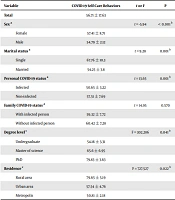
Table 2 shows a suitable self-care behaviors level (56.71 ± 7.63). In Table 3, regarding the self-care behaviors, the highest score (4.09 ± 1.27) was related to the item “I wash my hands with soap and water for at least 20 seconds after sneezing, coughing, finning and being in public places” and the lowest score (2.12 ± 1.14) was related to the item “I observe 1.5 meters distance with other people in public places”. Based on the independent t-test and one-way ANOVA results, female students, married students, and non-infected students by COVID-19 (P < 0.01) and also PhD students who were living in rural areas had a higher score than others significantly (P = 0·04, P = 0.02) (Table 2).
Table 2.
Comparative Analysis of the COVID-19 Self-care Behaviors and Coronavirus Anxiety Scale Score
| Variable | COVID-19 Self-care Behaviors | t or F | P | Coronavirus Anxiety Scale | t | P |
|---|---|---|---|---|---|---|
| Total | 56.71 ± 17.63 | 16.84 ± 3.75 | ||||
| Sex a | t = -5.94 | < 0.001 b | 3.72 | 0.012 b | ||
| Female | 57.41 ± 8.71 | 17.49 ± 1.67 | ||||
| Male | 54.79 ± 2.12 | 16.6 ± 3.23 | ||||
| Marital status a | t = 9.28 | 0.001 b | -13.73 | 0.022 b | ||
| Single | 67.76 ± 10.3 | 12.4 ± 6.14 | ||||
| Married | 54.25 ± 3.8 | 17.83 ± 1.86 | ||||
| Personal COVID-19 status a | t = 13.65 | 0.001 b | -17.09 | 0.024 b | ||
| Infected | 50.65 ± 3.22 | 19.48 ± 1.2 | ||||
| Non-infected | 57.51 ± 7.69 | 16.49 ± 3.85 | ||||
| Family COVID-19 status a | t = 14.95 | 0.570 | -20.06 | 0.001 b | ||
| With infected person | 59.32 ± 7.72 | 19.53 ± 1.49 | ||||
| Without infected person | 60.42 ± 7.28 | 15.66 ± 3.94 | ||||
| Degree level c | F = 302.286 | 0.041 b | 0.130 | |||
| Undergraduate | 54.16 ± 3.31 | 14.21 ± 4.85 | ||||
| Master of science | 65.6 ± 6.95 | 13.65 ± 6.61 | ||||
| PhD | 79.83 ± 3.63 | 12.4 ± 6.08 | ||||
| Residence c | F = 727.527 | 0.022 b | 0.001 b | |||
| Rural area | 79.65 ± 5.19 | 9.43 ± 2.44 | ||||
| Urban area | 57.54 ± 4.76 | 15.39 ± 3.09 | ||||
| Metropolis | 50.81 ± 2.18 | 17.52 ± 1.08 |
a Independent t-test.
b Significant at 0.05.
c One-way ANOVA
Table 3.
COVID-19 Self-Quarantine Behaviors Items
| Items | Mean ± Standard Deviation |
|---|---|
| 1. I avoid going on unnecessary trips. | 3.44 ± 1.28 |
| 2. I observe 1.5 meters distance with other people in public places. | 2.12 ± 1.14 |
| 3. I cover my mouth and nose with my elbow or tissue when coughing or sneezing. | 2.34 ± 1.35 |
| 4. I wash my hands with soap and water for at least 20 seconds after sneezing, coughing, finning, and being in public places. | 4.09 ± 1.27 |
| 5. I will disinfect my hands with an antiseptic If water and soap are not available. | 3.25 ± 1.22 |
| 6. I wash my hands before cooking, eating, bathing, or going to the bathroom. | 2.43 ± 1.76 |
| 7. I avoid touching my eyes, nose, or mouth with contaminated hands. | 3.44 ± 1.87 |
| 8. I avoid socializing and traveling. | 2.32 ± 1.14 |
| 9. I avoid close contact with people who are sick. | 3.46 ± 1.98 |
| 10. I will stay home if I feel sick without the need for hospital care. | 3.29 ± 1.23 |
| 11. I cover my face with a mask if I feel COVID-19 symptoms. | 3.54 ± 1.36 |
| 12. I disinfect surfaces that are exposed to contact and touch daily. | 3.77 ± 1.76 |
| 13. I use gloves when disinfecting surfaces. | 3.98 ± 1.95 |
| 14. I clean the surfaces before disinfecting with soap and water or disinfectant if they are clearly dirty. | 3.33 ± 1.57 |
| 15. I avoid eating in public spaces (café, ...). | 2.22 ± 1.28 |
| 16. I carefully disinfect the purchases. | 2.76 ± 1.66 |
| 17. I avoid sharing my personal belongings with others. | 3.25 ± 1.27 |
| 18. I quarantine myself at home if I feel sick. | 3.62 ± 1.23 |
| 19. I will inform the relevant health centers if I feel sick. | 4.02 ± 1.54 |
| 20. I use personal vehicles. | 3.64 ± 1.65 |
4.3. Coronavirus Anxiety Scale
Table 2 shows how the emotional health of students was affected by anxiety during the COVID-19 outbreak (16.48 ± 3.75). A statistically significant difference was found between students, as female (P = 0.012), single (P = 0.022), infected students (P = 0.024), and students with an infected person by COVID-19 in their family had higher anxiety levels than others (P < 0.001). Also, students living in metropolises had significantly higher anxiety levels than residents of other areas (P < 0.001).
4.4. Correlation Between the COVID-19 Self-care Behaviors and Corona Virus-Scale
Based on Pearson’s correlation coefficient, self-care behaviors were negatively related to the anxiety level in students (r = -0.922, P < 0.001).
5. Discussion
Since the onset of the COVID-19 pandemic, the World Health Organization presented a wide range of health and care measures that, given the current situation, they are the most effective solutions to deal with the disease (20). The main goal of this study was to evaluate the level of self-care behaviors and anxiety in medical students during the COVID-19 pandemic.
This survey indicated the appropriate level of self-care behaviors in students, which is consistent with various studies (6, 21). This result can be related to some factors, such as appropriate scientific information about health behaviors, as previous studies have suggested the influence of awareness on preventive behaviors (22, 23). On the other hand, this finding is in conflict with some studies, which have reported the unacceptable level of preventive behaviors in nursing students during the outbreak of MERS (24). This discrepancy may be due the difference in the characteristics of diseases and the prevailing culture in the research population. According to the results, the highest score in self-care behavior was related to the item “I wash my hands with soap and water for at least 20 seconds after sneezing, coughing, finning and being in public places,” and the least was related to the item “I observe 1.5 meters distance with other people in public places”. Probably the reason for this is the recommendation of the World Health Organization to wash hands due to the prevalence of COVID-19. The results showed the self-care behaviors in female students were significantly higher than male students, which is in line with many studies (21, 23). Due to their better understanding of the risk of the respiratory disease (25), there is a stronger tendency to observe this kind of behavior in them. Also, PhD students exhibited the highest level of self-care behaviors, which was consistent with some studies (26) and in contrast to some others (27). PhD students are more likely to engage in self-care behaviors than others. It is probably related to their higher specialized knowledge about this health issue and their age and experience in various critical situations. Previous studies have pointed to the relationship between preventive behaviors and specialized health information (28) and the age of students (23). The level of self-care behaviors in married cases was higher than single students, which is in line with some studies (29). Among the related reasons, we can mention the importance of the health of spouses and children as one of the most important concerns in such situations (30). One of the interesting results was the highest level of self-care behaviors in rural residents and its low level in urban areas, which is contrary to the results of different studies (31, 32). It can be argued that although the health information of rural people is less (32), being a medical student caused a different result in this study. On the other hand, in metropolitan areas, the social concerns and job complexity, which can be a factor for the lack of proper observance of health behaviors, lead to a reduction in adherence to this kind of behavior. Finally, infected students by COVID-19 were less likely to adherence to self-care behaviors, which was quite consistent with expectations because preventive behaviors are the best way to break the COVID-19 transmission chain (33), and weak compliance by the community can increase the chances of getting infected.
Students exhibited a high anxiety level during the COVID-19 outbreak, which is consistent with several studies (5, 6). Possible reasons are working in hospitals (7), unpreparedness for such conditions (8), and lack of daily activities due to staying home during this period (34). The results showed that male subjects experienced a higher level of anxiety, which is in line with other studies (6). However, this finding was in conflict with some studies (35, 36). Also, there was a difference between the anxiety level of students (although not significant) and undergraduate students who experienced more anxiety, which is consistent with some studies (37) and contradicts others (35). Based on previous studies, undergraduate students experienced more stress in such situations due to their age and less professional experience (38); thus, they become more anxious. We indicated that married students experienced significantly less anxiety than single students. In line with this finding, various studies have also suggested a low level of anxiety and stress in married people during the COVID-19 outbreak (38, 39). Residents of urban areas had the highest anxiety level, which was expected due to the various hospitals with COVID-19 patients in large cities. Also, the high level of social interactions increases the risk of spreading the virus. In line with other surveys (35, 40), infected students by COVID-19 and students who had the infected person in their family had significantly higher levels of anxiety. Among the related reasons, the rejection of infected person by COVID-19 from the community (41), negative labeling of the infected person (42), fear of being infected by the infected person in the family, and fear of death due to lack of definitive treatment for the disease can be mentioned. The findings also showed a negative and significant relationship between the level and anxiety of the elf-care behavior, as various studies have acknowledged the effect of anxiety on different behaviors (43).
To date, there are now two major challenges: Suitable but unacceptable self-care behaviors in students with regard to their related academic fields and also the re-peak of COVID-19 in Iran is the first challenge. In order to strengthen these behaviors, dome actions can be performed. According to Rogers’ theory of motivation and protection (people’s movement towards health behaviors through understanding the sensitivity of the issue (44)), we can increase the sensitivity of these behaviors and finally move towards their promotion in the face of COVID-19. One of the solutions is to hold online discussion sessions by university professors about scientific and warning news of COVID-19 and provide electronic content (educational videos and posters, platforms, and audio podcasts) on a regular and periodic basis for students.
The second challenge is the significant anxiety level caused by COVID-19 in students, which can lead to many other personal and social problems (9, 10). Given that these condition will continue for a long time, if the appropriate measures are not taken to reduce students’ anxiety, we will undoubtedly face more harm at different dimensions. In this regard, perhaps the best solution lies on the Internet because access to the Internet is easy, and in the present study (41.4%), subjects spent most of their free time using social media and the Internet and also, the American Psychological Association has suggested that using the Internet correctly can reduce anxiety (45). Nevertheless, social media itself can also be a source of anxiety during the current situation (6, 46) because exposure to too much information can lead to a condition called “infodemic,”, defined by the World Health Organization as the inability to choose a trustworthy source and follow the right guidelines duo to get excessive information (47). Therefore, it is suggested that universities reduce the psychological impacts of COVID-19 by providing accurate and scientific information about this critical condition (48) and also provide online psychological counseling for students as an effective factor (49).
It should be mentioned that the strength of this study lies in being first using comprehensive tools assessing Iranian medical students during the COVID-19 outbreak in Iran. Nevertheless, the predominance of women and undergraduate students (due to their lesser experience and perhaps more emotional making-decision), limit our ability to generalize these findings to a wider population. Also, due to students’ self-reporting and lack of questions about disease-specific diagnostic tests, the number of infected students may differ from the reported rate.
5.1. Conclusion
Finally, due to students’ unacceptable level of self-care behaviors and its negative relationship with their level of anxiety during the COVID-19 pandemic, macro-policy measures to reduce perceived anxiety levels and improve self-care behaviors should be taken separately and correlatedly. One of the practical solutions can be considered the design of a comprehensive native COVID-19 software with various sections, such as education, psychological counseling, news, games, and entertainment, which can significantly lead to time-directed management of information and also the information received by students make them able to achieve the mentioned goals.