1. Background
Attention to mental health following the outbreak of infectious diseases is rooted in history. In recent decades, special attention has been paid to the complex links between common anxiety, mood disorders, and infectious and viral diseases in medical sciences (1). Infectious diseases and mental health issues are considered a significant burden of disease globally (2).
Anxiety and mood disorders include generalized anxiety disorder, acute anxiety disorder, posttraumatic stress disorder (PTSD), fears, panic disorder, bipolar disorder, and other mood disorders (3). The main symptoms of anxiety and generalized anxiety include restlessness, premature fatigue, difficulty concentrating, irritability, muscle tension, and sleep disturbance. These symptoms often manifest after traumatic events and are similar to the symptoms of PTSD (4). These symptoms occur after experiencing traumatic events such as death threats, severe injuries, or the death of another person. However, it is not only the nature of dealing with such events that leads to anxiety disorders, and the way an individual experiences a specific traumatic event could also cause anxiety. Such an example is exposure to natural disasters and life-threatening pandemics (5).
Previous studies have examined psychological trauma and the associated health consequences (6) and determined the possible mechanism of interaction between the mental state and other health conditions, such as infectious and non-communicable diseases (1), highlighting the importance of biological, social, and cultural factors. In the study of the correlation between the mental state and the underlying causes of death, several biological and behavioral pathways have been identified between mental health and viral diseases, which may differ depending on the type of these diseases. Anxiety and depression are associated with biological complications such as decreased cell-mediated immunity and increased inflammatory processes (7). Furthermore, other viral diseases have been reported to directly affect the brain, thereby leading to mood disorders and cognitive impairment (1). Illness anxiety has long been an issue in every community, and several cases have been reported during health crises such as SARS, Ebola, rubella, and even food poisoning with long-term effects (8-10).
In late December 2019, a new coronavirus, currently known as COVID-19, was reported in Wuhan, China, and spread worldwide (11). The diseases was declared a pandemic by the World Health Organization (WHO) on March 11, 2020 (12). Evidently, there is significant anxiety regarding this health crisis as the coronavirus could be fatal although its mortality rate is directly correlated with a weakened immune system. The rate of coronavirus transmission is extremely high, while the mortality rate is low. Global data indicate that 80% of COVID-19 patients show symptoms that do not require hospitalization. In other words, there is no need to panic about the disease. The estimated mortality rate of the coronavirus is 2% worldwide, while this rate was reported to be 9 - 12% for SARS; the comparison of these infections in terms of mortality rate could help generate new perspectives (13-15).
During the current COVID-19 pandemic, the risk of infection is rather high, and a greater understanding of the risk of the disease is associated with a number of behavioral responses that may indicate anxiety in individuals. Although the response to the H1N1 influenza pandemic has been investigated (14, 16-18), such investigations are scarce in the COVID-19 pandemic. Previous studies have evaluated anxiety disorders and their association with infectious diseases, while also discussing multiple bio-behavioral pathways to determine the correlation between mental health and viral diseases, as well as the specific mechanism of viral diseases. The findings of these studies indicate a direct, bivariate correlation between anxiety disorders and viral diseases. Fear of infection leads to anxiety, and anxiety reduces resistance to these diseases through weakening the immune function (19). Therefore, identifying the main influential factors in anxiety regarding viral diseases (especially COVID-19) could largely contribute to proper healthcare planning.
2. Objectives
The present study aimed to investigate the influential factors in the anxiety caused by COVID-19.
3. Methods
This correlational study was conducted on 458 men and women who completed a questionnaire of the influential factors in the anxiety caused by the coronavirus (social, economic, personal, and environmental factors) during March 15-April 15, 2020. The participants were selected from the general population and invited to partake in the study based on the inclusion criteria, which were willingness to participate, age of 15 - 70 years, and Iranian nationality.
The sample size of the study was determined to be 357 based on the Cochran formula with 95% confidence level and the P-value of 50%. Notably, 100 participants were added for more reliable results. Convenience sampling was performed by inviting people via social networks to complete the questionnaire using the provided link. The social networks were public, and the users were from different regions of Iran. The participants were those aged more than 15 years who had access to the internet and completed the questionnaire. They were asked to choose the closest choice to their perception from among the options.
The questionnaire consisted of three sections; the first section included demographic characteristics, economic status, social status, and belief status in 30 items. The second section contained Beck’s anxiety inventory with 21 items, each of which was scored from zero (none) to three (strongly). Scores 0 - 7 indicated minor anxiety, scores 8 - 15 showed mild anxiety, scores 16 - 25 indicated moderate anxiety, and scores 26 - 63 showed severe anxiety. This section of the questionnaire was developed and adapted by Beck et al. (20, 21), and the Cronbach's alpha was estimated at 0.92 in the present study. The third section of the questionnaire consisted of 30 researcher-made items to express the fear of COVID-19 disease by the respondents. The required data for this section were collected by reviewing the current literature and using expert opinions. The content validity of the questionnaire was confirmed, and the convergence validity was estimated at 0.588. In addition, the Cronbach's alpha and Guttman split-half coefficient were used to evaluate its reliability, which were estimated at 0.91 and 0.859, respectively.
The sample size of the study was calculated to be 384 using the Cochran formula and Morgan’s table, and the minimum sample size was determined to be 400. The link to the online questionnaire was provided to the participants.
Data analysis was performed in SPSS version 23, and the influential factors in anxiety were identified in terms of significance using Pearson’s and Spearman’s correlation-coefficients. Notably, completing the questionnaires was voluntary.
4. Results
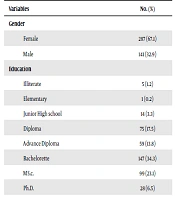
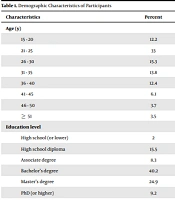
According to the analysis of the demographic characteristics, 334 participants (72.9%) were female, 124 (27.1%) were male, and 56 (12.2%) were aged 15 - 20 years (Table 1).
Table 1.
Demographic Characteristics of Participants
| Characteristics | Percent |
|---|---|
| Age (y) | |
| 15 - 20 | 12.2 |
| 21 - 25 | 33 |
| 26 - 30 | 15.3 |
| 31 - 35 | 13.8 |
| 36 - 40 | 12.4 |
| 41 - 45 | 6.1 |
| 46 - 50 | 3.7 |
| ≥ 51 | 3.5 |
| Education level | |
| High school (or lower) | 2 |
| High school diploma | 15.5 |
| Associate degree | 8.3 |
| Bachelor’s degree | 40.2 |
| Master’s degree | 24.9 |
| PhD (or higher) | 9.2 |
| Marital status | |
| Married | 37.3 |
| Single | 57 |
| Divorced/widowed | 5.7 |
| Financial status | |
| Very poor | 2 |
| Poor | 17 |
| Average | 78.5 |
| Rich | 2.5 |
| Very rich | 2 |
According to the obtained results, more than 85% of the participants had mild or moderate fear, and more than 82% had mild or moderate anxiety (Table 2).
Table 2.
Fear and Anxiety Levels of Participants a
| Variables | COVID-19 Fear | COVID-19 Anxiety |
|---|---|---|
| None/mild | 65 (14.2) | 239 (52.2) |
| Mild and moderate | 329 (71.8) | 137 (29.9) |
| 63 (13.8) | 46 (10.0) | |
| Severe | 1 (0.2) | 36 (7.9) |
| Total | 458 (100.0) | 458 (100.0) |
a Values are expressed as No. (%).
The correlations between the scores of COVID-19 anxiety and fear with the variables of employment status, number of family members, type of residential home, mental state, place of residence, education level, type of job, economic status of individual/family, type of religion, religiosity, trust in praying, individual/family income levels, travel, exercise, physical health, COVID-19 disease, COVID-19 prevention, and treatment preference indicated that the COVID-19 fear scores were poorly correlated with religion and efforts for COVID-19 prevention, while no correlations were observed with the other variables (P ≤ 0.05). Furthermore, the anxiety scores had weak, inverse correlations with efforts to prevent COVID-19 and satisfaction with the government’s efforts (P ≤ 0.05).
The mean score of COVID-19 fear was estimated at 78.64 ± 18.77 in the male subjects and 82.36 ± 19.22 in the female subjects. The results of independent t-test showed no significant difference between the male and female subjects regarding the score of COVID-19 fear. The mean score of COVID-19 anxiety was 8.12 ± 9.83 in the male subjects and 10.84 ± 9.9.9 in the female subjects, and no significant difference was observed between these groups in this regard (P ≤ 0.254) (Table 3).
Table 3.
t-Test for Equality of Means between Male and Female Participants
| F | t | df | Mean Difference | Std. Error Difference | P-Value | |
|---|---|---|---|---|---|---|
| COVID-19 fear | 0.009 | -1.85 | 456 | -3.71 | 2 | 0.924 |
| COVID-19 anxiety | 1.306 | -2.611 | 456 | -3.71 | 1.98 | 0.254 |
According to the multiple comparison of the difference between the levels of COVID-19 fear and COVID-19 anxiety with the marital status of the participants indicated that the single participants had less fear and anxiety about COVID-19 with a significant difference with the married subjects in this regard (P = 0.022). However, no significant correlation was denoted between the level of anxiety and marital status of the participants (Table 4).
Table 4.
Multiple Comparisons Between Married, Single, and Divorced/Widowed Participants
| Dependent Variable | (I) Marital Status | (J) Marital Status | Mean Difference (I-J) | Std. Error | P-Value |
|---|---|---|---|---|---|
| COVID-19 fear | Married | Single | 4.98 a | 1.87 | 0.022 |
| Divorced/widowed | 3.34 | 4.00 | 0.682 | ||
| Single | Married | -4.98 a | 1.87 | 0.022 | |
| Divorced/widowed | -1.63 | 3.91 | 0.908 | ||
| Divorced/widowed | Married | -3.34 | 4.00 | 0.682 | |
| Single | 1.63 | 3.91 | 0.908 | ||
| COVID-19 anxiety | Married | Single | 0.93 | 0.97 | 0.607 |
| Divorced/widowed | -2.01 | 2.09 | 0.602 | ||
| Single | Married | -0.93 | 0.97 | 0.607 | |
| Divorced/widowed | -2.94 | 2.04 | 0.321 | ||
| Divorced/widowed | Married | 2.01 | 2.09 | 0.602 | |
| Single | 2.94 | 2.04 | 0.321 |
a Mean difference significant at 0.05.
The comparison of the levels of COVID-19 fear and anxiety based on the source of information about the disease indicated that the participants who received information from other sources had a different fear of COVID-19 from other groups (P ≤ 047). However, no significant difference was observed in the anxiety variable between those who received information from different sources (Table 5).
Table 5.
Multiple Comparisons of Information Sources About COVID-19
| Dependent Variable | (I) Source of Information About COVID-19 | (J) Source of Information About COVID-19 | Mean Difference (I-J) | Std. Error | P-Value |
|---|---|---|---|---|---|
| COVID-19 fear | National TV | International TV | -2.44 | 3.37 | 0.888 |
| International social media | -1.09 | 2.07 | 0.953 | ||
| Other | 9.28 | 4.17 | 0.119 | ||
| International TV | National TV | 2.44 | 3.37 | 0.888 | |
| International social media | 1.35 | 3.13 | 0.973 | ||
| Other | 11.72186 | 4.79472 | 0.070 | ||
| International social media | National TV | 1.09023 | 2.07297 | 0.953 | |
| International TV | -1.35163 | 3.13341 | 0.973 | ||
| Other | 10.37023 a | 3.98794 | 0.047 | ||
| Other | National TV | -9.28000 | 4.17951 | 0.119 | |
| International TV | -11.72186 | 4.79472 | 0.070 | ||
| International social media | -10.37023 a | 3.98794 | 0.047 | ||
| COVID-19 anxiety | National TV | International TV | -2.42123 | 1.75758 | 0.514 |
| International social media | -2.24218 | 1.07989 | .162 | ||
| Other | -0.86774 | 2.17727 | 0.979 | ||
| International TV | National TV | 2.42123 | 1.75758 | 0.514 | |
| International social media | 0.17905 | 1.63232 | 1.000 | ||
| Other | 1.55349 | 2.49776 | 0.925 | ||
| International social media | National TV | 2.24218 | 1.07989 | 0.162 | |
| International TV | -0.17905 | 1.63232 | 1.000 | ||
| Other | 1.37444 | 2.07748 | 0.911 | ||
| Other | National TV | 0.86774 | 2.17727 | 0.979 | |
| International TV | -1.55349 | 2.49776 | 0.925 | ||
| International social media | -1.37444 | 2.07748 | .911 |
a Mean difference significant at 0.05.
5. Discussion
The present study aimed to investigate the fear and anxiety caused by COVID-19. According to the obtained results, more than 80% of the participants experienced mild-to-moderate anxiety and fear, and moderate-to-severe anxiety was observed in less than 20%. A study by Cowling et al. indicated that although people understood the importance of the H1N1 pandemic, they experienced less anxiety (22). Studies have also shown several emotional disorders due to diseases such as AIDS at the beginning of its outbreak although these disorders decreased with antiviral therapies (23).
Due to their evolving nature, the prevalence of emerging infectious diseases may be associated with considerable public fear and in specific communities, especially when the disease and its mortality are significant. Reducing fear and discrimination against patients with infectious diseases could be effective in controlling disease transmission. Individuals with the fear and stigma of becoming infected may not seek treatment and remain anonymous in society, which delays their treatment (24). On the other hand, low anxiety and fear caused by diseases could lead to negligence and disregarding standard health regulations, thereby increasing the number of patients in the community. This is particularly important in Iran, which has led to the relatively higher incidence rate of COVID-19 in this country.
The comparison of fear and anxiety between the male and female participants in the present study indicated that the married and single subjects and different information sources caused women to be more afraid of developing COVID-19 compared to men. This is in line with the results obtained by Davoudi et al., which were focused on gender differences in health anxiety (25). Our findings in this regard are also consistent with the research by Modara et al., who determined the mean score of anxiety in Iran in a systematic review and meta-analysis (26). The higher susceptibility of women to anxiety could be attributed to gender roles and the socialization of women in society (27) as women are often encouraged to express their emotions more frequently and seek social support due to their sexual role. On the other hand, men are more likely to deny stressful situations and are often inclined toward independence. This difference may be associated with women's communication style as they have more extensive communication networks compared to men, and these communication traits and interdependencies encourage women to express their emotions and health-seeking behaviors more easily. Moreover, women are more encouraged than men owing to their health-seeking and supportive behaviors in society (28). According to Ginsberg, symptoms of anxiety (including health anxiety) are more common in women compared to men. He believes that based on the social learning model, reassuring behaviors and expressing concern are more acceptable in women. Therefore, accepting the role of the patient is more common among women compared to men (28). High anxiety levels in women could also be associated with more health and preventive behaviors (22).
In the current research, a significant difference was observed in the levels of fear and anxiety of the married subjects compared to the singles. In a similar study, Juliao identified the factors associated with the tendency to die in patients with advanced disease stages, stating that this tendency was not correlated with gender, which is inconsistent with the results of the present study. Meanwhile, it is in line with our findings in terms of the lack of a correlation between other variables, such as education level, religion, and the number of family members (29).
According to the results of the present study, the level of fear of developing COVID-19 differed among the participants with various sources of information apart from domestic, international, and social networks. Anxiety of COVID-19 is highly common and may mostly be due to the unknown nature of the disease and cognitive ambiguity about the virus. Fear of the unknown causes anxiety in humans and disturbs their perception of immunity. As scientific knowledge remains scarce regarding COVID-19, the anxiety of the disease will likely exacerbate (30).
Currently, people are constantly seeking information to relieve their anxiety of COVID-19. Anxiety may render people unable to distinguish between right information and misinformation, and they may be exposed to false news as a result (31). Since stress and anxiety may weaken the immune system and increase susceptibility to diseases such as COVID-19, it is recommended that anxiety be managed by proper strategies, such as the use of special techniques to reduce anxiety and manage stress. In addition, individuals must learn to change and improve their lifestyle to effectively control COVID-19.
5.1. Limitations of the Study
One of the main limitations of our study was the Iranian culture, which differs with the cultural background of other countries. Moreover, the small sample sizes restricts the generalizability of the results, and further investigations in this regard should be conducted on larger sample sizes.
5.2. Conclusions
According to the results, the fear and anxiety caused by COVID-19 were mild in the Iranian society. Therefore, it is recommended that the importance of the disease be further emphasized and fear and anxiety be controlled properly by using special techniques to reduce anxiety and manage stress. Lifestyle changes could also be significantly effective in the management of COVID-19.