


1. Context
COVID-19 is a viral disease first reported in Wuhan, China, in 2019 and was recognized as a pandemic due to its wide prevalence worldwide (1). All countries are affected by the disease threatening public health and negatively affecting many aspects of life (2).
As of this writing (March 2022), more than 440 million cases and more than 5,970,000 deaths from COVID-19 have been reported worldwide (3), making it the leading global cause of death. There have been various pandemics, and the incidence and mortality rate has been much higher than COVID-19 (4). Nevertheless, what sets this pandemic apart from previous pandemic and epidemic conditions is the overwhelming spread of information technology, social media, and the Internet, which has exposed people to false information (5-7). COVID-19 news spreads faster than the virus through social media and unfiltered private social networks such as WhatsApp, Facebook, Twitter, YouTube, and TikTok. Such information about the disease is often obtained from preliminary observations and, therefore, is unreliable and causes confusion, panic, and substantial anxiety among citizens (8).
With the growth of health information in various fields in the recent decades, a new concept called infodemiology emerged. Infodemiology is the science of determining and distributing information through the electronic media, especially on the Internet, or among the general population, with the ultimate goal of enhancing public health and forming public policy (9-11). This field, which consists of information and epidemiology, pertains to properly managing information and its wide propagation (12). Suppose this information is not managed for any reason. In that case, individuals and users will face vast amounts of true and false information that can have irreparable consequences for the society. The term infodemic has been introduced in this context and dates back to the new century (13).
According to the World Health Organization, infodemic is exposure to too much online and offline information, which can also occur during an epidemic or pandemic disease outbreak. This phenomenon causes confusion and high-risk behaviors during pandemics and can negatively affect public health. When people are unsure about their health and that of their relatives, an infodemic can intensify or prolong the spread of the disease. With the growth of information technology and the expansion of social media and the Internet, information can be generated and propagated more quickly and expose people to vast amounts of information (14).
During the COVID-19 outbreak and its infodemic, numerous studies were carried out in this field, and the term “infodemic” was widely circulated. According to a Google search trend, most infodemic searches have occurred since 2004 during the COVID-19 outbreak (Figure 1).
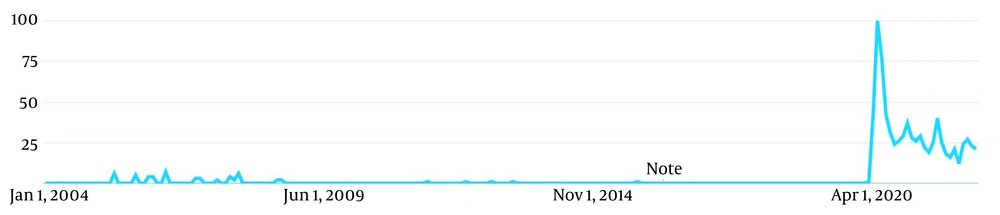
Figure 1.
Infodemic word search trend from 2004 to now (15).
This figure indicates that the period with the most search and attention to the word “infodemic” was the period of the COVID-19 pandemic.
According to the World Health Organization, infodemic management can address community concerns and questions, promote health awareness, generate expert health advice, build resistance to misinformation, and empower communities to take positive action. Several studies were conducted to determine infodemic types during the COVID-19 pandemic (8). Nonetheless, this study did not aim to investigate the types of infodemics during the COVID-19 period.
Considering the severe infodemic threats worldwide, the present study identified and elaborated the challenges of infodemic and coping strategies. The current study’s results can mitigate the adverse effects of infodemic in similar situations and crises through identifying challenges and adopting appropriate coping strategies. However, infodemic is a novel phenomenon, and its current and immediate consequences should not be overlooked; and urgent action is of critical importance.
2. Evidence Acquisition
In this narrative review study, which was conducted in 2022, we searched infodemic-related sources in the PubMed and Scopus databases using related keywords such as infodemic, pandemic, and COVID-19.
Following retrieving related publications in the initial search, we imported the results into Endnote software. After removing duplicate articles, initially, the titles and abstracts of the pieces were evaluated in terms of thematic relevance, and irrelevant articles were removed.
Inclusion criteria were defined for relevant articles. Articles about the infodemic phenomenon during the COVID-19 pandemic related to the challenges and coping strategies were included. The papers were selected regardless of their type (original articles, review studies, letter to the editor, etc.) and purpose. They were included even if parts of them were relevant to the study. For example, if some parts of an article were related to the challenges posed by infodemic in COVID-19, it was included in the study. Articles papers focus on the infodemic during the COVID-19 pandemic, and those that did not deal with the related challenges and strategies were excluded. Also, we excluded articles in languages other than English.
After selecting the relevant articles, the texts were analyzed through the content analysis method, and the relevant information was identified and classified into two main categories: Infodemic challenges and coping strategies.
3. Results
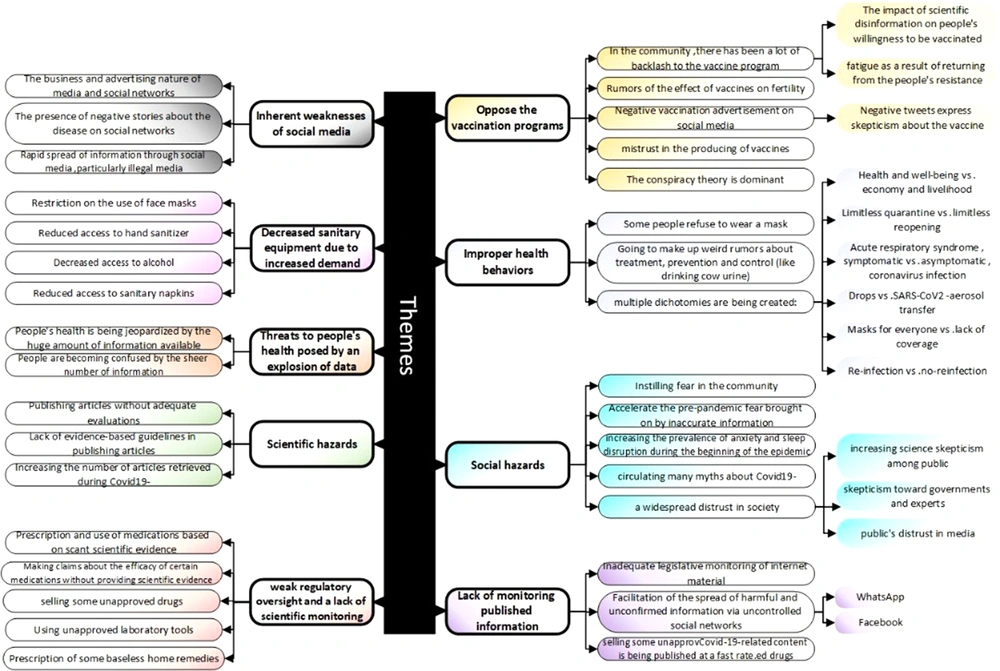
Ultimately, a total of 3601 articles were identified in the primary search, and 39 papers were included in the study. The analysis of the data showed that the challenges posed by infodemic in the COVID-19 period in different communities fell into nine main categories, which included coping with the vaccination program, health misconduct, scientific risks, lack or weakness in scientific oversight, lack of management of published information, social risks, inherent weaknesses of the social media, threats to public health due to the large amounts of data and exhaustion of health resources as a result of increased demand. Figure 2 shows the categories and subcategories in detail.
The study results also showed that different countries and societies have proposed or adopted various strategies to deal with infodemic in the COVID-19 period. As tabulated in Table 1, they fell into seven main categories.
Table 1.Infodemic Coping Strategies
| Category | Subcategory |
|---|---|
| Active confrontation of centers and scientific resources | Active conflict of scientific journals with misinformation (16) |
| Accurate and timely translation of the knowledge (40) | |
| Suggest further studies to investigate the infodemiological dimensions of disease (37) | |
| Disseminate messages and perform science and evidence-based interventions (43) | |
| Transforming knowledge into practical messages for behavior change (43) | |
| Timely translation of evidence into knowledge that can be used according to local cultures, languages, and contexts (43) | |
| Development of scientific approaches to infodemic exposure based on the acquired experiences (43) | |
| The effective intervention of health care professionals | Active and effective presence of health professionals in social networks (32) |
| Advise and emphasize to health care professionals about the sensitivity of the credibility of information resources (36) | |
| An accurate and complete investigation of suspicious sources by experts (36) | |
| Proper and timely informing health care providers about the latest recommendations and research (20) | |
| Responsible participatory actions | Involvement of social media companies in distributing accurate information (27) |
| Responsible participation of community members in social dialogue (44) | |
| Strategies developed for collaboration between governments, care institutions and technology, communication companies, and other stakeholders (25, 42) | |
| Formation of strategic partnerships among all involved parties, including social media and technology sectors, universities, and civil society (43) | |
| Actions of governments and authorities | Imprisoning people who create and share fake news in Peru (45) |
| Development of strategies to regulate the amount and type of health information disseminated on the Internet (46) | |
| Considering individual responsibility for the disclosure and dissemination of information in the field of COVID-19 (47) | |
| Effective government communication with key communities to ensure their trust (43) | |
| Strengthening social behaviors through the provision of timely information (43) | |
| Adopt an infodemic management approach tailored to national contexts and practices (43) | |
| Creating legal and ethical requirements for social media for data sharing (48) | |
| Inclusion of “Infodemic Management” in Crisis Management Topics (31) | |
| Monitor and identify incorrect information | Using technologies such as natural language processing to detect misinformation (Internet and social media) (49) |
| Ongoing monitoring of social media platforms (25) | |
| Monitoring social media data is the best way to track rumors in real-time (27) | |
| Detection of incorrect information by health care organizations and agencies, including verification agencies (27) | |
| Do more research on using artificial intelligence to detect fake news (45, 50) automatically. | |
| Apply filters to release data to increase reliability (47) | |
| Encourage knowledge refinement and quality improvement processes such as fact-checking and peer review (40) | |
| Design and use of datasets to identify incorrect information (51) | |
| Improving people’s awareness | Promoting long-term public health literacy (32) |
| Adopt strategies to increase public health literacy about pandemic conditions (52) | |
| Answers to questions and misinformation in society (43) | |
| In case of doubt about the accuracy of the information, do not share the news (44) | |
| Establish awareness campaigns in rural communities to ensure access to reliable information (53) | |
| Launching ways to improve health literacy in rural African communities (53) | |
| Informing people about how to protect themselves and the community in a health emergency (43) | |
| Increasing people’s access to knowledge transformed into simple messages (43) | |
| Encouragement to get vaccinated | Establish an effective vaccine campaign to increase public confidence and address doubts about the supply of COVID-19 vaccine (21) |
| Inform patients about the risks and benefits of COVID-19 vaccination (19) | |
| Encourage healthcare providers and the medical community to “tweet” effectively to combat the growing threat of misinformation and vaccination doubts (22) | |
| Active involvement of pharmacists in disproving misinformation about vaccination (23) |
4. Discussion
The infodemic phenomenon during the COVID-19 pandemic has significantly influenced the management, control, and combating of the virus worldwide and led to many challenges in this regard. These challenges and problems may differ in various societies and include many areas. Also, strategies that were adopted to overcome these challenges were different. This study investigated the challenges posed by infodemic during the COVID-19 pandemic and proposed a related coping strategy against them.
One of the most critical challenges posed by the infodemic of the COVID-19 pandemic is the widespread propaganda against vaccination. After discovering effective vaccines against COVID-19, some Internet sources, intentionally and unintentionally, produced and disseminated information against vaccination. Over time, this information became more widespread in cyberspace (54). This challenge led to resistance and abstinence of some people in the community from vaccination, which delayed the disease management process. Besides, the frustration and difficulty of overcoming the resistance created in the community (16) made it more difficult for authorities to convince this group of people about the benefits of vaccination.
The infodemic wave that has taken place in the community led to many health misconducts cases. For example, some communities resisted using masks as a protective barrier. If health information is freely available to the public without adequate assessment and monitoring, it may lead to unhealthy and high-risk behaviors not mentioned in the study. Scientific challenges and defective scientific oversight against COVID-19 can be considered further challenges posed by the COVID-19 infodemic. The absence or insufficiency of scientific management has undoubtedly paved the way for the profiteers’ exploitation of the situation during the current turmoil.
According to the results of other studies, social risks were another challenge posed by infodemic in the COVID-19 pandemic. Exposure of people to a large amount of contradictory information about COVID-19 and easy access to the sources, especially at the initial stages of the pandemic, led to the generation of anxiety among people (36, 37). This resulted in the generation of global waves of pre-epidemic panic due to misinformation (8), an increase in the rates of anxiety and sleep disturbance at the initial stages of the pandemic (38), the development of various myths about COVID-19 (25), distrust of governments and experts (21) and the public’s distrust in the media (34, 39). Officials and policymakers should provide reliable information for the media and internet sources so that individuals can access appropriate intervention information and identify reliable sources to prevent adverse effects at a community level. Other challenges include the inherent weaknesses of social media, the threat to public health caused by the massive flow of information, and the decline in health equipment due to increased demand; therefore, targeted strategies are needed to deal with them.
In the present study, coping strategies were also identified in addition to reviewing, identifying, and explaining the challenges posed by infodemic in the COVID-19 pandemic. Although some known methods have not been implemented and have only been put forward as proposals in some studies, other strategies have been implemented in different communities at different levels. One of the main strategies to deal with infodemic in pandemic conditions like COVID-19 is monitoring and identifying incorrect information. Although with the widespread use of information technology such as smartphones (55), this solution looks general and impractical, on this basis, in the face of the infodemic of the COVID-19 era, some effective measures have been implemented. One of the most notable cases was the continuous monitoring of social media platforms (25) and surveillance of social media data as an effective real-time strategy for preventing the propagation of false information (27). As one of the most widely-accessible information sources with substantial influence, social media can be considered one of the primary sources of infodemic. Therefore, when an infodemic is generated, officials (government officials and influential decision-makers in the country) should have enough control over social media because people obtain a significant proportion of their information about the disease from these sources. However, managing social media profiles seems a complex task that requires numerous studies by psychologists and large technology companies. Without such research, overcoming this challenge appears elusive.
One of the main strategies to deal with the infodemic caused by COVID-19 is active confrontation against centers and generation sources and implementing effective intervention measures amongst health care professionals. Many infodemic-related issues may be attributed to the scientific nature of health information and the general public’s unfamiliarity with the related terminology. Due to the defective public understanding of health jargon, the ground needed for some people to take advantage of the situation is provided. Several sectors and components may be involved in generating and propagating misinformation, which should not be overlooked. The role of institutions and scientific sources should also be considered because measures such as disseminating messages and performing interventions based on science and evidence turn knowledge into implementing health interventions (43). Responsible behavior and timely translation of evidence into the practical knowledge that integrates into local cultures, languages, and contexts (43) can mitigate the widespread influence of infodemic in society.
The study results showed that one of the effective strategies for managing infodemic is the influence of governments and authorities. However, in some cases, some measures cannot be generalized to other communities. For example, in Peru, punitive actions such as imprisonment were considered for those who fabricated or participated in producing and propagating fake COVID-19 information (45). However, while incorporating “Infodemic management” into crisis management measures (31), the government can systematically confront the infodemic and design particular plans for dealing with it in the crisis times. For example, by monitoring infodemic, the government should develop strategies for regulation of the amount and type of health information dissemination on the Internet (46), adopt an infodemic management approach tailored to national contexts and practices (43), and establish legal and ethical requirements for data sharing by the social media (48). Moreover, according to the present study’s results, heightening individuals’ awareness through appropriate strategies suitable for mature societies will be helpful.
Another strategy introduced was encouragement for vaccination to overcome the challenge of coping with the vaccination schedule following the spread of infodemic during this period. Given that in the event of an epidemic or pandemic similar to COVID-19, one of the main strategies against it will be vaccination (56), authorities should make the necessary predictions to face the adverse publicity against vaccination.
4.1. Conclusions
The most severe and notable infodemic since the creation of this term was the case COVID-19. From advertising and producing a wealth of information content to counter the vaccination program to the emergence and spread of infodemic-induced health misconduct, it has challenged officials and policymakers worldwide and created crises that sometimes cause irreparable financial damage. Accompanied and sometimes affected people’s mental health, safety, and well-being. In this study, we identified and reported different coping strategies from around the world that are very broad, and different countries and societies can adopt appropriate ones based on their criteria and characteristics. Efforts to disseminate accurate information and prevent the dissemination of incorrect information during a pandemic crisis can be vital.
The level of health literacy of individuals in the society, both in developed countries and cultures and in developing ones, especially at the beginning of the pandemic outbreak, was low. Governments must promptly and extensively provide comprehensive and accurate information in similar circumstances. Questions and false information disseminated in the community should be addressed promptly to allow people to increase their access to knowledge in the form of simple messages, thereby increasing their level of health literacy. It should be noted that the strategies presented in infodemic exposure in the COVID-19 era in this study are general and may be different in different societies, so it is suggested in other organizations due to differences like studies in the field of priority classify the applications of strategies to identify practical priorities to encounter the infodemic created effectively.



