


1. Context
1.1. Risk Factors for Community-Acquired Pneumonia
1.2. Microbiology
| Values |
|---|
| Typical bacteria |
| S. pneumoniae (most common bacterial cause) |
| Haemophilus influenzae |
| Moraxella catarrhalis |
| Staphylococcus aureus |
| Group A streptococci |
| Aerobic gram-negative bacteria (e.g., Enterobacteriaceae such as Klebsiella spp. or Escherichia coli) |
| Microaerophilic bacteria and anaerobes (associated with aspiration) |
| Atypical bacteria |
| Legionella spp. |
| Mycoplasma pneumoniae |
| Chlamydia pneumoniae |
| Chlamydia psittaci |
| Coxiella burnetii |
| Respiratory viruses |
| Influenza A and B viruses |
| Severe Acute Respiratory Syndrome Coronavirus 2 (SARS-CoV-2) |
| Other coronaviruses (e.g., CoV-229E, CoV-NL63, CoV-OC43, CoV-HKU1) |
| Rhinoviruses |
| Parainfluenza viruses |
| Adenoviruses |
| Respiratory syncytial virus |
| Human metapneumovirus |
| Human bocaviruses |
1.3. Scope and Purpose
2. Methods
2.1. Grading of Guideline Recommendations
3. Recommendations
3.1. Outpatient Setting
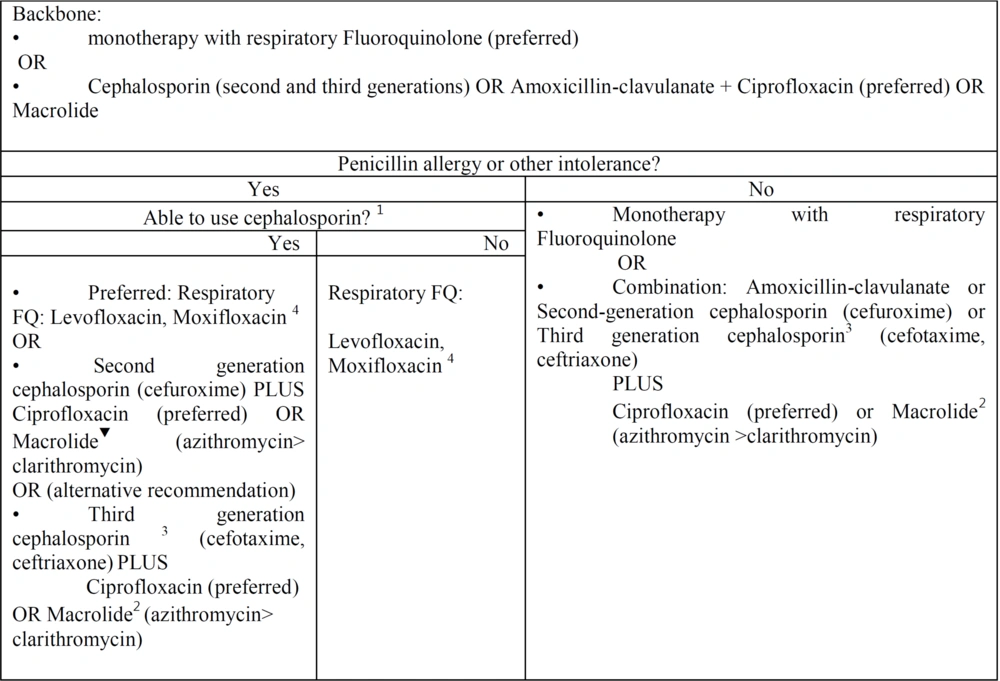
Outpatient community-acquired pneumonia. Empiric antibiotic selection in outpatient setting: This figure is adjusted of community-acquired pneumonia UpToDate and IDSA algorithms for treatment of outpatients according our published data and resistance antibiotic rate in Iran. 1 Patients with mild non-IgE-mediated reactions (eg, maculopapular rash) to penicillin or known cephalosporin tolerance can generally use later-generation cephalosporins safely. Patients with IgE-mediated reactions (hives, angioedema, anaphylaxis) or severe delayed reactions should generally use other agents. Refer to the UpToDate text on penicillin hypersensitivity reactions for detail. 2 Reasons to avoid macrolides include baseline prolonged QTc interval or risk for QTc prolongation (eg, hypokalemia, hypomagnesemia, clinically significant bradycardia, or use of other QT-prolonging agents). 3 If Second generation cephalosporin, as oral agents were not available, however monitoring and injection equipment were available in an outpatient clinic, we recommend third generation cephalosporin with close monitoring as an alternative regimen. 4 According to our data we recommend levofloxacin 500 or 750 mg daily due to lack of data about moxifloxacin 400 mg daily.
3.1.1. In Outpatient Settings, Which Empiric and Initial Antimicrobial Treatment Regimens Are Recommended for CAP in Adults?
3.1.1.1. Summary of the Evidence
3.2. Inpatient Settings
3.2.1. In Inpatient Settings, Which Empiric and Initial Treatment Regimens Are Recommended for CAP in Adults?
3.2.2. In Patients with CAP Without Risk Factors for MRSA and P. aeruginosa, We Recommend These Empiric Antimicrobial Regimens
3.2.2.1. Without Severe Beta-Lactam Allergy (Strong Recommendation, High Quality of Evidence)
3.2.2.2. With a History of Severe Beta-Lactam Allergy
3.3. In Patients with Risk Factors for MRSA
3.3.1. With or Without Severe Beta-Lactam Allergy (Strong Recommendation, Moderate Quality of Evidence)
3.4. In Patients with CAP and with Risk Factors for P. Aeruginosa, We Recommend These Empiric Antimicrobial Regimens
3.4.1. Without Severe Beta-Lactam Allergy (Weak Recommendation, Low Quality of Evidence)
3.4.2. With Severe Beta-Lactam Allergy €: (Strong Recommendation, Low Quality of Evidence)
3.5. Among Patients with CAP and with Risk Factors for MRSA and P. Aeruginosa
3.5.1. Without Severe Beta-Lactam Allergy € (Strong Recommendation, Low Quality of Evidence)
3.5.2. With Severe Beta-Lactam Allergy € (Strong Recommendation, low Quality of Evidence)
3.5.3. Summary of the Evidence
![Empiric antibiotic selection in inpatient setting: This figure is adjusted of community-acquired pneumonia UpToDate and IDSA algorithms for treatment of outpatients according our published data and resistance antibiotic rate in Iran. <sup>1</sup> Methicillin sensitive <i>Staphylococcus aureus</i> (MSSA) Risk factor: • Influenza active in community • Structural lung disease (eg, bronchiectasis) • Endobronchial obstruction • Injection drug use • Gram-positive cocci in clusters on good-quality sputum Gram stain. <sup>2</sup> MRSA risk factor (<a href="#A133876REF1">1</a>): Strong risk factors that indicate need for empiric therapy: • Recognized colonization or previous infection with MRSA Other factors that raise suspicion for MRSA and may indicate need for empiric therapy depending on local prevalence and overall clinical assessment: • Recent hospitalization or antibiotic use, particularly hospitalization with receipt of IV antibiotics in the prior 3 months • Recent influenza-like illness • Necrotizing or cavity pneumonia • Presence of empyema • Risk factors for MRSA colonization: • End stage renal disease • Patients who are men who have sex with men • Injection drug use • Living in crowded conditions • Incarceration • Contact sport participation. <sup>3</sup> When patient has a contraindication to macrolide, the FQs are choice. <sup>4</sup> Individuals with a past reaction to penicillin that was mild (not Stevens Johnson syndrome, toxic epidermal necrolysis, or drug reaction with eosinophilia and systemic symptoms [DRESS]) and did not have features of an immunoglobulin (Ig) E-mediated reaction can receive a broad-spectrum third- or fourth-generation cephalosporins or carbapenems safely. <sup>5</sup><i>Pseudomonas</i> risk factor: Strong risk factors that indicate need for empiric therapy (<a href="#A133876REF1">1</a>): • Hospitalization and treatment with parenteral antibiotics in the prior 3 months • Know colonization or prior infection with pseudomonas in patients with Structural lung disease (eg, bronchiectasis) Other factors that raise suspicion for <i>Pseudomonas</i> and may indicate need for empiric therapy depending on local prevalence and overall clinical assessment (<a href="#A133876REF29">29</a>-<a href="#A133876REF33">33</a>): • Structural lung abnormalities (eg, bronchiectasis, cystic fibrosis)• Immunosuppression • Frequent COPD exacerbations requiring frequent glucocorticoid or antibiotic use • Recent antibiotic use of any kind • Recent hospitalization or stay in a long-term care facility.](https://brieflands.com/journals/archcid/articles/133876/figures/archcid-18-1-133876-i002-preview.webp "Empiric antibiotic selection in inpatient setting: This figure is adjusted of community-acquired pneumonia UpToDate and IDSA algorithms for treatment of outpatients according our published data and resistance antibiotic rate in Iran. <sup>1</sup> Methicillin sensitive <i>Staphylococcus aureus</i> (MSSA) Risk factor: • Influenza active in community • Structural lung disease (eg, bronchiectasis) • Endobronchial obstruction • Injection drug use • Gram-positive cocci in clusters on good-quality sputum Gram stain. <sup>2</sup> MRSA risk factor (<a href=\"#A133876REF1\">1</a>): Strong risk factors that indicate need for empiric therapy: • Recognized colonization or previous infection with MRSA Other factors that raise suspicion for MRSA and may indicate need for empiric therapy depending on local prevalence and overall clinical assessment: • Recent hospitalization or antibiotic use, particularly hospitalization with receipt of IV antibiotics in the prior 3 months • Recent influenza-like illness • Necrotizing or cavity pneumonia • Presence of empyema • Risk factors for MRSA colonization: • End stage renal disease • Patients who are men who have sex with men • Injection drug use • Living in crowded conditions • Incarceration • Contact sport participation. <sup>3</sup> When patient has a contraindication to macrolide, the FQs are choice. <sup>4</sup> Individuals with a past reaction to penicillin that was mild (not Stevens Johnson syndrome, toxic epidermal necrolysis, or drug reaction with eosinophilia and systemic symptoms [DRESS]) and did not have features of an immunoglobulin (Ig) E-mediated reaction can receive a broad-spectrum third- or fourth-generation cephalosporins or carbapenems safely. <sup>5</sup><i>Pseudomonas</i> risk factor: Strong risk factors that indicate need for empiric therapy (<a href=\"#A133876REF1\">1</a>): • Hospitalization and treatment with parenteral antibiotics in the prior 3 months • Know colonization or prior infection with pseudomonas in patients with Structural lung disease (eg, bronchiectasis) Other factors that raise suspicion for <i>Pseudomonas</i> and may indicate need for empiric therapy depending on local prevalence and overall clinical assessment (<a href=\"#A133876REF29\">29</a>-<a href=\"#A133876REF33\">33</a>): • Structural lung abnormalities (eg, bronchiectasis, cystic fibrosis)• Immunosuppression • Frequent COPD exacerbations requiring frequent glucocorticoid or antibiotic use • Recent antibiotic use of any kind • Recent hospitalization or stay in a long-term care facility.")
Empiric antibiotic selection in inpatient setting: This figure is adjusted of community-acquired pneumonia UpToDate and IDSA algorithms for treatment of outpatients according our published data and resistance antibiotic rate in Iran. 1 Methicillin sensitive Staphylococcus aureus (MSSA) Risk factor: • Influenza active in community • Structural lung disease (eg, bronchiectasis) • Endobronchial obstruction • Injection drug use • Gram-positive cocci in clusters on good-quality sputum Gram stain. 2 MRSA risk factor (1): Strong risk factors that indicate need for empiric therapy: • Recognized colonization or previous infection with MRSA Other factors that raise suspicion for MRSA and may indicate need for empiric therapy depending on local prevalence and overall clinical assessment: • Recent hospitalization or antibiotic use, particularly hospitalization with receipt of IV antibiotics in the prior 3 months • Recent influenza-like illness • Necrotizing or cavity pneumonia • Presence of empyema • Risk factors for MRSA colonization: • End stage renal disease • Patients who are men who have sex with men • Injection drug use • Living in crowded conditions • Incarceration • Contact sport participation. 3 When patient has a contraindication to macrolide, the FQs are choice. 4 Individuals with a past reaction to penicillin that was mild (not Stevens Johnson syndrome, toxic epidermal necrolysis, or drug reaction with eosinophilia and systemic symptoms [DRESS]) and did not have features of an immunoglobulin (Ig) E-mediated reaction can receive a broad-spectrum third- or fourth-generation cephalosporins or carbapenems safely. 5Pseudomonas risk factor: Strong risk factors that indicate need for empiric therapy (1): • Hospitalization and treatment with parenteral antibiotics in the prior 3 months • Know colonization or prior infection with pseudomonas in patients with Structural lung disease (eg, bronchiectasis) Other factors that raise suspicion for Pseudomonas and may indicate need for empiric therapy depending on local prevalence and overall clinical assessment (29-33): • Structural lung abnormalities (eg, bronchiectasis, cystic fibrosis)• Immunosuppression • Frequent COPD exacerbations requiring frequent glucocorticoid or antibiotic use • Recent antibiotic use of any kind • Recent hospitalization or stay in a long-term care facility.


