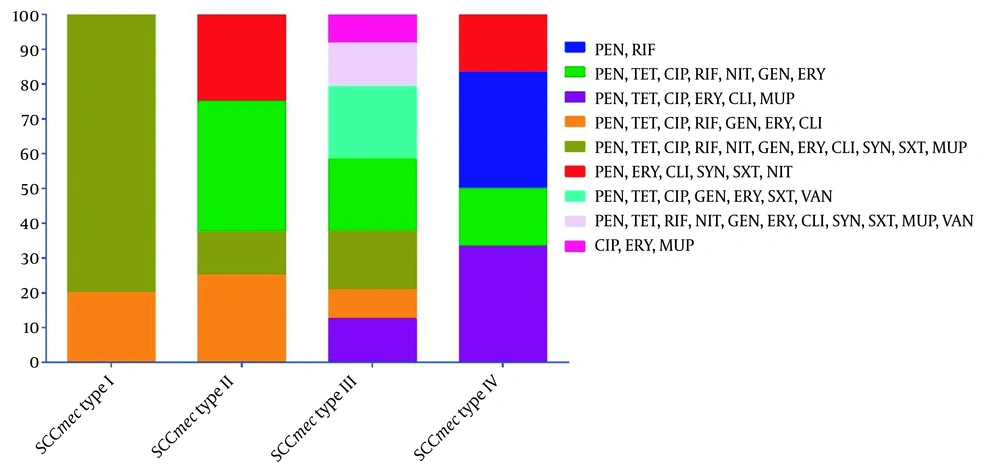
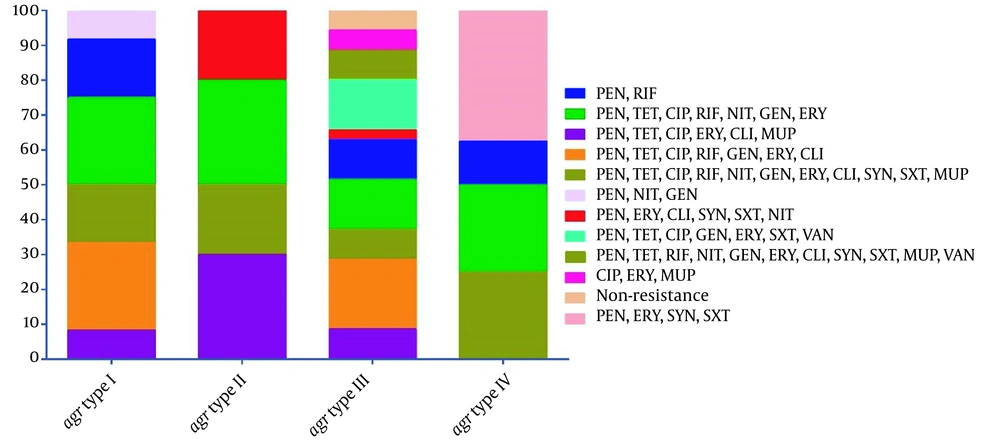
This survey demonstrated several striking results, including a relatively high frequency of PVL-positive S. aureus strains and a high diversity of their types. This study also showed a high frequency of PVL-positive S. aureus with simultaneous resistance to antibacterial agents. It manifests as a prominent threat in clinical settings. Another finding of the present study was the high resistance prevalence to vancomycin among S. aureus isolates.
The frequency of PVL among
S. aureus in this study was 18.8%, a higher prevalence than that observed (4.9%) in
S. aureus-related infections in the United Kingdom (
7). However, various percentages of PVL-carrying
S. aureus were reported by several studies worldwide (
5-
8). A high prevalence of PVL-carrying
S. aureus strains has also been reported in Tunisia (79%) (
8), Uganda (49.3%) (
5), and Saudi Arabia (30%) (
6). The findings of the current survey indicated that the prevalence of PVL-carrying
S. aureus in Iran is quite similar to the previously reported rates of 21.4% and 19.5% in 2016 and 2017 in Iranian hospitals, respectively (
11). The results pointed to a conclusion that despite the low prevalence of PVL positive, special attention for the laboratory routine detection of these isolates is needed because the mobility of the
pvl gene across MRSA isolates might increase the morbidity of nosocomial infections caused by HA-MRSA (
15-
17).
Mupirocin is used to control the dissemination of
S. aureus isolates in communities and healthcare settings and the occurrence of severe infections (
18-
21). In the present survey, the data showed a high prevalence rate of mupirocin-resistant MRSA isolates (32.3%). This finding is supported by the observations of Chamon et al. from Brazil (33%) (
17) and Goudarzi et al. from Iran (30.5%) (
11). In a recent meta-analysis study by Dadashi et al., various prevalence rates of mupirocin-resistant MRSA isolates were reported in different geographic areas (e.g., less than 1.0% in France, India, Iran, and Australia or more than 50% in India, the USA, and Egypt) (
19). The reason for the high mupirocin resistance rate is not well-understood but can be attributed to the ward, sample type, geographic or socioeconomic factors, and policies in the use of mupirocin in hospitals.
Furthermore, this study reported a high prevalence of HLMUPR and LLMUPR at 42.9% and 57.1% among MRSA isolates, respectively. A recent study in Egypt reported a high prevalence of HLMUPR and LLMUPR, with a proportion of 61.5% and 38.5% (
22). In the present survey, the prevalence rates of high and low levels of resistance to mupirocin in MRSA isolates were reported as 13.5% and 18.5%, respectively. The reported rate of HLMUPR-MRSA in this study was higher than in France (0.8%) (
20), Canada (4.3%) (
18), and China (7%) (
21). Overall, the reason for this high mupirocin resistance rate is not well-understood; however, it appears to be related to a shortage in the implementation of antibiotic stewardship programs, incorrect policies unrestricted, and widespread use of this antibiotic. Therefore, before mupirocin therapy, it is essential to determine the susceptibility of isolates to mupirocin.
Methicillin-resistant
S. aureus is important; nevertheless, the emergence of vancomycin-resistant
S. aureus (VRSA) represents an additional challenge and concern for controlling staphylococcal infections (
23). It is worth noting that VRSA was found in 12.3% of PVL-positive isolates. The results of a meta-analysis performed in 2020 depicted an upward trend in VRSA and vancomycin-intermediate
S. aureus (VISA) worldwide. Shariati et al. demonstrated that VISA strains (1.7%) had a higher global rate than VISA strains (1.5%). Likewise, an increasing trend of 2 and 3.6-fold of VRSA and VISA after 2010, compared to before that, was noted. However, Asian countries, especially Iran and India, included the highest rates of VRSA incidence (67%) (
23). This relatively high prevalence of VRSA in the two aforementioned countries, compared to American/European countries, can be due to the unrestricted and unscheduled administration of antimicrobials, geographic area, level of hygiene, poor health policies, and diverse attitudes toward antimicrobial protocols.
The present study’s observations about SCC
mec types are in line with those of other studies that confirmed the relationship of SCC
mec types I, II, and III with HA-
S. aureus infections; nevertheless, IV and V are prominent types in community-associated (CA)-
S. aureus infections (
24,
25). Staphylococcal cassette chromosome mec typing illustrated a dominance for type III at 55.8%, which is similar to the results of several studies indicating PVL-positive HA-MRSA strains carrying SCC
mec types II and III. This finding indicated that PVL-positive strains with SCC
mec type III spread in different regions of Iran. Contrary to the finding of a study by Chamon et al. (
17) from Brazil which reported a predominance of one SCC
mec IV in PVL-positive
S. aureus strains, representing 62% of the isolates, the current study’s observations indicated SCC
mec type IV at a low level (14%). This emergence has been reported regionally to higher levels in reports of the nearby countries, with dominance in SCC
mec type IV ranging from 19% to 90% (
26).
Although numerous studies have characterized
agr types of HA- and CA-
S. aureus isolates from the community and hospitals; narrow studies have focused on the features description of
agr types among PVL-positive
S. aureus strains (
8,
10). The results of
agr typing performed for strains also showed that
agr type I was the second predominant genotype in PVL-positive strains. In a study in Thailand on 92
S. aureus strains, this type was more frequent in the tested isolates (
27). Another study conducted by Javdan et al. on 150
S. aureus isolates showed that
agr type I was predominant (54.7%), followed by type II (24.7%), type IV (14%), and type III (6.6%) (
28). The present study observed relatively low infection rates of 15.4% and 12.3% of
agr types II and IV, respectively. Similar rates were reported by Ghasemian et al. (
29). It could be speculated that
agr type I can have a crucial task in the regulation of staphylococcal toxins, especially PVL. The high prevalence of
agr type III among PVL-positive isolates promoted us to understand its virulence.
5.1. Conclusions
Overall, this study indicated a diversity of agr and SCCmec types, easily transferred “from and to” hospitals. The widespread dissemination of MDR PVL-positive S. aureus strains was a wake-up call for researchers. Resistance to vancomycin in this study emphasized that using this and other antibiotics, especially mupirocin and clindamycin, and resistance to them should be carefully monitored.