Vaccination against SARS-CoV-2 has significantly contributed to controlling the COVID-19 pandemic. However, there remains substantial uncertainty regarding the optimal humoral response to SARS-CoV-2 vaccination in PwMS. Previous studies have suggested that PwMS on DMTs might exhibit a reduced humoral response to the vaccine, particularly those treated with anti-CD20 therapies and fingolimod, raising critical questions about how to vaccinate immunocompromised individuals most effectively (
8,
14-
16).
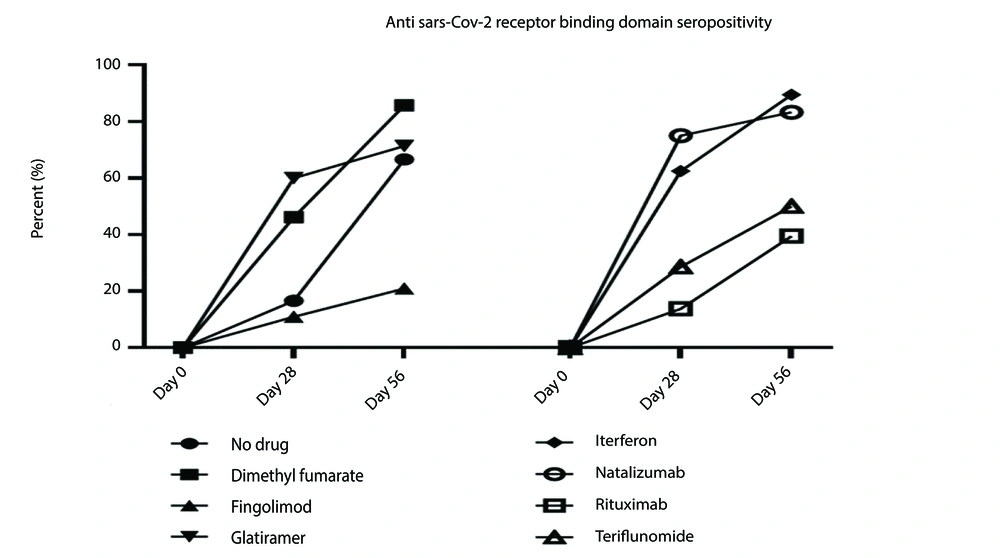
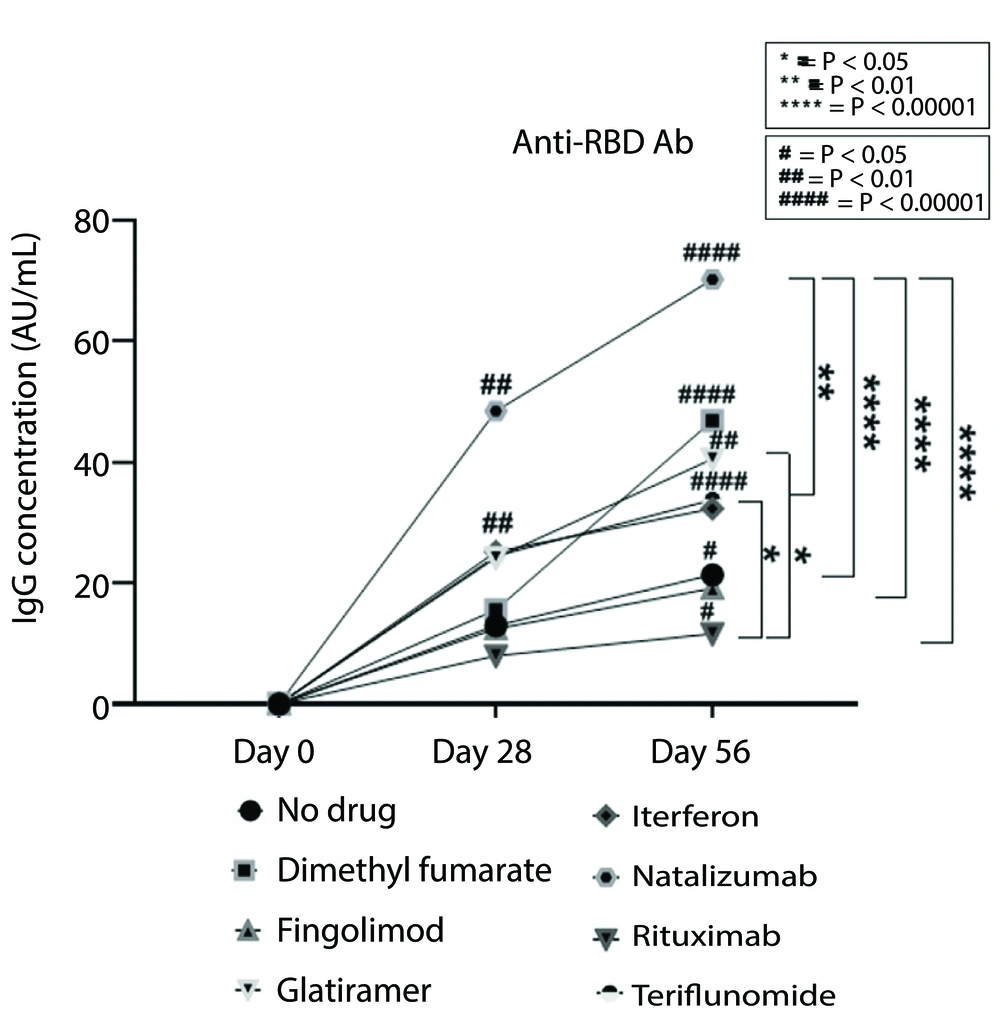
Since the Sinopharm vaccine is the most commonly used in Iran, and limited data exist on the immune response to the COVID-19 vaccine in the Iranian population, the present study investigated the humoral response in Iranian PwMS treated with different DMTs. Patients received the Sinopharm vaccine in two stages, with evaluations conducted 28 days after the first and second doses. The results revealed that 28 days after the first dose, antibody levels in PwMS treated with teriflunomide, fingolimod, and rituximab showed no significant difference compared to baseline. However, 28 days after the second dose, an increase in humoral immunity was observed across all PwMS, regardless of the DMT type. Nevertheless, PwMS treated with fingolimod and rituximab failed to meet the minimum vaccine efficacy requirements based on WHO standards.
Our findings align with numerous reports during the COVID-19 pandemic indicating a lower humoral response in PwMS treated with fingolimod and anti-CD20 therapies (
8,
14-
16). The primary reason for the diminished humoral response with anti-CD20 therapies is attributed to their mechanism of action, which reduces the number of naive and memory B-cells, thereby decreasing antibody secretion (
17). However, other factors, including disease duration, treatment duration, dosing interval, age, comorbidities, and BMI, may also influence the immune response (
18). Several studies have demonstrated a negative association between BMI and age with vaccine immunity, while others, consistent with our results, have not found such an association (
19-
23). Additionally, robust evidence suggests that exposure to anti-CD20 therapies 3-6 months before COVID-19 vaccination may significantly impair the development of a protective humoral response. This is consistent with prior observations that B-cell repopulation typically begins approximately six months after the last anti-CD20 treatment (
24,
25).
Despite a diminished humoral response, growing evidence suggests a preserved T-cell immune response in patients treated with anti-CD20 therapies. A recent review demonstrated that SARS-CoV-2-specific memory T-cell responses were not only comparable between BNT162b2-vaccinated healthy controls and ocrelizumab-treated PwMS, but also showed a higher level of IFN-γ-producing T-cells in the ocrelizumab group. This finding signifies an enhanced vaccine-induced T-cell response in PwMS treated with ocrelizumab (
10). Similarly, another study reported preserved CD4 and CD8 T-cell responses in rituximab-treated patients with autoimmune diseases, even in those lacking a humoral response (
10). However, limited data suggest reduced SARS-CoV-2-specific CD4 T-cell responses in patients treated with fingolimod, likely due to CD4 T-cell lymphopenia or disrupted T and B-cell interactions in lymph nodes (
10).
The effect of teriflunomide on the immune response remains a topic of interest. While some studies have shown a mild dose-dependent reduction in the efficacy of influenza and rabies vaccines in PwMS treated with teriflunomide, others have demonstrated effective immune responses to seasonal influenza vaccination, consistent with the preservation of protective immune responses (
10). Additionally, most studies on COVID-19 vaccination indicate that PwMS treated with teriflunomide are likely to mount a similar immune response to untreated patients (
8,
14-
16).
Considering all factors, PwMS should be encouraged to follow immunization programs, with appropriate timing for patients treated with anti-CD20 therapies and the inclusion of booster doses to achieve optimal immune responses.
Like other observational studies, our work has some limitations, the most notable being the small sample size and the lack of a control population for comparison. Additionally, we did not assess SARS-CoV-2 serostatus after the third and fourth vaccination doses. Furthermore, we evaluated only IgG responses as a measure of humoral immunity, whereas the adaptive immune response to SARS-CoV-2 depends on both cellular responses and specific antibodies. Therefore, these findings should be interpreted cautiously and generalized with care. Further studies with larger sample sizes and longer follow-up durations are needed to confirm our findings.
5.1. Conclusions
The present study revealed that PwMS treated with INF-β, glatiramer acetate, teriflunomide, dimethyl fumarate, and natalizumab produced optimal humoral immune responses after receiving two doses of the BBIBP-CorV (Sinopharm) vaccine. However, anti-CD20 therapies and fingolimod significantly reduced humoral immune responses, underscoring the need for cautious interpretation of vaccine effectiveness in these populations. This calls for a comprehensive evaluation of both B and T-cell responses, as well as consideration of booster doses in COVID-19 vaccination strategies for these patients.