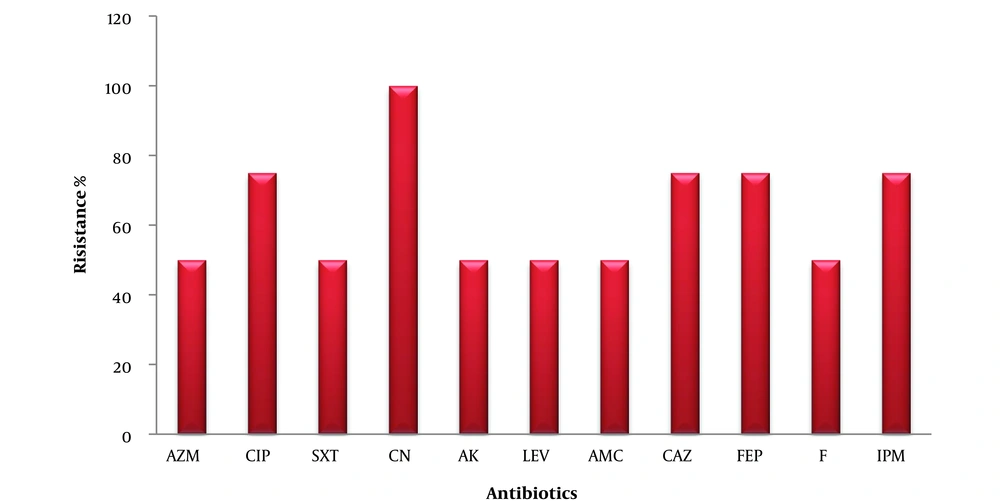
Overprescription of antibiotics is common in primary healthcare facilities. To reduce the likelihood of antibiotic resistance developing, health authorities should strictly regulate or outright prohibit the overprescription of antibiotics (
12).
It is reported that
E. coli (64.5%),
Klebsiella species (11.6%), and
Enterococcus species (6.1%) were the most common bacteria isolated from urine samples (
13). This was supported by Luo et al. (
14), which indicated that gram-negative bacteria were the most frequently isolated species in UTIs. A study highlighted the predominance of
E. coli bacteria in patients suffering from UTIs (
15).
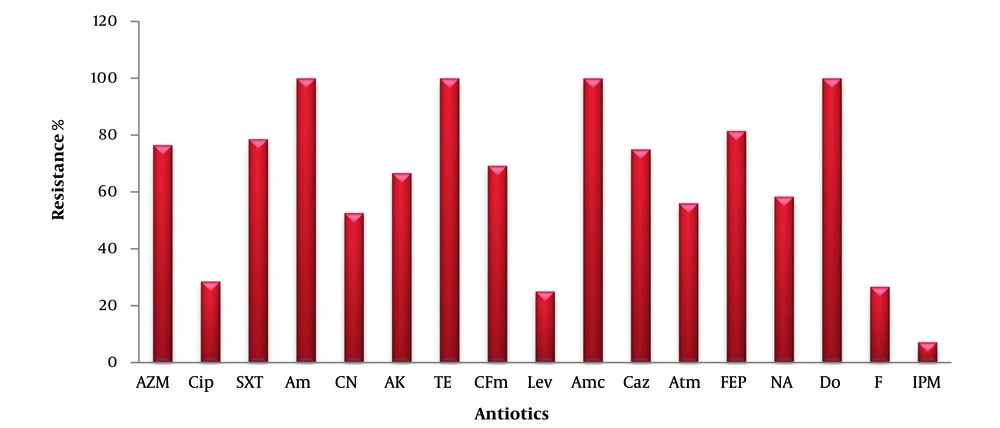
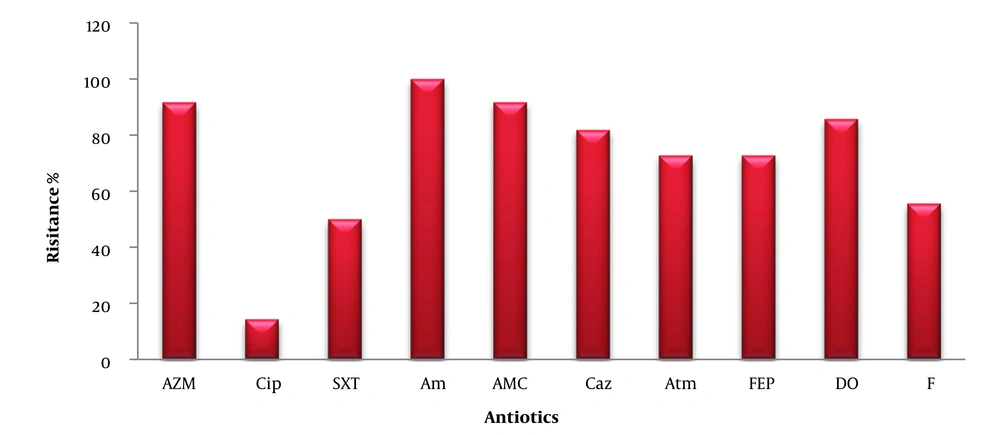
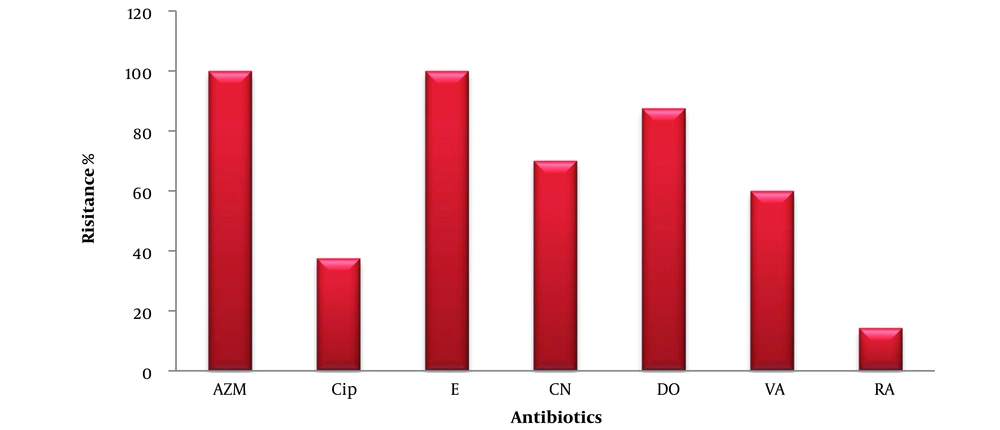
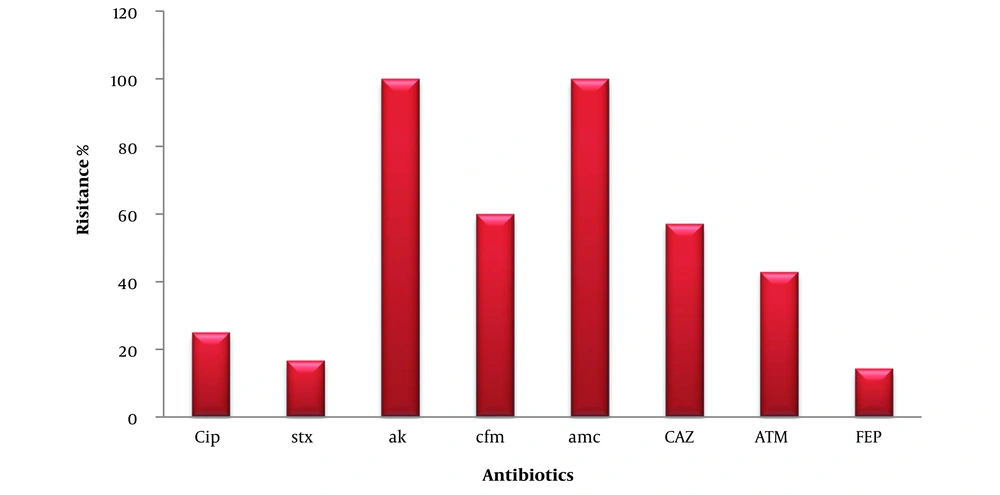
The results indicated that bacteria isolated from urine samples exhibited resistance to many antibiotics, classifying them as multidrug-resistant (MDR) bacteria. This was confirmed by a study (
16), who recorded the resistance of gram-negative bacteria to each of the following antibiotics: Gentamicin, Am/sulbactam, CIP, IM, FEP, LEV, ATM, and AK, with resistance rates of 69.56%, 56.52%, 43.47%, 0%, 52.17%, 82.60%, 60.87%, and 39.13%, respectively.
Similarly, Islam et al. (
17) found that
E. coli and
Klebsiella species were resistant to a range of antibiotics, including sulfonamides (56%, 41%), fluoroquinolones (69%, 53%), third-generation cephalosporins (69%, 58%), macrolides (70%, 76%), and penicillin (85%, 95%), respectively.
According to a study (
18), a significant proportion of antibiotic resistance was observed in
K. pneumoniae and
E. coli.
K. pneumoniae demonstrated high resistance to streptomycin (88%), E (88%), cloxacillin (96%), while
E. coli exhibited resistance to all three antibiotics.
The antibiotics IM (95%), STX (69.8%), ATM (60.5%), chloramphenicol (45.3%), and meropenem (27.9%) were more effective against
Pseudomonas isolates (
19).
Regarding the resistance of
Pseudomonas bacteria, the results of a study (
19) indicated that
Pseudomonas isolates exhibited greater resistance to IM (95%), STX (69.8%), ATM (60.5%), chloramphenicol (45.3%), and meropenem (27.9%).
In contrast, Mapipa et al. (
20) reported that the antibiotic ceftazidime had the highest resistance rate (63%) against
P. aeruginosa isolates, with resistance to other antibiotics ranging between 7% and 35%.
Regarding the antibiotic resistance of
Staphylococcus bacteria, a study (
21) indicated that all
Staphylococcus isolates were 100% resistant to AZM and E, and 95.56% resistant to cefixime, 50% resistant to Am, and 95% resistant to amoxicillin. Meanwhile, another study (
22) indicated that all
Staphylococcus aureus isolates were 100% resistant to Am and penicillin, 97.6% resistant to AK, and 90% resistant to ciprofloxacin and gentamicin.
According to a study (
23), the development of quinolone resistance in
Enterobacteriaceae is a complex and multifaceted process. The primary resistance mechanisms include one or more genetic mutations at the target site that alter the drug's affinity for binding to target enzymes, overexpression of the AcrAB-TolC MDR efflux pumps, and decreased expression of porins and plasmid-coded resistance proteins, such as the protection protein Qnr.
A study assessed gene sequencing in
E. coli bacteria and indicated the presence of the genes orf00490, orf00819, orf001916, and orf01200, which regulate the expression of the enzyme fumarate reductase subunit D (frdD) as well as the cell division protein FtsI (penicillin-binding protein 3) (
24). Additionally, the outer membrane porin protein OmpD is controlled by the genes orf00490, orf00819, and orf001916.
The occurrence of several mutations in these genes leads to bacterial resistance to many antibiotics, while the gene orf04094 expresses histidine kinase, orf02235 expresses multidrug resistance, and orf03479 expresses valine-glycine repeat G, which is excreted through the type VI secretion system (T6SS), one of the extracellular substances that contribute to antibiotic resistance.
The resistance of
P. aeruginosa to cephalosporins, carbapenems, aminoglycosides, and fluoroquinolones is primarily due to horizontal gene transfer, involving integrons, plasmids, and transposons (
25).
It is noted from the results that the MARI of bacteria isolated from urine was mostly greater than 0.2, indicating the extent of the epidemic of each of the bacteria (E. coli, K. pneumoniae, Enterobacter spp., Pseudomonas spp.).
This is supported by Ayandele et al. (
18), which found that
E. coli had the highest MAR index, reaching 1.00 in 17 isolates that showed resistance to 14 antibiotics. Meanwhile, another study (
26) indicated in their study that 44% of
Staphylococcus spp. isolates and 50% of
E. coli isolates had MAR indices greater than 0.2.
In a study, the MARI of
Pseudomonas was 0.85 (
27), while a study by Ayandele et al. (
18) showed in their study that the MARI in
Pseudomonas isolates ranged between 0.0 and 0.8.
As for
Enterococcus bacteria, a study (
28), indicated in their study that the MARI for
Enterococcus ranged between 0.08 and 0.83, while another study (
20) showed that the MARI for
P. aeruginosa ranged between 0.23 and 0.38.
Multiple Antibiotic Resistance Index is a useful tool for assessing the vulnerability of humans to the risk of resistant bacteria, as well as the extent of environmental danger due to antibiotic-resistant bacteria (
10). This is especially important because antibiotic-resistant environmental bacteria can evolve into pathogens through genetic association (
29) and phenotypic diversity between environmental and clinical bacteria (
30). Additionally another study (
31) indicated that a rise in MARI to 0.82, 0.73, and 0.64 signifies significant contamination with Vibrio parahaemolyticus bacteria. The MARI for
Pseudomonas putida isolated from fish was 0.76, indicating high antibiotic use in fish farms (
32). The rise of MARI above 0.2 signifies the extensive use of antibiotics in the aquatic environment. This variation in the MARI of isolated bacteria is attributed to mobile genetic elements, particularly Class 1 integrons, which provide a significant opportunity for the spread of antibiotic resistance among fish.
While Mishra et al. (
33) indicated that
Enterobacter with an MARI above 0.3 was observed to possess outer membrane proteins as well as other virulence factors, such as Type 1 fimbriae, biofilm production, and serum resistance.
This is supported by a study (
34), which noted that there is a difference in MARI between bacterial genera.
Pseudomonas aeruginosa had a higher MARI than
Klebsiella spp. and
Proteus spp., which in turn had a higher MARI than
Enterobacter spp. The study also pointed out that 25% of the isolates posed a significant risk to humans and animals, with the majority being
P. aeruginosa, which poses a higher threat as a potential pathogen compared to
Enterobacter spp., based on MARI and virulence factors.
It was indicated that bacterial isolates with an MARI greater than 0.3 and a virulence factor above 0.5 pose a significant threat, while isolates with an MARI less than 0.3 and a virulence factor less than 0.5 represent a medium risk (
34). Isolates with low risk have both an MARI less than or equal to 0.3 and a virulence factor greater than or equal to 0.5. Non-risk isolates are those with an MARI greater than 0.3 and a virulence factor greater than 0.5.
It is noted from the results that the values of MARI vary between genera as well as between the same bacterial species. This may be due to many factors, as indicated by (
35-
37), who found that differences in MARI values depend on the source of the sample, geographical location, and the method of testing.
5.1. Conclusions
According to the current study, UTIs are the most common pathological cases among young people, and urine is one of the most frequently examined samples. Escherichia coli is the most common bacterium, and antibiotic-resistant bacteria spread through the increasing MARI of isolated strains, including Enterobacter species, Pseudomonas species, E. coli, and K. pneumoniae.