


1. Background
Leishmaniasis is one of the most important parasitic diseases which has wide ranges of clinical symptoms, currently threatening 350 million people in more than 88 countries (1). Cutaneous leishmaniasis (CL) is a main public health problem in various regions of Iran and prevails in rural districts of 15 of 31 provinces of Iran (2). In the recent years, researches on CL have been carried out by various scientists in Iran (2-7). Phlebotomine sandflies are the vectors of leishmaniasis and papatasi fever in Iran (8, 9). Both Zoonotic and Anthroponotic Cutaneous leishmaniasis (ZCL and ACL) have been prevalent in a number of rural and urban areas of this country. They have also emerged in new foci during the recent decades (8, 10). There are at least two species of old world leishmaniasis, responsible for CL in Iran (11). CL due to Leishmania major is still a great and increasing public health problem in many rural areas in 15 out of 31 provinces of Iran (9). As CL is endemic in different parts of the country and the disease has been documented increasingly in various age and gender groups in some parts, the aim of this survey was to determine the epidemiological factors associated with CL in Behbahan County during five years. As the epidemiological aspects of CL in this County has not been examined in the recent years for the implementation of future control measures to control the disease more effectively and organize a control program, basic information is needed to be determined (12).
2. Objectives
The current study aimed to assign the epidemiology and clinical features of CL in Behbahan County, Iran.
3. Materials and Methods
3.1. Study Area
Khuzistan Province in the Southwest is one of the 31 provinces of Iran, bordering Basra Province of Iraq. Its capital is Ahvaz and covers an area of 63,238 km². Behbahan is one of the 18 counties of the province. Geographically, the province of Khuzistan can be basically divided to two regions, the rolling hills and mountainous regions located in the north of the Ahvaz ridge, and the plains and marsh lands in the south. The climate of Khuzistan is generally hot and occasionally humid, particularly in the south, while winters are more pleasant and dry. Summer time temperature routinely exceeds 50°C and in winter it can drop to extremely low levels, with occasional snowfall all the way south to Ahvaz. Khuzistan Province is known to have the hottest temperatures on record for a populated city anywhere in the world. Sand and dust storms are frequent with arid and deserted lands.
3.2. Clinical Samples and Data Collection
A questionnaire was designed to examine a clinical course, using a descriptive cross-sectional method, in Behbahan County, Khuzistan Province. Clinical samples were collected from all confirmed cases - proved to have the symptoms of CL as well as amastigotes in the Giemsa-stained smears - of Behbahan County health center between 2004 and 2008. In a proper parasitology laboratory all slides prepared by scraping the edges of ulcers of all patients contained parasites, fixed by methanol, stained by Giemsa method and identified under a microscope by a trained person. Parasites considered to be Leishmania major according to the existence a large vacuole in the cytoplasm. For each patient, the demographic features including the patient’s gender, age, clinical signs which comprise the number of ulcers and their locations in the body, months of diseases occurrence, incidence rate and geographical regions was recorded by interviewing the patients. Data were analyzed using SPSS version 11.0.1 (SPSS Inc., Chicago, IL, USA).
4. Results
A descriptive cross-sectional survey was performed in Behbahan County. A total number of 172 positive cases of CL were reported in the County, during 2004 - 2008, including 95 (55.2%) males and 77 (44.8%) females from which 81 (47.1%) resided in urban and 91 (52.9%) in rural areas. Table 1 shows sex-related CL cases as well as their prevalence in urban and rural areas in Behbahan County from 2004 to 2008, respectively.
Table 1.Prevalence of Cutaneous leishmaniasis Based on the Incidence (Per Thousand), Gender, Patients’ Locations, Site of Lesions and Number of Ulcers during 2004 - 2008 in Behbahan County, Khuzistan Province, South West of Iran
| Year | Number of Patients With CL | Incidence Rate/1000 People | Gender, % | Location, % | Site of the Lesions, % | Number of Ulcers, % | |||||||||
|---|---|---|---|---|---|---|---|---|---|---|---|---|---|---|---|
| Male | Female | Rural | Urban | Face | Feet | Hands | Other | One | Two | Three | > Three | ||||
| 2004 | 24 | 0.12 | 62.5 | 37.5 | 25 | 75 | 16.7 | 20.8 | 41.7 | 20.8 | 29.2 | 33.3 | 33.3 | 4.2 | |
| 2005 | 33 | 0.17 | 54.5 | 45.5 | 42.4 | 57.6 | 26.2 | 23.2 | 43.4 | 7.2 | 45.9 | 27.8 | 21.7 | 4.6 | |
| 2006 | 43 | 0.22 | 37.2 | 62.8 | 62.8 | 37.2 | 2.3 | 27.9 | 53.4 | 16.4 | 44.2 | 20.9 | 16.3 | 18.6 | |
| 2007 | 34 | 0.7 | 50 | 50 | 73.5 | 26.5 | 20.6 | 17.6 | 44.1 | 17.7 | 55.9 | 17.6 | 23.5 | 2.9 | |
| 2008 | 38 | 0.20 | 50 | 50 | 57.9 | 42.1 | 15.7 | 35.6 | 34.1 | 14.6 | 52.6 | 15.8 | 15.8 | 15.8 | |
Analysis of the ulcers distributions in the body showed that most of the lesions including 32% of the cases were observed on the hands, 31.4% on the feet, 19.2% on the faces and 17.4% on other parts of the body (Table 1). Majority of the patients had only one ulcer (n = 84, 48.8%), also 34 (19.8%), 26 (15.1%) and 28 (16.3%) cases exhibited two ulcers, three and more than three ulcers on their body, respectively (Table 1). The highest disease prevalence (n = 39) was observed in February (Figure 1 and 2).
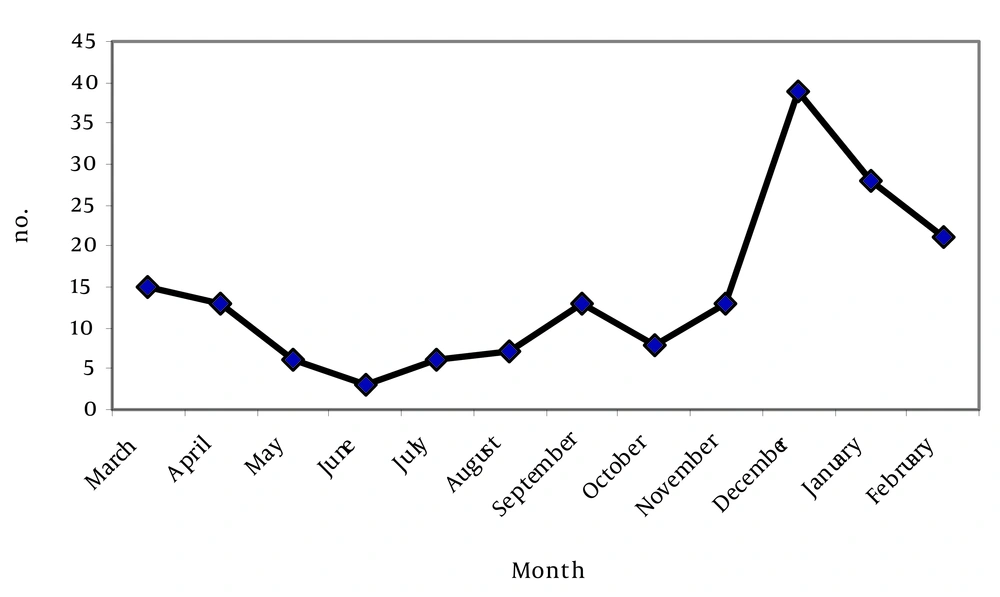
Figure 1.
Monthly Prevalence of Cutaneous leishmaniasis in Behbahan County, Khuzistan Province, South West of Iran (2004 - 2008)
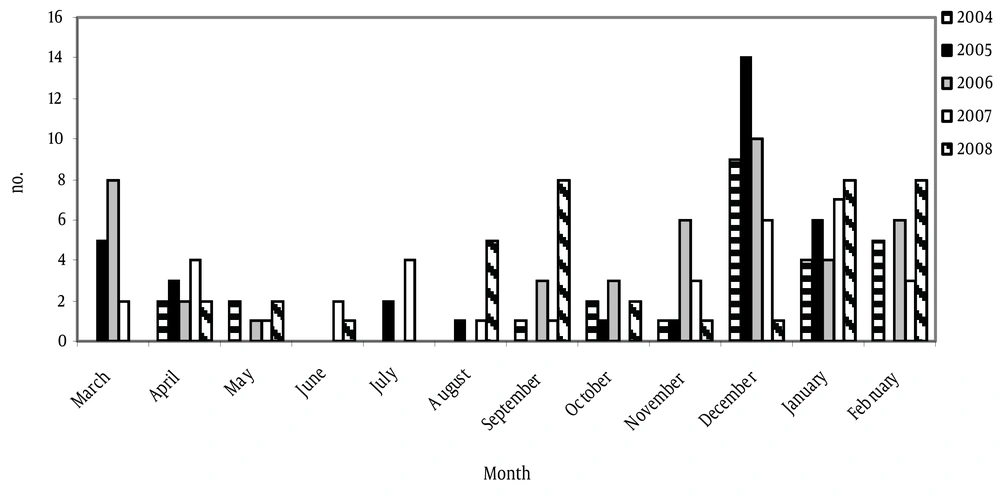
Figure 2.
The Monthly Variation in Cutaneous leishmaniasis Cases Based on the Year of Referral, in Behbahan County, Khuzistan Province, South West of Iran (2004 - 2008)
The highest disease prevalence was in winter since 88 of the cases had occurred in this season (Figure 1 and 2). The highest frequency of CL occurrence was observed significantly in the age group of 20 - 29 (27.3%) while the least prevalence was seen in the 40 - 49 age groups (Figure 3).
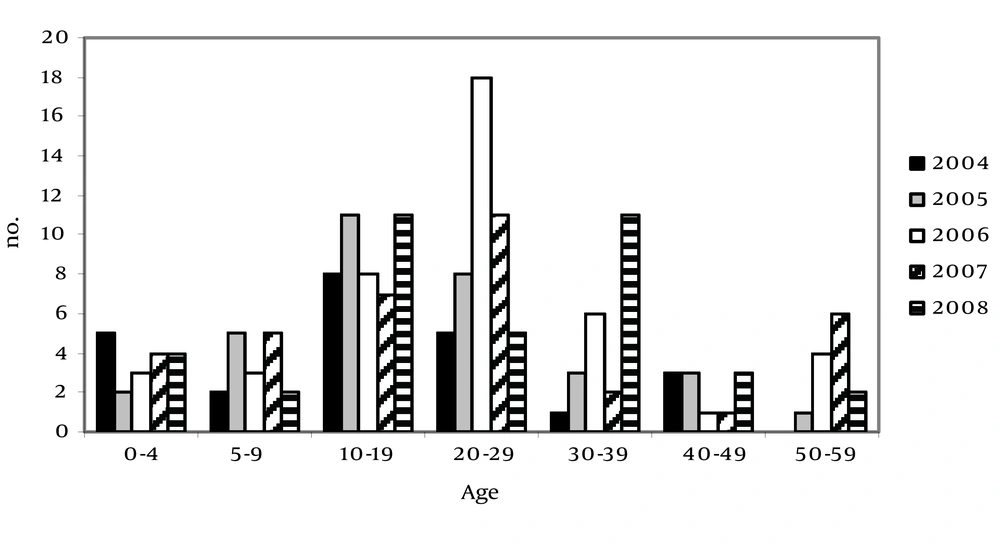
Figure 3.
Comparison of The Number of Positive Cutaneous leishmaniasis Cases in Different Age Groups, in Behbahan County, Khuzistan Province, South West of Iran (2004 - 2008)
The year 2006 had the most prevalent cases of CL in the County. The incidence of the disease in Behbahan County, during 2004 - 2008 is shown in Table 1.
5. Discussion
CL is a main public health problem in Iran including Khuzistan Province, and its prevention and control is one of the priorities of the health ministry. In this survey, main epidemiological aspects of 172 CL cases were diagnosed between 2004 and 2008. The present study was designed to determine the epidemiological aspects in Behbahan County, south west of Iran, in order to point out our beneficial recommendations for planning a more accurate program for leishmaniasis control. In this study, there was a relationship between gender and incidence of the disease since it was more frequent in men than women. It is due to the higher incidence of working or sleeping in open areas with less coverage of the body as well as more exposure to the infected sandflies compared with the women (13, 14). Some studies have hypothesized that the gender difference observed in some parasitic diseases can be attributed to hormonal effects. However, controversy still exists regarding the role of sex hormones in the cellular immune response (15, 16). Although it is believed that sex hormones may influence the establishment and the course of parasitic diseases, behavioral factors that are making male individuals more likely to be exposed to the vectors in the fields and other transmission environments are probably equally or more important (17, 18). The most anatomical site for lesions concentrations was on the hands. Repartition of CL positive cases according to age was also in agreement with the previous findings (5, 19), which demonstrate that in general CL has more prevalence among adults aging 20 - 29 years. Other studies show that people younger than 20 are the highest CL-infected age group (20, 21) . The reason is that adults develop resistance to CL due to their previous exposure to the parasite. The age group of 20 - 29 included patients who spend their time mostly in farms and orchards at night without self-protection. Due to the hot weather of the study area, people prefer to sleep outside in the house yards and majority of children leave their faces and hands coverless, exposed to the bites of sandflies, Therefore, using personal protection equipment such as insect repellent chisel and insecticides-impregnated bed nets in addition to covering the exposed body parts are recommended in order to prevent the disease in people who are at the sandfly bites' exposure (22, 23). The prevalence of CL had remarkable changes in the different months and seasonsof the year and the highest rate was observed in February, which was related to the sandflies activity. Results of this study showed that most ulcers (32%) were observed on the hands which were similar to the results of other studies (24-26). In most cases hands are unprotected and since sandflies are not capable of sucking the blood through clothes due to having short mouth appendices, they mostly attack open and unprotected parts of the body (23, 27). Results showed that 48.8% of the cases only had one ulcer on their bodies, because sandflies complete their feeding in one bite (23, 27). The role of cultural and demographical factors has been well-described in the prevalence of CL which is very important in the control of CL in this County as well as in Iran. The study area has an important strategic position, bordering with Iraq country. Concluding the present findings, CL is posed as a health problem in Behbahan County. Therefore, planning for the disease control and taking appropriate measures to reduce the incidence of the disease are necessary. Health education through the public media and individual and group training, fighting against rodents, full protection during the transmission season, environmental reforms plus proper disposal of garbage and sewage and using insecticide impregnated mosquito nets should also be included in the planning. Results showed that there were some limitations for the study including not referring all the patients to the health centers of the County and passive case finding. According to the results of the study and high incidence and prevalence of the disease in the region under study in addition to the symptoms of leishmaniasis and presence of amastigotes in Giemsa-stained smears, it is concluded that serious public health monitoring should be taken into account in this area.

