


1. Background
Urinary tract infections (UTI) are the most common bacterial infection during pregnancy. Although, asymptomatic bacteriuria is the most common form, acute pyelonephritis is the most prevalent medical complication of gestation, which occurs in 1% - 2% of all pregnancies and may result in significant fetal and maternal morbidity and mortality (1-4). On the other hand, pyelonephritis is the leading cause of septic shock in pregnancy (2). Normal perineal flora bacteria such as E. coli, Proteus and Klebsiella are the most important organisms leading to pyelonephritis during gestation (5). Infection usually ascends through bladder easily during gestation, since higher progesterone level causes additional urine stasis due to increased vesicoureteral reflux, decreased urethral peristaltism and bladder hypotonia (6, 7). Asymptomatic UTI incidence does not increase in pregnant women in comparison to non-pregnants, but due to mentioned anatomical and physiological changes, the risk of clinical diseases increases in gestation and 30% - 40% of untreated cases develop symptomatic infection such as pyelonephritis (6, 8). However, bacteriuria eradication by antibacterial agents decreases symptomatic infection occurrence (6).
Regarding increased risk factors such as nulliparity, younger age, nephrolithiasis, anomalies, higher urinary pH and glucosuria, pyelonephritis is most prevalent during the second trimester (9, 10). Since pregnant women uterus develops pressure on the right urethra and causes some degrees of urinary stasis, pyelonephritis occurs mostly in the right kidney. Although, 25% of cases are two-sided, isolated left kidney pyelonephritis can be associated with anomalies or anatomic urinary tract disturbances (9).
Abrupt chill and fever is common in disease onset and continues with persistent pain in one or both flunks. Nausea and vomiting are probable in patients and one-sided or bilateral costovertebral angle tenderness is present in 85% of patients. Prophylactic nitrofurantoin therapy until the end of gestation is important in pregnant women, since recurrence of pyelonephritis arises in 6% - 8% of patients. To diminish its complications, all patients with pyelonephritis should be admitted and rehydrated, empirical antibacterial regimen and vital signs monitoring (9).
2. Objectives
Because of different results among studies and since none of them described the incidence of pyelonephritis in pregnant women in our region, the current study designed to investigate the pyelonephritis incidence and its outcomes in pregnant women in Tabriz, Iran.
3. Patients and Methods
In the current cross-sectional study, 60 pregnant women with acute pyelonephritis admitted to a gynecology center, Tabriz Taleghani and Al-Zahra hospitals (during March 2010 to October 2011) were enrolled. These patients had no known chronic renal diseases. Patients who died during the study or we could not follow them up were excluded.
All data including age, parity, gestational age based on LMP (last menstrual period) and primary ultrasonography report and presence of urinary tract infection were listed during the first visit. During admission, clinical findings such as fever, chills, flunk pain, costovertebral angle tenderness (one or two-sided) and blood pressure recorded as well as laboratory tests results (including hemoglobin, hematocrit, urea, creatinine, urine analysis, urine culture and antibiogram).
In addition, patients’ information including their antibiotic regimen, response to therapy and urine cultures results recorded in designed checklists. All urine cultures repeated one or two weeks after starting the treatment. Similarly, late outcomes of pyelonephritis in patients, such as termination of gestation, new-born birth weight and Apgar score were listed as well.
However, if patients could not fulfill the follow-up process after childbirth, information received by telephone interview.
To analyze demographic and clinical data, chi square test used for qualitative and independent samples t-test for quantitative variables.
All patients’ data were protected. They were free to leave the study at any stage. This study was approved by the local ethical committee of Tabriz University of Medical Sciences.
4. Results
Among 60 pregnant patients with pyelonephritis, the mean age was 23 ± 4.88 years (ranged 15 and 34 years). Forty-one (68.3%) patients were nulliparous and 19 (31.7%) multiparous (10 (52.6%) were in second gravid and 9 (47.4%) were in third gravid or more). In addition, two (3.33%) patients had abortion history in their last gestation. Demographic characteristics are shown in Table 1.
Pyelonephritis incidence in each trimester is listed in Figure 1. It is more seen (65%) in the second trimester. On the other hand, none of the newborns had birth weight less than 2,500 g according to reports. All patients received antibiotics regimen including gentamicin and ampicillin.
Table 1. Demographic Information and Vital Signs of Pregnant Patients With Acute Pyelonephritis a
| Data | Mean ± SD | Maximum | Minimum |
|---|---|---|---|
| Age, y | 23 ± 4.88 | 34 | 15 |
| Gestational age, wk | 25.73 ± 7.42 | 41 | 9 |
| SBP, mmHg | 113.16 ± 8.78 | 130 | 90 |
| DBP, mmHg | 69.6 ± 6.23 | 80 | 60 |
| BT, °C | 38.25 ± 0.3 | 39 | 37.9 |
| WBC | 11498.3 ± 2735.29 | 18000 | 6700 |
| Hb, mg/dL | 11.7 ± 0.98 | 14 | 10 |
| Creatinine, mg/dL | 0.79 ± 0.1 | 1 | 0.5 |
| Newborn body weight, g | 2897.16 ± 297.33 | 3620 | 2500 |
a Abbreviations: BT, Body temperature; DBP, Diastolic blood pressure; SBP, Systolic blood pressure.
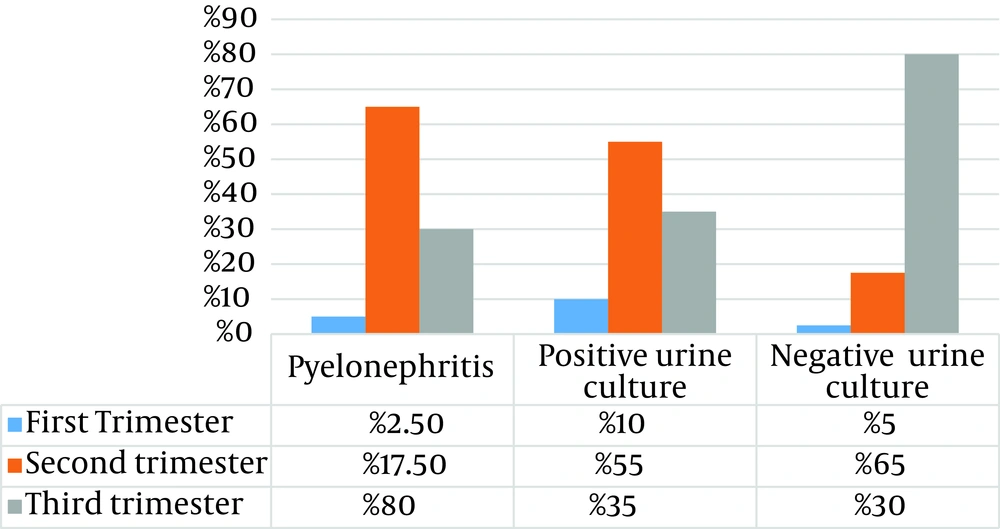
Figure 1.
Pyelonephritis Incidence in Each Gestational Trimester and Urine Culture Findings in Pregnant Patients With Acute Pyelonephritis Admitted to Taleghani Hospital
In this time period, 12,948 childbirths reported in both centers and pyelonephritis prevalence was 0.46%.
Flunks pain, nausea and vomiting, fever and chills were cardinal symptoms in the studied patients. However, flunks pain and vomiting were the most prevalent symptoms (Table 2). Vital signs and laboratory tests results are listed in Table 1. CVA tenderness was present in all patients, however 40 (66.7%) patients had right side tenderness, 4 (6.7%) left side tenderness and 16 (26.7%) bilateral tenderness. Besides, laboratory tests proved pyuria in all patients (Table 2.)
Table 2. Clinical Manifestations of Pregnant Patients With Acute Pyelonephritis a
| Clinical Findings | Percentage | Manifestation | Percentage |
|---|---|---|---|
| Flunk pain | 100 | ||
| Nausea and vomiting | 70 | ||
| Fever | 66 | ||
| Chills | 13.3 | ||
| CVA tenderness | |||
| 100 | Right side | 66.7 | |
| Left side | 6.7 | ||
| Bilateral | 26.7 | ||
| Hydronephrosis | |||
| 53.7 | Right kidney | 33.3 | |
| Left kidney | 10 | ||
| Both kidneys | 10 |
a Abbreviation: CVA, Cerebrovascular Accident.
Bacteriuria was detected in 42 (70%) patients. However, 18 (30%) patients had negative results for urine culture. E. coli was the dominant pathogen in 33 (78.6%) samples, Klebsiella in 8 (19%) samples and coagulase negative staphylococcus in 1 (2.4%) sample.
Ultrasonographic study had normal findings in 28 (46.7%) patients, right kidney hydronephrosis in 20 (33.3%), left kidney hydronephrosis in 6 (10%) and bilateral hydronephrosis in 6 (10%) patients.
Follow-up study results proved that 46 (76.7%) had normal vaginal delivery (NVD) and only 14 (23.3%) patients had cesarean section delivery, while preterm delivery (before the 37th week) reported in 4 patients (6.66%). However, none of the newborns had low birth weight (less than 2,500 in this study) and Apgar score was 9 - 10 in all newborns.
Because of poor follow-up attendance of patients after delivery, it was impossible to get urine samples.
5. Discussion
Pyelonephritis is one of the most common causes of serious medical complications and hospital admissions during pregnancy, which affects 1% - 2% of pregnant women (1-4). It is the leading cause of non-obstetric antepartum hospitalization and may result in significant maternal and fetal morbidity and mortality (1, 2, 11). Although pyelonephritis implications and its management and treatment principles in antepartum period have been well defined 20 - 30 years ago (11), there is not much information about its regional incidence, outcomes and complications. Nowadays, it is well established that pregnant women with pyelonephritis are at increased risk of sepsis, ARDS (acute respiratory distress syndrome) and ICU care requirement compared to non-pregnants with pyelonephritis. On the other hand, studies claimed that pyelonephritis absorbs a considerable proportion of healthcare budgets (12.4 million dollars per year) and causes excessive load of expenses (6, 11, 12). The advantages of early screening and treatment of asymptotic bacteriuria, especially in gestational period is an undeniable fact.
In the current study, 60 pregnant patients with pyelonephritis were studied. Most (65%) were in the second trimester and the mean gestational age was 25.73 ± 7.42 years, however previous studies reported up to 90% of cases in the second trimester, which is consistent with the peak period of urinary stasis and urinary tract immunological changes due to hormonal influence. Patients’ age range in this study was 22 to 24 years, which is similar to previous studies (13).
Although none of the patients had creatinine rise, respiratory failure and need for dialysis during admission and follow-up, in Hill et al. study, 23% of patients had anemia, 2% had creatinine rise and 7% of patients had respiratory failure (5).
The most prevalent clinical complaint was flunk pain among patients and CVA tenderness was the most common sign, although it was more prevalent in the right side. Similarly, Dawkins et al. reported flunk pain as the most common symptom in their study(6). In addition, the right side CVA tenderness was present in most patients (66.7%), the same as reported by Angel et al. (14).
In this study, low birth weight (less than 2,500 g) detected in none of the newborns and preterm delivery occurred only in four (6.66%) cases, which is similar to Hill et al. study, but Angel et al. proved higher incidence of low birth weight (14.7%) and preterm delivery (32%) (5, 14). On the other hand, low birth weight incidence of 13.8% was lower than that reported by Sharma and Thapa, also the preterm delivery of 6.66% was lower than 7.44% described by the same group (13). Moreover, the data did not allow us to establish an association between pyelonephritis occurrence and newborn low birth weight or preterm delivery, but most of the reports were consistent with our results.
The predominant organism isolated from urine cultures was E. coli with 92.3% sensitivity to gentamicin, similar to previous studies. Although organisms were less sensitive to ampicillin, in combination therapy with gentamicin, all patients had response to treatment and other drugs were not added (1, 5, 13, 14).
To identify the recurrence risk, serial urine cultures are important, but is unfortunately impossible due to lack of patients’ cooperation and poor follow-up.
In the current study, there was no significant adverse maternal outcome, because an accurate management was performed. The study proved no significant association between preterm delivery, low birth weight and lower Apgar scores with acute pyelonephritis occurrence. Similar to Sharma and Thapa study that is similar to UHWI ten-year data, the current study did not reveal lower rates of preterm birth and low birth weight, however the incidence of pyelonephritis was higher in the second trimester the same as previous international studies (6, 13).
Sometimes, symptoms and signs of pyelonephritis resemble acute abdomen (15) during pregnancy, but in our study we had not such confusing problems.
Pyelonephritis may be seen more frequently in patients with systemic lupus nephritis and anti-cardiolipin may be detected in some of them (16), but none of our patients had this type of disease.
Prevalence of acute kidney injury sometimes increases during pregnancy (17) associated pyelonephritis, but it was not happened in our studied patients.
Some reports showed that prenatal care providers should consider women with abnormal pregnancy BMI and gestational weight gain to avoid pregnancy-associated complications (18), but in our patients BMI was not a risk factor.
Association between daily physical activity during the last month of pregnancy and pregnancy outcome is proven (19), but this was not studied in our investigation.
This study showed that despite the low prevalence of pyelonephritis, its management and aggressive therapy can diminish complications and prevent serious problems.
This study reported no significant complication due to pyelonephritis during pregnancy including low birth weight, preterm delivery or another morbidity. However, pyelonephritis is an important and serious disease that can lead to fatal complications, which can be prevented with well-timed treatment and management.
