


1. Background
Animal bites, as the most important risk factor for rabies, are common public health problems in both developed and developing countries (1). Although, rabies is a fatal disease but it is a vaccine-preventable viral disease which is transmitted to human from domestic and wild animal bites. Millions of people are bitten by animals and more than 15 million people receive a post-exposure prophylaxis (PEP) to prevent the disease worldwide (1). Nonetheless, about 60,000 people die from rabies worldwide annually (2).
Besides the health importance in the community, the occurrence of rabies in livestock is also considered as a significant source of economic loss (3). Rabies disease exists in Iran for a long time and it is endemic in the country (4). Incidence of animal bites is increasing in different parts of Iran in the recent decades (5-8). In addition, dogs are the main reservoir of the disease and all rabies cases reported in Iran were associated with dog bites often poorly controlled (4).
Over the last decades, a substantial increase of human PEP is reported in Iran. Despite the importance of PEP, studies conducted in Iran on PEP showed different findings. One study indicated that 37.2% of the bitten people received timely PEP within the first six hours (9). In another epidemiological study, 81% of the subjects did not complete the vaccination schedule (6). Farahtaj et al. (10) concluded that in a total of 1,188,579 subjects receiving PEP, it is not known whether all PEPs were correctly administered according to the world health organization (WHO) standards. Accordingly, PEP is not well documented yet.
2. Objectives
Therefore, the current study aimed to evaluate delayed time of PEP and associated factors in bitten people. The analysis of the existing data on the healthcare system could be effective in increasing the knowledge about the epidemiological aspects of rabies and animal bitten people.
3. Materials and Methods
This cross-sectional study was conducted on 397 animal-bite cases in Khalilabad County of Khorasan Razavi province (Northeast of Iran) from March 2012 to March 2013 (for one-year period using the census method).
Khalilabad (1767.5 km2; population: 49,111) is a city located in Khorasan Razavi province, Northeast of Iran (census 2011). The weather in this area is hot and dry.
The animal bitten person is a person bitten by domestic or wild animals including pecking the bare skin, prickle or bloodless abrasion and wound licking. Accordingly, the animal bitten person should receive a post-exposure prophylaxis based on the WHO recommendations. Cases of healthy skin licking or contact with animal were not considered as bite cases; the subjects who were not the residents of the county were excluded from the analysis (No. = 15 subjects).
Demographic and clinical information were extracted from the rabies treatment center (RTC) using a checklist including age, gender, area of residence, distance from the RTC, season of bits, wound status (deep, superficial), bite site (leg, hand, body, head or face), type of biting animal (dog, cat, domestic or wild animal) and time of receiving PEP.
The main outcome was the delay in PEP divided into two groups: (a) less than 48 hours, and (b) more than 48 hours. Descriptive statistics and Chi-square test were used for data analysis at the 5% significance level to identify factors affecting the delayed time of PEP using the statistical software Stata 11 (StataCorp, College Station, TX, USA).
4. Results
The incidence of animal bite was 11.0 per 1,000 individuals. Overall, 93.4% of the subjects received PEP by less than 48 hours after exposure. The distribution of demographic and clinical characteristics of the bitten subjects is shown in Tables 1 and 2.
Table 1. Distribution of Demographic Characteristics of Subjects Bitten by Animals in Khalilabad County, 2015
| Variable | Frequency | Delayed Time | P-Value | |
|---|---|---|---|---|
| Less Than 48 Hours | More Than 48 Hours | |||
| Gender | 0.846 | |||
| Male | 341 | 319 (93.5) | 22 (6.5) | |
| Female | 56 | 52 (92.9) | 4 (7.1) | |
| Residency | 0.620 | |||
| Urban | 140 | 132 (94.3) | 8 (5.7) | |
| Rural | 257 | 239 (93.0) | 18 (7.0) | |
| Age groups, y | 0.379 | |||
| < 5 | 20 | 17 (85.0) | 3 (15.0) | |
| 5 - 15 | 72 | 67 (93.1) | 5 (6.9) | |
| 16 - 30 | 153 | 142 (92.8) | 11 (7.2) | |
| 31 - 45 | 73 | 71 (97.3) | 2 (2.7) | |
| 46 - 60 | 45 | 41 (91.1) | 4 (8.9) | |
| + 60 | 34 | 33 (97.1) | 1 (2.9) | |
| Distance from the RTCa | ||||
| Less than 30 km | 367 | 345 (94.0) | 22 (6.0) | 0.118 |
| More than 30 km | 30 | 26 (86.7) | 4 (13.3) | |
| Season of biting | 0.537 | |||
| Spring | 116 | 106 (91.4) | 10 (8.6) | |
| Summer | 106 | 102 (96.2) | 4 (3.8) | |
| Fall | 88 | 82 (93.2) | 6 (6.8) | |
| Winter | 87 | 81 (93.1) | 6 (6.9) | |
aRTC, rabies treatment center.
Table 2. Distribution of Clinical Characteristics of Subjects Bitten by Animals in Khalilabad County, 2015
| Variable | Frequency | Delayed Time | P-Value | |
|---|---|---|---|---|
| Less Than 48 Hours | More Than 48 Hours | |||
| Wound status | 0.943 | |||
| Deep | 32 | 30 (93.7) | 2 (6.3) | |
| Superficial | 365 | 341 (93.4) | 24 (6.6) | |
| Bite site | 0.625 | |||
| Hand | 161 | 148 (91.9) | 13 (8.1) | |
| Leg | 191 | 181 (94.8) | 10 (5.2) | |
| Body | 38 | 35 (92.1) | 3 (7.9) | |
| Head and Face | 7 | 7 (100) | 0 (0.0) | |
| Type of biting animal | < 0.001 | |||
| Domestic dog | 317 | 301 (94.9) | 16 (5.1) | |
| Stray dog | 15 | 14 (93.3) | 1 (6.7) | |
| Cat | 58 | 53 (91.4) | 5 (8.6) | |
| Other | 7 | 3 (42.9) | 4 (57.1) | |
Of the 397 subjects, 86.0% were male, and male to female ratio was 6.1/1. There was no significant association between the delay in PEP and gender (P = 0.846). Females were 1.11 (95% CI: 0.37, 3.37) times more likely to have delayed time of PEP, but there was no statistically significant difference. The highest proportion of subjects (61.7%) aged 0-30 years. There were no significant differences in the delayed time of PEP between various age categories (P = 0.379).
The majority of the subjects (64.7%) were rural, and the distance from the RTC was less than thirty kilometers in most of them (92.4%). No statistically significant association was found among delay in PEP, place of residency, and distance from the RTC.
The subjects were mainly bitten by domestic dogs (79.8%) and most of them (91.9%) were also involved with superficial wounds rather than deep wounds (8.1%). The most common sites of the animal bite were legs (48.1%) and hands (40.6%). However, there were no significant differences among delay in PEP, site of animal bite and wound status. There was only significant difference in delayed PEP with respect to the type of biting animal (x2 = 30.8, P < 0.001).
The bite incidents happened throughout the year with more bite incidents in spring (29.2%) followed by summer (26.7%). There were no significant differences between delay in PEP and seasons (P = 0.537).
Figure 1 shows the rate of animal-bite cases by occupational status. Farmers, businessmen and students were the most common victims of the bites.
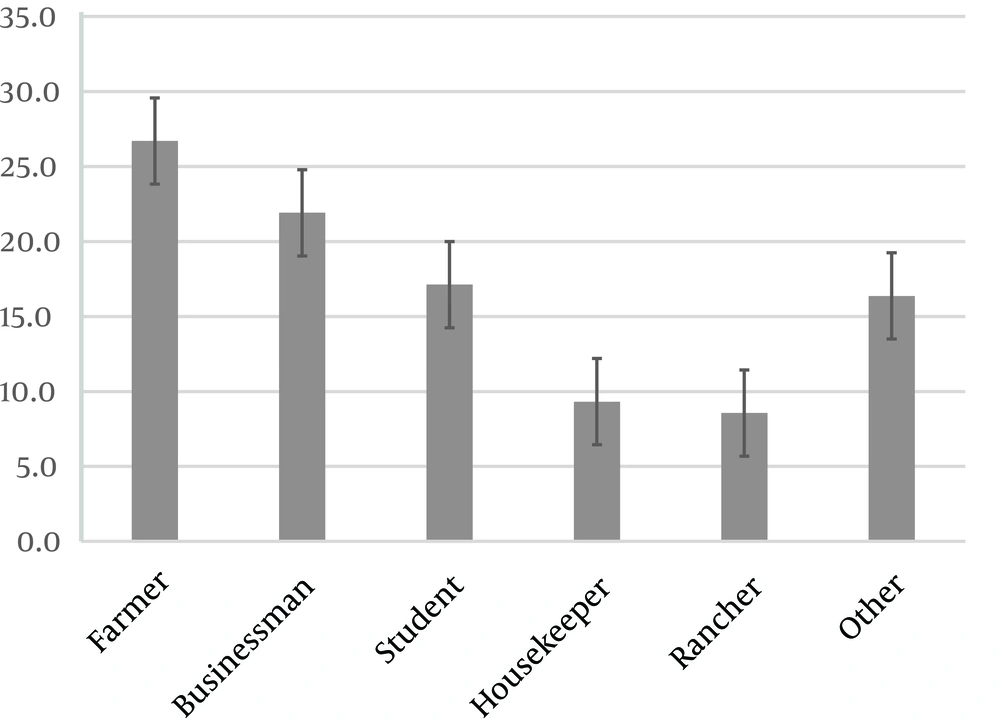
Figure 1.
Occupational Status of the Animal-Bite Cases, 2015
5. Discussion
The current study aimed to determine the delayed time of PEP and the associated factors among bitten people; the study found that 93.4% of the subjects received PEP less than 48 hours after exposure. The results of previous studies in Iran and also in other regions showed that the PEP of the bitten subjects was not desirable (9-12).
The current study found that animal bites mostly happened in males rather than females which was consistent with the results of studies conducted in Iran (9, 13) and some studies worldwide (14, 15). A study conducted in Puerto Rico reported no difference in the distribution of animal bites based on gender (16). The reason of higher occurrence of animal bites in males is because males have some occupations such as animal husbandry with direct contact with dogs more than females, and they also spend more time outdoors. The current study results also showed no significant differences between delayed time of PEP by gender and age groups. A previous study conducted in Iran to evaluate the delayed PEP in bitten people showed that delayed PEP occurred more often in females, but there was no difference regarding the age groups (9). Another similar study also showed a significant difference between PEP and age (17).
The current study found that distance to RTC and place of residence were not significantly associated with delayed PEP. Distance to the RTC was more than 30 km for 7.6% of the subjects, and only 13.3% (four subjects) of them received PEP more than 48 hours after the exposure. There was no information about rabies and the risk of animal bite in the current study population. But the findings were consistent with those of the previous studies revealing that the population may not be aware of the risks of animal bites (18, 19). Khazaei et al. (9) in a similar study reported that distance to the RTC was more than 30 km for 51.3% of the bitten people and 72.5% of them did not receive timely PEP. The current study also found that among the individuals who received PEP more than 48 hours after exposure, 69.2% lived in rural areas. In this regard, Tiwari et al. (14) showed that those living far away from RCT and in rural areas had higher PEP mean time. The current study findings suggest that PEP should be provided among primary health centers to reduce the mean time of receiving PEP in rural areas.
The current study results showed no significant differences between delayed time of PEP and site of animal bite and wound status. In the study, 8.1% of the wounds were deep. Studies performed in different parts of Iran such as Hamadan (Western Iran), Tabas (East of Iran) and Rafsanjan (Southeast of Iran) reported that 16.2%, 27.9% and 15% of the wounds were deep, respectively (5, 9, 17). There are not consistent results on the association between delayed PEP and wound status. A study revealed a significant relationship (9), whereas another one reported no significant differences (17). In agreement with the results of previous studies, it was also found that the most common sites of the animal bite were legs (9, 20).
The estimated incidence of animal bite is unknown worldwide, but based on the WHO report (21) over 90% of the rabies cases caused by dogs. Based on the results of the current study, most subjects were bitten by domestic dogs (79.8%), which was consistent with the results of studies in Iran (9, 22, 23). Regarding the presence of domestic dogs in most of the rural households, it is necessary to provide appropriate educational programs to train behavioral skills in high risk groups. It was also indicated that the type of biting animal was significantly associated with delayed time of PEP which was consistent with the results of previous study (9). In the current study, those bitted by domestic animals such as dogs referred with further delay to vaccination. This issue could be due to lack of awareness of individuals about rabies and transmission methods.
In the current study, the bite incidents happened throughout the year with more bite incidents in spring (29.2%) followed by summer (26.7%) with no significant differences between delay in PEP and seasons. Other previous studies also reported the higher proportion of animal bites in spring (13, 20, 24) and summer (20). This finding may be due to increase of travelling in rural and agricultural areas.
The study had some limitations; the data recorded in the RTC profile were used. Hence, the quality of the data in this study depends mainly on the quality of the data recorded in the RTC. On the other hand, a cross-sectional study was conducted by the recorded data. Accordingly, authors were unable to collect some other variables such as educational level, previous history of rabies vaccination, socio-economic status, and other variables related to the delayed PEP due to the retrospective design of the study. Despite its limitations, the study revealed some potential information to help policymakers to improve the national rabies PEP protocol.
5.1. Conclusion
The rabies PEP is well monitored in the region and its delayed time depends on the type of biting animal especially domestic dogs. Considering the high proportion of stray and domestic dogs as a public health concern in the district, the educational programs and the rabies vaccinations of dogs are recommended in the community. In addition, a sensitive surveillance system is needed to prevent and control rabies.

