


1. Introduction
Human papillomaviruses (HPV), which is a common type of sexually transmitted disease spreads via anal, vaginal, oral sex, or any other type of skin-to-skin touching during sexual activity (1-3). HPV is a widespread infection that can cause different problems such as creating tumors in the skin and mucous membranes (1, 4, 5).
Smoking, number of sexual partners, early age of sexual activity, illicit drug use, anoreceptive intercourse, and imuno-suppression are considered as different types of risk factors for HPV infection (6-9). It can also be related to different diseases such as cervical cancer, which is a genital tract disease (10). Although much has been known about the epidemiology of human papillomavirus (HPV) infection in women, it is not a well-studied phenomenon in men yet. The reason for the limited knowledge in this area is that there isn’t any exact definition regarding the exact parts of the body of men that should be tested and sampled. Studies conducted on men cases presents a range of 5.5% to 76% estimates of prevalence. Manifestation of HVP infection is commonly subclinical in men (11). It can affect anywhere in the genital tract such as the penile shaft, scrotum, periurethral, and perianal regions in males. Warts occur most commonly on the glans penis, penile shaft, and prepuce (10). Periurethral lesions can occur in 1% to 25% of patients (1). The majority of these lesions are in the terminal Urethra (80%), however, these can be transmitted to the proximal urethra (12). Symptoms are reduction in urinary stream or urethral discharge and bleeding (1). Involvement of the meatus and urethra (occurring in approximately 5% of all cases) constitute a greater therapeutic challenge (3). We aimed to present a case of primary urethral condylomata acuminate, which was misdiagnosed as urethral cancer.
2. Case Presentation
A 27-year-old-male patient was referred to the urology clinic with the complaint of dysuria, hematuria, and urethral lesion. Previously, a biopsy was taken from the center of the lesion that revealed a high-grade papillary neoplasia (grade IV). In the description of the first pathology report, multiple gray colored soft tissue fragments measuring 1 * 0.5 * 0.2 CM was reported. No muscle tissue was seen to evaluate the possibility of invasion. In addition, cystoscopy examination did not reveal any abnormality in the bladder and only a lesion in the urethra was identified.
In the second evaluation, we identified no lesion in external genital examination of the patient with a suspected malignancy. Although we noticed risky sexual behavior in this case and having multiple sexual partners, he didn't have a history of previous sexually transmitted infections (STIs), and the laboratory evaluations of the STIs (HBV, HCV, and HIV) were negative. The lesion had been diagnosed as cancer based on pathology, however, there was no etiologic factor or clinical findings proposed for urethral cancer in the medical history of this case. Due to the inconclusive initial diagnosis and report of a rare cancer for this single young patient, slides were requested from the first pathology laboratory and we considered getting a second opinion from an expert. Slides review showed no dysplastic change and was in accordance with condyloma acuminata (Figure 1), not urothelial papillary cancer (Figure 2). We started the treatment with topical podophyllin and the lesion responded well to the initial treatment. In the six months follow up period there werent any findings that proposed cancer.
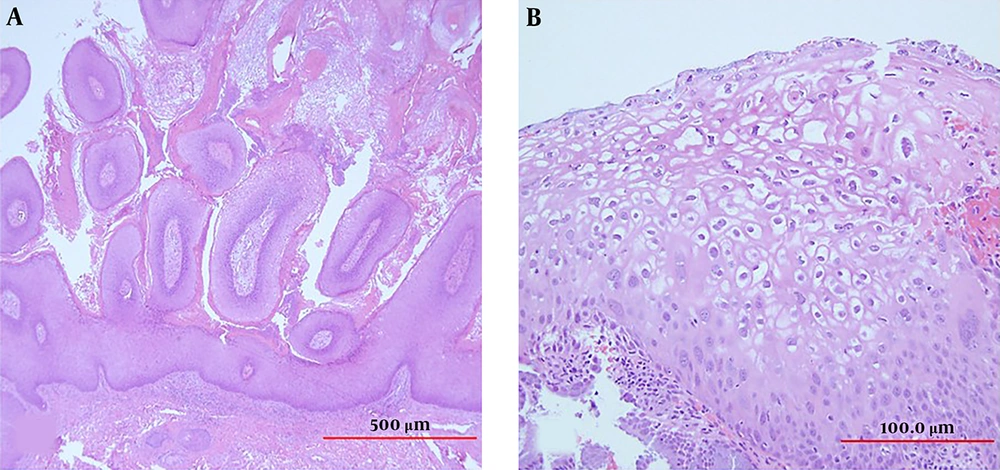
Figure 1.
Condyloma acuminata: section revealed fragments of tissue with complex papillary enfolding composed of proliferated squamous epithelial cells, some of them showing atypical features with occasional hyper chromatic nuclei with risin-like feature showing koilocytic changes at times with binucleated features in upper layers. The stroma is scant.
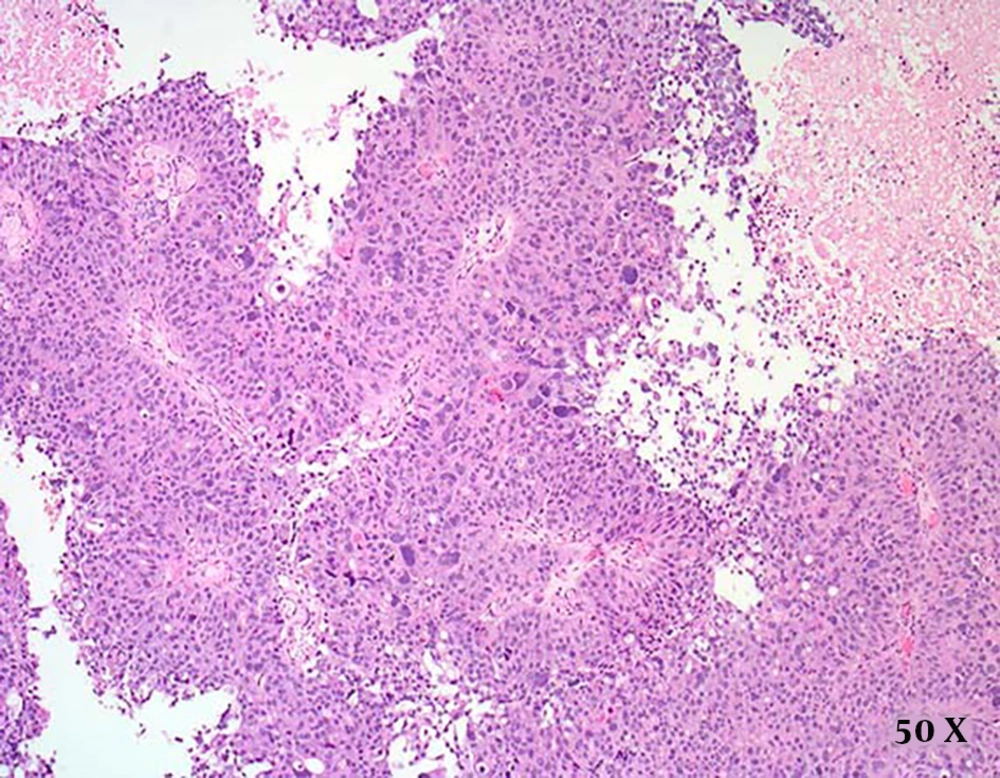
Figure 2.
High-grad papillary carcinoma: these neoplasms show significant nuclear hyperchromosia and pleomorphism. The epithelium is disorganized and there are mitoses in all layers.
3. Discussion
In the last decade, HPV infection has increased due to population growth, urbanization and overcrowding, rapid international travel, changing sexual behaviors, poverty, and population structure changes (13). There is no exact prevalence in Iran; however, genital warts in men can be as common as they are in women (14). In the present case that was a 27 years-old male, the condyloma acuminata was confused with urethral cancer. It should be considered that papillary cancer of urethra is one of the rare types of cancer in male, which is comprising of about < 1% of urologic malignancies reported in the fifth decade of their life (8, 12). Etiologic factors for urethral papillary carcinoma include chronic inflammation due to STI urethritis, urethral stricture, and HPV 16 in squamous cell carcinoma (SCC) of the urethra. The most common presenting symptoms are hematuria, palpable urethral mass, and obstructive voiding symptom (12).
Our case complained of dysuria, hematuria, and urethral mass, however, the patient was young and had multi-partner sexual behaviors. We got a second opinion from another pathologist. Second pathology report confirmed condylomata acuminata. Urethral condylomata acuminata is rare and can still be misdiagnosed (15).
Diagnostic error in pathology is an important problem and can occur in pre-analytical, analytical, and post-analytical phases. Tracking the cause of error in the diagnostic process is very difficult. Interpretation Errors in the analytical phase can be categorized as failure to see a feature on the slides or failure to correctly interpret it (16). Misdiagnosis of condyloma acuminta, as a papillary carcinoma, was attributed to errors in histopathology interpretation.
It should be noted that human papillomavirus infection is not associated with urethral dysplasia (1, 17). The urethra is involved in about 5% of cases in the penile condylomata acuminata, which is usually limited to the end of the urethra. The purpose of the treatments is to remove the warts and to induce lesion-free periods. Treatment options for urethra warts include drug agents such as podophyllin, 5-fluorouracil (5FU), imiquimod, trichloroacetic acid, and interferon alpha 2b. Surgical excision, cryotherapy, laser therapy, and electrocautery are also appropriate treatment options (18). Such treatments do not eliminate the infection nor do they prevent continued transmission of the virus (19). Our patient had no condyloma acuminata on the external genitalia and we started treatment with podophyllin; the urethral lesion responds well to this treatment.
In the initial assessment of the patient, the type of virus was not specified. Although approximately 90% of condylomata acuminata are related to HPV types 6 and 11, coexistence of other types in the same patient is common. HPV types 16 and 18 are the most common cause of HPV-related cancer (20, 21). Considering the risk of penile, anal, and oral cancers, the type of HPV virus should also be determined in the patients.
3.1. Conclusion
Urethral condylomata acuminata is uncommonly encountered and can be confused with papillary urothelial cancers. Clinical features, especially urinary symptoms such as dysuria, urethral discharge, or mass should heighten suspicion. In similar cases we must also consider medical history and sexual behaviors of patients. HPV is the risk factor of ano-genital cancers, thus, it is very important that clinicians investigate this virus as well as type of HPV in patients with risky sexual behaviors. Due to difficulties in diagnosing HPV infection in urinary tract and its cancerous risk, importance of early diagnosis increases.

