
1. Background
Cerebrovascular accident (CVA) is one of the most common causes of movement impairment f. Cerebrovascular accident refers to any type of damage caused, either directly or indirectly, to the brain and its associated elements and is classified into three categories: mild (GCS 14-15), moderate (GCS 9-13), and severe (GCS < 9. Statistics indicate that 80% of all brain injuries are mild, and 20% are moderate and severe (1). It is estimated that about 60% of CVA survivors have permanent impaired function (2). Worldwide surveys indicate that brain injuries account for about 20% of almost all accidents and that the rate of cerebrovascular accident is increasing (1).
Cerebrovascular accident (CVA) is currently one of the major causes of movement disability. It is associated with movement disorders in the upper and lower limbs. Even though individuals often develop compensatory strategies for both the impaired and healthy organs, voluntary control of the affected limbs is unusually difficult. Indeed, there is little information available with regards to the most effective way to rebuild the motor system so as to optimize improvement in neural function (3-5). Another major point is that cerebrovascular accidents result in a compound effect nerve damage as well as secondary problems that can potentially be prevented or treated. Some secondary problems are due to inertness (e.g., altered muscle function, decreased aerobic capacity), and these secondary problems are likely to be imposed on patients with varying levels of severity of disability after brain injury (6).
Some side effects of cerebrovascular accidents include reduced movement speed, weakness, functional impairments, as well as decreased power and balance (7), both of which are based on Bandura’s self-efficacy hypothesis. Bandura (1997) defines self-efficacy as one’s perception of one’s abilities in a particular area of activity (8). Powell and Myers (9) define self-efficacy as one’s beliefs about their ability to engage in certain activities of daily living without falling or losing balance. About 22% to 59% of people with stroke have reported a basiphobia (fear of falling). Equilibrium means the ability to maintain the center of gravity at the level of reliance, including factors such as strength, endurance, flexibility, and deep sense. These factors are gradually declining and shrinking among people who have experienced a stroke. Another psychological factor is related to falling in confidence. Balance trust is an understanding of one’s belief in their capability to perform daily functional tasks without losing balance (10). The above-mentioned can affect a person’s motor function. Various tests are deployed to assess motor performance, one of the most validated of which is walking, climbing up the stairs, and rising and pacing tests (11). These tests evaluate the day-to-day functioning of people who are affected, especially after a cerebrovascular accident. The severity of central nervous system damage, depending on the lesion or the age of the individual, can affect the patient’s retraining potential. Moreover, environmental conditions and training slightly affect motor recovery. There is general agreement that early rehabilitation improves the quality of recovery and that the intensity of physical therapy is particularly important during the first post-stroke month. Probably the most important factor is education, and recent research suggests that the best way to learn an activity is to practice it as a task. Recent findings on balance training can improve the symmetry of limb movement during walking, which supports the concept of training (12). Rehabilitation is one of the most important processes that can be carried out for these patients to optimize their function in daily life. There are various therapies in rehabilitation. However, it is not yet known which of these methods is most effective. Therapies have had decent success recently. For instance, the Pan-2018 study examined the impact of early rehabilitation exercise on walking and quality of life factors in people with acute cerebrovascular accident. The results indicated a significant impact of early rehabilitation, and the researchers emphasized the importance of early rehabilitation according to their research and similar research results (13). Ursin et al. (8), conducted a study to examine gait and balance one year after stroke and its relationship to the cognitive skills of post-stroke individuals. The results showed that dementia was associated with impaired walking ability and poor balance. The result is that, if not physically rehabilitated, there also is a detrimental effect on the cognitive ability of the brain (8).
According to what was stated above and given the extensive study of the sources of neurosecretory and post-traumatic brain injury and the fact that little research has been done to evaluate motor function after rehabilitation programs, as well as the effects of specific therapeutic exercise on the physical activities of some of CVA patients’ daily lifestyle has led the researcher of this study to evaluate the impact of a specific exercise program on the quantitative (or improved) assessment of brain injury while walking.
Since the effects of some of the exercise methods studied in this study on adults with brain injury have not been investigated, the results of this study will be able to further the researchers to new ends in the field of these exercises and their effect on improving these people’s walking ability.
2. Objectives
Moreover, the results of this study can help physiotherapists and sports therapists by estimating the balance and specific biomechanical parameters in the lower extremities and providing a useful and effective exercise method to improve walking ability and balance of adults with brain injuries. Other applications of the plan include the development or growth of a new, well-established practice protocol to improve the treatment of patients with CVA, to help find solutions to other motor problems caused by sports illness and injuries, and to provide a suitable area among different groups of specialists for collaborating to meet future needs to reduce treatment time, increase productivity of existing methods and reduce costs.
3. Methods
The research design was quasi-experimental with a pre-test and post-test design (or experimental and control group). Random clustering method was applied to reduce the effects of differences between samples and to control for confounding and disturbing variables. The study location was Rasool Akram Hospital in Tehran, Sattarkhan District, Tehran, Iran, during Dec, Jan, Feb- (2018 - 2019).
The statistical population included all male patients with cerebrovascular accidents referring to Rasool Akram Hospital in Tehran in 2018. Thirty subjects of this study were selected by purposive sampling and available with regard to brain injuries. The study groups included 15 individuals in the special training group and 15 in the control group. A total of 30 individuals were randomly assigned to the study groups.
The inclusion criteria included having a specific brain injury (confirmation and referral from a specialist). Individuals whose spasticity based on modified Ashworth scale (MAS) was 2 and 3 were included in the study. These people were between 4 - 6 weeks after the CVA. Exclusion criteria were having a known or treated physical or mental illness, severe stress; such as death of a close one or surgery in the past three months, taking medication as well as participating in similar studies.
To assess motor-physical performance, 10-m walk time tests, up and down time tests, and stepping tests were used (11).
1- In the 10-meter walk test, the subject walked the 10-mile distance by standing behind the start line and hearing the “face” command, walking safely to the finish line, and the 10-meter walking time was recorded (Figure 1).
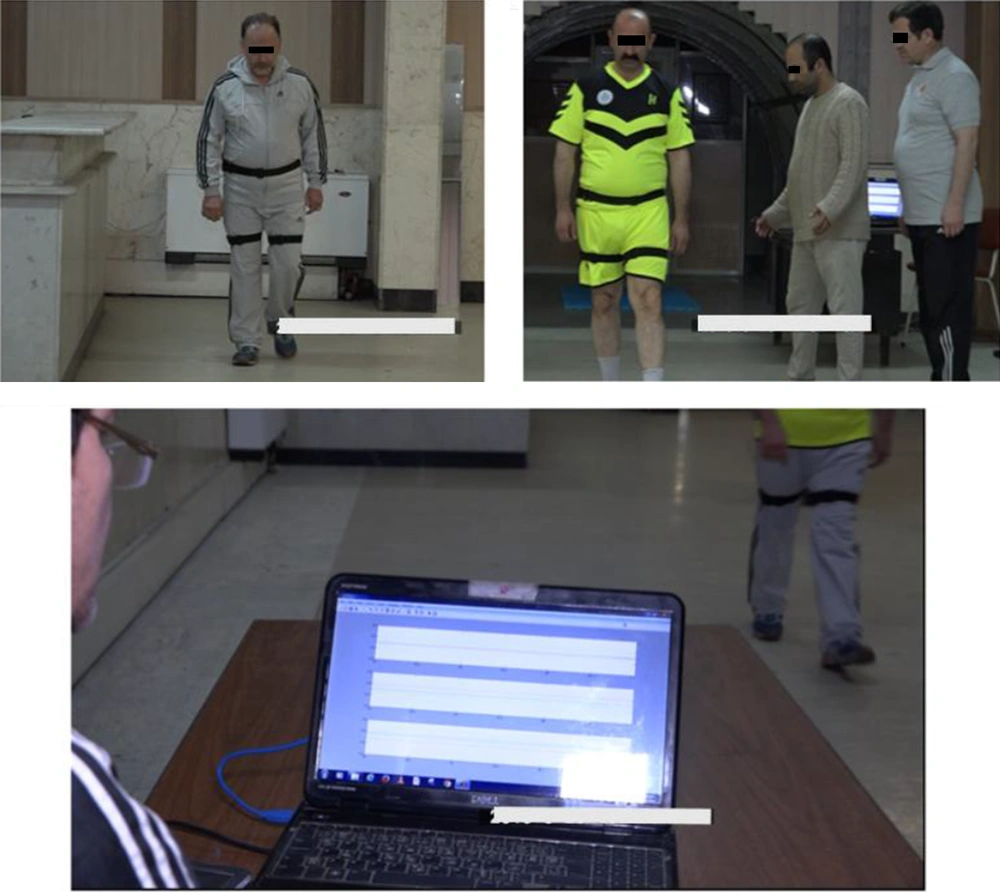
Figure 1.
The 10-meter walk test
2- Get up and Go Test: The person sits on a chair that is 47 cm upright and 65 cm high with armrests. The length of time a person gets out of a chair, and when he/she opens and closes his/her eyes, moves three meters forward, then turns around, returns back to the chair, and sits on the chair without help was measured and recorded.
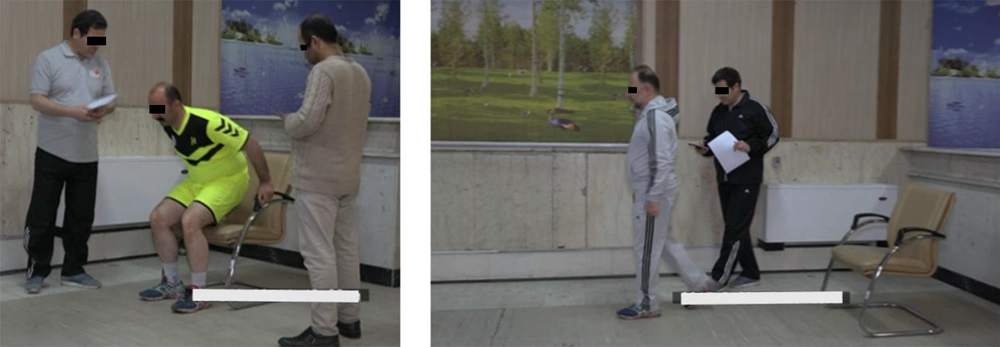
Figure 2.
Get up and go test
To perform this test, an unoccupied chair is first placed 3 meters from a barrier (end of route) (Figure 2). The subject is then asked to stand on his chair without the aid of his hands, and the subject is asked to return to the chair after a three-meter path. Do this as quickly as possible without running. To learn how the test is performed, subjects practice this exercise three times before recording the test. Subjects then performed the test three times, and the average of these three times was recorded. The six steps of the test are as follows: (1) Getting up from the chair; (2) Going the specified three-meter route; (3) Turning around the obstacle; (4) Returning the three-meter route in the second stage; (5) Turning around at the chair; (6) Sitting on the chair. The person moves by listening to the command, and the examiner calculates the time from start to finish. The duration of this test was recorded by the examiner as a score.
3- Stairs Climb Test/Three-Minute Stair Test: The subject was asked to stand on a set of steps 15.2 cm (6 inches) high and walk on the steps for as many minutes as possible. The number of steps was then recorded within three minutes (Figure 3) (11).
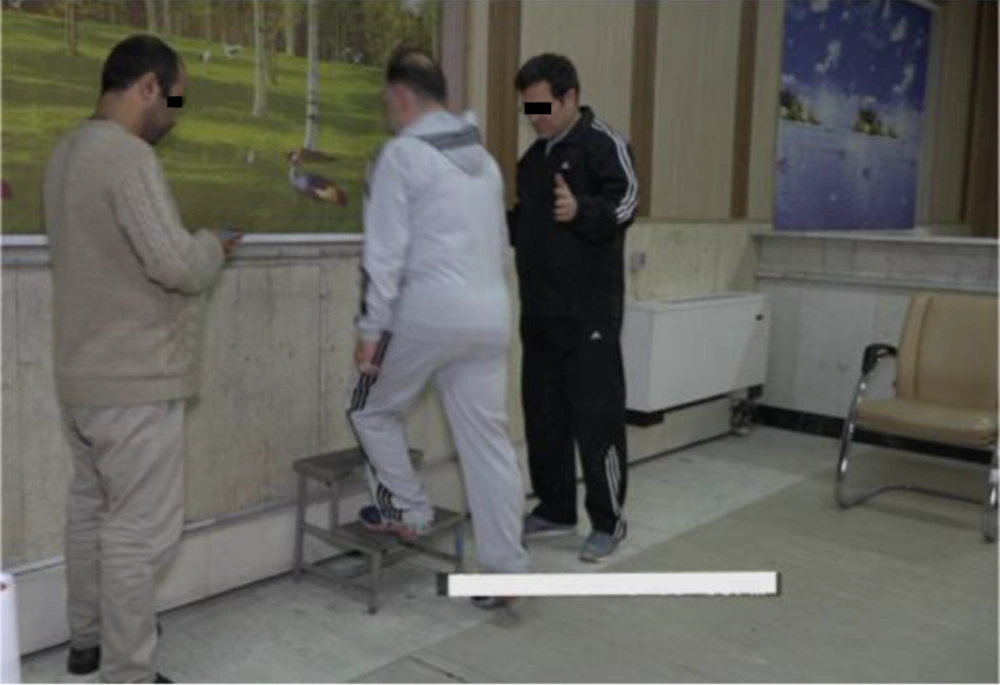
Figure 3.
Stairs test
The training protocol consisted of three main parts. (1) Strength training and stretching with the NASM approach; (2) basic and advanced level balance exercises; (3) walking re-training exercises (14). All three sections of the training session were tailored to the individual’s needs and progress. Exercises gradually increased in intensity. Initially, it took about 10 minutes for organizational preparation, such as changing clothes and so on. Furthermore, at the end of the training session, 5 minutes of stretching exercises were performed to cool down. Exercise movements are shown in Figure 4.
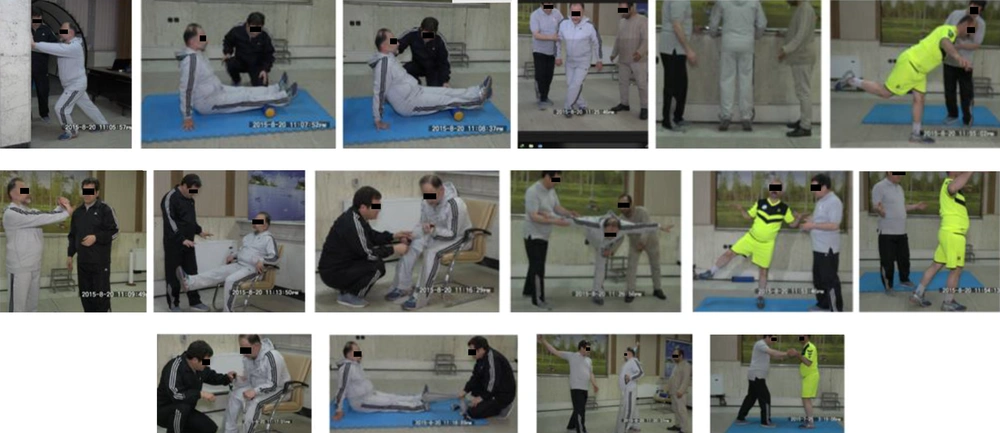
Figure 4.
Special training program
SPSS software version 21 was used for data analysis. Data were analyzed using the Kolmogorov-Smirnov test. Dependent t-test and covariance analysis were used to investigate the inter- and intra-group variations of dependent variables. Significance levels were considered throughout the research at the 95% level with alpha smaller than or equal to 0.05. MS-Excel-2013 software was used to depict the charts.
4. Results
Thirty subjects were selected by purposive sampling and were randomly divided into two groups of exercise and control group. Table 1 presents some demographic characteristics of the subjects.
Table 1.
Demographic Characteristics of the Subjects
| Group | Number | Mean ± SD |
|---|---|---|
| Age | ||
| Special exercise | 15 | 52.4 ± 4.47 |
| Control | 15 | 52 ± 6.38 |
| Height, cm | ||
| Special exercise | 15 | 171.5 ± 3.85 |
| Control | 15 | 175 ± 4.64 |
| Weight, kg | ||
| Special exercise | 15 | 77.8 ± 7.53 |
| Control | 15 | 79.9 ± 3.24 |
| Body mass index, kg/m2 | ||
| Special exercise | 15 | 26.5 ± 3.07 |
| Control | 15 | 26.1 ± 1.5 |
The results of the dependent t (Table 2) showed that there was a significant difference between the ability of ten meters walking, lifting time, and climbing time of the experimental group before and after 12 weeks of specific training program (P = 0.00). No significant change was observed in any of the variables in the control group.
Table 2.
Dependent t-test Results Examine the Effect of a Specific Exercise Program on the Ability of Ten Meters of Walking, Get up and Go Test, and Stairs Climbing Time of Patients with CVA (Experimental and Control Group of 15 Subjects)
| Variable | Group | Time | Average | Standard Derivation | t | df | P |
|---|---|---|---|---|---|---|---|
| Ability to walk ten meters | Experimental | Pre-test | 11 | 1.56 | 8 | 14 | 0.00 |
| Post-test | 8.6 | 1.5 | |||||
| Control | Pre-test | 12.5 | 2.9 | 0.87 | 14 | 0.39 | |
| Post-test | 11.9 | 2.6 | |||||
| Get up and go time | Experimental | Pre-test | 13.07 | 2.58 | 5 | 14 | 0.00 |
| Post-test | 9.2 | 1.87 | |||||
| Control | Pre-test | 12.9 | 3.3 | 1.87 | 14 | 0.08 | |
| Post-test | 11.8 | 2.2 | |||||
| Stairs climb time | Experimental | Pre-test | 23.9 | 5.2 | 10 | 14 | 0.00 |
| Post-test | 58.4 | 13.3 | |||||
| Control | Pre-test | 24.6 | 4.6 | 1.7 | 14 | 0.09 | |
| Post-test | 28.2 | 10.4 |
Table 3 shows the results of the analysis of covariance for the 10-meter walking ability variables.
Table 3.
Covariance Analysis Test to Investigate the Variables of Ability of 10-Meter Walking, Lifting and Climbing Time, and Climbing Time in Two Experimental and Control Groupsa
| Variable | Variable Source | Sum of Squares of the Third Type | Degrees of Freedom | Average Sum | F | Significance |
|---|---|---|---|---|---|---|
| Ability to walk 10 meters | Modified model | 125.337A | 2 | 62.668 | 20.395 | 0 |
| 17.508 | 1 | 17.508 | 5.698 | 0.024 | ||
| Ability to walk 10 meters | 45.304 | 1 | 45.304 | 14.744 | 0.001 | |
| Group | 40.324 | 1 | 40.324 | 13.123 | 0.001* | |
| Error | 82.963 | 27 | 3.073 | |||
| Total | 3391 | 30 | ||||
| Modified total | 208.3 | 29 | ||||
| Get up and go time | Modified model | 78.101A | 2 | 39.051 | 12.069 | 0 |
| 51.255 | 1 | 51.255 | 15.84 | 0 | ||
| Get up and go time, pre-test | 29.968 | 1 | 29.968 | 9.262 | 0.005 | |
| Group | 49.877 | 1 | 49.877 | 15.414 | 0.001* | |
| Error | 87.365 | 27 | 3.236 | |||
| Total | 3494 | 30 | ||||
| Modified total | 165.47 | 29 | ||||
| Stairs climb time | Modified model | 7679.835A | 2 | 3839.9 | 32.722 | 0 |
| 313.47 | 1 | 313.47 | 2.671 | 0.114 | ||
| Stairs climb time, pre-test | 839.54 | 1 | 839.54 | 7.154 | 0.013 | |
| Group | 7142.1 | 1 | 7142.1 | 60.861 | 0.000* | |
| Error | 3168.5 | 27 | 117.35 | |||
| Total | 67095 | 30 | ||||
| Modified total | 10848 | 29 |
aThe results of analysis of covariance in Table 3 showed that there was a significant difference between the average of climbing time scores after adjusting for pre-test means in the special training and control groups in all three variables (P < 0.05).
5. Discussion
As shown in the results, the motor performance of the subjects in the 10 m walking, sitting and lifting tests as well as the step test was significantly improved. This result was in line with the results of the 2015 Darekar et al. (15) and Louie and Eng (16) studies. This improvement is probably due to the development of the components of power, toughness, balance, etc., which prevent the individual from falling and also improve his balance. The deep sense exercises in the present study were designed to disrupt the balance of individuals, in which case the balance of the individual is challenged and the feeling of falling is created thereby (17). This causes the body to maintain balance with strategies such as sense of depth, power, balance, etc. (18), which assures the individual of self-balance as well as improving motor performance.
The results showed that the 10 m walking speed and the number of steps in the experimental group in the post-test increased significantly after the exercise intervention program and also the time of rising and walking in the post-test decreased. Such cases prove an improvement in motor function in people with CVA after a workout. Cao et al. (19) reported a significant improvement in the 10 m walking speed following a 12-week training program report by Zhuang et al. (20) and Nakao et al. (21). The findings of this study and concurrent research indicate the possibility of motor improvement in the specimens. As one of the most important components of the exercise intervention program was endurance training, it can be concluded that increased muscle endurance provides the basis for improvement among the factors of motor function (22). Endurance and strength training improves performance by making structural changes (increasing muscle volume, increasing ligament and tendon diameter, increasing bone density and capability, and increasing capillary density), and biochemically (increasing ATP and PC stores, increasing testosterone and growth hormone). Growth factors (23) consequently, improvement in the motor function of individuals with CVA can be attributed to the strengthening of physiological systems following exercise.
The most important factor for improving motor performance of the specimens, this study examined, is the positive impact of exercise on physical fitness components such as strength, endurance, flexibility, and balance (22), which is one of the most important mediators of post-workout performance improvement. Walking exercises in the present study make the specimens work more freely as well as with less restriction, which has a positive effect on the specimens and justifies the proper exercise for these individuals. Some studies show that physical activity and exercise by enhancing the synaptogenesis and neurotrophic factors have a vital role in the central nervous system (24). Hence these reinforce the idea that physical activity acts as a neuroprotective element by generating the brain and glial cell-derived neurotrophic factors (24).
As the researchers have pointed out, the sources of balance in the eyes are the vestibular system and the deep sense; and that in people with CVA the vestibular system is reduced. Visual conditions and the vestibular system are improved by assistive devices and are never fully implemented (25), however, the deep sense component, which is one of the most important sources of balance in humans, improves after balance and deep sense exercises (26). Improvement in motor performance tests may also be due to improved balance and confidence. Speed is one of the most important aspects of walking, therefore clinically, a significant reduction in walking speed is an important indicator for assessing patients’ balance problems and falling risk. Stepping is a complex combination of voluntary and reflexive actions that involves the interaction of the central nervous system, joints and muscles, some sensory systems, gravity and environmental conditions. Changes in spasticity as well as muscle relaxation in people with stroke can affect the process of stepping (27). Changes in the patient’s walking pattern include reduced leg length, increased leg rest, reduced toe height when swinging, reduced ankle joint range of motion, and reduced walking speed. The difference in the walking pattern of the healthy and the sick is mostly due to the difference in the speed of walking. Patients slowing down certainly does not mean that they cannot walk faster; they prefer to walk slower. One way to increase the speed of the step is to increase the stride length, increasing the stride length requires more hamstring flexibility and more balance (28). In people with hamstring hemiplegia, the muscles are often shortened, and this study included hamstring release and stretching exercises that may have a positive effect on their step length and ultimately improve motor function (walking speed and rising and walking time).
There was a significant improvement in the samples in get up and go test. Reaction time is defined as the time required to initiate a motor response following visual, auditory, or other sensory messages and indicates the rate of exchange in the central nervous system. In a simple reaction time move, the reaction time has been shown to increase from 0.5 milliseconds per year (29) to 2 milliseconds per decade (30).
In the test, one rises and walks out of the chair, and when he opens and closes his eyes, he walks three meters forward, then turns around, walks back to the chair and sits on the chair without help. Exercise and physical activity can improve blood circulation. Increased circulation in the central nervous system is essential to increase brain cell life and information processing efficiency. In addition, physical activity increases the performance of some neural peaks. These factors have a positive effect on the central parts of the reaction time. Increased circulation in the extremities produces sufficient temperature to rapidly direct nerve impulses to the muscles, thereby affecting more peripheral segments of the reaction time (31). As a result of the exercise test, which requires a quick reaction and some form of agility, the results of the exercise have been improved. As Bandura 1977 describes, completion of performance provides the most reliable source of self-efficacy expectations. Exercise research was progressive, and the sample observed and felt changes and improvements in training, their self-esteem increased, and they eventually performed better in post-test trials (32).