
1. Background
Parkinson's disease (PD) is a chronic neurodegenerative disorder resulting from the reduction, damage, or loss of the dopamine-producing neuronal cells in the substantia nigra in the midbrain. (1) Motor symptoms constitute the primary symptoms of Parkinson's disease. Other signs include speech impairment, bending stature, and depression. Disruption in walking and daily activities and impairments in the patient's brain and mental state appear in the advanced stages of the disease. (2)
Reductions in the level of physical activity due to aging lead to a decline in the patients’ individual functional levels. This process accelerates as the complications caused by pharmacotherapy in PD patients advance. This leads to lower levels of strength and functionality (3).
This decline is caused by the lack of basal ganglia impact on the cortical motor centers due to damaged underlying complexes that ultimately reduce the activity of the motor neurons and cause muscle weakness and loss of strength (4). These patients lose their physical fitness, balance, and self-confidence in a short time, which lowers their quality of life (5, 6).
The motor difficulty appears first in the upper limbs; then, over time, it extends to the lower limbs. This has several effects on the patients' walking, like reduced speed, joint locking or freezing, reduced range of motion (ROM) of the lower limb joints, a shaking leg swinging on the ground, unbalanced walking, and increased risk of falls, especially when changing paths or crossing obstacles (7).
Many studies suggest that physical activity reduces disease-related mortality by preventing body degradation and muscle weakness and increasing the ROM, strength, and quality of life in patients with PD (7-9). Scandalis et al. found that muscle strength and length, walking speed and stature could be improved in PD patients just like their healthy peers of the same age through resistance training (10-12).
Arfa-Fatollahkhani et al. have provided evidence that a period of mild to moderate intensity treadmill training has significant and persistent benefits for balance, functional capacity, and quality of life in PD patients. They stated that exercise could have positive significant effect even after a short period of intervention. Also long-term effect of the exercise is well established (13).
In another study by Rawson et al., researchers compared the effect of Tango dance, treadmill, and stretching exercises on the forward and backward walking of PD patients. They declared that only treadmill exercise had a positive effect on forward walking, while backward walking improved with treadmill and stretching (14).
Pilates is one of the well-known forms of mind-body exercise, where the focus is on movement control, body position, and breathing (15). This exercise includes a set of unique movements that encourage the mind to control the muscles (16). The focus of Pilates is on the ability of the muscle position to maintain body balance and support the improvement of the vertebrae. Pilates includes stretching and strength movements that take place throughout the joint's ROM at a controlled speed accompanied by mental concentration and deep breathing. This exercise can be done in standing, sitting, and prone positions; without moving a distance, jumping, or hopping, thereby reducing the damage caused by joint injuries (17). These exercises are accessible to all people with normal physical fitness and do not require any special skills (18).
Since PD appears at older ages, naturally accompanied by motor disorders and lack of balance, taking exercises on the ground is difficult for the patients and may lead to more injury. Therefore, in favor of preventing further injury to patients and older adults, providing a safe and effective environment has become a primary issue of concern among researchers in this field.
Aquatic exercise is one of the non-pharmacological methods adopted to increase the patients' strength and flexibility as well as decrease pain and musculoskeletal spasms (19). Compared to other exercises, aquatic exercises are appreciated by patients and older adults because they lead to considerable reduction in the heart rate and cardiac workload, mental health problems, fatigue, and a noticeable increase in oxygen intake and cardiovascular performance (20, 21).
2. Objectives
As described above, exercise can have a significant positive effect on different variables like quality of life, walking, etc., in PD patients. Therefore, the researchers of this study decided to acquire a different approach to this matter and analyze the effect of Pilates and aquatic exercise on PD patients. Hence, the objective of this study was to assess the effect of a 12-week course of Pilates and aquatic exercises on the ROM and strength of patients with Parkinson’s disease.
3. Methods
The method adopted in this study was a quasi-experimental, controlled study, and it was conducted with a pre-posttest design. Targeted sampling is made from the male Parkinson's disease patients subjected to the following criteria, according to Al-Zahra Hospital, Isfahan city: They consented to participation in the research; the patients had mild to moderate disease (stages I-III) based on the neurologist's diagnosis; no diagnosis of musculoskeletal problems was evident; no defects in the organs were observed; no cardiovascular or acute illnesses were reported, and they were not subjected to physiotherapy, but were willing to and could take the Pilates and aquatic exercises. The disease stages were recorded based on the Hoehn and Yahr five-stage scale (22).
Based on the nature of the research and lack of access to a greater count of subjects, the sample size was limited to 25. The participants were randomly assigned into three groups of Pilates, Aquatic exercise, and Control group. All subjects were put under a specialist physician's supervision and were treated with the same pharmacological protocol as before, with no regular exercise other than the exercises predetermined by the researchers.
To assess the exercise intensity in both exercise groups, researchers used RPE (rate of perceived exertion) and tried to keep the exercise at a moderate level throughout the study (23). This way, the researchers ensured to increase the exercise intensity according to patients’ adaptation to the activity.
The Aquatic exercise group took one hour of aquatic balance exercise, three sessions per week for 12 weeks in a pool at 32°C water temperature. The program included: (1) adaptation to the water environment (warm-up), (2) two stretching exercises during which stretching was maintained for 30 seconds (stretching), and (3) a final main stage (main), consisting of eight forms of walking in different directions and three other exercises explained in Figure 1 and Table 1.
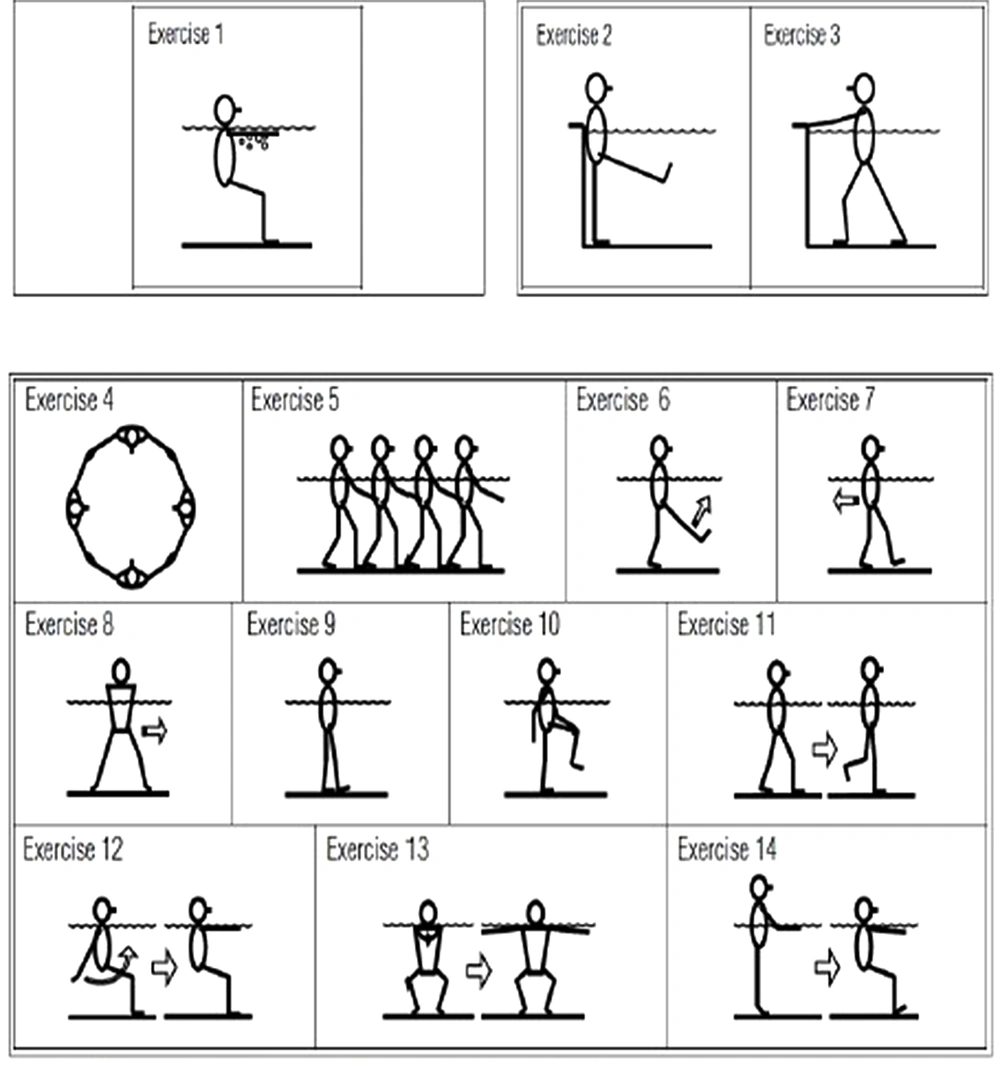
Figure 1.
Aquatic exercise workout
Table 1.
Explanation of the Aquatic Exercise Workout
| Exercise | Description |
|---|---|
| Warm-up | Exercise 1: Breathing (breath control). Position: The subject is placed in the water in a semi-sitting position without any support so that he is immersed in water up to the level of the shoulders. Hands parallel to the front of the body, elbows perfectly straight, shoulder joint in a 90-degree flexion position; Activity: He continuously and slowly performs the action of inhaling above water, then he is immersed in water and exhales in water. |
| Stretching | Exercise 2: Stretching the hamstring muscles; Position: The subject leans against the back wall of the pool. Activity: Raises one of the lower limbs and brings the toe close to the leg while keeping the knee fully extended. |
| Exercise 3: Stretching the Gastrocnemius, Soleus, and Suez muscles; Position: The subject stands with his hands on the edge of the pool facing the wall. Activity: Stands in lunges position, keeping the front knee bent and the behind leg perfectly straight. In this case, the sole of the foot is in contact with the bottom of the pool. | |
| Main | Exercise 4: Step sideways in a circular path in both directions |
| Exercise 5: Step forward on a circular line in both directions | |
| Exercise 6: Step forward and raise the leg with a straight knee | |
| Exercise 7: Take a step back | |
| Exercise 8: Step sideways with stretched steps | |
| Exercise 9: Supportive step so that the foot is placed right in front of the other foot (short steps) | |
| Exercise 10: Step in the knee-high position, reach his hand and touch the opposite knee. | |
| Exercise 11: Step while the heel is rising from behind. In this position, while raising the heel from behind, he stands on one foot for 10 seconds. | |
| Exercise 12: The subject is placed in a semi-sitting position and performs flexion and extension movement of the shoulder joint. | |
| Exercise 13: The subject is placed in a semi-sitting position and performs horizontal flexion and extension of the shoulder joint. | |
| Exercise 14: Subject performs the squat movement |
In the Pilates group, the subjects performed adjusted Pilates with the guidance of a trained Pilates instructor for 1 hour, three sessions per week over 12 weeks. In the first session, the instructor provided the participants with the basics of Pilates training and general information on this form of exercise. The participants followed these basic principles in all sessions. The Pilates sessions consisted of three parts (Table 2):
Table 2.
Explanation of the Pilates Exercise Workout
| Number | Exercise | Equipment | Repetitions |
|---|---|---|---|
| Warm-up | |||
| 1 | Breathing | No equipment | 10 |
| 3 | Spinal rotation | No equipment | 10 |
| 4 | Cat stretch | No equipment | 10 |
| 5 | Hip rolls | No equipment | 10 |
| 7 | Arm circles | No equipment | 10 |
| 8 | Scapula elevation | No equipment | 10 |
| Exercise | |||
| 1 | Standing side bends | No equipment | 8 |
| 2 | Calf strengthening | No equipment | 8 |
| 3 | monkey squat | No equipment | 5-10 |
| 4 | Roll-down | No equipment | 5-10 |
| 5 | Spine stretch | Mat | 8 |
| 6 | The hundred | Mat | 8 |
| 7 | Single leg stretch | Mat | 8 |
| 8 | Spine stretch forward | Mat | 8 |
| 9 | Shoulder bridge | Mat | 8 |
| 10 | Double leg stretch | Mat | 8 |
| 11 | The saw | Mat | 8 |
| 12 | Mermaid | Mat | 8 |
| 13 | Standing side bends | Elastic bands | 10 |
| 14 | Seated row | Elastic bands | 10 |
| 15 | Reformer leg press | Elastic bands | 10 |
| 16 | Long sitting ankle plantar flexion | Elastic bands | 10 |
| 17 | The frog | Elastic bands | 10 |
| 18 | Rowing | Elastic bands | 10 |
| 19 | Shoulder abduction to 90º | Elastic bands | 10 |
| 20 | Shoulder flexion to 90º | Elastic bands | 10 |
| 21 | Inner thigh flexion | Elastic bands | 10 |
| 22 | Hip abduction | Elastic bands | 10 |
(1) Warm-up (10 minutes): After preparing the participants for the training session, which included checking their breath control and posture, the exercise began with Pilates breathing and stretching movements to increase circulation and mobility. These moves were selected from basic Pilates exercises (24). For this group, the exercise sessions began with simple stretching movements.
(2) Pilates exercises (40 minutes): These exercises were selected to be taken over 12 weeks and were planned according to the patients' performance in the initial tests.
(3) Cool down (10 minutes): This included simple rhythmic moves to reduce the heart rate and flexibility exercises to increase the ROM in joints and prevent damage in the long term.
The control group did not take any regular exercise and physical activity, but only received medications and took the pretest and posttest at the same time as the other groups.
In this study, the strength of the quadriceps and the knee joint ROM was measured through Biodex Isokinetic System 3 (Biodex multi-joint system, PRO, Shirley, New York, USA) dynamometer in an isotonic manner. This dynamometer is a precision measuring instrument that measures the maximum muscular strength as the peak torque in Newton per Meter (25, 26).
The data were summarized as the mean ± SD. The normal distribution of the data was verified by running the Shapiro-Wilk test. The data were analyzed by the repeated measures ANOVA in IBM SPSS Statistics for Windows, Version 24.0. Armonk, NY: IBM Corp. The statistical significance was set to 0.05.
4. Results
The baseline characteristics/features of the three patient groups with Parkinson's disease are shown in Table 3. The results of repeated measures ANOVA for muscle strength and ROM in the experimental and control groups are shown in Table 4. The time effect was found to be significant in the changes in muscle strength in the aquatic exercise group compared to the control group (P < 0.05), while the group × time interaction on the different measurement occasions was not significant (P > 0.05). There were no significant intergroup differences between the Pilates and Aquatic exercise groups (P > 0.05).
Table 3.
Baseline Characteristics of the Participants
| Aquatic Exercise Group (n = 10) | Pilates Group (n = 7) | Control Group (n = 8) | F | P | |
|---|---|---|---|---|---|
| Age (y) | 56.10 ± 11.69 | 59.71 ± 6.10 | 51.88 ± 10.78 | 1.12 | 0.34 |
| Height (cm) | 169.20 ± 7.07 | 170.29 ± 7.32 | 164.88 ± 9.19 | 0.32 | 0.73 |
| Weight (kg) | 72.10 ± 10.52 | 74 ± 13.90 | 69 ± 12.84 | 1.04 | 0.37 |
| Duration of illness (y) | 4.25 ± 3.74 | 5.86 ± 4.88 | 5.50 ± 2.56 | 0.44 | 0.65 |
| BMI (kg/m2) | 24.44 ± 3.78 | 25.42 ± 3.19 | 23.67 ± 4.96 | 0.35 | 0.70 |
| UPDRS | 16.5 ± 15.96 | 16.14 ± 8.9 | 25.66 ± 9.68 | 1.52 | 0.24 |
| MMSE | 26.1 ± 2.66 | 24.43 ± 1.67 | 23.2 ± 9.82 | 0.55 | 0.58 |
| H&Y | 0.52 | 0.26 | 0.61 | - | - |
Abbreviations: BMI, body mass index; UPDRS, Unified Parkinson's Disease Rating Scale; MMSE, mini-mental state examination; H&Y, Hoehn & Yahr.
Table 4.
The Results of Repeated Measures ANOVA for Muscle Strength and ROM in the Experimental and Control Groups
| Groups | Measurement Occasion | Group × Time | Group | |||
|---|---|---|---|---|---|---|
| Pretest | Posttest | F | P | F | P | |
| Muscle strength | 0.15 | 0.8 | 1.42 | 0.2 | ||
| Control | 206.36 ± 105.80 | 164.71 ± 108.01 | ||||
| Aquatic | 264.56 ± 176.85 | 259.5 ± 102.57 | ||||
| Pilates | 222.67 ± 97.91 | 211.3 ± 92.66 | ||||
| Range of motion | 5.5 | 0.01 a | 0.44 | 0.6 | ||
| Control | 64.82 ± 18.53 | 53.03 ± 15.41 | ||||
| Aquatic | 59.75 ± 10.93 | 65.06 ± 10.56 | ||||
| Pilates | 60.08 ± 12.62 | 68.54 ± 8.23 | ||||
a Significant at 0.05.
The primary effect of measurement occasion on ROM (time factor) was significant (P < 0.05), and the group × time interaction revealed a significant difference on the different measurement occasions (P = 0.01), Table 3. The effect of the group revealed no significant difference between the study groups (P > 0.05). Three months of Pilates and aquatic exercise significantly increased the ROM of PD patients compared to the control group, while the comparison of the two experimental groups did not indicate any significant difference (P > 0.05).
5. Discussion
The results showed that the aquatic exercise intervention in the experimental group’s subjects significantly increased muscle strength compared to the control group.
Findings suggest that after 50, muscle strength reduces by about 15% per every following decade and about 3% after 70 (27-30).
Longitudinal studies of muscle strength in the lower extremities of men and women (aged 46 - 74 years) unveil an average of 14% decrease in knee extensor muscle strength and 16% decrease in knee flexor muscle strength over a 10-year period. Reduced muscle strength next to muscle mass loss upon aging lead to muscle fiber loss (31). It is found that the death cause in patients with PD is not related to the disease but merely to the patients' inactivity, which increases mortality (32).
A progressive central nervous system disorder reduces strength in the dorsal, hip, and ankle muscles and leads to Parkinson's disease. The weakness in these muscles and knee extensor muscles is a major cause of postural instability in these patients. The strength of these muscles plays an essential role in the neuromuscular processes required to control balance in patients with Parkinson's disease and has a positive correlation with dynamic balance and a negative correlation with disease severity (33).
Reduced muscle strength in the lower extremity shifts the center of gravity higher, which leads to increased imbalance and causes falls in these patients. Trying to maintain balance and taking high-intensity resistance exercises could improve muscle strength and reduce the chance of falls, provided that the center of gravity, step length, speed, and posture in patients are improved (34, 35). In a study, 12 weeks of strength training exercises increased hypertrophy of quadriceps and improved strength and motor function in PD patients (36).
The significant effect of aquatic exercise on muscle strength is evident among the subjects, something that the control group did not face. This could be caused by water resistance, hydrostatic pressure, and exercise procedure type based on the overload principle, which enhanced muscle strength and ultimately improved neuromuscular adaptation.
In this context, like any other field of science, some findings are in contradiction with previous results (33). This could be introduced by the differences in exercise types, level of patients’ physical fitness, and age. Moreover, Pilates does not significantly affect the muscle strength of the patients, which could be due to the small sample size and low intensity of the exercises (level-4). Therefore, the training protocol in this study began with level 4 exercises, and then, with strict adherence to the principle of overload and considering the patients’ physical fitness, it was raised to level 2 at the end.
It was observed that Pilates and aquatic exercises significantly increased the patients’ ROM, which was in accordance with the previous studies (30, 37). This progress may have been made by change in the elasticity of the muscle-tendon units through the generated motion in that joint(s). One of the stretching exercises in hydrotherapy was static stretching, (stretching a muscle to the point of discomfort and holding there), allowing the antagonist muscle to have active stretch by resorting to the agonist muscle contraction. This way, the joint ROM increases by stretching and strengthening the muscles and other joint structures, like tendons and ligaments. Proper water temperature had a direct effect on increasing the joints’ ROM. Pilates increased the joints’ ROM by increasing neuromuscular coordination.
Taking aquatic exercises and Pilates to improve ROM has been documented in other diseases as well.
In a study on patients with breast cancer, Pilates improved the ROM in the experimental groups vs. the control (37).
Mazloum et al. revealed that four weeks of aquatic exercises significantly increased the ROM in patients with hemophilia as a result of floating in the water and the reduction of pressure on the lower extremity (38). Mulvany et al. assessed the effect of a six-week training program on patients with arthritis and found that the intervention led to a significant increase in the patients' ROM (39). Pilates revealed an increase in ROM by increasing the patients' neuromuscular coordination in mastectomy patients (40).
Our study had some limitations that should be considered in interpreting the results:
(1) All subjects were male, within the 36-76 age range. (2) Patients were in stages I to III of the disease, indicating that the results may not be generalizable to patients with severe stages as they might have severe problems in terms of muscle strength and posture control. (3) Researchers could not have medication-free experimental groups due to ethical limitations, and (4) small sample size due to the unwillingness of some patients to participate in this research.
In conclusion, taking aquatic exercise improved the patients' health status regarding their muscle strength and joint ROM. Taking Pilates exercises could extend ROM in these patients. These affordable physical exercises can be taken as complementary therapy to pharmacological treatments to increase the quality of life and alleviate symptoms and complications of PD and other neurological disorders among the patients. To generalize such findings, more assessments are required where a broader range of age and advanced stages of the disease will be of concern.