1. Background
Anterior cruciate ligament (ACL) is essential for knee joint stability. ACL tears are the most common knee ligamentous injuries (1, 2). Changes in kinetics, kinematics, functional limitations and muscle activity are among the consequences of ACL injuries (3-7). In an unstable knee, neuromuscular coordination is affected possibly because of long-term proprioceptive dysfunction. As a result, many professionals suggest surgical reconstruction of ACL for active people or athletes who wish to regain their activities with the same level as before injury (1, 8).
Studies have shown that ACL reconstruction to be successful in maintaining performance and mechanical stability of the knee. However, ligament replacement may not be effective in preserving sensorimotor function and may lead to a disturbed afferent nervous system. According to a study by Noyes, only 30% of people with ACL deficiency were able to return to their pre-injury level of activity after ACL reconstruction. Almost 30% had to decrease and the rest would require to stop their sport activity (9).
Abnormal gait pattern has been shown to persist in a great number of patients after ACL reconstruction. There is evidence on altered gait performance in most patients even 6 to 12 months after ACL reconstruction (10). A reconstructed ligament is accompanied by biomechanical changes and reduction of power and muscle function (especially quadriceps) followed by walking disorders (11). Gait analysis has been wildly used in order to evaluate functional performance in patients with ACL deficiency. Through this technique, mechanical loads exerted on the lower limbs can be indirectly measured (12). There are several methods to assess the kinetic and kinematic profile of the joints involved in the gait cycle. Kinematics analysis considers movements occurring in different parts of the body regardless of forces (13). The most common method for data collection of kinematic information is using image-based three-dimensional (3D) motion capture systems. In this method, 3D coordinates of the markers attached to the anatomic points are processed to calculate the kinematic parameters. Although these systems been shown to have good reliability, accuracy, and reliability for kinematic recording of walking, they are generally expensive, which is a major limitation to their use. In another class of kinematic motion capture systems, coordinates of the markers are determined using ultrasound waves. Taking the advantage of the proximity of the sensors placed in a particular joint, these systems are believed to be more accurate in the kinematic evaluation of the joint as compared to motion analysis imaging systems. Furthermore, these systems benefit greatly by their inexpensiveness, portability and independence from specialized laboratory settings. Above all, necessity of all markers being seen by the cameras in motion analysis imaging systems is the most important aspect (14).
The Zebris system is one of the most common 3D motion capture instruments in the market (ZEBRIS, CMS10, Medizintechnik GmbH, Germany). Each Zebris system has four active ultrasound markers for tracking body movements. Among advantages of the system are its user friendliness and possibility of quick familiarization of the operator with this device. Several studies have used Zebris system to examine the cervical and thoracic spine kinematic parameters in sagittal and horizontal planes. Studies have also been conducted on temporomandibular and the shoulder joint dysfunction (15-17). In addition, Zebris system has been used in patients after ACL reconstruction for the kinematic assessment of the knee joint during walking (18). Despite its wide usage, the reliability of kinematic parameters of gait captured by Zebris system has not been reported in people after ACL injury at different walking speeds. However, the reliability of walking kinematics parameters and determining the effect of challenging factors like walking speed on the reliability of the above-mentioned parameters using an ultrasound system motion capture have not been yet conducted on people who have undergone ACL reconstruction.
Walking speed, as well as testing condition and the subjects characteristics are believed to affect join motion, and therefore the reliability of its kinematics (19, 20). Most importantly, reliability of registered kinematic parameters is not the same in all conditions and diseases (21, 22). The results of any study on kinematic parameters of joints captured by Zebris system during walking, should be considered in light of the reliability of the collected data. Such information can be used to increase the accuracy of the measurement method by means of controlling the sources of error, including test conditions, test environment, testing instruments, examiner and the variability of the of the biological systems.
2. Objectives
The main objective of the present study was to evaluate the reliability of these data during walking on treadmill at different speeds in two groups of patients after ACL reconstruction and healthy subjects using Zebris ultrasound system. These parameters included stride time, stride length, maximum knee flexion, maximum knee flexion velocity and maximum knee extension velocity.
3. Methods
3.1. Participants
A total sample of convenience including 40 athletes participated voluntarily in this study. Twenty subjects with ACL reconstruction (with an average duration of 4 to 6 months after surgery) were recruited from medical- sport energy center of Tehran from January 2014 to August 2015. All ACLR surgeries were performed through a similar technique (arthroscopically assisted anatomic double-bundle anterior cruciate ligament reconstruction using autogenous hamstring tendons). Patients had ACL reconstruction 4 to 6 months before testing, without any injury on other knee structures (e.g. the meniscus, posterior cruciate ligament, lateral and medial collateral ligaments), uninjured contralateral limb, the ability to perform light activities 4 months after surgery, full range of motion of the operated knee, age of 20 to 40 years old, body mass index between 20 and 30, height between 160 and 180 cm, and normal functioning in other joints of the lower extremities. People with any history of knee fracture, instability in the injured knee before the surgery, problems with pain and abnormal swelling on testing day, severe cardio-respiratory problems, diabetes or using drugs effective on balance were excluded. Participants in the ACL reconstruction group were asked to introduce one of his/her teammates to serve as the control group matched for activity age and sport activity. All subjects had followed an accelerated rehabilitation protocol in a single rehabilitation center (including strengthening, balance, proprioception, stability, agility and return to sport training). The time to return to sports was based on the demonstrated ability to do sport-related movements safely, determined by surgeon and physical therapist. Table 1 demonstrates the demographic characteristics of the participants.
Table 1.
Demographic Information of the Study Subjects (n = 40)
| Patient Group (n = 20), Mean (SD) | Control Group (n = 20), Mean (SD) | |
|---|---|---|
| Age (y) | 24 (2.69) | 21.6 (2.26) |
| Height (cm) | 173.8 (6.4) | 177.33 (6.95) |
| Weight (kg) | 73.6 (10.47) | 72.20 (8.35) |
| BMI (kg/m2) | 24.28 (2.53) | 22.52(3.07) |
| Period after surgery (mon) | 5.5 (3.2) |
Healthy subjects consisted of 20 athletes with no previous lower extremity injuries. The subjects were selected after obtaining informed consent approved by the research ethics committee of Tarbiat Modares university according to the inclusion and exclusion criteria. Participants of the two groups were matched regarding their age, sex, and exercise history.
3.2. Study Design
It was a methodological study in order to assess the reliability of Zebris motion analysis system in healthy athletes and athletes after ACL reconstruction. Sample size was determined according to Cohen for correlational studies with minimum correlation coefficient of 0.60 and the power of 0.90 (25).
3.3. Motion Analysis
A Zebris 3D motion analysis system (ZEBRIS, CMS10, Medizintechnik GmbH, Germany) was used to collect and record the kinematic data during walking. This is a goniometer ultrasound system having 4 active markers, which present local coordinates of the system, including the x, y, and z coordinates for any marker (Figure 1).
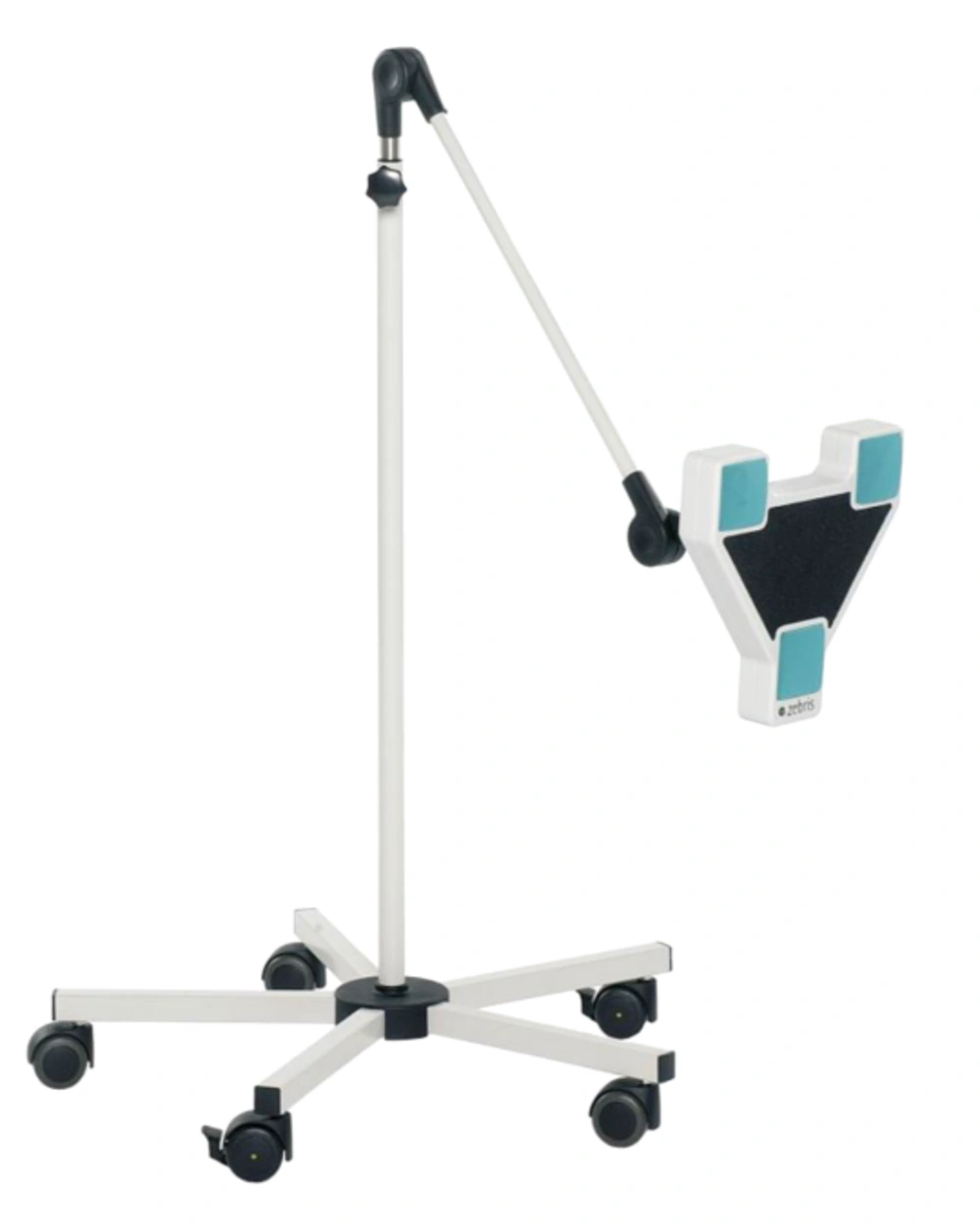
Figure 1.
Zebris Device
Zebris system also consists of a receiver, a measuring unit, 3 microphones and small ultrasound markers. All gathered data was saved on a computer connected to the device which worked with Windata software (developed and owned by the Zebris Company).
Four small simple markers with the size of 10 × 8 mm and circular cross-section were attached to the head of fibula, the greater trochanter of the femur, lateral epicondyle of the femur and lateral side of the ankle (Figure 2).
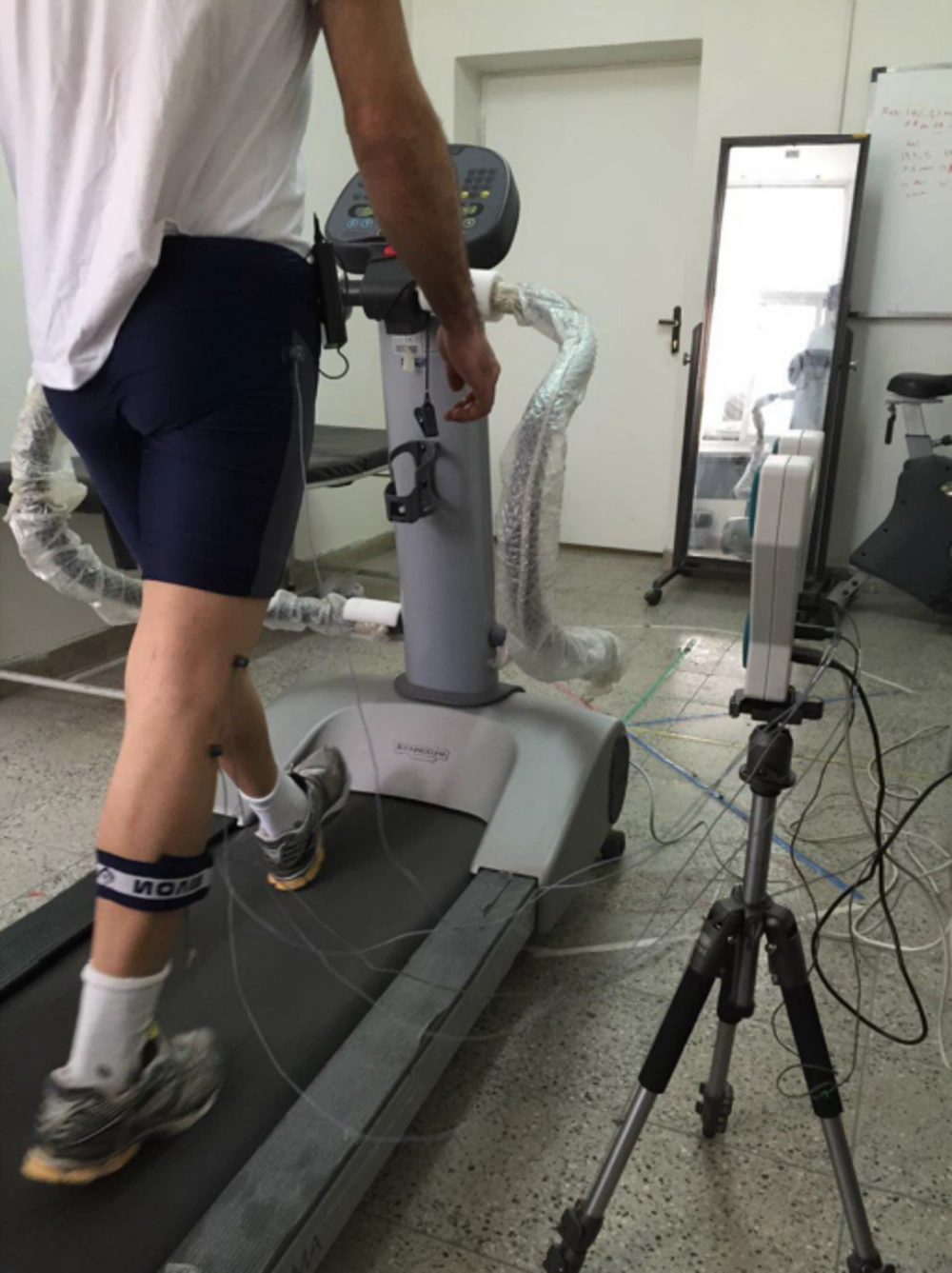
Figure 2.
Figure 2.
3.4. Foot Switch
In order to measure heel contact instant, an electro-mechanical foot switch was attached to the heel. The sensor converted the compressive forces to a digital signal (0/1 logic). The jack in the other end of the connected wire to the foot switch was attached to one of the outputs of the Zebris system and its data was recorded. Foot switch data represented the initial time of a gait cycle.
3.5. Walking Activity
Participants were asked to walk on a treadmill (Forma, Techno gym, Wellness company, Italy) and adjust its speed to their preferred level. During the registration process of their preferred speed, participants had no information on the speed of their choice because the screen monitor was covered. At First, walking started with the speed of 1.5 km/h and then, with increments of 0.2 km/h, walking speed decreased or increased by the experimenter based on the subjects’ request. The subject reached the preferred speed once from higher speeds and once from lower speeds. After determining each subject's preferred speed, high and low speeds were defined as 20% above and 20% below the preferred speed, respectively (26). The time for familiarity with walking on the treadmill was 6 minutes for all participants (27). The subjects walked on the treadmill with comfortable shoes. Each participant walked on the treadmill at each three different speeds for one minute. In addition, each walking trial was repeated three times. Therefore, a total of 9 trials were completed by each participant. Thirty second inter trial resting periods were considered and the order of trials were selected randomly.
3.6. Statistical Analysis
Kinematic data generated by markers and foot switch were collected by Zebris system. These data were then sent to MATLAB software in order to calculate stride time (in seconds), stride length (in millimeters), maximum knee flexion angle (in degrees), maximum knee flexion velocity (in degrees/second), and maximum knee extension velocity (in degrees/second).
Intraclass correlation coefficient (ICC) was calculated as an index of relative reliability of gait parameters between test and retest sessions (28, 29). According to Munro’s classification of correlation coefficients, values of 0.26 to 0.49, 0.5 to 0.64, 0.7 to 0.89, and 0.90 to 1.0 were considered as low, average, high, and very high relative reliability levels, respectively (30). Significance level for all ICC tests was set at 0.05.
In addition, in order to evaluate absolute reliability, coefficient of variation (CV) (CV = σ/μ), standard error of measurement (SEM), (SEM = σ √[1-ICC]) and minimally metric detectable change (MMDC), (MMDC = SEM × √2 × 96.1) were calculated. MMDC represent the amount of change which can be considered significantly higher than measurement error. It allows the researchers or clinicians to judge whether the difference seen between assessments is due to the impact of treatment and real change or it is just a measurement error. In the previous studies, MMDC was calculated. It is expected that due to advancement of the disease, MMDC would have greater changes over time and show higher values (31). The above-mentioned reliability indices were calculated separately for each group of participants.
4. Results
In ACL reconstruction group, ICC values for all gait parameters at low walking speed ranged from 0.70 to 0.97, except for left maximum knee extension velocity (ICC = 0.59). At preferred walking speed, all the parameters showed ICCs ranging between 0.75 to 0.97 except for right maximum knee flexion velocity (ICC = 0.40). At high velocity speed, all kinematic parameters showed ICCs ranging from 0.79 to 0.97, except for right maximum knee flexion velocity (ICC = 0.57.
In the control group, all gait parameters at low walking velocity showed ICC values between 0.74 and 0.99, except for left stride time (ICC = 0.67). ICCs for the studied parameters at preferred walking speed ranged from 0.89 to 0.99, except for left stride time (ICC = 0.60). At high walking speed, all the parameters had ICCs ranging from 0.83 to 0.99.
Reliability indices for ACL reconstruction and control groups are presented in Tables 2 and 3, respectively. All ICC values were statistically significant (P < 0.05).
Table 2.
Reliability Indices at Different Walking Speeds in ACL Reconstruction Group
| Parameter | Speed | Side | ICC (95%CI) | CV | SEM | MMDC |
|---|---|---|---|---|---|---|
| Stride time (second) | Low | Right | 0.97 (0.92 - 0.99) | 0.07 | 0.044 | 0.12 |
| Left | 0.9 (0.72 - 0.96) | 0.07 | 0.054 | 0.14 | ||
| Preferred | Right | 0.75 (0.41 - 0.91) | 0.05 | 0.063 | 0.17 | |
| Left | 0.9 (0.74 - 0.96) | 0.06 | 0.044 | 0.12 | ||
| High | Right | 0.94 (0.83 -0.97) | 0.06 | 0.031 | 0.08 | |
| Left | 0.95 (0.86 - 0.98 | 0.05 | 0.031 | 0.008 | ||
| Stride length (mm) | low | Right | 0.94 (0.84 - 0.98) | 0.16 | 35.12 | 97.28 |
| Left | 0.93 (0.80 - 0.97) | 0.15 | 39.65 | 109.83 | ||
| Preferred | Right | 0.97 (0.91 - 0.99) | 0.15 | 37.01 | 102.51 | |
| Left | 0.94 (0.83 - 0.98) | 0.14 | 43.62 | 120.82 | ||
| High | Right | 0.97 (0.93 - 0.99) | 0.15 | 30.37 | 84.12 | |
| Left | 0.97 (0.92 - 0.99) | 0.14 | 31.04 | 85.98 | ||
| Maximum knee flexion (degrees) | Low | Right | 0.7 (0.32 - 0.98) | 0.56 | 2.57 | 7.11 |
| Left | 0.94 (0.83 - 0.97) | 0.26 | 1.514 | 4.19 | ||
| Preferred | Right | 0.95 (0.87 - 0.98) | 0.50 | 0.828 | 2.29 | |
| Left | 0.93 (0.80 - 0.97) | 0.26 | 1.835 | 5.08 | ||
| High | Right | 0.79 (0.48 - 0.92) | 0.49 | 1.76 | 4.84 | |
| Left | 0.94 (0.48 - 0.98) | 0.26 | 1.459 | 4.04 | ||
| Maximum knee flexion velocity (degrees/second) | Low | Right | 0.86 (0.65 - 0.95) | 0.55 | 13.78 | 38.17 |
| Left | 0.91 (0.75 - 0.96) | 0.28 | 14.64 | 40.55 | ||
| Preferred | Right | 0.4 (0.11 - 0.75) | 0.51 | 20.51 | 56.81 | |
| Left | 0.84 (0.58 - 0.94) | 0.30 | 17.16 | 47.53 | ||
| High | Right | 0.57 (0.10 - 0.83) | 0.50 | 12.72 | 35.23 | |
| Left | 0.93(0.81 - 0.97) | 0.30 | 11.12 | 30.8 | ||
| Maximum knee extension velocity (degrees/second) | Low | Right | 0.94 (0.83 - 0.98) | 0.52 | 10.10 | 27.97 |
| Left | 0.59 (0.13 - 0.84) | 0.28 | 33.27 | 92.15 | ||
| Preferred | Right | 0.95 (0.85 - 0.98) | 0.50 | 14.43 | 39.97 | |
| Left | 0.85 (0.63 - 0.95) | 0.33 | 25.2 | 69.8 | ||
| High | Right | 0.87 (0.72 - 0.96) | 0.49 | 16.61 | 46.009 | |
| Left | 0.96 (0.89 - 0.98) | 0.36 | 15.7 | 43.48 |
Table 3.
Reliability Indices at Different Walking Speeds in Control Group
| Parameter | Speed | Side | ICC (95%CI) | CV | SEM | MMDC |
|---|---|---|---|---|---|---|
| Stride time (seconds) | Low | Left | 0.70 (0.39 - 0.90) | 0.07 | 0.54 | 0.14 |
| Right | 0.67 (0.26 - 0.87) | 0.07 | 0.054 | 0.14 | ||
| Preferred | Left | 0.81 (0.53 - 0.93) | 0.05 | 0.03 | 0.08 | |
| Right | 0.60 (0.15 - 0.84) | 0.06 | 0.05 | 0.14 | ||
| High | Left | 0.89 (0.70 - 0.93) | 0.06 | 0.031 | 0.08 | |
| Right | 0.83 (0.56 - 0.94) | 0.05 | 0.03 | 0.08 | ||
| Stride length (mm) | Low | Left | 0.90 (0.74 - 0.96) | 0.16 | 54.68 | 150.04 |
| Right | 0.89 (0.79 - 0.97) | 0.15 | 63.02 | 172.92 | ||
| Preferred | Left | 0.98 (0.94 - 0.99) | 0.15 | 38.71 | 106.22 | |
| Right | 0.89 (0.70 - 0.96) | 0.14 | 52.09 | 142.93 | ||
| High | Left | 0.95 (0.86 - 0.98) | 0.15 | 36.99 | 101.05 | |
| Right | 0.96 (0.91 - 0.98) | 0.14 | 52.26 | 143.40 | ||
| Maximum knee flexion (degrees) | Low | Left | 0.99 (0.96 - 0.99) | 0.56 | 1.68 | 4.60 |
| Right | 0.96 (0.90 - 0.98) | 0.26 | 3.37 | 9.24 | ||
| Preferred | Left | 0.99 (0.97 - 0.99) | 0.50 | 1.77 | 4.85 | |
| Right | 0.97 (0.93 - 0.99) | 0.26 | 3.24 | 10.559 | ||
| High | Left | 0.99 (0.96 - 0.99) | 0.49 | 2.67 | 7.32 | |
| Right | 0.97 (0.93 - 0.99) | 0.26 | 2.39 | 6.55 | ||
| Maximum knee flexion velocity (degrees/second) | Low | Left | 0.99 (0.98 - 0.99) | 0.55 | 10.39 | 28.51 |
| Right | 0.94 (0.84 - 0.98) | 0.28 | 19.85 | 54.46 | ||
| Preferred | Left | 0.98 (0.96 - 0.99) | 0.51 | 16.69 | 45.79 | |
| Right | 0.97 (0.92 - 0.99) | 0.30 | 12.86 | 35.28 | ||
| High | Left | 0.99 (0.93 - 0.99) | 0.50 | 13.05 | 35.80 | |
| Right | 0.97 (0.91 - 0.99) | 0.30 | 14.29 | 39.21 | ||
| Maximum knee extension velocity (degrees/second) | Low | Left | 0.98 (0.96 - 0.99) | 0.52 | 11.69 | 32.07 |
| Right | 0.97 (0.92 - 0.99) | 0.28 | 17.72 | 48.62 | ||
| Preferred | Left | 0.97 (0.94 - 0.99) | 0.50 | 18.25 | 50.07 | |
| Right | 0.98 (0.95 - 0.99) | 0.33 | 16.93 | 46.45 | ||
| High | Left | 0.99 (0.97 - 0.99) | 0.49 | 11.83 | 32.46 | |
| Right | 0.97 (0.91 - 0.99) | 0.36 | 24.66 | 67.66 |
5. Discussion
The present study investigated the intra- session test-retest reliability of the kinematic and spatiotemporal gait parameters during walking at 3 different speeds after ACL reconstruction using Zebris ultrasound motion analysis system. The results showed high to very high reliability of most of these parameters. Reliability is affected by real differences between measurement sessions which are of the most important elements of every study. Raters’ error can be controlled by training with standard protocols, proper use of instruments, and data processing techniques (32).
To the best of authors’ knowledge, no study has been conducted on the reliability of Zebris system parameters in patients with ACL reconstruction during walking. Parameters of Zebris motion analysis system showed reliable and can be beneficial as an index of walking kinematics and control for programs to improve these indicators in walking and other activities of athletes with knee ligament injury.
The results showed that in patients, relative reliability of parameters were high at all levels of walking speeds, except for step time of left foot, which had moderate and low reliability at low and preferred speeds, respectively. In the control group, the reliability of parameters was also high at all levels of walking speed, except for the stride time of left foot, which showed moderate and low reliability at preferred and low speeds, respectively. Uritani et al. measured the reliability of upper quadrant pasture analysis using an Ultrasound-based Three-dimentional motion. They found ICC values higher than 0.77 for all the parameters related to shoulder angle. Their instrument was the same and their findings were similar to those of ours. Knoll et al also measured the reliability of measuring knee extention force using a hand-held dynamometer US-based 3D motion analyser in 24 patients with haematological malignancies. They reported ICCs higher than 0.75 which were interpreted as acceptable (33). In spite of different target populations, these results were also similar to those shown in the present study.
In another study, Choi et al. investigated the reliability of the walking speed and gait dynamics variables while walking on a feedback - controlled treadmill in 15 healthy male. Although their instrument was different, their results indicated acceptable ICCs ranging from 0.63 to 0.98 (34), which are comparable with our findings.
In addition, our results showed that among all spatiotemporal parameters, stride time had the highest absolute reliability and smallest MMDC and CV values, especially in high walking speed. Because CV expresses the standard deviation as a percentage of the sample mean which allows the comparison of variability estimates by eliminating the effect of mean values, small CV values may be indicative of high sensitivity of stride time (11).
CV values for the majority of parameters found in this study were higher at low walking speed as compared with preferred and high speeds. This is in contrary to Jordan et al. who investigated the effect of walking speed on gait cycle and found lower CVs at low walking speeds (35). The participants of Jordan’s study were female which is considerably different from our subjects who were male athletes. Females have different musculoskeletal performance from males and in addition, our participants are athletes with different power and fitness. Both these factors can affect walking ability.
Hamill et al. suggested that higher gait variability at lower speeds explains how the central nervous system facilitates movement patterns to comply with changes in the walking speed (19). By comparison of gait parameters in the two groups, low to average reliability levels in some parameters at low walking speed seem to be due to the preferred walking speed. Kyrolainen et al. in their studies pointed out the effect of walking speed on the kinetic parameters. However, Wilken did not report any relationship between these variables and walking speed. Some studies also showed that walking speed in adults affects the variability of kinematic and spatiotemporal parameters of gait (31).
Stergiou et al. claim that variability in joint coordination can reflect the adaptability of the movement control system. They concluded that low walking speed is more challenging for neuromuscular control and higher efforts are necessary to maintain a dynamic balance. Walking speed in adults has been shown to have significant effect on variability of spatiotemporal parameters of walking such as spatio angular variability parameters. It is possible that our athletes had greater CV values at low speed because of more effort of neuromuscular system for more adaptation in low speed, as well. It may be suggested that skilled athletes with efficient agility have greater challenge in controlling their movements at low walking speed (26).
MMDC values for knee kinematic and gait spatiotemporal parameters were also calculated in the present study. The MMDC for a measured parameter provides information essential for setting the least significant changes expected following further testing (11).
MMDC values were somewhat higher at low speeds in both groups. The amounts of MMDC in patients were also higher as compared to those of control group and lower for stride time as compared with the other parameters.
Uritani et al. reported MMDCs of > 39.7 for the cranial rotation angle during standing posture in healthy young adults, while those of the neck inclination angle and angle of the shoulder were < 16.1. Knols et al. calculated SEMs greater than 6.73 and smallest detectable differences below 18.66 in their study (33). They interpreted the observed measurement errors to be modest. Meanwhile, Koblbauer et al found the smallest detectable differences between 19.0 and 57.5 which they believed to indicate high measurement errors (33).
Wilken suggests that several factors may contribute to higher ICC and lower MMDC values including the studied sample, the interval between test and retest sessions, and the computational process (31). Klejman et al. calculated test -retest reliability of discrete gait parameters in 28 children with cerebral palsy and obtained higher values of MMDC for temporal- spatial parameters of gait in a study conducted on children with cerebral palsy (36). Lobet et al. assessed measurement error in 18 adults with a degenerative joint desease. Though a study obtained higher MMDC values for spatiotemporal parameters, it was mentioned that increased variability in patients might be due to the reduced control of walking, the instability of body movements and increased spatiotemporal variability of parameters (31). Perhaps the reason for increased variability in the patient’s group in our study was due to knee joint problems after reconstruction and their impact on walking.
As we noted earlier, SEM values were small for stride time as compared with other parameters. Choi et al. showed low SEMs for walking speed and spatiotemporal variables including stride time and stride length (36). In addition, SEM values for the cranial rotation angle reported by Uritani were > 14.5, while those of neck inclination angle and angle of the shoulder were < 5.8 (33). Knols et al. reported SEMs greater than 6.73 and the smallest detectable differences lower than 18.66 in their study. Meanwhile, Koblbauer et al suggested the smallest detectable difference between 19.0 and 57.5 as high measurement errors (33).
In conclusion, mainly within the high and very high range, it can generally be concluded that Zebris system can be considered as a reliable instrument according to the calculated ICCs. Therefore, it may provide accurate kinematic gait parameters in healthy subjects as well as patients after ACL reconstruction surgery and has high sensitivity to detect gait events.
5.1. Study Limitations and Suggestions
The results of the present study should be applied in light of their limitations. All subjects were young athletes with or without ACL reconstruction. For a number of reasons, motor performance, and consequently the consistency of functional parameters are different in these people as compared with non-athletes and other age groups. Therefore, examining the reliability of gait parameters in these target populations, as well as subjects suffering from other movement disorders, by Zebris system is recommended. This is also true for the selected technique of reconstruction surgery which results may not necessarily generalized to ACL reconstructed knees.
Due to the limited accessibility to subjects, retest assessments of gait on another day were not possible. Therefore, the calculated reliability values are not necessarily generalizable to between-days test-retest situations. Future studies may assess reliability by testing gait parameters in separate days. There are a number of studies indicating differences between normal, on-the-ground walking and walking on treadmill. By solving some technical difficulties, it may be possible to evaluate the reliability of gait parameters during walking on the ground. Furthermore, the values and the reliability of gait parameters may be different in single task and dual task postural or gait conditions. So, it will be necessary to have such information by studies in the future. Finally, the central nervous system seems to select control strategies that sufficiently facilitate movement of upper limb joints in variable walking speeds. Therefore, reliability assessment kinematic data from trunk and upper limbs is suggested in future studies.
As we mentioned earlier, zebris has some characteristics. It is portable, not expensive and it doesn’t require a large area for monitoring events compared to other motion analysers such as VICON. Because of these traits it can be used in most musculoskeletal disorders, in investigation of adolescent problems and gait analysis of paralytic patients.