
1. Background
Hypertension is a primary component of metabolic syndrome (MetS) and one of the leading causes of cardiovascular morbidity and mortality worldwide (1, 2). Metabolic syndrome, on the other hand, comprises a cluster of metabolic disorders, including abdominal obesity, dyslipidemia, insulin resistance, and hypertension, posing a significant threat to public health. The prevalence of MetS has been steadily increasing, paralleling the global rise in obesity and sedentary lifestyles (3-5). Despite advances in pharmacological treatments, there are instances where these approaches fail to fully control blood pressure (BP) or improve cardiovascular outcomes. As a result, there is an increasing emphasis on non-pharmacological interventions, particularly exercise (6, 7).
The coexistence of hypertension and MetS can present complex challenges, especially for at-risk populations diagnosed with one or both conditions. Addressing these challenges through tailored exercise regimens may significantly benefit both conditions (4).
Isometric resistance training (IRT), which involves static muscular contractions without joint movement, has emerged as a powerful non-pharmacological strategy for lowering blood pressure and enhancing endothelial function (8, 9). Unlike dynamic exercises, IRT involves applying constant pressure to muscles rather than continuous movement, eliciting distinct cardiovascular responses (8, 10).
This review explores the impact of isometric exercise on BP and endothelial function in individuals with MetS. It provides a comprehensive overview of previous studies, highlighting key findings and offering valuable insights into potential therapeutic applications.
Hypertension is a prevalent and serious cardiovascular condition, defined as a persistent elevation of systolic blood pressure above 140 mm Hg and/or diastolic blood pressure above 90 mm Hg (10). It is a major risk factor for cardiovascular diseases (CVDs), including stroke, myocardial infarction, and heart failure (11). The pathophysiology of hypertension is complex, involving a combination of genetic, environmental, and behavioral factors. In the context of metabolic syndrome, hypertension is often accompanied by insulin resistance, dyslipidemia, and central obesity, all of which contribute to endothelial dysfunction and increased cardiovascular risk (12, 13). The rising prevalence of metabolic syndrome is largely attributed to lifestyle factors, particularly sedentary behavior and unhealthy dietary habits (14). Addressing these risk factors through lifestyle modifications, including increased physical activity, is crucial for mitigating the adverse health effects associated with metabolic syndrome (14, 15).
Non-pharmacological interventions play a critical role in the management of hypertension, particularly in individuals with MetS, where pharmacological treatments alone may not be sufficient (15-17). Lifestyle modifications, including dietary changes, weight loss, and increased physical activity, are essential components of hypertension management (18-20). Exercise, in particular, has been shown to have a direct impact on BP regulation and cardiovascular health (20-22). Various forms of exercise, including aerobic, resistance, and isometric training, have been studied for their effects on BP (15, 21, 23). Aerobic exercises such as walking, running, and cycling are widely recommended for lowering BP and enhancing cardiovascular health (24, 25). However, some recent studies have highlighted the potential benefits of both resistance and isometric exercises, especially among individuals with hypertension and MetS (4, 10, 15, 26). Notably, isometric exercise has been shown to reduce both systolic and diastolic BP, with effects comparable to those achieved through aerobic exercise (10). Isometric exercise involves the contraction of muscles without any movement of the muscle filaments at the intracellular level or movement at the joint. Common examples include planks, wall sits, and handgrip exercises. Isometric exercise improves cardiovascular health by increasing nitric oxide bioavailability, enhancing autonomic balance, boosting parasympathetic activity, reducing sympathetic outflow, and decreasing vascular resistance through sustained intramuscular pressure (10, 12, 27, 28). Unlike dynamic exercises, which involve a full range of motion, isometric exercises are performed by maintaining a static position, which places continuous tension on the muscles. Isometric training contributes to reduced oxidative stress and improved vascular health, further supporting cardiovascular stability and reducing the risk of cardiovascular events (6, 8, 25, 29). This unique aspect of isometric exercise contributes to its distinct physiological effects, particularly in relation to BP and vascular function. The sustained increase in intramuscular pressure leads to a reduction in blood flow to the active muscles, resulting in a localized increase in vascular resistance. This triggers a compensatory increase in cardiac output and a subsequent rise in systemic BP. However, with regular isometric training, these acute responses are attenuated, leading to long-term reductions in resting BP (6, 10).
2. Methods
2.1. Evidence Acquisition
This review provides a complete analysis of the current evidence regarding the impact of isometric exercise on the regulation of blood pressure and endothelial function in patients who have been diagnosed with metabolic syndrome. The review provides an in-depth examination of papers obtained from several sources such as PubMed, Scopus, and Web of Science. The primary focus is on randomized controlled trials, meta-analyses, and observational studies that have been published in peer-reviewed journals. The search approach used the use of specific keywords like "isometric exercise," "blood pressure," "endothelial function," "metabolic syndrome," and "cardiovascular health."
2.2. Study Selection
Studies were included if they met the following criteria: (1) Involved adult participants diagnosed with metabolic syndrome or related cardiovascular risk factors; or (2) investigated the effects of isometric exercise on BP and/or endothelial function; and/or (3) provided quantitative measures of outcomes. Studies that focused on other exercise modalities without comparison to isometric exercise, or those that did not report on BP or endothelial function, were excluded.
2.3. Data Extraction and Synthesis
Data on study design, participant characteristics, exercise protocols, duration, and outcomes were extracted and synthesized to provide a comprehensive overview of the impact of isometric exercise on BP and endothelial function. The review also compares isometric resistance training with other exercise modalities to evaluate its relative effectiveness and discusses potential mechanisms underlying the observed effects.
2.4. Limitations
It is acknowledged that the heterogeneity of study designs, variations in exercise protocols, and participant characteristics may influence the outcomes. Additionally, the review is limited to studies published in English, which may introduce language bias. Based on existing literature, this review aims to synthesize and represent more application-based studies for a more straightforward investigation. Another consideration is the potential for publication bias, as studies showing positive results are more likely to be published than those with null findings. Moreover, the review was restricted to English-language publications, which may exclude relevant studies in other languages and contribute to language bias.
3. Results
The articles included in this review consist of descriptive reviews (1, 3-5, 8, 10, 11, 13-17, 20, 22-24, 26, 30-37) and practical studies (12, 21, 25, 27, 28, 38) (Table 1). These studies focus on MetS, hypertension, and practical non-pharmacological interventions. Numerous studies have investigated the effects of isometric exercise on blood pressure, consistently showing significant reductions in both systolic and diastolic BP (6). A meta-analysis of randomized controlled trials by Carlson et al. demonstrated that isometric handgrip exercise led to an average reduction of 6.77 mm Hg in systolic BP and 3.96 mm Hg in diastolic BP among hypertensive individuals (6). These reductions are significant and suggest that isometric exercise could serve as a complementary therapy for hypertension management, with effects comparable to those achieved with antihypertensive medications (10).
Table 1.
Practical Studies Extracted
| Author(s), Year | Study Design | Population | Intervention | Comparison/Control | Duration | Outcomes Measured | Main Findings | Quality/Risk of Bias |
|---|---|---|---|---|---|---|---|---|
| 1. Cornelissen and Smart, 2013 (12) | Systematic review and meta-analysis | 5 223 adults (1 401 exercise;1822 control) from 93 RCTs | Endurance, dynamic resistance, combined endurance & resistance, isometric resistance training | Control groups (no exercise) | ≥ 4 weeks | SBP and DBP | Isometric resistance training led to the largest SBP reduction (-10.9 mmHg) compared to endurance (-3.5 mmHg) and dynamic resistance (-1.8 mmHg). DBP reductions were significant across all modalities, with isometric training showing substantial decreases (-6.2 mmHg). | A high number of studies included robust meta-analytic methods. Potential heterogeneity due to varying exercise protocols. |
| 2. Cornelissen et al., 2010 (38) | Randomized crossover study | Sedentary adults ≥ 55 years old | Endurance training at low (33% HR reserve) and high intensity (66% HR reserve) | Sedentary period (no exercise) | Ten weeks per training intensity | SBP, HR, HRV | Both low and high-intensity training significantly reduced SBP similarly. High-intensity training had more pronounced effects on HR but no significant impact on HRV. | Randomized crossover design reduces inter-subject variability. Limited sample size may affect generalizability. |
| 3. Correia et al., 2023 (27) | Systematic review and meta-analysis of RCTs | 253 hypertensive adults from 14 studies | Strength Training (various protocols) | Control groups (no exercise) | ≥ 8 weeks | SBP, DBP | Significant reductions in SBP and DBP, especially with moderate to vigorous intensity (> 60% 1RM), ≥ 2 times/week, and ≥ 8 weeks duration. | Cochrane methodology enhances reliability. A limited number of studies on isometric training specifically. |
| 4. Decaux et al., 2022 (28) | Randomized sham-controlled study | 30 physically inactive adults (15 males, 15 females) | Isometric exercise training (IET)-Wall squats at 95% peak HR | Sham group (wall squats < 75% peak HR), No-intervention control | Four weeks | Resting and continuous BP, cardiac autonomic modulation HRV | IET significantly decreased SBP, DBP, and mean BP compared to sham and control. Improved HRV indicators (↓ LFnu, ↑ HFnu) in the IET group. | Sham-controlled design strengthens causal inferences. A small sample size may limit statistical power. |
| 5. Park et al., 2020 (25) | Pilot study (randomized controlled trial) | 20 obese older men (10 EXP, 10 CON) | Combined exercise: Elastic-band resistance training + aerobic (walking/running, cycling) at 60 - 70% HR max, 3 days/week | Control group (no exercise) | 12 weeks | Body composition, cardiometabolic risk factors, bp, arterial stiffness, physical functions | Significant decreases in body weight, BMI, % body fat, BP, arterial stiffness, LDL-C, and epinephrine. Increases in VO2 peak and grip strength in the EXP group. | A pilot study with a small sample size; results are promising but need replication in larger trials. |
| 6. Pedralli et al., 2020 (21) | Randomized clinical trial | 42 individuals with prehypertension or hypertension (average age 54 ± 11 years) | Aerobic training, RT, combined training | Each exercise modality compared to others | 8 weeks | Endothelial Function FMD, Ambulatory BP SBP, DBP | All three modalities reduced BP and improved FMD similarly. CT showed the greatest improvement in FMD (+6.8%). | Randomized allocation enhances internal validity. Variability in BP response suggests individualized effects. |
Abbreviations: SBP, systolic blood pressure; DBP, diastolic blood pressure; HR, heart rate; HRV, heart rate variability; 1RM, one-repetition maximum; FMD, flow-mediated dilation; LFnu, low-frequency normalized units; HFnu, high-frequency normalized units; EXP, exercise group; CON, control group.
Further research by Millar et al. examined the impact of different intensities of isometric exercise on blood pressure reduction, finding that moderate-intensity exercises, conducted at 30 - 40% of maximal voluntary contraction, were particularly effective (8). The study showed significant decreases in both systolic and diastolic blood pressure, positioning isometric exercise as a viable non-pharmacological approach for managing hypertension. The flexibility of these exercises allows them to be adapted to individual fitness levels, making them accessible and effective for a wide range of people. This adaptability highlights the potential for isometric training to be widely used in both clinical and personal health settings to improve cardiovascular outcomes (8).
Endothelial dysfunction is a critical factor in the pathogenesis of hypertension and metabolic syndrome, contributing to increased vascular stiffness and impaired vasodilation. Evidence suggests that isometric exercise, particularly isometric handgrip training, can significantly improve endothelial function by enhancing nitric oxide production and reducing oxidative stress (11, 28). For instance, a study by Seals et al. demonstrated that 8 weeks of isometric handgrip training led to substantial improvements in endothelial function in older adults with prehypertension (11). These improvements were reflected in increased flow-mediated dilation and reduced levels of endothelin-1, a potent vasoconstrictor (28). The enhancements in endothelial function are especially beneficial for individuals with metabolic syndrome, where endothelial dysfunction is often worsened by insulin resistance and chronic inflammation. By improving endothelial health, isometric exercise may play a crucial role in mitigating the heightened cardiovascular risks associated with metabolic syndrome, as supported by findings that link these exercise-induced vascular benefits to a reduction in blood pressure and improved autonomic regulation (11, 15). While aerobic exercise has long been considered the gold standard for cardiovascular health, with well-documented benefits for BP regulation and endothelial function, isometric exercise offers unique advantages, particularly for individuals who may have difficulty performing dynamic exercises due to mobility issues or other health concerns (10, 27, 28, 37, 39).
Physiological benefits suggest that isometric exercise can be effectively integrated into standard hypertension management protocols. As a non-pharmacological intervention, it provides a viable alternative or complement to traditional pharmacological treatments, particularly for patients who do not respond adequately to medication alone or who wish to minimize drug dependency (16, 33). Furthermore, its versatility and adaptability make it accessible to a broad range of individuals, including those with mobility limitations or other health concerns that may restrict their ability to engage in more dynamic forms of exercise. Integrating isometric exercise into clinical practice could offer a comprehensive approach to blood pressure management, potentially leading to improved cardiovascular outcomes and a reduction in the overall burden of hypertension-related complications. Therefore, further research and clinical trials are needed to optimize isometric exercise protocols and fully incorporate them into hypertension treatment strategies (32-34).
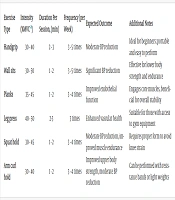
To maximize the benefits of isometric exercise, it is essential to establish clear guidelines for its implementation. Current evidence-based recommendations suggest that isometric exercises should be performed 3 - 5 times per week (Table 2), with each session lasting 10 - 15 minutes (10, 19, 32, 38). Exercises should be performed at a moderate intensity, equivalent to 30 - 40% of maximal voluntary contraction, to achieve optimal blood pressure reductions (Table 2). Additionally, healthcare providers should take into account individual patient characteristics—such as fitness level, comorbidities, and treatment goals—when prescribing isometric exercise programs (12, 19, 38). Table 2 summarizes guidelines for individuals and professionals to use when developing a training plan based on their specific needs. It is important to note that this sample plan is likely to be more generalized, and advanced clinicians should approach its practical application with caution.
Table 2.
Sample Recommendations for Implementing Isometric Exercise in Hypertension Management
| Exercise Type | Intensity (%MVC a) | Duration per Session (min) | Frequency (per Week) | Expected Outcome | Additional Notes |
|---|---|---|---|---|---|
| Handgrip | 30 - 40 | 2 - 3 | 3 - 5 | Moderate BP reduction | Ideal for beginners; portable and easy to perform |
| Wall sits | 30 - 50 | 1 - 2 | 3 - 5 | Significant BP reduction | Effective for lower body strength and endurance |
| Planks | 35 - 45 | 1 - 2 | 3 - 4 | Improved endothelial function | Engages core muscles, beneficial for overall stability |
| Leg press | 40 - 50 | 2 - 3 | 3 | Enhanced vascular health | Suitable for those with access to gym equipment |
| Squat hold | 30 - 45 | 1 - 2 | 3 - 4 | Moderate BP reduction, improved muscle endurance | Requires proper form to avoid knee strain |
| Arm curl hold | 30 - 40 | 1 - 2 | 3 - 4 | Improved upper body strength, moderate BP reduction | Can be performed with resistance bands or light weights |
Abbreviation: BP, systolic blood pressure.
a Percentage of maximum voluntary contraction.
The findings of this review support the efficacy of isometric exercise in reducing BP and improving endothelial function in individuals with MetS (11, 19, 21, 25). The observed reductions in BP are comparable to those achieved with antihypertensive medications, underscoring the potential of isometric exercise as a non-pharmacological intervention for hypertension management. The improvements in endothelial function further highlight the cardiovascular benefits of isometric exercise, particularly in populations at high risk for CVDs (34, 40). While aerobic and dynamic resistance exercises are widely recognized for their cardiovascular benefits, isometric exercise offers unique advantages, particularly in improving vascular function. The findings suggest that isometric exercise may be especially beneficial for individuals who are unable or unwilling to engage in more dynamic forms of exercise (12, 19, 38). However, further research is needed to determine the optimal combination of exercise modalities for maximizing cardiovascular health outcomes.
The clinical significance of these findings lies in the potential for isometric exercise to be integrated into routine clinical practice for managing hypertension and metabolic syndrome. Healthcare providers should consider prescribing isometric exercise as part of a comprehensive lifestyle intervention program for patients with elevated BP and cardiovascular risk factors (19, 30, 31, 33, 34). Given its accessibility and ease of implementation, isometric exercise could be a valuable tool for improving public health outcomes, particularly in underserved populations with limited access to traditional exercise facilities (20, 30).
4. Discussion
This literature review provides a synthetic analysis of existing research on the effects of isometric exercise on BP and endothelial function in individuals with metabolic syndrome. The findings demonstrate that isometric exercise significantly reduces both systolic and diastolic BP, with its impact being comparable to, and in some cases exceeding, those achieved through traditional aerobic or dynamic resistance training. This conclusion aligns with the findings of Edwards et al. (10). Additionally, isometric exercise enhances endothelial function, a critical factor in cardiovascular health, by improving nitric oxide bioavailability and simultaneously reducing oxidative stress.
The reductions in BP observed across multiple studies are clinically significant, with consistent results reported within the same category. For instance, Carlson et al. reported average decreases of 6.77 mm Hg in systolic BP and 3.96 mm Hg in diastolic BP following isometric handgrip training (6). Such reductions are noteworthy because even modest decreases in BP can substantially lower the risk of cardiovascular events, such as stroke and myocardial infarction. This is a crucial outcome for individuals at heightened risk, particularly those with underlying conditions like MetS. The findings of Millar et al. further reinforce the efficacy of moderate-intensity isometric exercise (30 - 40% of maximal voluntary contraction) in achieving optimal BP reductions (8).
The improvement in endothelial function triggered by isometric exercise is particularly relevant for individuals with metabolic syndrome, who often exhibit endothelial dysfunction due to factors such as insulin resistance and chronic inflammation. Enhanced endothelial function, as evidenced by increased flow-mediated dilation and decreased levels of endothelin-1, suggests that isometric exercise may help reverse some of the vascular impairments characteristics of MetS (11). This could potentially lead to reduced arterial stiffness and improved overall vascular health, thereby increasing longevity and overall well-being.
When comparing isometric exercise to other modalities, such as aerobic exercise and resistance training, several unique advantages emerge that underline the beneficial aspects of isometric training. While aerobic exercise remains the gold standard for cardiovascular health, improving both blood circulation and cardiac output, isometric exercise offers a viable alternative in certain cases. As argued by Edwards, isometric exercise may even surpass the potential benefits of aerobic exercise, particularly for individuals who have limitations that prevent them from engaging in dynamic activities—limitations often caused by aging or a sedentary lifestyle, which are common contributors to metabolic syndrome. For example, individuals with joint issues, mobility restrictions, or certain chronic conditions may find isometric exercises more accessible, offering various benefits, such as increased strength, greater muscle activity, and, as a result of training adaptation, a reduction in the root causes of MetS and CVDs. Edwards et al. highlighted that isometric exercise was more effective than aerobic exercise in improving vascular resistance and autonomic function measures (10).
The autonomic benefits of isometric exercise, such as enhanced parasympathetic activity and reduced sympathetic outflow, play a crucial role in blood pressure regulation (6, 26, 28). By modulating the autonomic nervous system, isometric exercise can lead to sustained blood pressure reductions and improved heart rate variability, both of which are important markers of cardiovascular health. Additionally, the muscle activation resulting from isometric exercise offers underlying benefits that may help decrease or even prevent metabolic syndrome and related health issues.
From a clinical and practical perspective, incorporating isometric exercise into hypertension management protocols offers a promising non-pharmacological strategy. Given the challenges associated with medication adherence and the potential side effects of antihypertensive drugs, isometric exercise provides a low-cost, low-risk intervention that patients can easily implement. The simplicity of isometric exercises, such as handgrip squeezes or wall sits, allows for flexibility in various settings, including at home or in clinical environments. However, exercise guideline developers must acknowledge several limitations. The heterogeneity of study designs, including variations in exercise protocols, duration, and intensity, makes it challenging to establish standardized guidelines, as each individual's circumstances may vary. Additionally, most studies had relatively short follow-up periods. As a result, the long-term sustainability of blood pressure reductions and improvements in endothelial function remains uncertain, which necessitates further cohort-based studies in diverse populations to track the ongoing adaptation to isometric training. Furthermore, there is a lack of large-scale, randomized controlled trials explicitly focusing on populations with metabolic syndrome, which limits the generalizability of the findings (36).
Future research should aim to address these limitations by conducting long-term, randomized controlled trials with larger and more diverse populations. Investigations into the optimal intensity, duration, and frequency of isometric exercise are necessary to develop evidence-based guidelines. Additionally, exploring the molecular mechanisms underlying the benefits of isometric exercise could provide deeper insights into how these exercises influence cardiovascular health.
4.1. Conclusions
This article presents a literature review of existing studies, which demonstrate that isometric training can effectively reduce and manage hypertension. Isometric exercise emerges as a potent, non-pharmacological intervention for lowering blood pressure and enhancing endothelial function in individuals with metabolic syndrome. Its ease of implementation and adaptability make it a practical addition to hypertension management strategies, particularly for those unable to participate in traditional exercise programs. By integrating isometric exercise into comprehensive lifestyle interventions, healthcare providers can offer patients a holistic approach to reducing cardiovascular risk and improving overall health outcomes.