
1. Background and Objectives
Encephalomyelitis is generally an inflammatory disease. Its incidence varies based on age, sex, and environmental factors. Data suggest a prevalence ranging from 1.4 to 13.8 cases per 100,000 people, with the risk of developing the condition increasing with age. Furthermore, multiple sclerosis (MS) is an autoimmune disease that currently has very limited treatment options. Multiple sclerosis (MS) is a demyelinating disease of the central nervous system that manifests as neurological disability in young and middle-aged individual. The disease is influenced by environmental factors, genetics, age, gender, and race, and its prevalence appears to be increasing (1). Evidence suggests that systemic inflammation and oxidative stress in MS can disrupt neurotransmitter function and affect other organs (2). Notably, heart disease occurs more frequently in MS patients due to neurotransmitter dysfunction (3). Furthermore, disturbances in cerebral blood flow in neurological diseases can alter neuropeptides - including neuropeptide gamma, oxytocin, adropin, neuropeptide 26RFa, ghrelin, prolactin, neurolysin - which in turn affect related physiological axes (4). Among these, B-type natriuretic peptide (BNP) has been associated with cognitive disorders (5)and cardiovascular dysfunction (6). while A-type natriuretic peptide (ANP) has been linked to cardiovascular diseases (7). Collectively, these findings suggest a potential role of BNP and ANP in cardiovascular complications of neurological disorders. Additionally, these peptides, BNP and ANP, not only play a critical role in cardiovascular regulation but may also influence neurological function (5).
Regular and long-term physical activity positively influences central nervous system function, improving memory and cognitive function through modulation of neurotransmitters, reduction of inflammation, and prevention of neuronal apoptosis (8, 9). Exercise also enhances mitochondrial biogenesis, antioxidant defense, and cardiac function even in older individuals and those with psychological disorders (10). Studies have been conducted on the effect of exercise on natriuretic peptides; for example, one study showed that NT-Pro BNP decreases during endurance training (ET) and decreases significantly after ET. While the change was not significant during resistance exercise and NT-Pro BNP levels increased only after resistance exercise (11). In another study, researchers reported an increase in BNP levels after exercise in athletes of various disciplines (12). Also, studies have reported a favorable effect of exercise on ANP in obese women with polycystic ovary syndrome (13). In another study, the effect of ET on increasing ANP after intense exercise has been reported (14).
In parallel, antioxidant supplementation, such as royal jelly (RJ), improves nervous system function (15). Rich in flavonoids, isoflavones, and 10-hydroxy-2-decanoic acid (10-HDA), RJ enhances neurogenesis, cognitive function, digestive health, metabolic profile, and blood pressure regulatione (16). RJ, as a known antioxidant, has long been used as a medicinal and therapeutic method in some diseases; for example, a study found that RJ can increase vascular vasodilation and reduce blood pressure through the activation of endothelial nitric oxide synthase (17). Also, in a study, the results showed an improvement in the function of the cholinergic system, the autonomic system in ovariectomized rabbits (18). Even in a study, the results showed an improvement in blood pressure, blood lipid indices, cardiovascular function and oxidative stress (19).
In recent years, the interaction between endurance training and metabolic regulation has gained considerable attention in animal models. For instance, Saghebjoo et al.(2025)demonstrated that endurance training significantly improved insulin sensitivity in obese rats, although no substantial changes in nicotinamide N-methyltransferase (NNMT) levels were observed in liver or adipose tissue. These findings provide a relevant comparative framework for investigating cardiac peptides (ANP/BNP) in neuroinflammatory conditions, highlighting the systemic biochemical effects that exercise may exert beyond key metabolic enzymes (20). Understanding how their levels change in response to interventions such as endurance training and royal jelly supplementation can provide insight into both cognitive and cardiovascular outcomes, emphasizing the relevance of these endpoints in neurological disorders (11). Despite these findings, to our knowledge, no studies have investigated the combined effect of endurance training and RJ on BNP and ANP, which play critical roles in cardiovascular health in neurological disorders. Therefore, the present study aimed to examine the effect of eight weeks of endurance training combined with RJ consumption on ANP and BNP in the brain tissue of rats in an experimental autoimmune encephalomyelitis (EAE) model.
2. Methods
2.1. Animals
In this experimental study, 56 healthy female Sprague - Dawley rats (8 - 10 weeks old, 200 - 220 g) were obtained from an accredited animal facility. Only animals with stable body weight and no signs of infection, external injury, systemic illness, or neurological abnormalities were eligible for inclusion. This study was approved and conducted in accordance with institutional animal ethics requirements. During the study, the animals were kept in standard conditions in terms of light (12-hour dark-light cycle), temperature (22 - 24 degrees Celsius), and humidity (55 - 60%) in transparent polycarbonate cages with autoclaving capability; also, sterile wood shavings were used to change the animal bedding, as well as the animals had free access to water and food throughout the study.
2.2. Induction of Experimental Autoimmune Encephalomyelitis Model
After an adaptation period to the new environment, to induce EAE, first 20 guinea pigs were obtained from the Pasteur Institute of Iran and transferred to the animal laboratory; then the guinea pigs were dissected after anesthesia with ketamine and xylazine and their spinal cord tissue was extracted. Then the guinea pig spinal cord tissue was immediately immersed in a nitrogen tank and then pounded in an oven filled with nitrogen; to homogenize the spinal cord tissue, it was then mixed with an equal amount of normal saline and placed in a shaker at 5°C until completely homogenized. Next, the homogenized solution was mixed with compound Freund's adjuvant (CFA) in a ratio of 1:1 to form an emulsion solution. Two glass syringes connected by a steel connector were used to prepare this suspension. One of the syringes contained homogenized guinea pig brain and spinal cord and the other syringe contained the same volume of Freund's adjuvant, and they were mixed in the same ratio. The solution was shaken until its color became uniform and white. After the rats were completely anesthetized with ketamine and xylazine, 400 microliters of the antigen and adjuvant mixture were injected subcutaneously in the back and 100 microliters were injected subcutaneously in other designated areas of each animal with a 25-gauge needle. To diagnose disease induction, the disease course was assessed daily and the disease scale was evaluated based on 0: no disease, 1: impaired tail movement, 2: paralysis of the tail, 3: impaired walking, 4: paralysis of one leg, 5: paralysis of both legs, 6: paralysis of all four limbs, and 7: death (21, 22). It should be noted that, given the researcher's need for the patient rat to perform minimal daily activities, rats that were on the scale of 6 and 7 were naturally excluded from the study. It is worth noting that in the research process, two rats were excluded due to being on the scale of 6 and 7.
2.3. Grouping and Research Design
After ensuring that EAE, (rats were induced according to the scales and homogenized based on motor power and disability scale) 49 rats with EAE were divided into 7 groups including (1) EAE, (2) sham, (3) 50 mg/kg RJ (RJ50), (4) RJ100, (5) ET, (6) ET+RJ50, and (7) ET+RJ100. It is also worth noting that seven healthy rats were selected as the healthy control (HC) group to examine the effects of EAE induction on the research variables. Rats in the RJ groups received daily doses of RJ (dissolved in normal saline) intra- peritoneally for 5 weeks (23). Rats in the ET groups also performed ET on a special rat treadmill for five weeks, five sessions per week, and each session lasting 30 minutes at a speed of 11 m/min (24, 25). The sample size per group was chosen based on previous studies in similar animal models. A standard method for animal studies was used to estimate statistical power, which was approximately 80%, ensuring adequate sensitivity to detect significant differences among groups. To ensure comparability among groups, rats were stratified based on EAE severity and then evenly distributed so that each group had similar levels of motor impairment and disability; according to the study protocol, animals with very severe disease (scores 6 - 7) would have been excluded, but after random placement in groups, no rats met this criterion, and therefore none were excluded.
2.4. Endurance Training Protocol
ET was started approximately 10 days after induction of the experimental EAE model. Rats were familiarized with the treadmill for one week for 5 - 25 minutes every day at a speed of 6 m/min, and an 11-degree incline. Then, they performed ET for 5 weeks, at a speed of 11 m/min for 25 - 35 minutes every day. In other words, the ET was 25 minutes in the first week, and due to the progressive motor disorder in rats, the duration was increased by 2 minutes each week until it reached 35 minutes in the fifth week. One of the reasons for choosing this training protocol is the neuronal improving effects of this type of training in rats with cognitive disorders in small laboratory mice and rats in the experimental model of Parkinson's and EAE models (24, 25).
2.5. Royal Jelly Consumption
To consume RJ at doses of 100 and 50 mg/kg over five weeks, RJ prepared from the Agricultural Jihad Center in Marvdasht city was dissolved in normal saline daily and then injected intra- peritoneally (23).
2.6. Sampling Method
Rats were weighed once a week throughout the study, including the MS infection phase and the exercise protocol phase. Rats were also handled and transported by one person throughout the study period. All stages of maintenance and killing of rats were carried out according to the rules of the animal ethics committee. Forty- eight hours after the last ET session, rats were anesthetized with drugs, and their brain tissue was isolated and homogenized and stored in liquid nitrogen at -80°C for subsequent analysis.
2.7. Method of Measuring Variables
In the present study, BNP protein concentration was measured using an ELIZA kit manufactured by Fine Test Company, China, with Catalogue No. ER0775 and sensitivity of picograms per milliliter (pg/ml) as well as ANP measured using an ELISA kit manufactured by Fine Test Company, China, with Catalogue No. ER0738 and sensitivity of pg/ml.
2.8. Statistical Analysis of Data
First, the Shapiro- Wilk test was used to examine the normal distribution of the findings of this study. Also, one-way analysis of variance (ANOVA) was used to examine between group differences, and the Tukey post-hoc test was used in SPSS (version 22) software to determine the location of the differences between the groups (P ≤ 0.05).
3. Results
Table 1 presents the mean and standard deviation of the variables in the research groups. The results of one-way ANOVA showed that there was a significant difference in the levels of ANP (F = 45.25 and P = 0.001) and BNP (F = 14.87 and P = 0.001) in the brain tissue of rats in the research groups. To estimate the magnitude of between-group differences, effect sizes (eta squared) were calculated for the ANOVA models. ANP levels showed a very large effect size (η² = 0.868), indicating that 86.8% of the variance in ANP values was explained by group differences. BNP levels also demonstrated a large effect size (η² = 0.684), suggesting that 68.4% of the variance was attributable to group differences.
Table 1.
Mean ± SD of ANP and BNP Values in the Study Groups a
| Grouping | ANP (pg/mL) | BNP (pg/mL) |
|---|---|---|
| HC | 151.88 ± 13.26 | 80.40 ± 10.09 |
| Sham | 140.46 ± 8.12 | 91.31 ± 2.10 |
| EAE | 243.23 ± 26.42 | 121.56 ± 11.35 |
| RJ50 | 202.84 ± 6.93 | 103.56 ± 2.78 |
| RJ100 | 191.57 ± 24.93 | 95.40 ± 16.43 |
| ET | 276.96 ± 24.48 | 127.40 ± 17.91 |
| ET+RJ50 | 218.15 ± 12.05 | 91.90 ± 5.54 |
| ET+RJ100 | 151.80 ± 10.82 | 85.06 ± 7.47 |
Abbreviations: ANP, atrial natriuretic peptide; BNP, B-type natriuretic peptide; EAE, experimental autoimmune encephalomyelitis; ET, endurance training; HC, healthy control; RJ, royal jelly; SD, standard deviation.
a Values are presented as mean ± SD.
Post-hoc analyses revealed no significant difference in ANP levels between the Sham and HC groups (P = 0.94, Mean Difference: -11.43 pg/mL). The EAE group exhibited significantly higher ANP levels compared to HC (P = 0.001, MD: +91.35 pg/mL) and Sham (P = 0.001, MD: +102.78 pg/mL). Treatment with RJ50 (P = 0.006, MD: -40.40 pg/mL), RJ100 (P = 0.001, MD: -51.67 pg/mL), and ET+RJ100 (P = 0.001, MD: -91.43 pg/mL) significantly decreased ANP levels compared to the EAE group. In contrast, the ET group showed a significant increase compared to EAE (P = 0.03, MD: +33.73 pg/mL). Compared to RJ50, ANP was higher in ET (P = 0.001, MD: +74.13 pg/mL) and lower in ET+RJ100 (P = 0.001, MD: -51.03 pg/mL). Similarly, compared to RJ100, ANP was higher in ET (P = 0.001, MD: +85.40 pg/mL) and lower in ET+RJ100 (P = 0.001, MD: -39.76 pg/mL). Furthermore, ANP levels in ET+RJ50 (P = 0.001, MD: -58.81 pg/mL) and ET+RJ100 (P = 0.001, MD: -125.16 pg/mL) were significantly lower than ET, and ET+RJ100 was lower than ET+RJ50 (P = 0.001, MD: -66.35 pg/mL) (Figure 1).
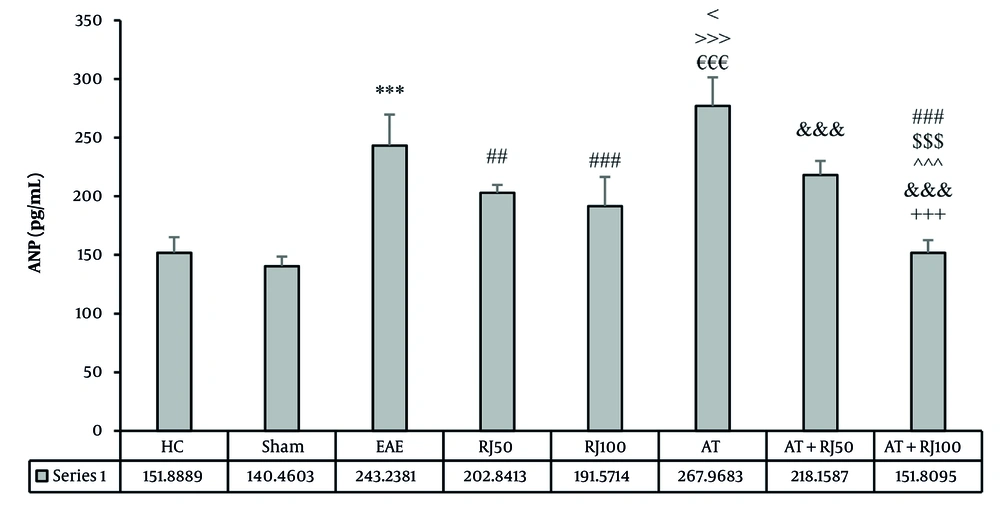
Figure 1.
Results of one-way ANOVA test to examine the inter- group and intra- group changes in ANP in the research groups. significant increase compared to the HC and Sham groups; *** P = 0.001 significant decrease compared to the EAE group; ## P = 0.01 and significant increase compared to the RJ50 and RJ100 groups; ### P = 0.001 significant increase compared to the ET+RJ100 group; &&& P = 0.001 and & P = 0.05 significant decrease compared to the ET group; $ P = 0.001 significant decrease compared to the ET+RJ50 group.
BNP levels showed no significant difference between the Sham and HC groups (P = 0.64, MD: +10.92 pg/mL). The EAE group had significantly higher BNP levels compared to HC (P = 0.001, MD: +41.17 pg/mL) and Sham (P = 0.001, MD: +30.25 pg/mL). Treatment with RJ100 (P = 0.003, MD: -26.17 pg/mL), ET+RJ50 (P = 0.001, MD: -29.67 pg/mL), and ET+RJ100 (P = 0.001, MD: -36.50 pg/mL) significantly decreased BNP compared to the EAE group. Moreover, compared to ET, BNP levels were lower in RJ50 (P = 0.009, MD: -23.83 pg/mL), RJ100 (P = 0.001, MD: -32.00 pg/mL), ET+RJ50 (P = 0.001, MD: -35.50 pg/mL), and ET+RJ100 (P = 0.001, MD: -42.33 pg/mL) (Figure 2).
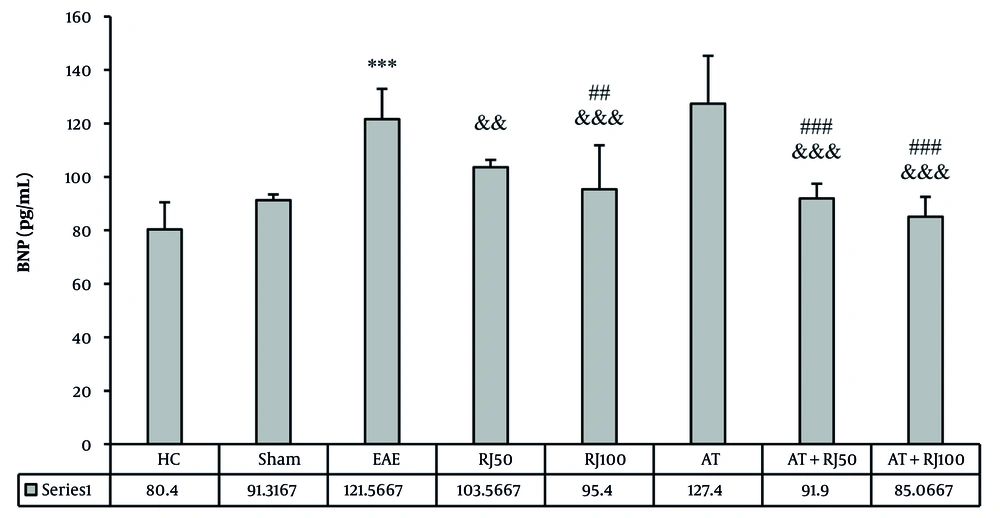
Figure 2.
Results of one-way ANOVA test to examine the inter- group and intra- group changes in BNP in the study groups. *** P = 0.01 significant decrease compared to the EAE group; ## P = 0.01 significant decrease compared to the ET group.
4. Discussion
This study investigated the combined effects of exercise training and royal jelly on ANP and BNP levels in brain tissue within the EAE model. While previous research has established the beneficial effects of exercise training and royal jelly individually in neurodegenerative diseases, this is the first study, to our knowledge, to examine their simultaneous impact on these specific biochemical markers in the brain under EAE conditions. Therefore, direct comparative analyses with studies reporting identical variables and conditions are limited due to the novelty of this combined approach. Our findings provide a foundational understanding of the synergistic or additive effects of these interventions, paving the way for future research exploring the underlying molecular mechanisms. The results showed that in the EAE group, the ANP and BNP levels were higher than in the HC group. However, in the ET group, the ANP levels were significantly higher than in the EAE group. Exercise may induce these changes by activating the P38 protein, a subunit of the mitogen-activated protein kinase (MAPK) pathway, which binds to NF-κB, facilitating its translocation to DNA and promoting transcription of the proBNP precursor, ultimately increasing proBNP synthesis at the ribosome (26). Consistent with these findings, eight weeks of resistance training has been shown to elevate BNP levels in healthy male rats (26). In a review study that was conducted by reanalyzing nine studies, the results indicated an increase in pro-BNP and NT-pro-BNP levels in patients with myocardial infarction (27). Moreover, NT-proBNP levels appear to rise during exercise training, although eight weeks of ET may eventually decrease these levels, whereas resistance training over eight weeks increases NT-proBNP (11). Giallauria et al. similarly reported increased NT-proBNP and improved cardiac function following acute myocardial infarction (28). Oxidative stress and activation of inflammatory factors during exercise likely contribute to NF-κB activation, which may further elevate ANP levels, particularly in inflammatory conditions such as MS. Supporting this, eight weeks of ET increased ANP and isoproterenol in rats with polycystic ovary syndrome (13). Also, a study conducted on inactive elderly men showed that eight weeks of weight training led to an increase in ANP, BNP, and galectin-3 in these men (29). Additionally, exercise modulated ANP receptor expression, increasing NPR-A and decreasing NPR-C in kidney tissue (30). However, information regarding these changes in brain tissue remains limited, highlighting the need for further studies. Although endurance training is generally considered safe in the context of MS, some studies report a modest increase in minor adverse events. Systematic reviews of exercise training in people with MS found no increased risk of relapse or serious adverse events compared to controls, but there was a slightly higher rate of mild adverse events (such as musculoskeletal discomfort or illness) (31, 32). Therefore, while our exercise training regimen was well tolerated in the EAE model, potential low-grade side effects should be monitored in future studies.
The results showed that in the RJ100 groups, the ANP and BNP levels were significantly lower than EAE group. Also, in the RJ50 group, the ANP levels were significantly lower than EAE group. RJ appears to exert these effects due to its abundant flavonoids and high levels of 10-HDA, which activate the AMPK pathway, subsequently leading to NRF1/2 activation. These proteins in turn stimulate PPAR-γ and PGC1-α, enhance transcription of antioxidant enzymes, and inhibit NF-κB by suppressing Toll-like receptors 2 and 4, thereby downregulating inflammatory factor transcription. Moreover, RJ can inhibit MAPK signaling, reducing PARP-1, Caspase-3, and acetylation of histones H3 and H4, ultimately decreasing cell apoptosis (33). Daily intake of 1000 mg RJ reduced inflammatory markers in patients with MS (34), and anti-inflammatory effects at 100 mg/kg have been reported in skeletal muscle tissue in an animal model of nervous system disorders (35). However, lower doses or shorter durations may not produce sufficient biological effects. Therefore, RJ100, in addition to inhibiting inflammation and oxidative stress, may exert multiple beneficial biological effects in MS(36). RJ is largely safe in animal models, but high or prolonged doses may carry some risk. For instance, rodent studies have shown that RJ can affect liver enzyme levels or renal markers when administered chronically or at high doses (37, 38). Although no overt toxicity was observed in our study, these findings suggest that dose optimization and monitoring of hepatic or renal function are important in future investigations.
In the present study, the ANP and BNP levels in the ET+RJ100 group were significantly lower than EAE group. However, ANP levels in the ET group were significantly higher than EAE group. Also, ANP and BNP levels in RJ50, RJ100, ET+RJ50 and ET+RJ100 groups were significantly lower than ET group. ANP levels in the ET+RJ100 group were significantly lower than RJ50 and RJ100 groups. Also, it was significantly lower in the ET+RJ100 group compare to ET+RJ50 group. BNP levels in the ET+RJ50 group were significantly lower than EAE group.
Exercise training may elevate ANP and BNP in brain tissue by stimulating muscle protein synthesis in striated muscles, improving neuronal function, and activating angiogenesis-related pathways such as MAPK/NF-κB (15, 26, 39); In contrast, RJ increases antioxidants dose-dependently, enhances insulin sensitivity, supports neurotrophin function, promotes neurogenesis, improves neuronal function, and activates AMPK/NRF1/2, ultimately stimulating PPAR-γ, PGC1-α, and antioxidant transcription. RJ also inhibits TLR2/4/NF-κB via MAPK suppression, reducing inflammatory factor transcription (15, 33). Therefore, ET and RJ appear to modulate ANP and BNP through complementary pathways: Exercise training promotes their expression via neuronal and angiogenic mechanisms, while RJ exerts antioxidant and anti-inflammatory effects. Consuming RJ alongside exercise training not only enhances the beneficial effects of ET but also helps regulate ANP and BNP levels more effectively.
Our findings demonstrate that both RJ supplementation and ET exert favorable effects on BNP and ANP levels in our experimental model, underscoring their potential neuroprotective and cardiovascular benefits. While direct extrapolation from rodent models to human Multiple Sclerosis (MS) requires careful consideration due to inherent physiological differences, these results offer crucial insights into the therapeutic potential of lifestyle interventions and natural compounds. This study provides a strong preclinical foundation, suggesting that these combined or individual strategies could serve as valuable adjunctive approaches to ameliorate MS pathology and improve patient outcomes, thereby paving the way for future human clinical investigations into their efficacy and safety.
Consistent with previous studies, our findings suggest that endurance training can modulate cardiac peptide levels in EAE rats. This is in line with evidence that exercise exerts systemic biochemical effects, including improvements in metabolic and inflammatory markers, even when key metabolic enzymes such as NNMT remain unchanged (20). These results further support the potential protective role of exercise training interventions in neuroinflammatory conditions.
Considering that the present study was probably the first study to examine these two natriuretics in brain tissue in an encephalomyelitis model, one of the limitations and innovations of the present study was the limited information in this field. Therefore, further studies in this field are recommended. Considering the role of exercise training in activating the MAPK/NF-κB pathway and RJ in suppressing it, the lack of evaluation of this pathway is another limitation of the present study. Therefore, it is suggested that the upstream pathways of ANP and BNP be evaluated in future studies. A limitation of the present study is that we were unable to perform final functional assessments of motor deficit in the rats. Future studies could integrate longitudinal behavioral evaluations with molecular analyses to better correlate functional recovery with changes in BNP, ANP, and other molecular markers. Also, while RJ supplementation and endurance training showed promising effects on BNP and ANP, this study has limitations including small sample size, lack of behavioral data, and potential confounding factors. Future research should address these by using larger cohorts, incorporating detailed behavioral assessments, and performing advanced pathway analyses.
4.1. Conclusions
Although ET leads to an increase in BNP and ANP, and RJ at different doses leads to a decrease in them, it seems that the use of RJ along with ET, in addition to enhancing the effect of training on cardiac and cerebral natriuretic factors, can control their excessive increase. It is believed that overexpression of ANP and BNP is associated with left ventricular dysfunction and consequently cardiac mortality. However, further studies are needed to investigate the synergic effects of exercise training and royal jelly consumption. Such studies will be crucial for validating these findings and paving the way for human clinical trials to explore their therapeutic potential in MS.