
1. Background
Volleyball became popular with people all over the world; in addition to the Olympics, competitions such as the World Championship, the World Cup, the World League, the World Grand Prix, the Grand Cup of Continental Champions, and the World Junior and Youth Championship are only part of the global plans of the planners. Volleyball policy makers aim to please the fans of this sport. It is a worldwide sport played by approximately 200 million people (1). It is played across various levels of competition, with organizations catering to participants from youth to professional level. Although volleyball is classified as a "non-contact" sport with players divided by a net, individuals competing at advanced levels are still susceptible to both traumatic and overuse injuries (2, 3). Injuries in sports can prevent athletes from participating in training and competitions, leading to significant repercussions for both the individuals and the club (4), highlighting the need to comprehend the occurrence and distribution of injuries (5). The occurrence of musculoskeletal injuries in volleyball is approximately 10.7 injuries per 1,000 hours of play (2). Injuries are prevalent in the ankle, knee, and shoulder, with the ankle exhibiting the highest rate of acute injuries, while overuse injuries are more commonly seen in the shoulder and knee (6).
Although volleyball has a lower injury rate compared to several other sports (7-9), there is a need to quantify these injuries (10). For planning preventive measures, it is essential to understand the incidence and causes (risk factors and mechanisms) of injuries in order to implement effective preventive measures tailored to a specific population (11, 12). The sources stated that preventive strategies should be designed in order to reduce the injuries. The prerequisite for designing and evaluating these strategies is continuous access to longitudinal and high-quality information on sports injuries. Holder stated that the success of injury prevention strategies depends on comprehensive epidemiological information on the incidence and severity of injuries (13). In Finch's injury prevention model and van Mechelen model, the first step is to count the number of injuries (TRIPP) (11, 14) In fact, without reliable information, health sector planners are severely handicapped in allocating resources in order to achieve maximum effectiveness in injury prevention.
There are limited studies on women’s injuries in volleyball. Furthermore, earlier studies focused solely on time-loss (TL) injuries, which are defined as injuries that restrict participation for a minimum of 24 hours. As a result, data on non-time-loss (NTL) injuries — those causing participation restrictions of less than 24 hours — were not collected.
2. Objectives
The current research aimed to investigate the epidemiology of volleyball-related injuries in the Iranian Women's Premier League during one season.
3. Methods
The epidemiology of sports injuries was studied over one season involving three women's Premier League teams during the 2023 - 2024 period, comprising a total of 48 players via convenience sampling. Injury rates were determined based on 1,000 athlete-exposures (AEs). All injuries were documented by the teams’ athletic trainers or physicians using an injury report form.
We classified an injury as either new (meaning pre-existing conditions that were not fully rehabilitated were excluded) or recurring (referring to athletes who had returned to full participation after a prior condition). This definition encompasses musculoskeletal complaints, concussions, or other medical issues (injuries) that occurred during competition or training from the beginning of pre-season training to the end of the season (October 2, 2023, to February 27, 2024), provided they received medical attention, irrespective of the impact on participation in competitions or training (15). Severe injuries were defined as injuries estimated to lead to absence from training or competition of more than 28 days.
Injuries were classified by affected body parts, which included the head/face, neck, shoulder, arm/elbow, hand/wrist, trunk (encompassing the chest, abdomen, upper back, and lower back), hip/groin, upper leg, knee, lower leg, ankle, foot, and other categories. Diagnoses were grouped into categories such as tendonitis, tears, strains, sprains, scratches/attrition, dislocation, contusion/bruising, stress fracture, and other. Injury mechanisms were categorized as non-contact, contact with the ball, equipment or teammate, dealing with opponent, collision with surface, and etc. All descriptive analyses were performed using Microsoft Excel and SPSS software (version 26).
This study received approval in line with the ethical guidelines established by the ethics committee of the University of Tehran and was conducted under the ethics code IR.UT.SPORT.REC.1403.041.
4. Results
4.1. Overall Incidence Rates
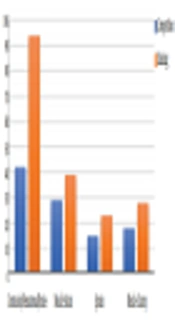
A total of 59 injuries (55 injuries during practice and 4 injuries during matches) were reported during 13,470 playing hours (11,616 practice and 1,854 competition), and the injury rate of 4.38 per 1,000 AEs was calculated. The practice injury rate was greater than the competition among all injuries (4.73 vs 2.15 per 1,000 AEs). The injury rate was higher in the preseason than the in-season injury rate (22% vs 77.9%). In the first half of the season, more injuries were reported than in the second half of the season (44% vs 33.9%). The practice injury rate in the first half of the season was more than the competition (8.01 vs 1.22 per 1,000 AEs). However, in the second half of the season, the match injury rate was higher than the training (2.88 vs 2.81 per 1,000 AEs). Women aged 16 to 20 incurred most of the injuries (55.9%) (Figure 1).
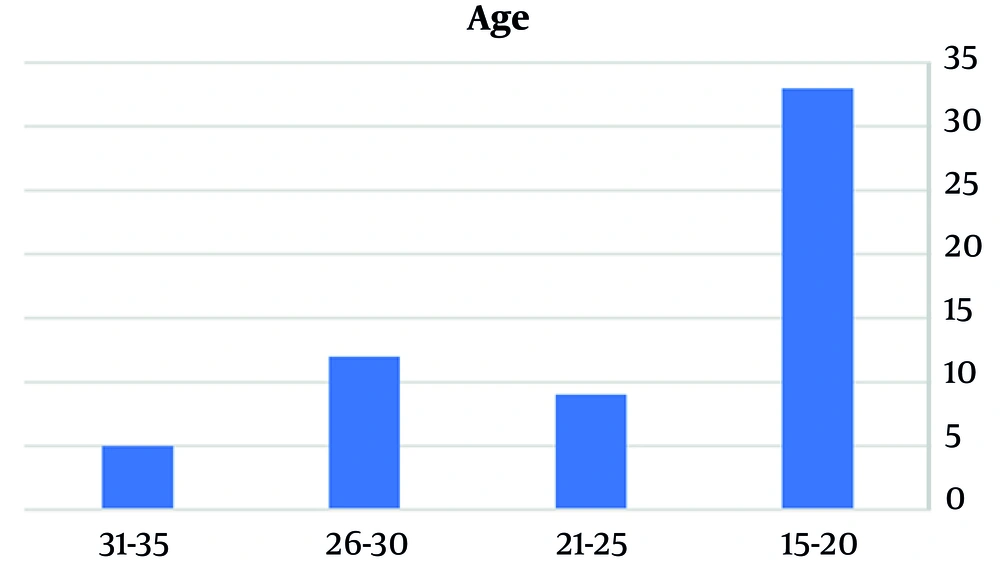
Figure 1.
Prevalence of volleyball injuries in different age categories
4.2. Injury Mechanisms and Activities
Various injury mechanisms were reported. The most common mechanisms of injury were non-contact (66.1%), whereas 20 injuries were contact with the floor (11.8%), contact with ball or equipment (11.8%), and contact with another player (8.4%).
4.3. Injury by Type and Anatomical Area
Acute injuries, such as spasms and sprains, were reported more frequently. The lower extremities were the most affected, accounting for 45.7% of all injuries, with the lumbar spine, shoulder, and shin being the most commonly injured body parts (18.6%, 16.9%, and 13.5%, respectively). Acute injuries were more prevalent than chronic injuries, with rates of 67.7% compared to 32.2%. Overuse injuries were primarily reported in the shoulder, followed by the lower leg. Additionally, spasms were the most common type of injury, particularly acute injuries to the lumbar spine, while shoulder tendinopathy was the most frequently reported overuse injury (Tables 1 and 2).
Table 1.
Distribution of Injury Type
| Variables | No (%) |
|---|---|
| Scratch/attrition | 4 (6.8) |
| Tear | 1 (1.7) |
| Sprain | 10 (16.9) |
| Strain | 4 (6.8) |
| Tendonitis | 9 (15.3) |
| Contusion/bruising | 3 (5.1) |
| Dislocation | 2 (3.4) |
| Inflammation | 4 (6.8) |
| Spasm | 17 (28.8) |
| Shin splint | 4 (6.8) |
| Others | 1 (1.7) |
| Open wound/cut | 0 (0) |
| Fracture | 0 (0) |
| concussion | 0 (0) |
| Total | 59 (100) |
Table 2.
Distribution of Injuries by Body Location
| Variables | No (%) |
|---|---|
| Shoulder | 10 (16.9) |
| Shin | 8 (13.6) |
| Lumbar spine | 11 (18.6) |
| Knee | 6 (10.2) |
| Hip, hip joint, groin | 6 (10.2) |
| Heel/achilles tendon | 1 (1.7) |
| Fingers | 5 (8.5) |
| Femur | 1 (1.7) |
| Elbow | 5 (8.5) |
| Arm | 1 (1.7) |
| Ankle | 5 (8.5) |
| Head | 0 (0) |
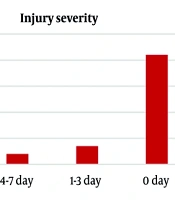
More than two-thirds (71.1%) of all reported injuries resulted in TL of < 1 day. Injuries resulted in TL of 1 to 3 days (11.8%), 4 to 7 days (6.7%), and 8 to 28 days (10.1%). None of the injuries required surgery (Figure 2).
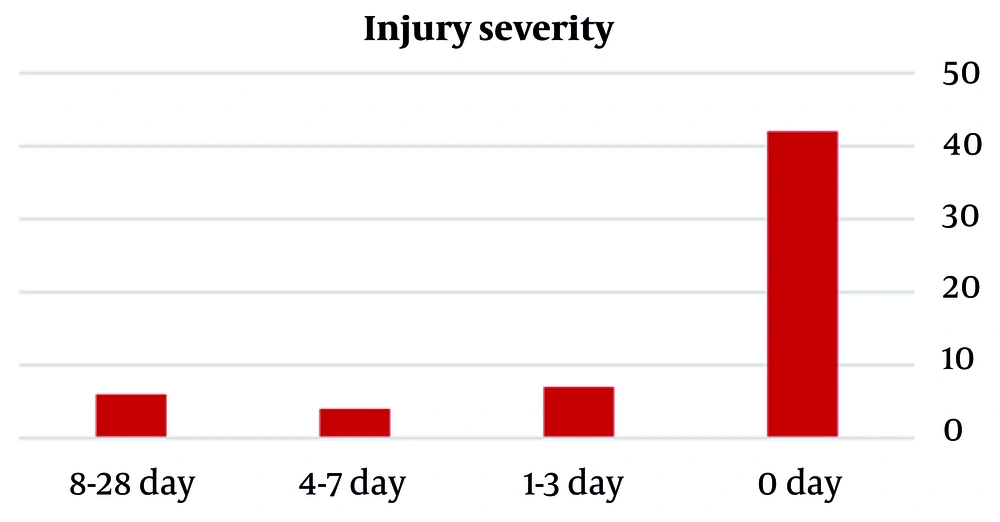
Figure 2.
Prevalence of volleyball injuries severity
5. Discussion
The present study aimed to investigate the epidemiology of injuries incurred in Iranian female volleyball premier league athletes in the 2023 - 2024 season. This study demonstrates an overall injury frequency of 64.5%. The injury incidence rate was 4.3 per 1,000. In the Danish elite division reported an injury incidence of 3.8 per 1,000 playing hours (1). In a six-day prospective study conducted during the USVBA National Tournament, Schafle et al. estimated the injury incidence to be 2.3 per 1,000 playing hours, considering only those injuries that resulted in at least one day of missed participation (16). Bahr et al. (17) found the acute injuries incidence of 1.7 per 1,000 in a prospective one-season study. In a one-season prospective cohort study in the second and third Dutch national volleyball divisions (1), the incidence rate of 2.6 per 1,000 playing hours was reported, with the incidence rate of 1.8 per 1,000 playing hours for training and 4.1 for matches also reported.
In general, injury rates across various sports tend to be higher during competitions compared to practices (3); however, in the present study, the practice injury rate was greater than the competition injury rate among all injuries (4.73 vs 2.15 per 1,000 AEs). These differences may be due to the difference in the definition of injury and its reporting method. Also, the rate of injury in pre-season training was high (5.29 per 1,000 AEs). In the second half of the season compared to the previous season and the first half of the season, the injury rate was lower. This reduction is probably due to the increase in the level of preparation and adaptation of players to training and competitions.
Previous research examining women’s volleyball from 1988 - 1989 to 2003 - 2004 (18), found injury rates of 4.58 per 1,000 AEs during competitions and 4.10 per 1,000 AEs during practices. In more recent NCAA-ISP data (2005 - 2006 to 2008 - 2009) (19), the injury rates for competitions and practices were recorded at 3.93 and 4.12 per 1,000 AEs, respectively. While the injury rates in the current study seem elevated, with competition and practice rates of 7.48 and 6.91 per 1,000 AEs, respectively, it is important to note that previous research focused solely on TL injuries that resulted in participation restrictions of at least 24 hours. Our data also encompassed NTL injuries that led to participation restrictions of less than 24 hours; these injuries represented 71.1% of all injuries reported in women's volleyball. These injuries are important because they may decrease athlete function.
With an incidence of 28.8% in the present study, acute spasms were the most common type of injury in volleyball. Most of them were acute spasms secondary to overuse affecting the lumbar spine. Ankle sprains were the most common type of injury (1, 16, 17, 20-24). Ankle injuries accounted for roughly 8.4% of all injuries (acute and overuse) and for 12.5% of all acute injuries. In turn, a lumbar spine injury that requires medical intervention accounted for 18.6% of all injuries. Most injuries occurred in the shoulder (16.9%). Tendonitis, spasm, and inflammation were the most common shoulder injuries that occurred due to overuse. Shin injuries accounted for 13.5% of all injuries. Shin splints were the most common cause of pain in the leg.
More studies are needed in this field to determine the cause of these severe spasms, especially in the lumbar region, because this injury led the player to stay away from training and competition for a significant period of time.
Overall, injuries were mild in severity. 71.1% of all reported injuries resulted in TL of < 1 day. Only 10.1% of injuries resulted in TL of 8 - 28 days.
77.9% of the reported injuries were new injuries, 11.8% were re-injuries, and 10.1% were injuries in the previous location, but the type of injury was different.
Acute injuries such as tear, sprain, strain, dislocation, and spasm were reported more than chronic injuries such as tendonitis and shin splint (67.7% vs 32.2%). Similar to those reported in previous research (1, 2, 18), most volleyball injuries were sustained to the lower extremity.
Protective equipment to prevent injury was present in only 13.5% of injuries, while no protective equipment was used in more than 80% of injuries. The court surface in 83% of the injuries was artificial flooring.
Most studies have been reported on men, and data on injuries in women are limited. Due to the limitations of studies about the injuries of Iranian elite women's volleyball players, preventive programs based on these data may help coaches, players, physiotherapists, and researchers regarding women's injuries.
In previous studies, pre-season injuries have been less examined, but in the present study, pre-season injuries during preparation were also reported. In this study, injuries were reported with the index of the athletic exposure, which is not reported in most studies.
5.1. Conclusions
The injury incidence rate was higher in practice than in competition. Most injuries occurred in the lower extremity with NTL. A significant number of injuries were overuse, which are potentially preventable. Most of the injury mechanisms were non-contact. The amount of injury in pre-season and first half-season preparation exercises was higher. The lumbar spine and shoulder are a priority for preventive measures. Coaches can also focus more on these areas in training. Preventive measures should be considered for the shoulder and lumbar spine in women’s volleyball players after considering the injury mechanisms. Further study is needed in women’s volleyball players in a larger population and with more supervision on injury mechanisms as well.