


1. Background
Baseball continues to be one of the most popular sports in the United States, with involvement ranging from recreational youth players to professional athletes (1). At any age and level of experience, a successful and effective baseball swing is key within the offensive goals of scoring runs and preventing injury. The baseball swing is considered to be a highly skilled motion, yet there are gaps in the research regarding the effectiveness of various training techniques to improve baseball swinging skills. Baseball coaches have been implementing various drills that are believed to develop bat speed, increase hip and trunk rotation acceleration, and keep a batter’s hands from moving inferiorly or anteriorly away from their center of mass, yet these drills have not been examined empirically to support their effectiveness. Validating some of these drills will enable coaches at all levels to utilize them or create other drills to assist with improving batting metrics and swing biomechanics.
Baseball batting requires coordination of multiple body segments in a kinematic chain sequence from a bottom-up approach with hip/pelvic rotation as the essential component to how the rest of the upper body initiates movement during the swing, with shoulder rotation, and upper limb swing to follow (2, 3). Using this kinematic chain sequence, baseball batting can be divided into seven phases waiting, shifting body weight, stepping, landing, swing, impact, and follow through (4, 5). During the shifting body weight, stepping, and landing phases, it is important to prevent the hand moving too far away from or staying too close to the pelvis to allow for proper transfer of torque created by the pelvis to the hand. These three phases are also where the batter will develop an increase in hip torque and acceleration, which is where they develop their power (6).
The torques created from the hip joints are large and generate a substantial amount of mechanical energy that are involved in rotation of the lower trunk (7). To produce the greatest force, the transition from the stepping phase to landing phase must be well-coordinated with the rotation of the hips/trunk and shoulders (8). Utilizing drills to keep the arms and hands cocked back to allow for initial hip and trunk rotation with the arms and hands following, will allow for increased hip acceleration which could lead to more power (9). For well-trained batters, the shoulder begins to rotate towards the lead foot at the beginning of the landing phase (2). It has been shown that a hitter’s hip rotation and acceleration through the entire swing will allow for optimal mechanics to provide energy and momentum to be transferred from proximal to distal through body segments in order to achieve maximum magnitude in the hands (10). The hip generates a large amount of mechanical energy during a swing which is positively correlated with the bat speed at bat-ball contact (11). An increase in pelvis/hip rotation has been proven to be effective in hitting through prior studies, and hip rotation was shown to be important in baseball batting (Escamilla comparison). Perrett determined that an increase in hip rotation contributed to hitting performance and quicker bat speeds (12). A faster bat speed was due to a result of an overall rotation of the hips as well as a higher pelvis rotation acceleration (12).
The action of a person hitting a baseball with a baseball bat is an example of a third-class level. The axis of rotation is the end of the baseball bat where the hitter’s hands are. The effort is the length of the hitter’s hands, possessing a short moment arm as force is exerted through the hands and meeting the resistance of the baseball. To generate greater power and effort in moving the baseball bat, the hitter will need to engage their hip/pelvis to generate momentum and the transfer of energy from their hips to their upper body, specifically their hands and arms.
There has been emphasis on increasing bat speed and bat quickness to help increase hitting mechanics and improve a player’s batting metrics (13, 14). Current all-star Major League Baseball hitters have been successful with their hitting mechanics by keeping their hand to hip alignment in a way that allows them to swing in the proper plane to produce hits and to hit for power. There have been multiple approaches used to improve batting metrics in baseball, however we are not aware of any literature testing the effectiveness of those methods. Major League Baseball hitters will use frisbees, tennis balls, elastic bands, and kickballs in practice drills, and even wear eye patches while practicing hitting to improve their swing and overall hitting mechanics.
Most batting drills aim to keep the hitter’s hands from extraneous movements, especially moving in an anterior direction. Keeping the hands closer to the body allows hitters to swing the bat slightly upward through the swinging plane of motion. The upper body movements work in conjunction with utilizing a hitter’s hip rotation and acceleration through the entire swing to allow for optimal mechanics. Existing research focuses more on hip rotation to initiate a swing; however, it remains unclear how this initial motion links to the hand motion. Therefore, analyzing drills experimentally can work to justify the basis for usage by hitting coaches (15).
2. Objectives
The goal of this research was to determine how three various hitting drills affect the magnitude of pelvic transverse rotation at baseball bat and baseball contact, the pelvic transverse acceleration at baseball bat and baseball contact, and the hand-pelvis linear distance at baseball bat and baseball contact. We hypothesized that each of the three drills would alter the magnitude of pelvic transverse rotation, the pelvic transverse acceleration, and the hand-pelvis linear distance.
3. Methods
3.1. Participants
An on-probability/convenience sampling method was utilized in this study. Nine male, right-handed hitters from a NCAA Division 1, collegiate team were recruited from the local campus. This study was approved by the United States Sports Academy Institutional Review Board (IRB#: USSA.2023.004-IR-EP-B) and written consent was obtained from all participants to participate in the study with the intent that the study was to be submitted for publication. The participant characteristics included age 21.0 ± 3.0 years, height 185.4 ± 8.2 cm, weight 89.5 ± 9.0 kg, and Body Mass Index (BMI) 26.0 ± 1.6. They were free of neuromuscular and musculoskeletal impairments to their upper or lower extremity that may affect their ability to complete a safe and pain free baseball swing.
3.2. Research Design
This experiment utilized a one group, repeated measures design focusing on evaluating the effectiveness of specific drills used by professional baseball players to improve their swing.
3.3. Procedures
Each participant completed four experimental conditions, as described in Thomas (16). The first was a baseline condition, during which participants swung the bat normally without intervention. The remaining three conditions were drill-based interventions performed in a randomized order.
The Step-Down Drill (Figure 1) was performed with both feet on a 2.5-inch step; participants initiated the swing by stepping down with the front foot while keeping the back foot on the step. The Back Ball Drill (Figure 1) was performed with both feet on the floor, with a foam ball placed between the biceps and forearm of the back arm. Participants were instructed to prevent the ball from dropping for as long as possible, promoting hand cocking and emphasizing pelvic control of the swing.
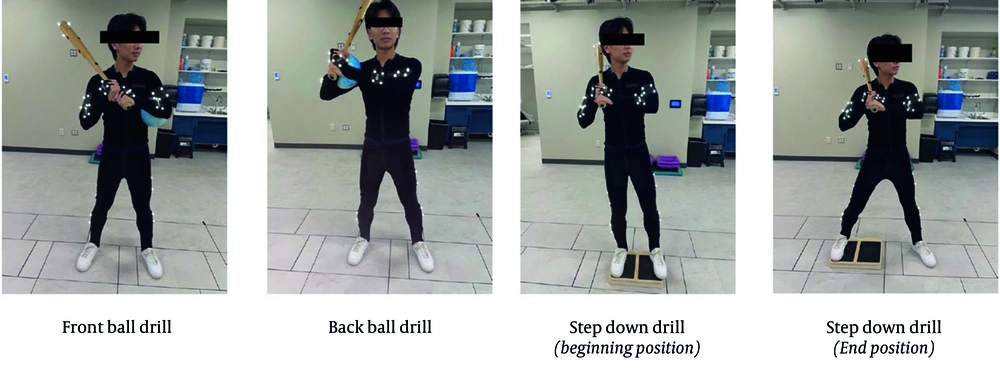
Figure 1.
Three interventions
The Front Ball Drill (Figure 1) was performed with both feet on the floor, with a foam ball placed between the axilla and brachium of the front arm. Participants were instructed to prevent the ball from dropping for as long as possible.
In each condition, the participant was required to swing the bat six times to hit a ball affixed on the SKLZ Hurricane Premium Portable Batting Practice/Hitting Swing Trainer System (Figure 2). This system is made of 80% iron, 7% fiberglass, 4% polyurethane, 4% polyvinyl chloride, 2% rubber, 2% polyester, and 1% polypropylene. The height of the system is adjustable and there are four power bands allowing for fast-back action. This was designed for baseball or softball swing training, and allows hitters to develop swing power, technique and speed with a stationary or moving target. Each leg of the swing trainer system included a 20-pound sandbag to prevent any displacement. The swing trainer system was placed so that the baseball is level with the anterior superior iliac spine (ASIS) of the participant. A marker was placed on the ball of the trainer system for determining the timing of bat contact. There was a 20 second rest period between swings to minimize fatigue. Twenty seconds was selected as a pitch clock is currently used in Major League Baseball and a previous study has utilized this timing in their study (17). There was a rest period of six minutes in between each condition. This was determined using prior studies by Bishop et al. and Manske et al., in which their research on catchers and pitchers performing simulated games utilized six minutes in between innings (18, 19). Prior to the six swings for data collection, warm up swings (dry swing not contacting the ball) were given for preparation.
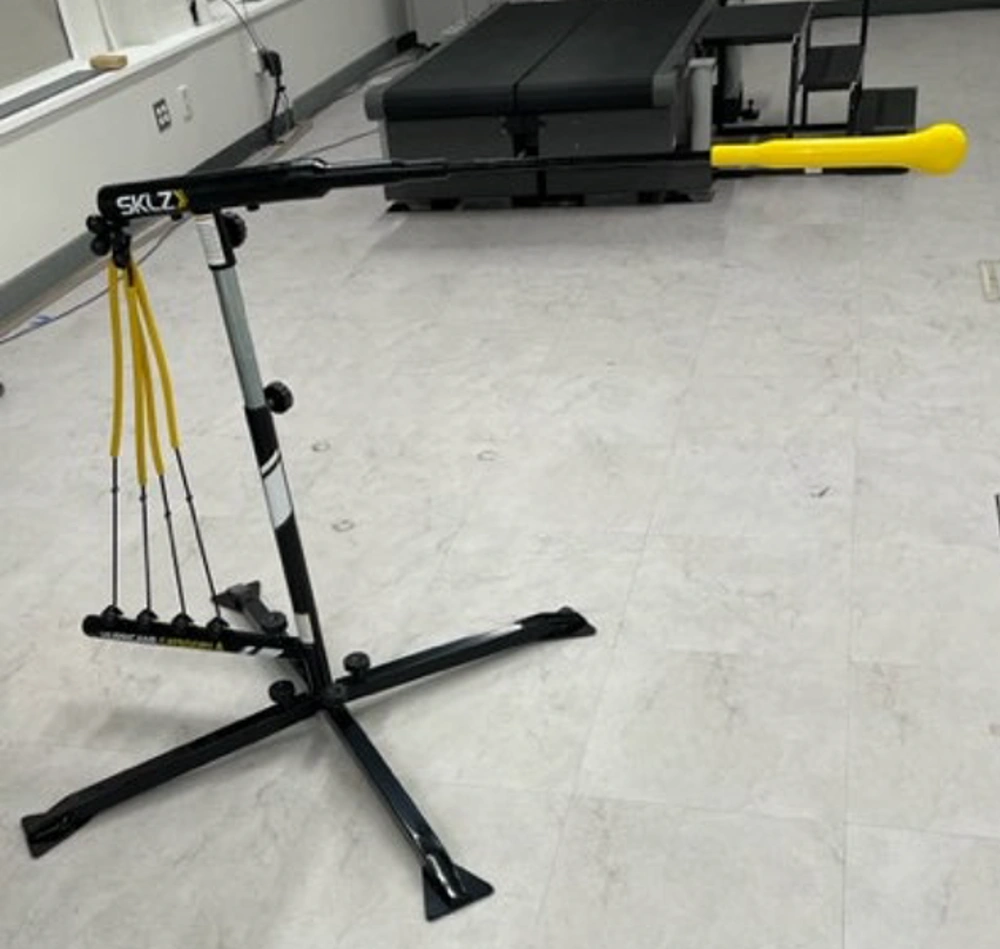
Figure 2.
SKLZ hurricane premium portable batting practice/hitting swing trainer system for baseball and softball
3.4. Instrumentation
The Qualisys Motion Capture System (Qualisys AB, Sweden) was used to capture the swing motion. Before motion capture was recorded, the Qualisys Motion Capture System was calibrated using the Qualisys calibration kit and the protocol for calibration as outlined by Qualisys AB. The calibration process included the computer, cameras, force plates, and reflective markers. During the calibration process, the average residual was set within the acceptable range of 0.5 - 1.5 mm and the sampling frequency was set to 100 Hz. Each participant was dressed in a black Velcro jumpsuit. A cluster of three markers were attached to the center of the sacrum to create a six-degree-of-freedom (6-dof) model for the pelvis. A cluster of four markers were attached to the back of the right-hand segment (dorsal metacarpals two to four) to create a 6-dof model of the hand segment. The motion of the pelvis and right-hand segments were captured and analyzed to test the hypotheses. We also placed marker clusters on the bat, left hand, bilateral lower extremities, and bilateral upper extremities to allow better identification of swing phases and motion.
3.5. Data Analysis
A 6-dof approach was used to calculate the segment position and orientation. The rigid body of each segment was created based on the marker cluster placed on the corresponding segment. The local coordinate of each segment was created during the static preparation stance and was in parallel to the global coordinate. The X axis indicated the medial-lateral direction, Y indicated the anterior-posterior direction (the anterior direction is the direction of bat swing to strike the ball, from right to left), and Z indicated the vertical direction. Eulers angles of each segment were calculated with the rotation sequence of XYZ. With this setup, the orientations of the pelvis segment and right-hand segment in the static preparation stance was at 0 degrees of rotation about the X, Y, and Z axis. The transverse rotation magnitude and acceleration of the pelvis at the ball contact was calculated based on the rotation of the pelvis about the Z axis. The linear distance between the hand and the pelvis was calculated as the position difference along the Y axis.
A generalized estimating equations (GEE) approach was used to determine whether each dependent variable varied as the function of test conditions. The covariance structure was set as unstructured, which allowed the observed data to dictate the correlations between drill conditions. Significant main effects were followed up by post-hoc tests for pairwise comparisons to determine if there were significant differences between the baseline and each drill condition. Cohen’s d was performed and utilized to determine effect sizes in which 0.01 - 0.4 = small effect size, 0.4 - 0.7 = moderate effect size, and 0.7 - 1.0 = large effect size (20). The GEE does not have a standardized way to calculate effect size of the equations, therefore the effect size for the pairwise comparison was provided. All statistical analyses were conducted using SPSS (Version 21, IBM Corp., Armonk, NY, USA) with critical α = 0.05.
4. Results
4.1. Hand-Pelvis Linear Distance at Ball Contact
Figure 3 summarizes the results of the hand-pelvis linear distance at ball contact for each condition. The mean distance for the baseline condition was 47.8 ± 1.2 cm, 49.3 ± 1.1 cm for the Front Ball Drill, 50.2 ± 1.3 cm for the Back Ball Drill, and 50.7 ± 1.2 cm for the Step-Down Drill. The GEE found a significant drill condition effect on the linear distance between the pelvis and hand, P = 0.02. The post-hoc test found a significant difference with a 2.9 cm increase in hand-pelvis linear distance at ball contact between the Step-Down Drill and the baseline condition, 95% Confidence Interval for the between condition difference was (0.2, 3.0), P = 0.02, Cohen’s d = 0.7, a large effect. The comparison between Front Ball Drill and baseline condition and the comparison between Back Ball Drill and baseline condition were not significant.
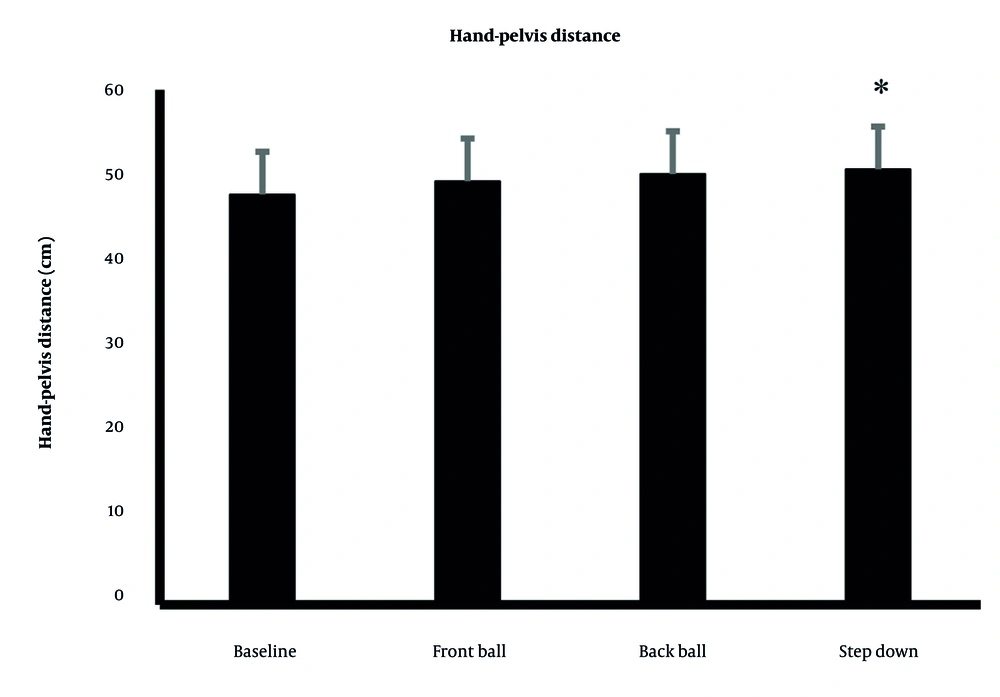
Figure 3.
Results of the hand-pelvis linear distance at ball contact for each condition (* indicates P < 0.05 as compared to the Baseline)
4.2. Magnitude of Pelvic Rotation at Ball Contact
Figure 4 summarizes the results of the magnitude of pelvic rotation at ball contact for each condition. The mean rotation for the baseline condition is 75.5 ± 2.7°, 78.6 ± 3.4° for the Front Ball Drill, 79.6 ± 2.9° for the Back Ball Drill, and 76.6 ± 4.5° for the Step-Down Drill. The GEE found a significant drill condition effect on the magnitude of pelvic rotation, P < 0.01. The post-hoc test found a significant difference with an increase of 4.1° in pelvic rotation at ball contact between the Back Ball Drill and the baseline condition, 95% Confidence Interval for the between condition difference was (1.77, 4.75), P < 0.01, Cohen’s d = 1.43, a large effect. There was also a significant difference with an increase of 3.1° in pelvic rotation at ball contact between the Front Ball Drill and the baseline condition, 95% Confidence Interval for the between condition difference was (0.002, 4.9), P = 0.05, Cohen’s d = 0.6, a moderate effect. The comparison between Step-Down Drill and baseline condition was not significant.
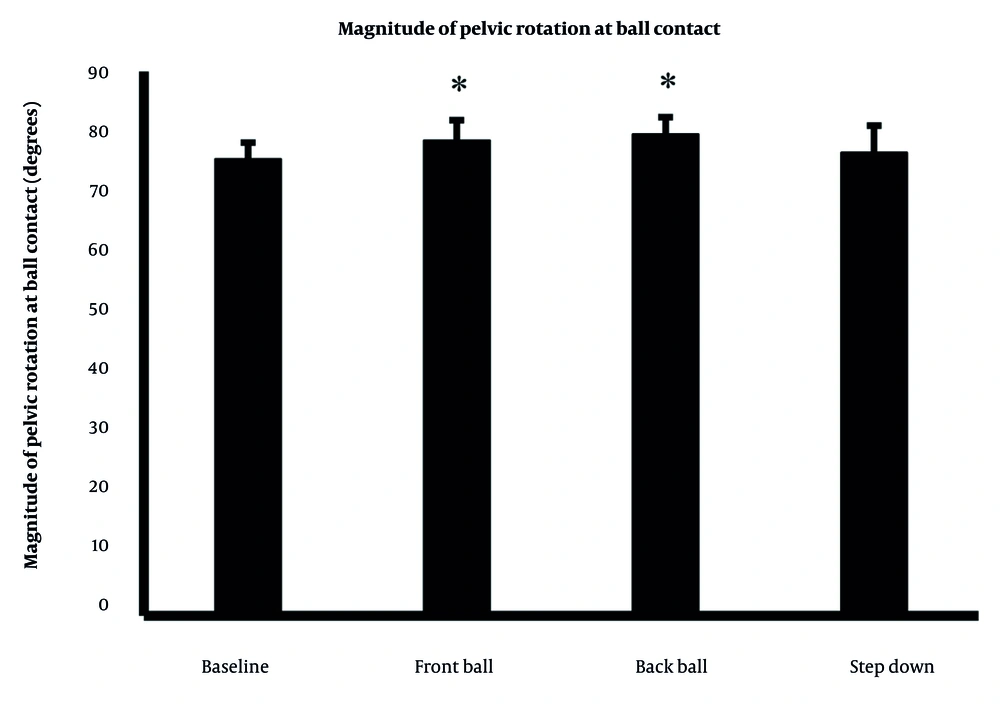
Figure 4.
Results of the magnitude of pelvic rotation at ball contact for each condition (* indicates P < 0.05 for the Front ball and Back ball drills compared to Baseline)
4.3. Pelvic Acceleration at Ball Contact
Figure 5 summarizes the results of the pelvic acceleration at ball contact for each condition. The pelvic acceleration for the baseline condition is 316.7 ± 32.0°/s2, 326.8 ± 27.5°/s2 for the Front Ball Drill, 310.5 ± 30.6°/s2 for the Back Ball Drill, and 283.9 ± 32.1°/s2 for the Step-Down Drill. The GEE found a significant drill condition effect on the pelvic acceleration at ball contact, P < 0.01. The post-hoc test found a significant difference with a decrease of 32.8° of pelvic acceleration at ball contact between the Step-Down Drill and the baseline condition, 95% Confidence Interval for the between condition difference was (-45.82, -8.24), P < 0.01, Cohen’s d = 0.9, a large effect. The comparison between front ball drill and baseline condition and the comparison between back ball drill and baseline condition were not significant.
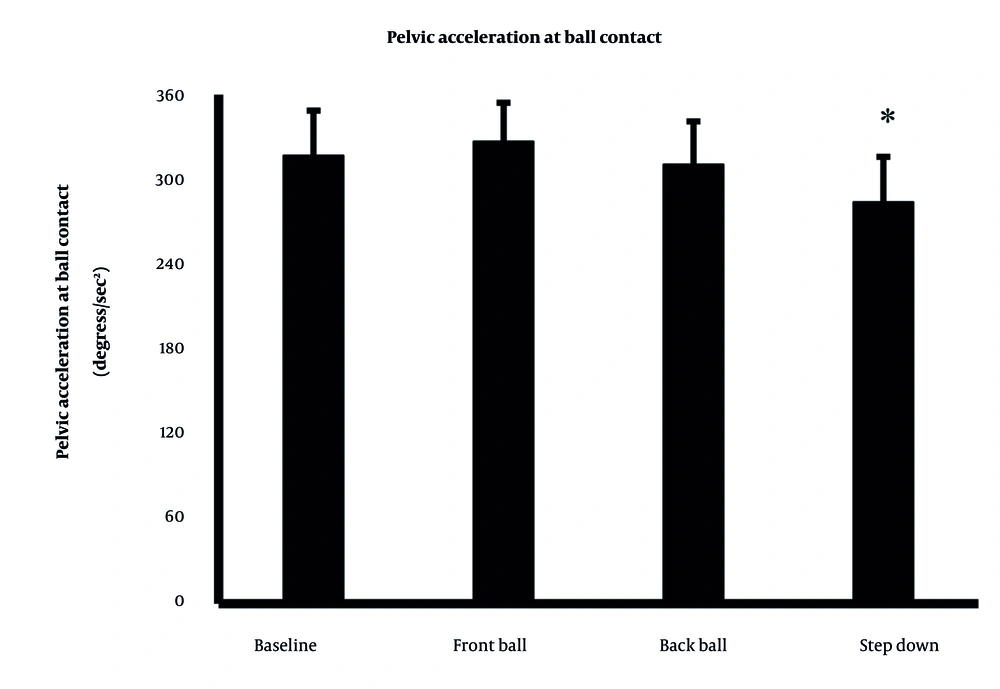
Figure 5.
Results of the pelvic acceleration at ball contact for each condition (* indicates P < 0.05 for the Step down drills compared to Baseline.)
5. Discussion
The first major finding of our research was an increase in the hand-pelvis linear distance at ball contact with the step-down drill when compared to the baseline condition. The second major finding was an increase in the magnitude of pelvic rotation at ball contact with the front ball drill and back ball drill when compared to the baseline condition. The last major finding was with the pelvic acceleration at ball contact, as the step-down drill decreased acceleration when compared to the baseline condition.
The Step-Down Drill was the sole drill found to significantly change the hand-pelvis linear distance at ball contact with an increase in distance between the hand and pelvis. During the step down, the body needs to shift anteriorly. To ensure the participant’s center of mass does not move anteriorly too quickly which could cause loss of balance, the participant may keep the bat and hand more posteriorly and separate the hip-hand distance. Studies have referenced the importance of the hip-shoulder and hip-hand separation to increase during the swing mechanics in order to activate the stretch-shortening cycle and allow the kinetic link system to include the trunk and upper extremity muscles during the preload phase (3, 14). Increasing the linear distance between the hand and pelvis can be a result of the increase in trunk rotation which has also been shown to help with increasing hand velocity (9). From this study, we further hypothesize that using the Step-Down Drill in a baseball player’s routine could be instrumental in increasing the linear distance between the hand and pelvis. This increase may subsequently increase trunk rotation and hand velocity at ball contact, leading to increased bat speed and resultant exit velocity of the baseball.
Hitting a baseball involves a kinetic link in which the hips and pelvis initiate a rotational force that allows the lower extremity and subsequently the upper extremity to follow. The baseball bat rotates around the longitudinal axis of the body; therefore, the pelvic rotation range of motion plays an essential role in the hitting mechanics (21). Pelvic rotation magnitude is attributed to a person’s trunk rotation strength and overall trunk musculature development. This trunk strength is corelated to an increased bat velocity as power in the baseball swing is initiated in the pelvis and hip (6, 22). During the acceleration phase of hitting, the pelvic rotation leads to the upper body rotation and causes a separation between the two, which creates an increase in the overall pelvic rotation magnitude (22). The Front Ball Drill and Back Ball Drill allow the hitter to utilize the range of hip/pelvis rotation to enable proper transfer of kinetic energy to the upper and lower extremities. Forcing the upper extremity to remain close to the hitter’s center of mass as not deviate too far anterior or inferior will decrease upper body excess movement and allow the hitter to utilize the hip/pelvis range more effectively. It has been shown when the bat is further away from the hitter’s body, there is an increase in torque to accelerate the baseball bat (22). An increase in torque due to poor position may place the hitter in a position to injure themselves.
The Step-Down Drill recorded a significant decrease in pelvic acceleration at ball contact. A decrease in pelvic rotation acceleration may actually help enhance stability during the Step-Down Drill as participants were able to better control their center of mass. Quick, uncontrolled changes in pelvic acceleration will lead to a larger expenditure of energy and a decrease in muscular efficiency (23). It has been shown that too much pelvic acceleration within a short period or range could lead to spine and muscle injuries (21). Increasing the pelvic acceleration in some hitters, will demand an increase in velocity in the upper extremity, therefore not allowing for a smooth movement pattern in order to maximize hitting efficiency (23).
This pilot study had limitations. Recruitment of participants included experienced hitters who were homogenous with hitting from the same side and all were Division One NCAA baseball players in order to compare similar style hitters to each other. The bat used for this study was deemed an average size for a collegiate baseball player and allowed us to put markers securely on the bat that would remain in the same position for each participant. In a future study, having each participant use their own bat would avoid this as there is a difference in height and weight with each participant. Using a heavier or lighter bat than a hitter is used to could have influenced the participant’s swing and could have potentially limited the swing efficiency. The results of this study may have been different if it included professional players as the participants instead of the collegiate players. Including professional baseball players who have had professional coaching and are considered elite hitters when compared to high school and collegiate hitters, may produce an outcome with different results due to a pool of higher quality participants. We elected to utilize a hitting tee instead of live pitching to decrease the variability of pitch location and having the same ball location for each swing for each participant based off the height of their ASIS. To improve ecological validity, using a pitching machine to mimic a pitcher would allow for game-like conditions. Starting the pitching machine throwing the ball at the same speed and in a consistent location can be progressed by utilizing varying velocities and adding in movement on the ball. The results produced from a study that incorporates this will allow for a more accurate translation to game like and training conditions.
This research aimed to identify if three hitting drills (Front Ball Drill, Back Ball Drill, and Step-Down Drill) commonly used in professional baseball had any effect on hand-pelvis linear distance at ball contact, magnitude of pelvic rotation at ball contact, and pelvic acceleration at ball contact. Based on a quantitative analysis using nine collegiate Division One baseball players, it can be concluded that there was a statistical significance in improving the hand-pelvis linear distance and magnitude of pelvic rotation at ball contact with the Step-Down Drill and the pelvic acceleration at ball contact for the Front Ball and Back Ball Drills.
