1. Background
Sports vision is an issue that has drawn the attention of many vision care specialists (ophthalmologists and optometrists), vision sciences researchers, physical education scholars and professional athletic trainers. Buys and Ferrira attribute acquisition of 80% of sportive environment information through sight (1). Athletes should know that vision is crucial in sports performance and influences athletic performance; and vision tests should be included along with other physical, medical, psychological and nutritional assessments in sport.
In general, the scope of sports vision studies falls into the following three categories: 1) description and examination of visual skills of elite/professional athletes and comparing them with amateur athletes and normal individuals; 2) proposing methods for the improvement of visual skills and performance in athletes; and 3) prevention and management of eye injuries. According to Zieman et al. (2): “sports vision encompasses performance orientated comprehensive vision care programs involving education, evaluation, correction, protection and enhancement of an athlete.” Visual skills required for achievement of success in different sports are not limited to visual acuity. Proper application of visual information and timely judgment on the speed, distance and specifications of the perceived object contribute to proper sports performance. If an athlete with satisfactory physical fitness cannot fully apply all his/her visual information, he/she cannot effectively benefit from his/her sports potential. A high level of physical stamina, reaction time rapidity and agility cannot compensate for defective visual information. As a matter of fact the contribution by talent vs. practice and skill development is controversial. Visual skills are one of the main four pillars of intangible skills of athletes that can influence their performance (Table 1) (3). That is why vision in athletic performance has recently attracted much attention and the discovery of the relationship between the visual system and sports performance is so desired.
Table 1.
Main pillars of Intangible Skills in Sport
| Intangible Skills | Description |
|---|---|
| Brain skills | Mind speed, information-processing speed, mental quickness, peripheral awareness, visual memory, visualization, reaction time |
| Sport I.Q | Knowledge of sport including its rules, strategies, tactics, customs, etiquette, records, and history |
| Sports psychology | Management of negative thoughts and emotions, maintenance of concentration, control of stress levels |
| Visual skills | Visual acuity, contrast sensitivity, focusing, tracking, depth perception, visual alignment, eye-foot-body coordination, dominance (eye-hand-foot) |
According to the results of previous research, visual skills have been categorized into five levels; Superior, above average, average, ineffective and needs immediate attention (4). Some established mean and standard deviation values for visual skills (5) and some others evaluated previous norms and revised them and suggested protocols for sports vision evaluation (1). Sports vision is a developing discipline and the proposed protocols are largely generic i.e. not customized for a specific kind of sport. We know that even sports of the same category like shooting and archery does not need same set of skills.
2. Objectives
In this article, we are to present a relatively comprehensive battery of tests and assessments on static and dynamic aspects of sight which seems relevant to sports vision. We shall explain the basis for the selection of visual tests and their operating condition (e.g. ambient illumination). Authors are doing their best to define and quantify past ‘athletic performance’. This allows determination of the associated visual indicators with a better athletic performance which is most relevant in sight-intensive branches of sports such as archery.
3. Materials and Methods
3.1. Settings and Sampling Framework
This protocol was performed in Farabi Eye Hospital, Tehran. Study population included archers registered in archery federation of Tehran and Alborz Provinces. A list of clubs and the number of their athlete members was prepared with the cooperation of the Archery Board of Tehran and Alborz provinces. Female and male archers aged 18 - 38 years were included in this research; all of whom practiced compound and recurve archery. Archers with archery history of not more than 6 months were excluded from the study (Table 2).
Table 2.
Participants Profile
| Archers | N | Gender | Average Age | |
|---|---|---|---|---|
| Male | Female | |||
| Elite | 35 | 17 | 18 | 28.25 ± 5.4 |
| Non elite | 22 | 10 | 12 | 28.64 ± 4.8 |
3.2. Variables
3.2.1. Evaluation of Elite Athletes and Past Performance
We calculated for every athlete a performance score based on the titles and medals he/she has won at international, national, provincial or club levels. Since this approach is not applicable to a person who has newly joined an archery club, a new variable called “trainee prospect” by the trainer was defined. Athletes with Gold medals were put into the “professional” category provided that their statuses were stable (Table 3).
Table 3.
Scoring Athletes Done According to the Awards Gained and Coach Judgement
| Done According to the Coach Judgment | Score |
|---|---|
| Amateurs | |
| Inapt | 0 |
| Talented | 1 |
| Club | 2 |
| Regional | 3 |
| Professional | |
| National | 4 |
| International | 5 |
3.2.2. Sports Experience
The sports experience of a person is calculated based on cumulative times he/she spent in practice as follows:
Number of practice days per week × year = Sports Experience
3.2.3. Visual test
Other variables were measured through vision tests for which full description is presented in the Table 4.
Table 4.
Definitions and Characteristics of the Visual Tests
| Test | Brief Definition | Measuring Device | Illumination, lux | Scale | Description |
|---|---|---|---|---|---|
| Static visual acuity | The ability to recognize English alphabets and spatial localization of the visual system with a 100% contrast (black optotypes on white background). | Electronic chart | 480 | Letter score(theoretical range: 0 to 100) | Monocular and binocular visual acuity and best spectacle-corrected visual acuity (BSCVA) are assessed and recorded during archery |
| Refractive error | Optical power deviation of the eye (in order to create a sharp image on the retina) | i-Trace | 12 | Spherical and cylindrical error with axis (Diopter) | This measurement is performed with and without cycloplegia. |
| Contrast sensitivity | The ability of the visual system to discern spatial variations; an object edge from its background in different conditions | CSV E 1000 | 12 | Log Unit | This is normally a binocular test which is performed in the same condition athletes experience during exercise in terms of object features and illumination conditions. |
| Ocular alignment | This indicates neuromuscular coordination of fellow eyes and their reserve for the maintenance of this binocular association (fusion). | alternative cover test | Photopic ≥ 25 | Prism Diopter | It is measured for near (40 cm), far (6 m) and very far distances. |
| Stereo-acuity | Ability to perceive spatial depth; it is a binocular faculty which is achieved through horizontally disparate images for right & left eyes of the same object | TNO Stereo test | 800 | Range: 15 to 480 s⁄arc | Uses red and green filters to dissociate right and left eye views which are variably disparate. Brain reconstructs a 3-D image |
3.2.4. Ocular Dominance
It is the tendency of the brain to receive information from the environment when it is inevitable to use only one eye. In fact, in normal binocular vision the brain omits or suppresses the information received by one eye (the non-dominant eye at the center of the visual field. Various methods have been proposed to determine the dominant eye, but the method used in this research was the Miles method. In this method, the athlete stretches his/her arms in front of the body with his/her palms facing out. The athlete creates a small weight by putting his/her hands together. He/she chooses an object about 15 to 20 feet away and looks at it through the aperture, then alternates closing the eyes or slowly draws opening back to the head to determine which eye is viewing the object, that is the dominant eye The possible results include right ocular dominance, left ocular dominance and cyclopean eye (6).
3.2.5. Dominance Congruence
Congruence and incongruence of the dominant eye and hand is determined by this variable. The dominant eye is identified through the miles tests while the dominant hand is identified by asking the person. Archers are classified into 4 group based on dominance in eye and hand (Table 5).
Table 5.
Conceivable Composition in Archers
| Dominance | Dominance Congruence | |
|---|---|---|
| Hand | Eye | |
| Right | Right | R (Hand and Eye) dominance |
| Left | Left | L (Hand and Eye) dominance |
| Right | Left | R Hand and L Eye dominance |
| Left | Right | L Hand and R Eye dominance |
3.2.6. Archery Figure
This variable shows the figure of archers while practicing archery. It is determined through dominance (hand, eye) and aiming (monocular or binocular). This variable can be used to study the effect of dominance congruence on aiming of an archer as well as the effect of archery figure on the sports performance.
3.2.7. Order of Examinations
Firstly, professional sportive information of athlete is written down in a form by a physical education graduate (one of the colleagues of this research). Next, vision examinations are performed on the athlete. In this study, illumination condition was defined as to simulate the real archery condition to the extent possible. Hence, in order to accelerate the tests, those requiring similar illumination conditions were performed in one spot. The full cycle of examinations of each athlete took about 40 minutes (Figure 1).
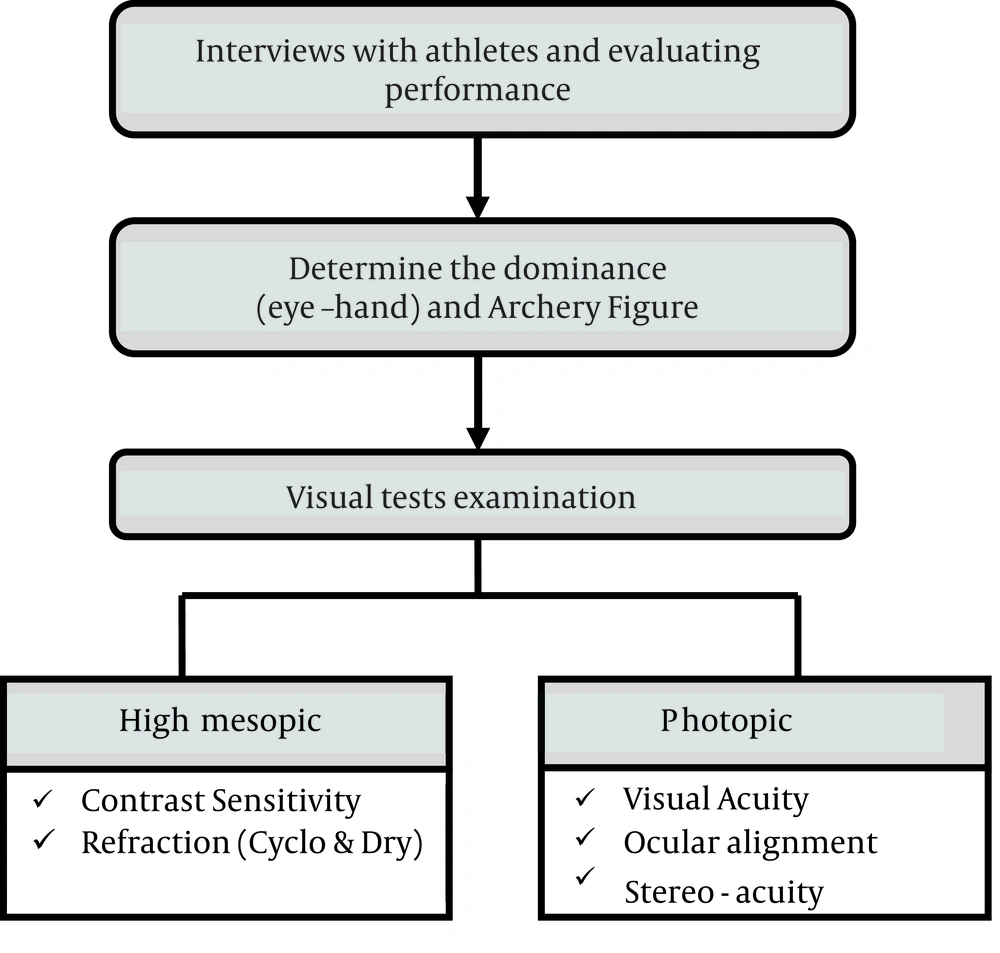
Figure 1.
Examination Fellow Chart
4. Discussion
In this protocol, it was tried to assess visual skills and introduce tests in accordance with the nature of the sport (7), contest illumination conditions, visual characteristics of the sport, and visual demands (8) (Table 6). Taking these definitions and notions into account provides for selection of more rational and appropriate tests suiting a specific pragmatic protocol for the sport. In addition, assessment and comparison of results of vision tests performed on elite and non-elite athletes help to introduce better vision tests because it will be time-consuming and irrational to perform all vision tests for every sport. In other words, every sport requires specific visual skills. Those vision tests resulting in higher scores for the elite group compared to the non-elite group are more worthy of application and enhancement. In this protocol study, variables including “dominance congruence” and “archery figure” were defined so as to scrutinize the effect of congruence on archery figure and the effect of congruence and archery figure on sports performance of athletes.
Table 6.
Introduction of Characteristics of the Sport to Introduce Proper Visual Tests
| Characteristics of Sport | Definition and Classification |
|---|---|
| Nature | Archery is the sport of using bows and arrows. In this sport, the archer shoots at the target from different distances. Usually 6 shots are available for every distance. Targets are composed of concentric circles with the innermost circle in yellow. The yellow circle has the highest score. Concerning the nature of this sport, it can be said that it is repetitive because a specific act is iterated several times during the contest. Hence, shooting an arrow and hitting the yellow circle does not prove superiority because only repetition of this score in a day defines superiority. Therefore, archery is a controlled sport. |
| illumination condition | Archery is practiced in two different spaces and is named after it as outdoor target archery and indoor target archery. The former one is practiced during the day under sunlight or in a hall with photopic illumination conditions. |
| visualcharacteristic | Archery is a static sport. The archer takes a fixed position while shooting and thus, the visual information obtained from the environment is invariant too. This information helps the athlete show a proper motor response based on the information. This is unlike dynamic sports in which the athlete takes very different positions and has to re-analyse visual information every time he/she takes a new position. |
| Visual demand | The visual skills required for every sport include two chief visual skills (aiming and anticipation). The role of each of the two skills depends on the nature of the sport. Aiming is the ability to take a suitable stand in relation to the target while anticipation is the athlete’s ability to get and hit the ball. This skill reduces the response time and helps the athlete make the right decision about how to hit the ball, hold the racket and such. This skill is influenced by other skills such as eye motion, visual acuity, contrast sensitivity, eye-hand coordination, and depth perception. Therefore, knowing this fact, it is possible to predict and assess the demands of the archery sport more accurately. |
Archery is normally practiced in highly illuminated conditions. Therefore, this research tried to record observations in similar conditions. In spite of the precision applied to the simulation of these conditions, the conditions provided for some tests are not necessarily the ones archers experience in real life archery. As a result, generalizability of the data is inevitably reduced. However, this limitation is considered while interpreting and extending the results. Tests such as the contrast sensitivity test were performed in highly mesopic illumination conditions (12 lux). The reason was that this test provides more information about visual acuity in such conditions (with 100% contrast), which comply with some real life functional conditions.
4.1. Static Visual Acuity
Static visual acuity (SVA) is “the ability to see a non-moving target at a fix distance” (9). Since archery is a static sport, visual acuity is assessed statically. Different methods have been so far developed to assess visual acuity; two types of log MAR are commonly used: the Bailey-Lovie chart (10) and the early treatment diabetic retinopathy study (ETDRS) chart (11). The sensitivity and proportionality of standard methods of visual acuity measurement vary depending on the diseases and response to treatment. A 20/20 cut-off is also defined and selected for this purpose. Using this limit as the basis for assessing the visual acuity of a healthy or superior group does not cause any analytic differences. This flaw is called the “ceiling effect”. Theoretically, there are three visual acuity measures better than 20/20 or 10/10 which is not employed in common studies. The aforementioned adverse effect is demonstrated in a study entitled “The role of visual skills in Archers’ performance” by Strydom . In a part of this study, a comparison was made between the visual acuity of archers and the standard visual acuity of professional athletes based on the Snellen chart in decimals. They reported a visual acuity score of 1.0 for most athletes. The reported value was smaller than that of professional athletes (12). But in the letter score test, every line includes five visual acuity scores. Moreover, this assessment is a letter recognition test and thus it is not performed through recognition of E, which minimizes the chance of recognizing alphabets (directions). The visual acuity score of a person includes the sum of scores obtained from each correctly recognized letter. In this 1, 20/20 and 10/10 vision are scored 85 but the maximum score is 100 (i.e. 15 marks higher).
Therefore, the method used in this protocol has the following advantages: 1) maximum distinction of visual acuity through alphabet-based scoring; 2) increased measurement scope to the highest theoretical level (i.e. supervision); 3) application of diverse English letters instead of E which reduces the effect of the chance of responding. These advantages help achieve a variable that not only provides for ideal descriptive distinction, but also allows for statistical analyses and examination of factors and correlations. The largest study to date evaluating the performance of the visual system in athletes was performed by Laby et al. (13). The visual acuity of 80% of baseball players was 20/15 or higher. In another study by Elliot et al. (14) the visual acuity of the normal group was 20/15 (or higher), and 20% of participants were reported to have a visual acuity of 20/12.5 or higher. When a comparison is drawn between the visual acuity levels of the normal people group and baseball players group, the athletes show a higher level of visual acuity achieved by their better recognition of one or two letters (15).
What are of functional importance in the examination of visual acuity of archers are whether the examination is monocular or binocular and whether archers’ position is similar to real life position of archers. Professional archers usually use both their eyes and thus binocular visual acuity was measured in the protocol used in this research. In addition, athlete’s eyes are not commonly equipped with the best corrections (up-to-date glasses and contact lenses). Therefore, visual acuity with the best optical correction was examined too. In this study, about 13% of athletes were diagnosed with uncorrected refractive errors. Monocular and binocular assessment of visual acuity of athletes was performed using the best optical correction and actual conditions. These assessments resulted in precious information for description and analysis purposes.
4.2. Refractive Errors
Analysis and assessment of the refractive state of athletes is a very important part of assessing their visual acuity. Prevalence of uncorrected refractive errors and visual complaints reported by Beckerman and Hitzerman reject the common belief that athletes have fewer uncorrected refractive errors (16). The study by Mann et al. (17, 18) aimed at examining the effect of blurred vision on the performance of cricket players. In this study, players using +1, +2 and +3D contract lenses experienced blurred vision. Results revealed that the performance of athletes using +1D and +2D remained the same, but +3D contact lens led to a decline in the sports performance of the players. Moreover, results of some other studies suggest that low degrees of blurred vision do not have adverse effects on sports performance. It seems that this finding cannot be extended to archery, in which distance vision (70 m) is of great importance. Correction of minor refractive errors is important in correction of blurred vision at distances and achievement of maximum visual acuity. Archers who use corrections to address their refractive errors need to be examined and provided with the best visual acuity. Even slight myopia results in blurred vision while oblique astigmatism causes optical aberrations that distort distant vision of archers. The process of assessing the refractive errors of athletes has to be completed according to standards. It is recommended to examine refractive errors using cycloplegic eye drops to detect latent hyperopia and prescribe the most suitable optical correction.
4.3. Contrast Sensitivity
Since one of the responsibilities of every athlete is to discern visual distinctions in different illumination conditions, it is necessary to examine their contrast sensitivity (19). Since visual acuity is measured with high contrast (black letters in a while background), this test is not enough for the examination of visual distinctions, and it is necessary to perform contrast sensitivity tests too.
Many systems have been developed for the assessment of contrast sensitivity. Most tests include black and white lines with different spatial frequencies and varying contrast levels. However, there are two main ways of assessing contrast sensitivity in athletes: vector vision contrast sensitivity test and Vistech contrast sensitivity test. These two tests are preferred to others due to their speed and portability (20).
Numerous studies have been carried out on contrast sensitivity assessment of athletes using grating at different spatial frequencies. The overall result of these studies indicates that unlike normal people, athletes have high contrast sensitivity at all spatial frequencies (13, 21). However, in sports such as archery which is about aiming based on a dominant eye, it is significantly important to know the contrast sensitivity of eyes especially when two eyes have the same visual acuity. Therefore, monocular and binocular measurements were performed in archery conditions in the form of a log unit for the purpose of more precise statistical analysis.
Illumination condition is of importance to contrast sensitivity assessment. Contrast sensitivity assessment was carried out in highly mesopic illumination conditions (10.6 lux). Findings of the present research suggest that contrast sensitivity assessment in glare conditions is more important for archery. Results of a study by Laby et al. showed that most archers and skating athletes demonstrate a high level of contrast sensitivity at 1.5 cpd and 6 cpd spatial frequencies in the presence of a glare source (22).
4.4. Ocular Alignment
Ocular alignment leads to synchronized delivery of information on the specific position of a target by two eyes. This ability is used for recording information necessary for recognizing the distances of objects (23). Seemingly, this ability is necessary for appropriate functionality of archers. Not only does heterophoria (latent eye deviation) affect recognition of distances, but also it causes fatigue and pain to the eyes. The pain, which is caused by an extreme neural-muscular effort made to compensate for latent deviations, can also affect the performance of athletes during contests.
There are various methods for measuring ocular alignment while assessing the performance of athletes. The cover test method is a standard way of assessing ocular alignment, although other methods such as the Maddox rod, Von Graefe, and Brock String methods have also been proposed (24). Cover test is usually performed in close (40 cm) and far (6 m) distances. What is important is the assessment of alignment of both eyes from specified distances based on the visual demand of the athlete practicing the sport. In archery, distance fixation is necessary and some binocular vision disorders (e.g. divergence excess) are better revealed at far distances. Hence, it is recommended to perform these assessments at the aforementioned distances and a further distance.
4.5. Stereo-Acuity
Assessment of depth perception is very necessary to the assessment of sports vision. Since many sports require spatial localization, the relationship between sports performance and depth perception sounds rational (25). Many studies have shown that binocular vision significantly contributes to the result of some activities as compared to monocular vision (26). On the other hand, according to results of another researches and examinations of vision of athletes in different sports practicing at the Olympics level, stereo-acuity is not important for archers. These researchers argue that due to the far distance between the archers and their target, stereo-acuity is insignificant. Moreover, since only one eye is used for aiming and watching the target, it is not possible to use both eyes. However, in response to this claim, it shall be said that this test gives very useful information about the alignment of both eyes. Results of studies on stereo-acuity of athletes are paradoxical, but it seems that stereo-acuity is an important skill in archery as it is used for spatial localization. For example, in IBO (International Bow hunting Organization) contests, where the shooting distance is not determined, stereo-acuity is a very useful skill. The TNO Stereo test was of greater importance to this study compared to other stereo-acuity tests because of the lack of monocular diagnosis keys. Unfortunately, this test is designed for near distances and although it can somehow reflect stereo-acuity at far distances, results of this test are more valuable in far distance in archery.
4.6. Dominance Congruence
Dominance is only associated with paired organs such as hands, feet, cerebral hemispheres and eyes. Ocular dominance was first introduced by Giovanni Battista in 1593. The relationship between sports performance and ocular dominance has drawn the attention of many researchers too. Many studies have focused on the relationship among the dominant eye, hand and foot. According to these studies, the dominant eye and hand are not necessarily at the same side (i.e. cross dominance). Some studies have also discussed the advantages and disadvantages of cross dominance in athletics. Results of these studies were finally summed up by Coren and Porac, who stated that the information received by the dominant eye is analysed about 14 miliseconds sooner than information received by the suppressed eye (27). The dominant eye is the eye that performs precise localization, and this is important in sports that require aiming (e.g. archery). Many different and diverse tests are available for the assessment of the dominant eye. One of the most common tests of this sort is the miles test, which does not require specific equipment. In order to ensure the validity of the miles test result, this test was repeated 3 times for each athlete. However, it is worth noting that whenever ocular dominance is introduced as an ability of the visual system for sports performance, we must ensure that our test does not disturb the trait we are measuring. The role of ocular dominance in athletic performance remains unclear to date, but it is important to examine the relationship between the dominant eye and hand, especially in sports involving aiming.
4.7. Archery Figure
This variable shows the aiming pattern used by an archer. Clearly, binocular shooting leads to increased visual acuity (28), contrast sensitivity (29), and depth perception. Seemingly, the eye-hand dominance pattern influences the figure of archers. According to the findings of this research, different archery figures of athletes were classified into 8 different groups based on the dominance and aiming (Figure 2). Hence, a variable called “archery figure” was defined to study the role of dominance congruence on archers’ Figure.
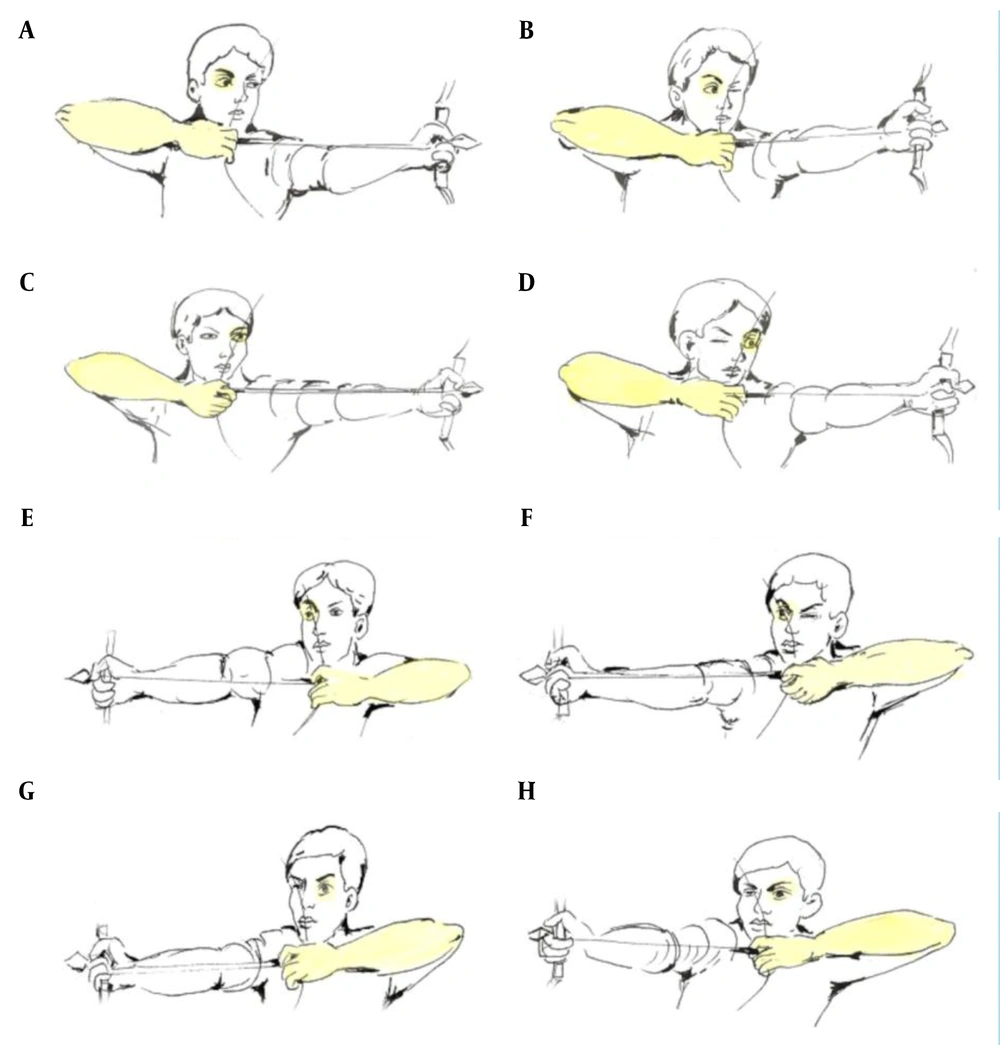
Figure 2.
A, binocular aiming- R (hand and eye dominant); B, monocular aiming- R hand and eye dominant; C, binocular aiming- R hand and L eye dominant; D, monocular aiming- R hand and L eye dominant; E, binocular aiming- L hand and R eye dominant; F, monocular aiming- L hand and R eye dominant; G, monocular aiming- L (hand and eye dominant); H, binocular aiming- L hand and eye dominant.
Those who practice archery believe that for a beginner the bow (left-hand or right-hand bow); needs to be selected based on his/her dominant eye not the dominant hand. But when there is an archer who has been practicing archery on a specific basis, recommendation of a new basis only confuses him/her. Moreover, the study by Jones et al. recommended that archery trainees with cross dominant patterns should be trained to be able to achieve eye-hand congruence and consequently be more successful (30). In this study, even many elite archers were shown to have archery figure problems. Trainers shall concentrate on beginner archers’ archery figures to help them experience more precise aiming, less fatigue, and no diplopia during contests. The appropriate figure of an athlete which is the result of exercise and experience (sports experience) as well as the athlete’s sporting intelligence can be the same figure shown by the trainer to the athlete in the beginning of his/her sports experience. However, final judgment requires wide studies.
4.8. Conclusions
Professional sport needs professional and evidence-based medical advice and physical education. At the moment eye care practitioners can provide meaningful services for athletes. So, it is recommended to assess the visual status of (professional) athletes on a routine basis. But sports vision is a young discipline and we have to clarify the role of vision and visual skills for different sport scenarios and visual demands. Visual characteristics (static or dynamic) of the sport and illumination conditions of the respective sport field are two examples of such determining factors. Comparison of visual performance of elite and non- elite athletes will shed light on the optimal sports performance mechanisms and on the other hand will help us on the selection of the relevant tests. That is why we defined the variable of past athletic performance.
On the other hand, the effect of exercise on the improvement of skills should be considered. In order to consider this effect, a variable named “sports experience” was defined so as to analyse the effect of sports experience on sports performance or improvement of athletic visual skills.
Current protocol has specifically been defined for sight-intensive and aiming type of sports like archery but the defined setting of vision examinations, general examination protocol (including the necessity of preparing illumination conditions and order of tests), criteria for test selection, and the generic variables are useful for sports vision studies in general and authors recommend its application in scientific studies of sports vision.