1. Background
Mixed martial arts (MMA) is a growing combat sport worldwide that incorporates grappling and striking motor actions, in both standing and ground positions (1, 2), which requires high physical fitness demands (3-5). MMA matches generally have three rounds lasting 5 minutes each, with the exception of main events and/or title fights, which have five 5-minutes rounds (2). The main objective of fighters is to apply knockouts (KO), technical knockouts (TKO) or submissions to achieve victory over their opponents, however, a fight can also be won by judge’s decision or disqualification (2, 3, 6). To improve the specific skills, simulated sparring matches are often a crucial component in combat sports training programs (1) and periodization processes (7). It is already well established that sports induce acute and chronic metabolic changes through training and competition (8). However, studies with MMA fighters have been limited to investigation of anthropometric profiles (4, 9, 10), time-motion analysis (2, 11) and physical fitness testing performance (9-13).
Specifically, biochemical data are limited to lactate responses (11, 14) and salivary osmolality (15), as the knowledge of additional parameters is limited (16). It is known that rapid weight loss harms biochemical parameters of MMA athletes (16), but it is not established if physical demands during sparring and official fights disturb metabolism and biochemical parameters in a similar manner. This information may be useful in interpreting how closely sparring mimics official competitions and in planning adequate training loads.
The study of biochemical responses to simulated matches is frequent in other combat sports, such as judo (17), Brazilian jiu-jitsu [BJJ; (18)], wrestling (19), karate (20), wushu (21) and taekwondo (22). Additionally, unpublished data from our laboratory indicate that simulated MMA sparring matches induced lactate values (~ 20 mmol/L) similar to official matches (14, 16), with no changes in physical performance and muscle damage, or inflammatory, immunological and psychometric markers, which suggest its efficacy during competitive microcycles or periods of technical/tactical training.
Previous physiological reports in combat sports that compared sparring to official matches, included heart rate and lactate responses in karate (10), and salivary cortisol and immunoglobulin A in BJJ (23). From these data, it was found that simulated karate fights showed lower blood lactate responses and the authors concluded that additional tasks should be included to raise anaerobic training demands (10). In addition, BJJ simulations induced lower salivary cortisol expression, which could be minimized with psychological strategies in order to raise training stress (23). Based on these findings, Bridge et al. (24) proposed an exercise protocol that simulated the activity pattern of taekwondo combats to address the differences in the training and competitive environments. However, the training session showed lower heart rate, plasma lactate, glucose, glycerol, adrenaline and noradrenaline values, which reinforced the potential limitations, specifically with regard to stress, of using training protocols to mimic official matches. Conversely, Amtmann et al. (14) compared blood lactate and rating of perceived exertion (RPE) from MMA official matches to three different training sessions, including sparring bouts, and concluded that these training sessions successfully replicated the metabolic demands, specifically lactate concentrations, of the competitive environment.
Due to the limited specific information about MMA, the knowledge applied is often based on data from other combat sports (4). Thus, considering that i) strength and conditioning programs are quite complex to design and apply in MMA (25) and ii) sparring matches are a relevant component of training (1, 7, 25) the behavior of metabolic parameters in the training and competitive environments is particularly relevant.
2. Objectives
Therefore, the main objective of this study was to compare biochemical responses from sparring and official MMA matches.
3. Materials and Methods
This study involved biochemical measurements before and after MMA simulated sparring (SIM) and official competitive (OFF) matches. The sample included 25 male professional MMA athletes (SIM: n = 13; OFF: n = 12) who were over 18 years old that had participated in at least two official fights during the previous 12 months and had been specifically training for the OFF event for at least three consecutive months. For SIM group, in the week before combat, athletes were solicited to keep feeding behavior and training they usually employ to real fights. Prior to data collection, all athletes responded to a demographic questionnaire and signed an informed consent. The protocol was approved by the local ethics committee (Nº.197/2011) and the study protocol conforms to the ethical guidelines of the 1975 declaration of Helsinki. The athletes went through health screening, and general demographic information was collected, including body weight, height, and weight class. In addition, self-reported age, competitive history, training frequency, dietary supplement usage and declaration of the usage of substances that could affect laboratory testing were considered.
3.1. MMA Official Event
The professional event started at 6:00 pm and took place in Pelotas/RS, Brazil. The weigh-in protocol occurred on the day of the event (~ 30 minutes prior fight) and athletes declared not having utilized any rapid weight loss strategies. Competitive parameters of the event include the fighting area, which was caged and featured eight sides (Octagon), and fight time (three rounds of five minutes with one- minutes rest intervals). Two athletes were excluded from the sample because they did not fit within the inclusion criteria or declared the use of substances that could alter or impair the examined biological variables. During the competitive event, blood samples were collected for analysis of biological variables before (pre-match - PRE; between 60 and 90 minutes prior the fight) and after (post-match - POST; immediately post fight) each athlete’s fight.
3.2. MMA Sparring Matches
Athletes were recruited by public announcement and direct contact at gyms. At the first meeting, participants completed a questionnaire addressing personal demographic information. In addition, after a 10 minutes warm-up consisting of articular movements, stretching, and calisthenics, PRE blood samples were collected.
Immediately after the blood sample was taken, each participant completed three sparring rounds of five min with one-minute rest intervals. Fighting occurred at same time of day (after 6:00 pm) as the official matches and relied on professional arbitration to ensure athletes’ physical integrity and to keep the rules consistent with those of official events. Official rules were adapted in relation to the continuity of the fights, which were not interrupted when submissions occurred and the application of techniques did not cause joint damage, asphyxiation, or unconsciousness. At their own discretion, athletes were allowed to use protective equipment such as shin and forearms protectors; and elbows and knees strikes directed to the head were not permitted (26). To ensure competitive balance, participants were matched according to body mass categories, history, age, and technical skills. Training partners and technicians throughout the bouts gave all participants verbal encouragement. Immediately after the fights, POST blood samples were collected.
3.3. Blood Samples
Blood samples (10 mL) were collected via venous phlebotomy in each participant’s upper limb (27). Samples were immediately divided among tubes containing appropriate additives and serum and plasma were obtained by the centrifugation of samples for 5 minutes at 3,000 rpm, and stored at 4°C until use.
The biochemical analyses of magnesium, lactate, glucose, total creatine kinase (CK), aspartate aminotransferase (AST), and alanine aminotransferase (ALT) were performed in a Dimension EXL automated biochemical analyzer (Siemens, Munich, Germany) using commercial kits (Siemens, Munich, Germany) according to manufacturer recommendations. The samples were tested in duplicate with intra-assay coefficients of variation of 3.4% (Mg), 5.6% (lactate), 4.3% (glucose), 5.2% (CK), 3.4% (LDH), 2.8% (AST), and 2.6% (ALT). These specific parameters were chosen to evaluate the activation of anaerobic metabolism (lactate), glucose availability (glucose), muscle damage (CK, LDH, AST and ALT) and mineral response (Mg) related to muscle function (8, 28), and with respect to logistic limitations in measuring additional parameters.
3.4. Data Analysis
For statistical analysis, the results are presented in tabular and graphical form. Shapiro-Wilk tests for normality were conducted, parametric values are reported as means and standard deviations (SD) and non-parametric values are presented as median and interquartile range (IQR, 25% - 75%). For descriptive data, independent samples t-tests were used to compare OFF and SIM groups. For parametric data, 2-way analysis of variance (time × group) was used to compare the dependent variables. In the event of a significant time × condition interaction, Bonferroni post hoc tests were used to compare the pre-post match values between the OFF and SIM groups. For non-parametric data, the Kruskal-Wallis test was used and differences were confirmed by Mann-Whitney tests. Cohen’s d values were calculated to evaluate effect size (ES) and interpreted as follows: 0.2 = small, 0.5 = moderate and 0.8 = large (29). For all results, P < 0.05 was considered significant. Analyses were conducted using Microsoft Excel 2010 and SPSS 17.0.
4. Results
Data from 25 MMA athletes (OFF = 12; SIM = 13) were included in the analysis. No significant differences were observed among the groups for demographic variables and, on average, the athletes were 26.5 ± 5 years old with a body mass of 80 ± 10 kg, height of 1.74 ± 0.05 m and had 39.4 ± 25 months of training experience. With regard to competitive history, the athletes had participated in an average of 6.7 ± 5 fights, with 4 ± 3.5 victories and 2.7 ± 1.7 defeats. For the OFF group, the six fights ended in the first (n = 5) or second (n = 1) round (1 by KO, 2 by TKO and 3 by submission) with 5.7 ± 3.7 minutes of fight time and were significantly faster than SIM fights (16.2 ± 3 minutes; P = 0.001).
The values of biochemical markers are shown in Table 1. No differences were found between winners and losers in OFF and SIM matches. Lactate concentration was not different between OFF and SIM (P = 0.72), however, significant differences prior to and following the fights (P < 0.001) were shown. Mann-Whitney tests indicated greater post values for both groups (OFF: U = 0.01; P = 0.001; ES = 1.2; SIM: U = 4; P = 0.001; ES = 0.9), with large effects. Glucose concentration was significantly different prior to and following the fights (F 1, 22 = 135.1; P < 0.001; ES = 0.8) and between groups (F 1, 22 = 14.1; P < 0.001; ES = 0.5), with large and moderate effects, respectively, and no significantly time x group interactions (F 1, 22 = 2.2; P = 0.14) were found (Figure 1A). In addition, post hoc analysis showed differences within time point for pre measures between groups (P < 0.001; ES = 1.1; Figure 1A).
Table 1.
Biochemical Responses to Official and Simulated MMA Fights
| Official (n = 12) | Simulated (n = 13) | |||||||
|---|---|---|---|---|---|---|---|---|
| Pre-Match | Post-Match | Pre-Match | Post-Match | |||||
| Median | IQR | Median | IQR | Median | IQR | Median | IQR | |
| Lactate, mmol/La | 4 | (3.4 - 4.4) | 16.9b | (13.8 - 23.5) | 3.8 | (2.8 - 5.5) | 16.8b | (12.3 - 19.2) |
| CK, U/L | 221 | (145.2 - 333) | 237 | (159.7 - 394.5) | 225 | (136.5 - 330) | 297 | (208.5 - 403.5) |
| AST, U/L | 30 | (22.2 - 36.8) | 32 | (22 - 40.7) | 30 | (22 - 39.5) | 33 | (23 - 40.5) |
| Magnesium, mmol/L | 0.1 | (0.1 - 0.11) | 0.12 | (0.1 - 0.11) | 0.12 | (0.1 - 0.13) | 0.12 | (0.1 - 0.13) |
Abbreviations: AST, Aspartate aminotransferase; CK, Creatine kinase; IQR, Interquartile range.
aDifference between pre and post measures: < 0.01.
bWithin group difference from pre: < 0.01.
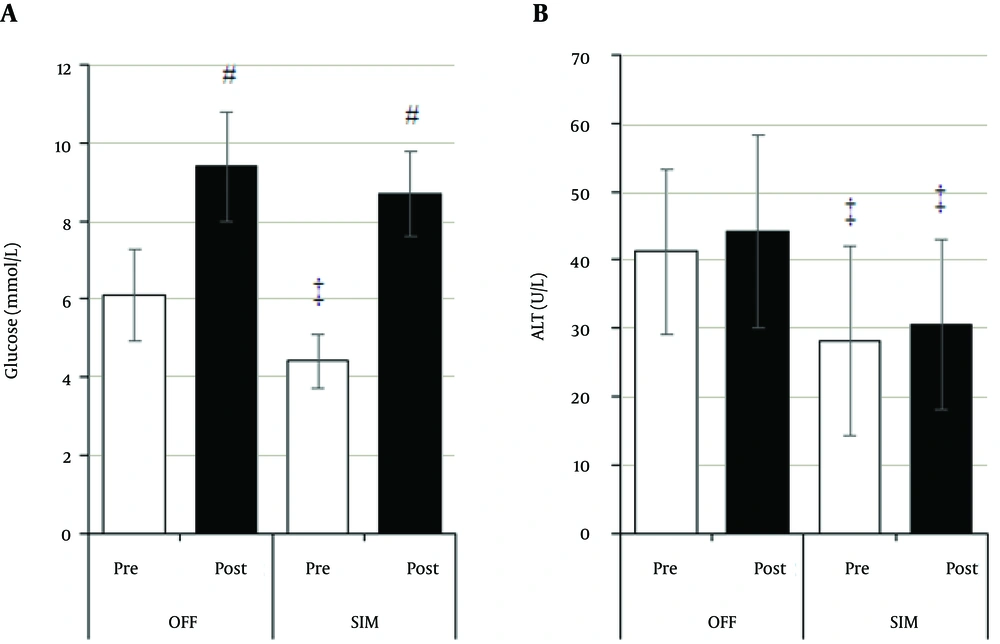
Figure 1.
A, blood glucose concentration; B, blood alanine aminotransferase (ALT) concentration. Within time point difference from OFF: ‡ < 0.01; within group difference from PRE: # < 0.01.
Enzymatic activity of ALT showed a difference between groups (F 1, 22 = 13; P = 0.001; ES = 0.8) with a large effect (Figure 1B). Post hoc analysis showed that OFF values were greater than SIM for both time points (P = 0.01; ES = 1.2). However, ALT was not significantly different from pre- to post match in either group (F 1, 22 = 0.54; P = 0.46; ES = 0.2). In addition no time x group interactions for ALT were found (F 1, 22 = 0.009; P = 92). No differences were shown for enzymatic activity of AST (P = 0.52; ES = 0.2) and CK (P = 0.14; ES = 0.1) between time points and between groups (AST: P = 0.6; ES = 0.2; CK: P = 0.7; ES = 0.4). Finally, Mg concentration showed no difference between time points or groups (P = 0.1; ES = 0.1; P = 0.9; ES = 0.1, respectively).
5. Discussion
The aim of this study was to compare biochemical responses from official and simulated MMA matches and, among the primary findings, we found a similar blood lactate concentration response for both groups and time points, a lower ALT level for SIM compared to OFF at PRE/POST and a higher blood glucose concentration at PRE in OFF matches. Additionally, there was an absence of difference in CK, AST and Mg between winners and losers for both groups and time points.
Increased blood lactate and glucose concentrations from PRE to POST are expected in combat sports, due to increased glycogenolysis and gluconeogenesis in response to demands of energy availability. However, these markers highlight important information when OFF and SIM groups are compared. Firstly, there is no difference between POST values for blood lactate concentrations, which indicates that similar anaerobic-glycolytic demands were achieved in both situations (14) and, secondly, when comparing OFF to SIM at PRE there was moderate effect size for glucose concentration, which could indicate anticipatory preparation for the fight by sympathetic system activation and consequently raised cortisol and glycogenolysis levels (18, 30).
Lactate responses to MMA fights appear to be higher than those reported for judo [12.3 ± 0.8 mmol/L; (27)], BJJ [11.6 ± 1.1 mmol/L; (31)] and boxing [13 mmol/L; (32)] athletes, but lower than those in wrestling that may reach values of 20.0 mmol/L (19, 33). On the other hand, the current values (~ 16 mmol/L) were similar to previous investigation of official MMA matches (16). In karate, Chaabene et al. (20) found higher lactate values for official matches and indicated that simulated fights may place a greater demand on the aerobic system rather than the anaerobic glycolytic pathways. Specifically with MMA athletes, this behavior was not confirmed by Amtmann et al. (14), whose data indicated that MMA sparring bouts and intermittent training protocols had similar lactate responses to official MMA matches with values between 18.7 and 20.7 mmol/L (14). In agreement, our data showed similar glycolytic profiles for both situations, indicating that sparring matches effectively simulate the metabolic demand of OFF matches.
Elevated blood glucose concentration prior to fights has been previously reported in combat sports (18). This phenomenon may be related to anticipatory cortisol behavior (23, 34) resulting in increased glucose levels through stimulation of gluconeogenesis or by hepatic glucose production from lactate (28). A relationship between blood glucose and cortisol has been reported prior to BJJ matches (18) and greater energy availability appears to be a positive anticipatory factor related to increased fighter competitiveness (30). Thus, Moreira et al. (23) suggested that training strategies should be considered to raise environmental stress in order to mimic real situations and create similar metabolic responses. To the author’s knowledge, this is the first study showing similar findings for MMA fighters and reinforces the need to create strategies that included anticipatory stress.
Enzymatic activity of CK, AST and ALT are frequently considered as muscle damage markers (5, 8). CK activity showed no difference from PRE to POST in the OFF and SIM groups, however, the peak of this measure is likely reached 24 to 48 hours after exercise (8) and may not have been reached. In addition, AST and ALT activity showed no time or group differences, reinforcing the absence of relevant muscle damage at these time points. However, ALT was significantly lower in the SIM group at both time points. Banfi et al. (8) suggested that ALT activity could be related to body mass index but no differences were found for anthropometric measures in the current investigation. However, considering that OFF group were specifically training for the competitive event, the difference in ALT could be explained by presumably increased training volume and intensities (3, 5), since this measure was previously related to overtraining (35).
In summary, the current results may support those of previous studies that compared official and simulated matches concluding that the anticipatory responses are greater in the competitive environment (23). Regarding glycolytic demands, while karate competitions indicate higher intensity than simulated matches (20), for MMA, sparring and official fights appear to have similar patterns (14). The main limitations of the current investigation are: i) the impossibility to control the time of fighting in official group; and ii) the absence of appropriately timed follow-up measurements, specially CK activity, due logistical issues with the athletes living in different cities. In addition, although it was not the main objective of this study, technical and tactical analysis could reinforce the findings and reduce imprecision for both OFF and SIM situation, including comparisons. It is suggested that future investigations evaluate the chronic effects of structured training protocols that includes sparring matches.
In conclusion, mixed martial arts official and simulated matches indicate similar high intensity glycolytic demands with minimal changes to biochemical markers of muscle damage immediately following the fights. Glycolytic availability prior to the fights was raised exclusively in response to official matches, which may be due to an anticipatory effect. Finally, in addition to providing an opportunity to focus of the technical/tactical components of MMA training, sparring matches appear to mimic the metabolic demands of the competitive environment.