1. Background
Kitesurfing is a relatively new water sport that involves a combination of sport modalities such as surfing, windsurfing, wakeboarding and power kiting (1). When kitesurfing, the subject uses the force of the wind to power a maneuverable kite, which subsequently propels him or her through the water on a board (2, 3). The athlete encounters unpredictable conditions in terms of the function of irregularities in the surface of the water and executes a succession of jumps and finely timed movements to maintain equilibrium and contact with the board and the water. The better an individual’s proprioceptive control, the more effectively he or she can execute the required maneuvers, thus performing better and decreasing the probability of suffering the musculoskeletal injuries that so frequently occur in this sport (4, 5).
There are many ways to evaluate proprioception; however, two factors are generally considered: static equilibrium and dynamic equilibrium (6). Static equilibrium is defined as an individual’s capacity to maintain a base of support and balance with minimum body movement (7). Researchers have employed many different methods of analyzing this form of equilibrium. These include the system of electronic baropodometry (8), the platform of force and the clinical scales, the balance error scoring system (9), and the Berg balance scale (10). Dynamic equilibrium is defined as an individual’s capacity to execute an activity or sportive action while maintaining body stability. However, very few existing studies have analyzed this form of equilibrium (11). One potential technique involves fractional perturbation, where signal decoding is performed by plates or platform of force (12, 13).
Another method that has recently been used to evaluate dynamic equilibrium is known as the star excursion balance test (SEBT). This has proven to be an effective method of measuring and analyzing the dynamic equilibrium of athletes while avoiding the risk of lesion in the lower limb. It can also be used to identify deficits in dynamic equilibrium with or without the effect of muscular fatigue (11). Overall, SEBT seems to represent an efficient approach to the deficit evaluation of dynamic equilibrium in sedentary people, as well as providing a means of rehabilitating damaged structures in lower limbs (14).
The study of dynamic equilibrium can also involve the analysis of the adaptive answers provided through the systematic realization of the complex sequence of tasks associated with the flexions, articular extensions, and rotations; e.g., jumping and landing. These tasks characterize the performance and motor action required in many sports; for example, kitesurfing. During the execution of a sequence of maneuvers, the athlete completes high intensity movements to such an articular extent that it is possible to cause serious damage to the musculoskeletal structures and/or generate musculotendinous lesions (15). In this sense, the SEBT, as an important instrument for evaluating proprioception, can help to effectively assess the adaptive mechanisms that can occur chronically when an athlete performs the articular stabilization required during kitesurfing activities. It can also be used during training activities to assist kite surfers to detect neuromuscular imbalances and subsequently use this information to guide training, improve performance, and reduce the risk of injury.
2. Objectives
As previously discussed, the objective of this case series study was to evaluate and compare the dynamic equilibrium of kitesurfing athletes with non-athletes through the application of a dynamic equilibrium test. The hypothesis that guided the study was that kitesurfing athletes would perform better in the dynamic equilibrium test than non-athletic subjects due to the fact that the former undergo an adaptive process to maintain correct proprioceptive control during the execution of maneuvers and, therefore, perform effectively in their sport.
3. Methods
3.1. Subjects
A total of 312 university students and 53 kitesurfing athletes were initially invited to participate in this study. Potential participants were informed of the research in class and through the distribution of fliers that provided an overview of the study. Interested candidates were then invited to complete a questionnaire in which their suitability for the study was assessed. Any subjects who had previously suffered bone or musculotendinous injury, presented neuromuscular or vestibular disturbances and/or used some form of stimulant or depressant medication were excluded from the study. As too were subjects who were involved in a program of physical training that was different to that executed by the kitesurfing group. A total of 33 healthy male volunteers who were aged between 16 and 25 years were selected for participation in the study: 15 kite surfers and 18 sedentary university students. During the course of the research, one athlete, and three students failed to complete the study; as such, a total of 14 athletes and 15 control individuals participated in the research. The chosen athletes participated in kitesurfing at national and regional championship level with a mean time of practice of 4.6 ±1.5 years. This met the study requirement for the subject to have been involved in the sport for a minimum of two years and a maximum of seven years. The sample size was firstly calculated, assuming the middle difference among independent groups of 4 cm and a variance of 7 cm in the values recorded during the SEBT, at a significance level (tα) of 0.05 and statistic power (β) of 80%, with a minimum number of 10 individuals. All subjects initially underwent an individual orientation and were informed about the objectives of the study and the method by which it would be conducted. All subjects subsequently gave their informed consent to participate in the research study in accordance with the Helsinki Declaration. They also signed the term of free and clear agreement accredited by the ethics committee.
3.2. Instruments
A digital scale with anthropometric ruler (Wenny, W110H, Saint Barbara, Brazil) and a metallic tape were used to measure the subjects’ anthropometric body mass, height and lower limb length. The SEBT was employed to evaluate their dynamic equilibrium. This method evaluates an individual’s capacity to maintain body equilibrium with the support of a lower limb while using the opposite lower limb to attempt to reach the furthest possible distance in eight distinct directions: anterior, anteromedial, medial, posteromedial, posterior, posterolateral, lateral and anterolateral. Each of the eight directions was clearly marked on the floor with tapes that were separated by an angle of 45°. Each tape was 120 cm long and marked in increments of 0.5 cm, starting from the central point in the common (central) point at which the supporting leg was positioned (16).
3.3. Testing Process
The research was implemented in three sessions. The first involved the collection of anthropometric data (body mass, height, lower limb length and dominant lower member) and was used to familiarize the participants with the SEBT evaluation. The first SEBT data collection exercise was performed during the second session and the second data collection exercise was completed in the third session. There was a period between 48 hours and seven days between each session. The purpose of the first session was to minimize the learning effect. The aim of the second and third sessions was to verify the reproducibility of the test.
During the familiarity exercise, the length of the lower limbs was evaluated by measuring the distance between the upper anterior of the iliac spine and the medial malleolus in both legs. The dominant lower limb was confirmed by simulating a fall. The limb that the participant favored to prevent falling was considered to be his or her dominant member. This was confirmed by questioning the subject as to which member he or she believed was dominant. In order to familiarize the participant with the process of the test, the examiner first demonstrated the exercise before each subject was placed in the orthostatic position in the center of the test area. Each individual was then asked to stretch the foot of the contra lateral member (free leg) in an attempt to reach the furthest point of the extremity of the line without losing equilibrium or displacing the foot of support that was localized in the test center area. After doing so, the participants returned to the initial position in bipedal support. This procedure was repeated for each one of the eight lines, forming a sequence. The same sequence was then performed using the other leg, thus changing the supporting leg. During this phase, each participant completed the exercise three times for each leg, totaling 24 repetitions of each leg. There was an interval of five minutes of rest in between each sequence. The same procedures were then repeated in the second and third session. All the sequences were executed in a random order. By the completion of the test, each participant had performed a total of 72 repetitions on each leg distributed across the three phases. It was assumed that this procedure minimized the learning effect.
Due to the differences between the right and left legs in relation to the sagittal plane, the designation of the directions was performed in different sequences for each leg. When the test was performed with the right leg acting as support, the directions were executed in the following order: anterior, anterolateral, lateral, poster lateral, posterior, posteromedial, medial and anteromedial. When the test was executed with the left leg acting as support, the directions were performed in the following order: anterior, anteromedial, medial, posteromedial, posterior, posterolateral, lateral and anterolateral. The distance from the central point to the furthest point reached by the participant’s toes was measured in centimeters. In the event that the participant’s foot extended beyond the line or moved from the test center, or when a loss of equilibrium occurred during the execution of the attempts, all evaluations were disregarded. In these situations, the section of the test was repeated. The record of the distances achieved during the SEBT was due to the lower limb supported in the center of the test and not by the free member that moved in different directions. The same examiner evaluated all the sequences and tests.
All the participants were instructed not to wear any footwear and completed the test barefoot and in light clothing to avoid any interference with their movement. They were also asked to refrain from ingesting stimulating substances six hours before the execution of each test and not to consume alcohol four hours before. Likewise, the volunteers were told not to participate in any intense physical activities or exercises in the 48 hours prior to testing.
In order to standardize the results, the distance measured for each individual participant was divided by the length of his lower limb and this value was multiplied by 100, resulting in a distance that represented the following: (distance/leg length) × 100. Previous studies have demonstrated that the distance measured during the SEBT is mainly influenced by the length of the individual’s lower limb; in other words, subjects with longer legs have more chance of reaching further than subjects with short legs (14).
The distances evaluated during the second and third phases of testing (tests 1 and 2) were used to tabulate the data. The farthest distance that the participant reached across the three attempts in each direction was used to evaluate the reproducibility of tests 1 and 2. Following this, the higher value achieved in each direction during tests 1 and 2 was used to compare the right and left legs (paired), the distance reached in the different directions in the same group (measures repeated), and the differences between the distance reached by athletes and the control (independents).
3.4. Statistics
The collected data was analyzed through the use of descriptive statistics (averages and standard deviation). The normality was evaluated through the use of the Shapiro-Wilk’s test Lilliefors (P > 0.05). Homogeneity tests were performed as precondition to correlate the data across tests 1 and 2 and to compare the performance of the right and left legs, the different directions in each group, and the control and athlete group. Homogeneity deviations were corrected with the Levene and Dunnet C’s tests. An independent samples t-test was used to compare the averages intergroup (athlete and control). To compare the averages of the intergroup (comparison between eight directions for the same group in the same leg) a repeated averages ANOVA (Tukey B and Dunnet C) was employed. A dependent samples t-test was used to compare the averages of the right and left leg in the same group and in the same direction. The intraclass coefficient correlation (ICC) was used to analyze the reproducibility of test 1 and test 2. For the variables that did not present normality and/or homogeneity, corrections and/or no parametrical tests were employed. The significance level adopted was α = 0.05. SPSS 11.0 was used to analyze the data.
4. Results
In both the control and athlete group, all the data evaluated presented normality (P > 0.05), with the exception of the anterior direction (right) and posterolateral (right). The average age of the participants in the athlete group was 20.8 ± 2.6 years and the average age of the participants in the control group was 19.6 ± 1.1 years. The participants in the group of athletes had an average body mass of 66.6 ± 10.1 kg body mass, a height of 171 ± 4.8 cm and a lower limb length of 88.8 ± 5.1 cm. The participants in the control group had an average body mass of 64.7 ± 9.4 kg, a height of 169.9 ± 6.6 cm and a lower-limb length of 88.8 ± 5.1 cm. No statistically significant differences were observed in terms of the average anthropometric measurements of the two groups. In terms of limb dominance, 12 athletes (85.7%) used the lower right limb as dominant and 2 (14.3%) the lower left limb. In the control group, 13 subjects (86.7%) had the lower right limb as a dominant and 2 (13.3%) the lower left limb.
Generally, a good ICC was found during tests 1 and 2. The reproducibility of the data was greater in the control group than it was in the athlete group. In the control group, only one direction (anterolateral in the right and left leg) presented ICC less than 0.70. In the athlete group, anteromedial (right), medial (left), posteromedial (right), posterolateral (left), lateral (left) and anterolateral (right and left) directions presented ICC less than 0.70. Both the athlete and control groups produced lower values of reproducibility in the anterolateral direction in both legs (Table 1).
Table 1.
Intraclass Coefficient Correlation Referent to the Values Measured in Tests 1 and Test 2 of the Star Excursion Balance Test With the Support of the Left and Right Leg in Kitesurfing Athletes and the Control Group
| Directions | Athletes | Controls | ||
|---|---|---|---|---|
| ICC | P | ICC | P | |
| Anterior (left leg) | 0.72 | 0.001 | 0.90 | 0.0001 |
| Anterior (right leg) | 0.88 | 0.0001 | 0.88 | 0.0001 |
| Anteromedial (left leg) | 0.74 | 0.0001 | 0.86 | 0.0001 |
| Anteromedial (right leg) | 0.53 | 0.002 | 0.87 | 0.0001 |
| Medial (left leg) | 0.53 | 0.01 | 0.88 | 0.0001 |
| Medial (right leg) | 0.71 | 0.001 | 0.76 | 0.0001 |
| Posteromedial (left leg) | 0.80 | 0.0001 | 0.88 | 0.0001 |
| Posteromedial (right leg) | 0.61 | 0.004 | 0.73 | 0.001 |
| Posterior (left leg) | 0.92 | 0.0001 | 0.73 | 0.001 |
| Posterior (right leg) | 0.81 | 0.0001 | 0.78 | 0.0001 |
| Posterolateral (left leg) | 0.63 | 0.003 | 0.81 | 0.0001 |
| Posterolateral (right leg) | 0.91 | 0.0001 | 0.82 | 0.0001 |
| Lateral (left leg) | 0.54 | 0.02 | 0.77 | 0.0001 |
| Lateral (right leg) | 0.83 | 0.0001 | 0.77 | 0.0001 |
| Anterolateral (left leg) | 0.46 | 0.04 | 0.57 | 0.009 |
| Anterolateral (right leg) | 0.21 | 0.218 | 0.39 | 0.07 |
No significant differences were observed between the performance of the right and left legs in the same direction in the same group with the exception of the anterior direction in the athlete group and the medial direction in the control group (Table 2). No significant differences were observed between the performance of the different directions in the athlete group in the medial, posteromedial, posterior and posterolateral directions when the left leg was used as the supporting leg. However, these same directions presented significant differences when they were compared to the anterior, anteromedial, anterolateral, and lateral directions. Differences between the anterior, anteromedial and lateral directions were not observed. The anterolateral direction presented similarities only with the anterior direction. Similar behavior was observed between the directions performed with the support of the right leg, with the exception of the posterolateral direction, which also presented similarities with the anteromedial and lateral directions. Beyond that, significant differences were not found between the anterior and lateral and in the anterior and anterolateral directions (Table 2).
Table 2.
Means and Standard Deviation (SD) of the Relative Distances to the Inferior Length of the Member (%) Measured During the Star Excursion Balance Test for Both the Left and Right Legs of Kitesurfing Athletes and the Control Groupa
| Directions | Athletes | Controls | ||
|---|---|---|---|---|
| Mean ± SD | Mean ± SD | Mean ± SD | Mean ± SD | |
| Left Leg | Right Leg | Left Leg | Right Leg | |
| Anterior | 106.1 ± 12.3A,B | 101.7 ± 10.1A,B,* | 100.7 ± 12.1A,B | 101.0 ± 13.1A,B |
| Anteromedial | 112.8 ± 13.1B | 116.0 ± 9.8C | 111.0 ± 15.0B,C | 108.3 ± 11.9B,C,D |
| Medial | 130.3 ± 6.1C | 129.5 ± 4.6D | 119.5 ± 13.0C | 116.3 ± 12.1D,* |
| Posteromedial | 132.2 ± 5.7C | 132.4 ± 4.2D | 117.9 ± 12.0C | 118.4 ± 9.7D |
| Posterior | 131.6 ± 7.0C | 132.3 ± 5.4D | 114.5 ± 11.1B,C | 115.2 ± 10.8C,D |
| Posterolateral | 130.0 ± 6.8C | 128.0 ± 10.1C,D | 112.3 ± 11.7B,C | 112.9 ± 11.6B,C,D,* |
| Lateral | 118.2 ± 9.1B | 113.0 ± 14.4B,C | 101.2 ± 14.9A,B | 102.9 ± 13.4A,B,C |
| Anterolateral | 93.1 ± 13.0A | 92.6 ± 15.3A | 91.1 ± 15.0A | 95.5 ± 13.1A |
aDifferent capital letters represent significant differences between the directions to the same group (P < 0.05).
*Significant differences between right and left legs (P < 0.05).
In the control group, no significant differences were observed in both the legs in the anteromedial, medial, posteromedial, posterior, and posterolateral directions. When the test was performed with the support of the left leg, similarities were also observed in the anteromedial, posterior and posterolateral directions with the anterior and lateral directions. When executed with the support of the right leg, only the anteromedial and posteromedial directions were similar to the anterior and lateral directions, while the posterior direction presented familiarity with the lateral direction. No significant differences were observed in both legs in the anterior, anterolateral and lateral directions (Table 2).
In relation to the performance of the groups, the athletes achieved statistically superior results to the control group in the medial, posteromedial, posterior, posterolateral and lateral directions in the left leg and in the medial, posteromedial, posterior and posterolateral directions in the right leg (P < 0.05). No significant difference in the lateral direction in the right leg was observed (P > 0.05). There were no statistically significant differences in the distance in the anterior, anterolateral and anteromedial directions between groups in both legs (Figure 1).
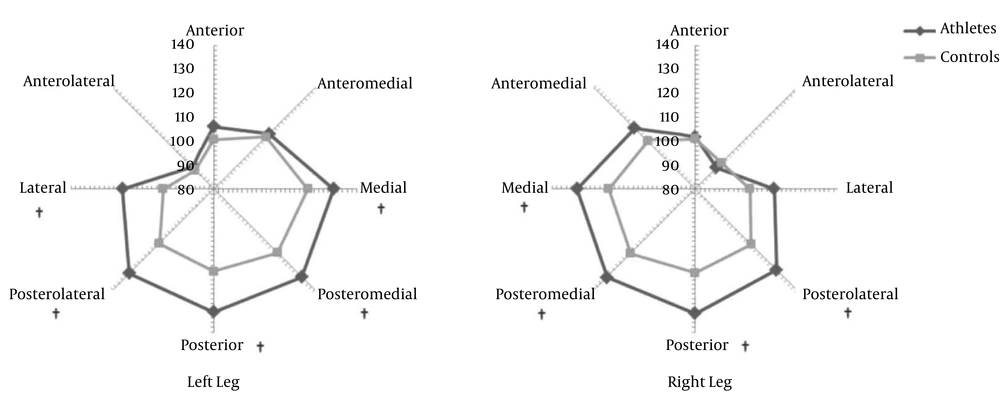
Figure 1.
† Significant differences in groups (P < 0.05). Left leg and right leg means the lower limb supported in the center of the test and not the free member that moved in different directions.
5. Discussion
The objective of this research was to compare and evaluate the dynamic equilibrium of kitesurfing athletes and non-athletes through comparing the distances subjects reached during a SEBT. The distances reached in each direction were used to compare the groups of athletes and non-athletes and to evaluate the different directions reached in the same group. The distances reached by both the right and left leg were compared for each group.
No statistically significant differences were observed between the distances reached by the right and left leg, with the exception of the anterior direction in the athlete group and the medial direction in the control group. As such, no differences were observed in dynamic equilibrium in the legs of both groups. These results were similar to other studies that have been performed using the SEBT. For example, Gribble and Hertel (14) compared the dynamic equilibrium in healthy men and women and did not find any significant differences in the distances reached by the legs of both groups in each one of the eight directions. Sabin et al. (17) compared the dynamic equilibrium between basketball players and non-athletes and did not find any significant differences between the distances reached by the right and left legs of both groups. In many cases, athletes of different sports are more susceptible to muscular disequilibrium than non-athletes due to differences in the specialization of each member or the predominance in the contraction of some muscular groups due to the sportive practice. The similarity in terms of the performance of both legs identified in this research indicated that kitesurfing does not provide this kind of adaptation. However, this may be due to the fact that the test was not sensitive enough to detect such differences. Many studies have evaluated the chronic adaptation of the sport about the dynamic equilibrium using the SEBT and did not verify differences between the performances of the right and left legs (17-20). However, studies that employ the SEBT methodology are sensitive to identifying this disequilibrium from chronic ankle instability (21) and in individuals with patellofemoral pain, where lower developments in the executions of the directions in the injured limb have been verified.
Kitesurfing is characterized by the elevated quantity of repeated and high impact movements that could overload the musculoskeletal structure and cause disequilibrium. During this sport, the athlete performs rapid and intense movements that are associated with a large range of motion, and this can cause damage to musculoskeletal structures (5). The continual impact produced during the maneuvers that are required to accommodate variations in the surface of the water is also associated with a high number of eccentric contractions (15). These aspects, when added to muscular weakness or proprioceptive deficits, could result in disequilibrium, leading to lesions and damage. However, these characteristics were not sufficient to result in differences in the dynamic equilibrium in the athletes’ limbs support.
This study also compared the distances the group of athletes and the control group reached in each of the eight directions during the SEBT. Similar characteristics were observed between the group of athletes and the control group. First of all, no statistically significant differences were observed in either group in the medial, posteromedial, posterior and posterolateral directions for both legs. The same directions always presented the higher mean values in their respective groups. Plisky et al. (22) evaluated the dynamic value in male soccer players through the use of a Y Balance TestTM, which is an adaptation of the SEBT. Similar to the results of the current study, the authors also verified that the farthest distance reached was in the posterolateral and posteromedial directions and the least distance reached was in the anterior direction. Rasool and George (23) used the SEBT method to train healthy male athletes over a period of four weeks. They also observed the farthest distance reached was in the posteromedial and posterior directions and that the least distance reached was in the anterior, lateral and anterolateral directions.
Similarities in the distance reached in the anterior direction with the lateral and anterolateral directions in both groups and both legs were observed. The anterolateral direction always presented a lower mean value, independently of the group or leg used for support. Smaller distances were obtained in this direction. This was potentially due to the fact that the participants experienced difficulties completing the maneuver due to the increased torque and higher need for dynamic balancing. Therefore, the ability to reproduce the test was compromised and a lower ICC was possibly obtained because of the difficulty in performing the test in this direction. The most significant differences in the distances reached in different directions were also observed when the left leg was used for support, while the distances reached were more similar when the test was performed with the right leg used for support (Table 2). In general, the differences observed in the distances reached in each direction were more significant in the athlete group than they were in the control group.
The kitesurfing athletes performed better during the SEBT than the control group. The athletes achieved the furthest distance in the medial, posteromedial, posterior, posterolateral and lateral directions with the support of the left leg and in the medial, posteromedial, posterior and posterolateral directions with the support of the right leg. The anterior, anteromedial and anterolateral directions presented similarities in both legs in the groups of athletes and non-athletes and the lateral direction was similar only when the left leg was used for support (Figure 1). The athletes reached greater distances because they could keep their supporting foot more balanced than the control subjects. This is probably due to chronic adaptations triggered by kitesurfing, such as increased muscle strength of the lower limbs and core musculature and more efficient proprioceptive and vestibular response, that allowed the group of athletes to reach greater distances in the dynamic balance test.
Previous studies have used the SEBT to verify the chronic effect of different kinds of sports in terms of dynamic equilibrium. Filipa et al. (19) compared the influence of an eight-week neuromuscular training program involving plyometrics, muscle strengthening exercises and functional exercises using a ball. They compared the dynamic equilibrium of soccer players and non-athletic subjects using the Y Balance TestTM. They observed that the female soccer players performed better than the non-athletes in all three directions of the test. Sabin et al. (17) also observed significant differences in the eight directions of the test in relation to the performance of a group of athletes versus non-athletes group. Plisky et al. (18) compared the dynamic equilibrium of female and male basketball athletes and verified that male athletes performed better in the posteromedial and posterolateral directions, while no differences were observed in the anterior direction. A study by Bhat and Moiz (20) observed similarities in the performance of hockey and soccer players and observed longer distances only in the lateral and posterior directions for the hockey players. Nevertheless, the authors argued that these sports generally involve similar sensorimotor characteristics and challenges and that this explains the similarity in the results.
In this sense, there is a similarity in the results of the present research and the data available from existing studies that have examined how the chronic adaptations of different sports impact dynamic equilibrium. The athletes’ enhanced performance seems to be result of the neuromuscular adaptation provided by the sportive modality; however, in light of the fact that not all researchers have identified differences between a group of athletes and a control group in terms of all the evaluated directions, this adaptation may be influenced by the characteristics of the sport the group of athletes practice. In the present study, the anterior directions did not present differences between the athlete group and the control group; however, differences were found in all directions in alternative studies (17, 19). The influence of the sportive practice on the chronic adaptation in equilibrium can be observed in a study by Bressel et al. (7) in which the statistic equilibrium through the BESS and the dynamic equilibrium of male and female gymnastics, basketball and soccer players was compared through the use of the SEBT. The female soccer players presented inferior static equilibrium to the gymnasts and inferior dynamic equilibrium to the female soccer players. On the other hand, no statistically significant differences in distance were observed between the gymnasts and the female soccer players. These results indicate that different sports result in different adaptations in the dynamic equilibrium of its practitioners. This adaptation seems to be influenced by the characteristics of each sport in terms of the intensity of the execution, the biomechanical characteristics and the production of strength, the muscular recruitment standard and the specificity of the motor gesture, the quantity and type of sensory information etc. (24).
A study by Earl and Hertel (25) evaluated neuromuscular activation in healthy young subjects by examining the electromyography of surface during executions of the SEBT. Activation differences were observed in the eight directions of the test. The authors noted that the participants exhibited better activation of the hamstring when performing movements in the posterior, posterolateral and lateral directions, while movements in the posteromedial and medial directions generally involved less hamstring activation. The activation of the quadriceps was better in the anterior, anterolateral and anteromedial directions. In terms of the anterior tibial muscle, the authors observed that better activations occurred in the posterior, posterolateral, posteromedial, medial and lateral directions. Furthermore, it was observed that the simultaneous contraction of the quadriceps and the hamstring occurred during the accomplishment of some movements with different predominance according to the standard of neuromuscular activation associated with each direction. For example, when reaching in the anterior directions, the subjects leaned back when performing the extension of the body to keep the equilibrium and performed the knee flexion of the leg of support, mainly, by action of the quadriceps. In the posterior direction, the predominant action of the hamstring can be explained as a function of the gravity action about the body that tended to trigger hip flexion. As the rearward extending leg tried to reach the furthest distance, the body flex required to maintain the necessary equilibrium in the support leg was controlled, mainly, by the eccentric action of the hamstring. In view of the fact that the different directions of the SEBT are executed by a different standard of neuromuscular activation, it was possible to evaluate and compare the chronic effect that different sports can have on dynamic equilibrium and the standard of neuromuscular recruitment of the different groups. In the case of kitesurfing athletes, an important increase in the performance of the dynamic equilibrium was observed; as such, it could be argued that chronic adaptations in the neuromuscular system of these athletes have occurred as a result of their participation in the kitesurfing sport.
5.1. Conclusion
The results of the present study indicate that kitesurfing does not generate muscular disequilibrium in athletes and that individuals who participate in this sport perform better than non-athletes in terms of their ability to reach their leg in the posterior, medial and lateral directions. This is a function of the sports-related characteristics responsible for generating chronic adaptations of the dynamic equilibrium in its practitioners. A certain standard of neuromuscular activation is required to perform the movements associated with these tests, and it appears that the neuromuscular system of kitesurfing athletes has adapted the ability to respond more effectively to situations that create body disequilibrium. Future studies in this area may be able to develop an ideal performance profile in dynamic balance tests in athletes of different categories to predict performance and injury risk. Future applications of this study could also seek to develop an ideal performance profile in dynamic balance test for kitesurfing athletes to detect neuromuscular imbalances in order to guide training, improve performance, and reduce the risk of injury.