1. Background
Body responses are varied from time to time in a day due to specific body conditions such as wakefulness, hunger, jet lag, etc. These responses are related to the circadian rhythm (i.e. body-clock). By the same token, the body-clock is believed to be a factor affecting sports performance.
Regarding circadian effect on aerobic exercise and maximal oxygen uptake (VO2max) shown in Chtourou et al. (1) was equivocal. Many researchers have investigated in the diurnal effect on endurance activities since 1980s (Table 1). Previous findings of diurnal effect on maximal oxygen uptake (VO2max) were not reached to the consensus. Brisswalter et al. (2) and Carter et al. (3) found that VO2max is significantly greater in the morning, but other studies found that greater VO2max performance is achieved in the afternoon (4, 5). However, most studies (6-10) indicated that the VO2max is a stable function, which is not altered by diurnal changes. Thus, the diurnal variation in cardiovascular endurance performance is still unclear.
Table 1.
Summary of Studies Related to Diurnal Effect on Sports Performance a
| References | Participants | Testing Methods | Intensity | Greatest VO2max/ Performance in Time of Day |
|---|---|---|---|---|
| Brisswalter et al. (2007) (2) | 14 Physically active males; Age: 22.3 ± 6.2 years | Cycling (L) | Max | 0700-0830 > 1900-2030 b |
| Carter et al. (2002) (3) | 9 Recreational volunteers; 6 Male; 3 Female; Age: 25 ± 8 years | Running (L) | Max | 0600 > 1800 > 1200 b |
| Chtourou et al. (2012) (4) | 20 Soccer players; Age: 17.6 ± 0.6 years | Yo-Yo test (F) | Max | 1700 > 0700 b |
| Torii et al. (1992) (5) | 12 Healthy sedentary males; Age: 30 years | Cycling (L) | Max | 1500-1530 b |
| Bessot et al. (2006) (6) | 11 Male competitive cyclists; Age: 19.1 ± 1.8 years | Cycling (L) | Max | NS |
| Martin & Thompson (2000) (7) | 7 Male collegiate swimmers; Age: 22 ± 4 years | Swimming (F) | Sub-max | NS |
| Reilly & Baxter (1983) (8) | 8 Female volunteers; Age: 19.5 years | Cycling (L) | Max | NS |
| Faria & Drummond (1982) (9) | 31 Participants; Age: 23.3 ± 0.7 years | Running (L) | Max | NS |
| Hill et al. (1989) (10) | 27 College students; 7 Male; 20 Female; Age: 26 ± 4 years | Cycling (L) | Max | NS |
| Giacomoni et al. (1999) (11) | 21 Female PE students; Age: 23 ± 3 years | Running (L) | Sub-max | 1700 |
| Hammouda et al. (2013) (12) | 15 Male soccer players; Age: 17.3 ± 0.5 years | Yo-Yo test (F) | Max | 1700 > 0700 b |
a Abbreviations: F, field test; L, laboratory-based test; Max, maximal; Sub-max, submaximal; VO2max, maximal oxygen uptake.
b Significant difference (P < 0.05), NS = No significant difference (P > 0.05).
Previous studies focused on investigating the diurnal effect on collegiate students and adult-athletes, but rarely had discussion and examination on young athletes or secondary school athlete students. The target participants of this study were secondary school athletes. Their circadian rhythms are more regular than the usual target participants (i.e. collegiate students and adult-athletes). The best single measure of young people’s aerobic fitness, VO2max (13) is an essential pre-requisite of elite performance in many sports (14), so the understanding of VO2max performance in varied time-of-day specific occasions for young athletes would be very important to identify the best training time or performing time. The purpose of this study was to find out the diurnal variation in cardiovascular endurance performance in the young athletes.
2. Objectives
Due to the complicated implementation, such as control of environmental factors, energy depletion, and hyperthermic fatigue (15), there were limited studies on the diurnal effect for endurance exercise. The aim of this study is to find out the diurnal variation in cardiovascular endurance performance. Sports trainers would benefit from the findings by adjusting their training plan to fit the best timing in a day for cardiovascular endurance training. The findings would also be valued for sports events managers to reconsider their planning on competition time especially for the events involving endurance activities, such as a marathon run.
3. Materials and Methods
3.1. Participants
Based on our understanding, previous studies recruited between 7 and 31 participants and 21 participants was the biggest sample size for repeated measures. In this study, 35 male athlete students (age: 15.17 ± 1.62 years; height: 170.11 ± 8.19 cm) were voluntarily recruited. Participants were recruited from four secondary schools in different districts in Hong Kong, and had regular sports team training experience. All participants were provided with written and verbal information on the study and needed to complete the self-consent and parental assent documents. The participants and their parent/guardian were also informed that participation was voluntary and they could withdraw from the study at any time. They were required to fill in the physical activity readiness questionnaire (PAR-Q) before the experiment. None of them had any history of a medical problem that may affect the ability to execute the experimental test. All participants followed the same sleep-wake schedule (wake up at 0700, sleep at 2300) and the same meal plan for two preparation days prior to each test. Vigorous exercise was avoided during the preparation days. Those procedures aimed to limit the internal variations among the participants. The protocol was approved by the Human Research Ethics Committee of the Hong Kong Institute of Education, specific for the student research projects.
3.2. Study Design
This study was a randomized repeated crossover design. It was designed to carry out three non-consecutive days in four secondary schools from December 2013 to March 2014. The briefing session was included in the first testing day. All participants were well instructed and familiar with all the measurements. The remaining days were testing days. The three testing days involved three randomized testing times (morning: AM, noon: NN, or afternoon: PM), with minimal 36 hours recovery time between each testing day (Figure 1).
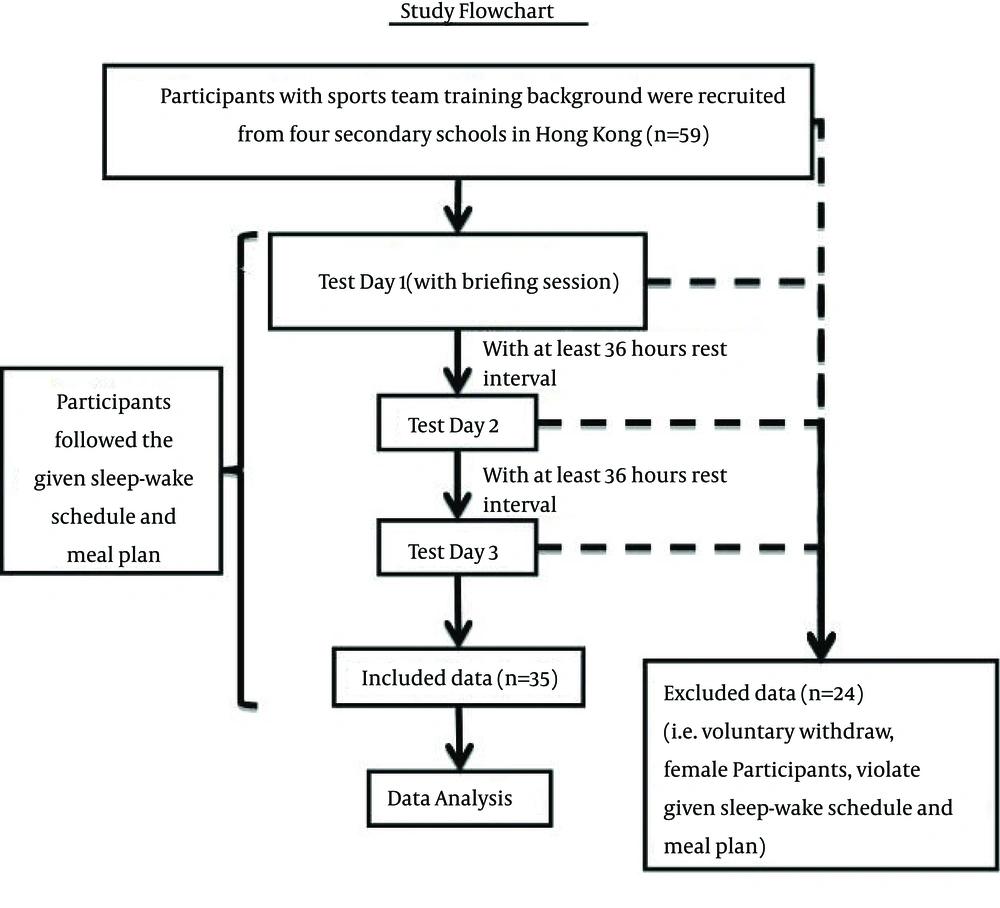
Figure 1.
Study Flowchart
Participants with school sports team training background (specialized in athletic or cross country or basketball) were recruited from four secondary schools in Hong Kong. The inclusion criteria were: 1) secondary school students and 2) regular participation in a sport team. The exclusion criteria were: 1) female participants; 2) participants who violated the given sleep-wake schedule and meal plan; and 3) any incomplete data, such as voluntarily withdrawal from the study.
The experiments were conducted in an indoor sports gymnasium, the testing environmental temperature was set at 21-23 ℃ (16), and the brightness atmosphere, humidity of three non-consecutive testing days were under control. All participants’ body water percentages were measured before the tests to ensure that there was no dehydration effect before the measurements. The testing environment was controlled and assumed no effect on the measurement result. Participants were expected to give their best performance during all tests.
3.3. Nutritional and Sleep-Wake Pattern Control
Nutritional and sleep-wake pattern were controlled in order to standardize the lifestyle and nutrition background. Nutritional intake was controlled to ensure amount (breakfast ≈ 620 kcal, lunch ≈ 810 kcal, dinner ≈ 620 kcal) and timing (breakfast: 07:00-08:00, lunch: 13:00-14:00, dinner: 19:00-21:00) of meal before and between the testing days. Smoking, alcohol, caffeine, stimulant were restricted. All participants were required to fill in a consent form to agree with the given meal plan and sleep-wake pattern. Participants followed the meal plan, designed to provide a daily nutritional intake before and between the testing days. Fluid balance was controlled through monitoring body water percentage. All participants were required to report their sleep-wake pattern and follow the suggested schedule, wake up at 0700, sleep at 2300. This sleep-wake pattern was closely related to the lifestyle of secondary school students’ school time. No specific comments were received from the participants on it.
3.4. Measurements of Cardiovascular Endurance Performance
The cardiovascular endurance is defined as the functional capabilities of heart, blood vessels, lungs, and skeletal muscles to perform work (17). Maximal oxygen uptake (VO2max) is the most common and valued parameter to represent the cardiovascular endurance (13, 18, 19). In this study, the VO2max was measured by the 20 m multi-shuttle run test (i.e. Beep test).
Beep test is a field test to estimate aerobic power and predict VO2max. The test made up to 21 exercise levels. Each level comprises a series of 20 meters shuttle runs. The audio CD sounds a “beep” at designed time intervals, with every level, the “beep” progressively got faster prompting the athlete to increase running speed. The result of beep test was transferred to VO2max via the calculation table (20). Therefore, the hypothesized diurnal effects on VO2max were measured and recorded in three testing times (AM, NN, and PM), which represented diurnal effects on cardiovascular endurance performance.
3.5. Measurements of Physiological Responses
As with other diurnal studies of long-duration exercise, the most common parameter to measure the physiological responses during endurance exercise were heart rate (21, 22), body temperature (23), and blood lactic acid concentration (24). These physiological parameters were related to the energy support during the high-intensity exercise. In this study, the three physiological parameters (25) including body temperature (23), heart rate (22, 23) and blood lactic acid concentration (24) were measured for finding out the association with VO2max.
Post exercise body temperatures (BTemppost-ex) were measured by tympanic methods within 30 seconds after participants finished the test, SFT65 multi-function thermometer (Hans Dinlage GmbH, Uttenweiler, Germany; testing error ± 0.2°C) was used to measure the body temperatures in present experiment. Polar heart rate monitors (Polar Electro OY, Kempele, Finland) were used to measure the participant’s post exercise heart rate in terms of percentage of post exercise maximum heart rate (MHR%post-ex), which were recorded immediately after participants finished the test. Fingertip blood lactate acid samples (LApost-ex) were collected within 3 minutes after the participant finished the test. Nova Lactate-Plus (Nova Biomedical Corporation, Waltham, USA) was used to measure the lactate acid concentration during the present experiment. BG21 Glass Diagnostic Scale was used to measure the participant body water percentage before the test.
3.6. Statistical Analysis
The Shapiro-Wilk test was used to reveal the normality of the data. Once the assumption of normality was confirmed, one-way ANOVA with repeated measures were used to determine the differences of the parameter among three testing times (AM, NN, PM). When the assumption of sphericity was accepted and significant difference was detected, a pairwise comparison (with Bonferoni adjustment) post hoc test was used to establish the source of differences. Once the assumption of normality was violated, non-parametric tests of Friedman were performed to determine the differences of the parameter among three testing times. The alpha level was set at 0.05. The partial eta squared (η2) was calculated to estimate the effect size of significant findings, suggested norms for partial eta-squared: small = 0.01; medium = 0.06; large = 0.14. All analyses were performed on SPSS software package.
4. Results
4.1. Test of Normality
In Shapiro-Wilk test, the VO2max, MHR%post-ex and LApost-ex were normally distributed (P > 0.05). The BTemppost-ex showed a violation of the assumption of normality (P < 0.05).
4.2. Cardiovascular Endurance Performance
VO2max in the noon (12:00-13:00) was significantly higher than the performance in the afternoon (16:00-17:00) (F2. 68 = 3.29, P < 0.05), and were slightly higher than in the morning (09:00-10:00) but without statistical difference. A statistically significant effect size for the diurnal VO2max was observed with medium effect (η2 = 0.088). No significant difference between the VO2max performance in the morning (09:00-10:00) and afternoon (16:00-17:00) was found.
4.3. The Other Physiological Parameters
The Physiological parameters (MHR%post-ex, BTemppost-ex, LApost-ex) were indicated in Table 2. The MHR%post-ex, BTemppost-ex, LApost-ex were not significantly altered by either time-of-days.
| Parameters | AM (09:00-10:00) | NN (12:00-13:00) | PM (16:00-17:00) | P Value |
|---|---|---|---|---|
| VO2max, ml/kg/min | 42.82 ± 6.7 | 43.85 ± 6.6 | 42.16 ± 6.9 | 0. 04 c |
| MHR%post-ex, % | 97.04 ± 5.7 | 95.21 ± 4.7 | 94.21 ± 6.0 | 0.03 |
| BTemppost-ex, ℃ | 35.80 ± 0.4 | 35.57 ± 1.0 | 35.97 ± 0.4 | 0.65 |
| LApost-ex, mmol-1 | 12.27 ± 2.9 | 13.33 ± 2.9 | 12.28 ± 4.2 | 0.19 |
a Abbreviations: AM, morning; BTemppost-ex, post-exercise body temperature; LApost-ex, post exercise blood lactic acid; MHR%post-ex, percentage of post-exercise maximal heart rate; NN, noon; PM, afternoon; VO2max, maximal oxygen uptake.
b Data are presented as Mean ± SD.
c NN higher than PM.
5. Discussion
This study used VO2max to represent endurance performance to illustrate if diurnal variations affected sports performance. The results demonstrated a significant medium diurnal effect on VO2max. Similar to this study, other researchers have reported that diurnal changes may affect sports performance (26). The diurnal peak VO2max in this study was at noon (12:00-13:00), which is not the same as previous findings (3).
Many researchers have investigated the diurnal effect on endurance activities since the 1980s (Table 1). They focused on immediate reactions in general, such as physiological and kinematic responses (i.e. oxygen uptake (VO2) (2, 3, 6-8, 11), carbon dioxide production (VCO2) (2, 7, 11), respiratory exchange ratio (RER) (2, 7, 11), ventilation (2, 11), exercise heart rate (3, 7-9, 12), body temperature (6-8, 11, 12), blood lactate acid level (3, 6-8, 12), blood glucose (7, 12), rated perceived exertion (RPE) (7, 8, 12)), sports performance (i.e. pedal rate (6), Yo-Yo test distance (4, 12), swimming (7)), as well as adaptations on training effect with influence of time of day (i.e. metabolic and cardiorespiratory adaptations (5, 10)).
In the present study, heart rate, body temperature and blood lactate acid level were only measured for the physiological responses, due to the limitation of the field test experiment. Moreover, the reliability of beep test is subject to voluntary exhaustion and so the participants must be highly motivated to achieve the maximal intensity on each testing day (1). In this study, the MHR%post-ex was no different among the times of day and closely achieved the peak intensity in terms of percentage of maximum heart rate (Table 2), it is reasonable to use beep test in this study as a reliable instrument for VO2max measurement.
Chtourou et al. (4) and Hammouda et al. (12) reported that soccer players performed significantly better in the on-field VO2max testing (i.e. Yo-Yo Test) in the afternoon (1700), while Martin and Thompson (7) and Brisswalter et al. (2) found improved running and cycling performance in the morning. The diurnal effect seems specific in sports endurance performance but altered with particular confounding variables, which may be fitness level, age, gender or type of sports. In this study, all participants were secondary school students. Their normalized wake-sleep habit and life style may help to pursue different peak performance times compared to other samples, such as elite soccer players (4, 12), collegiate swimmers (7), or even some adults who do sports in recreational purpose (3). Lower mean age of participants in this study was recruited compared to most of the previous researches. The difference of physical maturation and life style between teenagers and the adults may lead to a different diurnal variation in endurance performance.
In the present study, peak diurnal endurance performance (mean VO2max) was achieved at noon (12:00-13:00, Figure 2) in a controlled indoor environment. However, the other physiological factors (body temperature, exercise heart rate and blood lactic acid level) showed no significant difference among three times-of-day. Therefore, the diurnal variation of endurance performance was confirmed, but the reason of the varied diurnal endurance performance is still unclear.
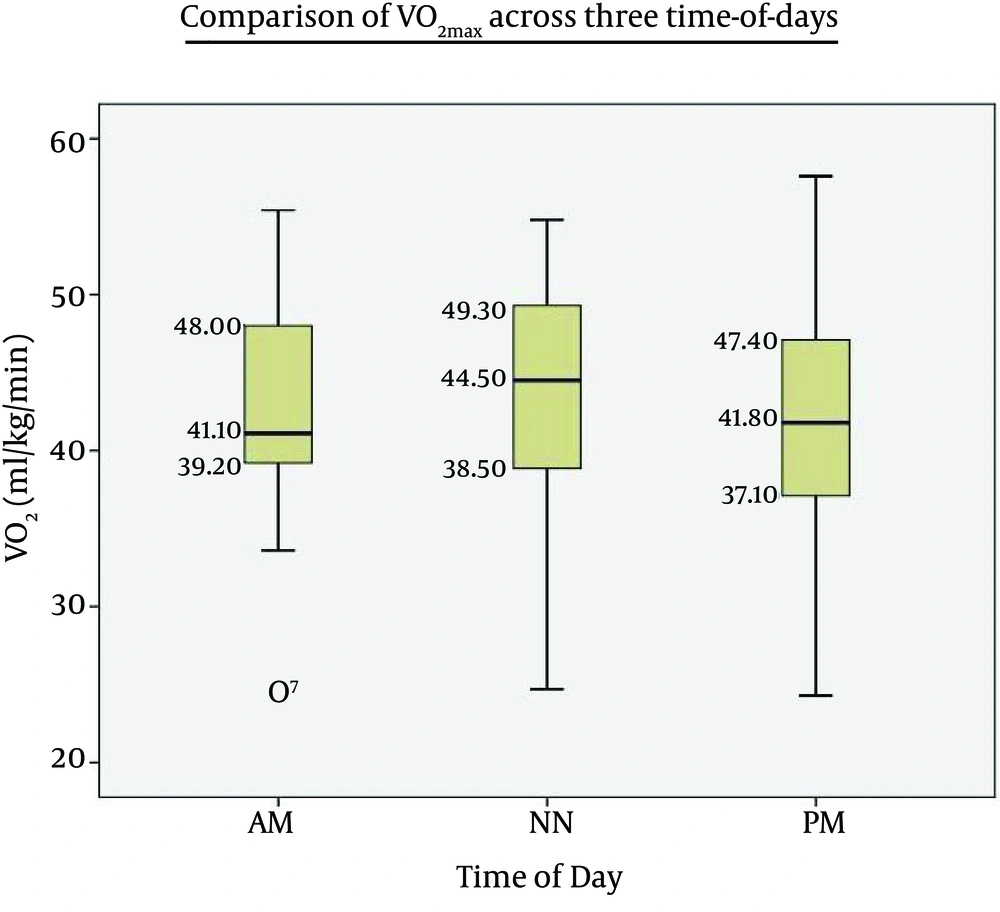
Figure 2.
Comparison of VO2max Across Three Times of Day (AM, NN, PM)
Unlike the professional athletes, the athlete students or amateur athletes usually have fewer training time. Through the findings of this study, the athlete student may enhance the training efficiency at the crucial time of day. Based on this finding, endurance performance would be better at noon. It would be a good idea for trainers to consider holding the endurance training sessions at noon. Training or competitions involving endurance ability are recommended to be held at noon regardless of environmental disturbance, such as cold and hot weather warning.
For most cases, the secondary school students only have an hour for the lunch break at noon, it is not practical for athlete students to practice the typical prolonged cardiovascular endurance training (i.e. over 30 minutes) and have lunch before their afternoon class. A short period of endurance training, such as high intensity interval training (≥ 20 minutes) (27) or high-intensity circuit training (2-3 × 7 minutes) (28) would be of specific benefit to secondary school athlete students on endurance training at noon. On the other hand, school management if possible should consider having special timetabling arrangement for athlete students, such as longer lunch hour. In the view of general secondary students, it may be also beneficial to arrange the physical education class around noon.
The recent findings on teenagers were differed from the previous studies on adults. Further investigation of diurnal effects on teenagers should be conducted and laboratory-based measurements are recommended. Controlled study design is suggested. Practical special arrangement on training and timetabling are recommended for all trainers or school management in the view of maximizing young athletes’ improvement in cardiovascular fitness.