1. Background
Elite soccer players should have the ability to perform powerful and accurate kicks with both legs (1, 2). Top scorers are players who are able to score with both feet (3). In general, players who have good kicking skills with both legs have an advantage over those players who use only their preferred leg, as they can easily change positions on the field during the game, depending on team strategy.
Several studies have reported significant biomechanical differences between kicks with the preferred and the non-preferred leg (4, 5). Barfield (4) found better inter-segmental co-ordination when kicking with the preferred leg and suggested that higher foot speeds of the preferred leg were correlated with higher ball speeds. Similarly, Dorge et al. (5) reported higher ball and foot linear speeds when kicking with the preferred leg. This was attributed to a greater amount of work on the shank generated by thigh angular velocity when kicking with preferred leg as opposed to non-preferred leg kicks. Moreover, Zago et al. (6) concluded that differences in motor control between preferred and non-preferred leg kicks existed in the movement velocity and the upper body kinematics. Nunome, Ikegami, Kozakai, Apriantono, and Sano (7) found that the faster soccer kick is due to a higher muscle movement when using the preferred leg compared with the non-preferred leg. These results indicate that for various reasons players tend to perform better with their preferred leg compared with their other leg. However, it is not known whether these bilateral leg differences continue when the player is fatigued.
A few studies have reported a decline in kicking performance after various fatigue protocols (8-10). However, these studies focused on fatigue effects in kicking with the preferred leg. There are several situations, such as during the last minutes of a game or after intense periods of performance (11), where a fatigued player must kick the ball with the non-preferred leg to score a goal or clear the defence area. As the soccer demands are very high, those instances are critical for the final result of the game. Therefore, players who have the ability to maintain kicking performance using both their legs throughout the game have an advantage over teammates or opponents who fail to maintain high levels of kicking performance with either leg.
Understanding fatigue effects on kicking technique with both legs would allow coaches to design soccer-specific training programs aiming not only to combine technique and maximum strength performance, but also to incorporate fatigue related exercises. Therefore, the purpose of the present study was to examine kinematic differences during instep kicks with the preferred and the non-preferred leg after a running fatigue protocol.
2. Objectives
The main research hypothesis was that fatigue effects on kicking performance are leg independent.
3. Methods
3.1. Participants
Ten adult male players (age: 24.5 ± 5.8 yrs; height: 179.2 ± 4.3 cm; mass: 79.3 ± 5.4 kg; training age: 11.5 ± 2.9 yrs) volunteered to participate in the present study. All participants were amateur soccer players who trained 2 to 3 times and played a game per week. Eight of 10 participants were right footed and the others were left footed. All participants had no history of neurological diseases or musculoskeletal abnormalities, and none were taking any medication during the course of the study. Participants were fully informed of the procedures of this study and provided written consent which was based on the Declaration of Helsinki. The University Ethics Committee approved the protocol.
3.2. Fatigue Protocol
The protocol of the present study has been previously applied by Aziz et al. (12). The protocol required that players had to run on a treadmill till exhaustion. They start running at a speed of 10.0 kmh-1 for 2 minutes, followed by an increase to 12.0 kmh-1 for another 2 minutes. Thereafter, inclination was systematically increased by 2% every minute until a maximum of 12% was achieved. If player’s exhaustion was not achieved by this time, the speed was increased by 1.0 kmh-1 every minute thereafter until the player attained volitional exhaustion.
3.3. Testing Procedure
All testing procedures were conducted in a standardized laboratory environment (temperature 22 - 25°C and humidity 55% - 65%) during two visits to the laboratory. On the first visit participants familiarized with the protocol, while on the second visit the main protocol was performed. All tests were performed during the same time of the day (6 - 9 p.m.) to avoid any chronobiological effect. The tests were conducted during the pre-season period. Participants were instructed to refrain from any vigorous exercise 48 hours before the tests. One day before the main protocol participants were asked not to undertake any training. All players followed their regular nutritional intake and maintained regular sleeping habits before the tests. The kicking trials were performed on an artificial turf, similar to the turf used during games, while all participants wore their own soccer shoes.
A 10-minute warm-up consisting of jogging, stretching exercises and several familiarization trials was performed. The participants performed instep kicks prior to and immediately after the implementation of the fatigue protocol in a random order. Each participant performed 2 consecutive kicking trials of a stationary ball with the instep portion of the preferred and the non-preferred leg after a one step angled approach (45°), against a goalpost located 7 m in front of the ball. A standard size and inflated ball was used (FIFA approved size 5 ball, weight: 430 g, pressure: 900 hp; Adidas, Herzogenaurach, Germany). Participants were instructed to kick the ball as fast and hard as possible aiming at the centre of the goalpost. A 15 seconds rest interval between consecutive kicks was provided, as previous studies have shown that soccer kick parameters recovered to pre-fatigue levels approximately within a minute after the end of a fatigue protocol (13). The average kinematic characteristics from the two trials of each kicking condition (preferred and non-preferred leg; pre and post fatigue) were further analyzed.
3.4. Kinematics
Kinematic data of the lower limb motion were collected with a 6-camera, 3-D Vicon motion analysis system (Oxford Metrics Ltd., Oxford, UK). Kinematic data were sampled at 120 Hz. Retro-reflective spherical markers were placed on selected anatomical landmarks of both limbs in order to identify segments and joints of the lower extremities: the head of fifth metatarsal, the heel, the mid-shank, the lateral malleolus, the femoral epicondyle, the mid-thigh, the greater trochanter and the anterior superior iliac spine. Four additional markers were placed on the surface of the ball. Prior to each kicking trial, a standing trial was recorded to establish initial joint angle conditions. Marker position was automatically tracked using the Polygon software. The three-dimensional coordinates were expressed as a right handed orthogonal reference frame, in which Z axis was vertical and pointed upward, Y axis was horizontal and X axis was perpendicular to Z and Y axis.
The foot-ball contact is well known that produces a sudden deceleration of the kicking leg, which causes a serious distortion of the kinematic data near ball impact when the data are filtered. In order to overcome this issue, the procedure previously described by Apriantono et al. (8) has been used in the present study. The kinematics were first computed from unsmoothed coordinates until three frames before ball impact, by which appropriate second derivatives were obtained without any influence of ball impact using central differentiation. Then, the non-smoothed kinematic data were extrapolated for 15 points, including the final 3 data points, using a polynomial regression. The kinematics were extrapolated using a first-order polynomial regression and angular velocities were extrapolated in the same manner using a second-order polynomial regression. The polynomial regressions were carefully defined for each single data set to resemble its final change. After these extrapolations, all parameters were smoothed by a fourth-order Butterworth filter at 12.5 Hz, and then the extrapolated region after the kinematics of ball impact was removed.
Angles between the segments were examined by viewing the Cardan angles decomposed from the rotation matrix which describes the orientation of one segment to another using an X-Y-Z rotation sequence (14). In the present study, the decomposition of the Cardan angles for each segment was as follows: the ankle was separated into plantar flexion/dorsi flexion; inversion/eversion and supination/pronation angles; the knee was separated into flexion/extension; internal/external rotation and abduction/adduction angles; and the hip was separated into internal/external rotation; abduction/adduction and flexion/extension angles.
The absolute magnitude of ball velocity (Vball) was calculated from the values of its vertical and horizontal components (15). The horizontal component of the ball velocity was calculated as the first derivative of linear regression lines fitted to their non-filtered displacements. The vertical component was calculated as the first derivative of a quadratic regression line with its second derivative set equal to -9.81 m.s-2 fitted to its non-filtered displacement in the available frames. The velocity of the centre of mass of the foot (Vfoot) was measured from the toe and heel markers coordinate data (16).
3.5. Data Analysis
The kicking motion was divided in two phases: a) The pre-support phase (from the toe-off of the kicking leg to ground contact of the support leg), and b) the support-phase (from ground contact of the support leg to initial ball impact) (17, 18). Each phase was set as 100%. Subsequently, the segmental linear and angular velocities and joint displacements were averaged for every 10% of each phase. In addition to the time-series calculation, maximum ball velocity and maximum linear and angular velocity of the hip, the knee and the ankle, as well as the time from movement onset to peak velocity and the duration of the kicks were also examined.
3.6. Statistical Analysis
A two-way analysis of variance (ANOVA) with repeated measures with two within participant variables (Leg X Fatigue) was used to examine differences in ball velocity, maximum linear and angular joint velocity, time to peak velocity and duration for each of the kicking trial.
A three-way ANOVA with repeated measures with three within participant variables (Leg X Fatigue X Phase) was used to examine differences between the two measurement sessions (pre and post) in angular joint displacements and segmental velocities over 10 data points of the pre-support and the support phase. Significant interactions were followed up with simple effects tests and, if significant, post-hoc Tukey tests were applied to examine significant differences between pairs of means. Statistical significance was set at P < 0.05.
4. Results
The ANOVAs showed no interaction effect on ball velocity. In contrast, a significant fatigue and leg main effect was observed (P < 0.01; Figure 1). Ball velocity was significantly lower during post-fatigue compared to pre-fatigue kicking trials and significantly lower for the non-preferred compared with preferred leg trials. In contrast, no interaction (Leg X Fatigue) effect on the duration of the kicks was found (820 ± 122 msec and 846 ± 142 msec for pre and post fatigue kicking trials with the preferred leg, respectively; and 832 ± 152 msec and 873 ± 152 msec for pre and post fatigue kicking trials with the non-preferred leg, respectively).
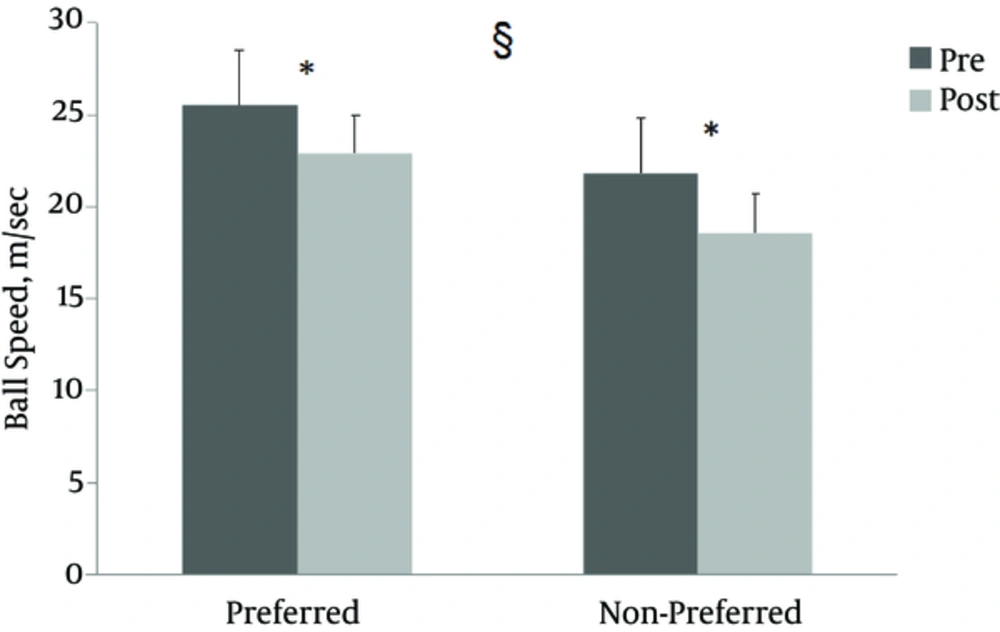
Figure 1.
*Significantly different compared with post fatigue kicking trials; §, Significantly different compared with non-preferred leg, P < 0.05.
The mean and standard deviation values for maximum linear velocities, maximum segmental angular velocities and time to peak velocities across all testing conditions are presented in Table 1. The ANOVAs showed no interaction effect on all values (P > 0.05). As far as the main effects are concerned, the results showed a statistically significant main effect (P < 0.05) for fatigue (values decreased after fatigue for both legs) and leg (values were lower for the non-preferred compared with the preferred leg) on maximum velocity values. The ANOVAs showed no interaction or main effects on time to peak velocity values (P > 0.05).
Table 1.
Maximum Linear and Joint Angular Velocity Variables and Time-to-Peak Velocity for the Preferred and the Non-Preferred Leg Before (PRE) and After (POST) Fatiguea
| Preferred Leg | Non-Preferred Leg | |||
|---|---|---|---|---|
| Pre | Post | Pre | Post | |
| Linear Velocity, ms-1 | ||||
| Hip | 3.06 ± 0.26 | 2.86 ± 0.33b | 2.48 ± 0.33 | 2.15 ± 0.27b |
| Knee | 8.23 ± 0.87 | 7.66 ± 0.74b | 7.27 ± 0.66 | 6.29 ± 0.74b |
| Ankle | 17.75 ± 1.85 | 16.61 ± 2.02b | 16.20 ± 1.76 | 13.97 ± 1.57b |
| Time to peak velocity, % | ||||
| Hip | 91.7 ± 1.92 | 91.5 ± 1.56 | 85.1 ± 2.50 | 82.9 ± 1.77 |
| Knee | 55.6 ± 2.66 | 53.5 ± 2.75 | 47.7 ± 1.24 | 45.3 ± 1.58 |
| Ankle | 98.7 ± 0.62 | 97.5 ± 0.63 | 93.1 ± 2.21 | 91.3 ± 1.55 |
| Angular Velocity, °s-1 | ||||
| Hip | 873.3 ± 135.4 | 811.9 ± 136.3b | 726.2 ± 103.3 | 638.3 ± 103.3b |
| Knee | 1675.1 ± 148.6 | 1553.7 ± 147.6b | 1477.7 ± 185.2 | 1280.1 ± 142.2b |
| Ankle | 1862.6 ± 170.2 | 1732.9 ± 146.2b | 1721.1 ± 141.1 | 1486.1 ± 169.1b |
aValues are expressed as mean ± SD.
bSignificantly different compared with Pre values at P < 0.05.
The hip linear and angular velocity and angular displacement curves are presented in Figure 2. The ANOVA results indicated a significant interaction effect on linear (Figure 2A, P < 0.05) velocities. Post hoc analysis indicated higher pre fatigue linear velocities at the final (60% to 100%) part of the pre-support phase (P < 0.05) for both legs and significant higher linear velocities pre fatigue during the entire support phase for the non-preferred leg. Similarly, a significant interaction effect on angular (Figure 2B, P < 0.05) velocities was observed. Post hoc analysis indicated higher pre fatigue angular velocities during the entire support phase for both legs and higher angular velocities at the final (60% to 100%) part of the pre-support phase (P < 0.05) for the non-preferred leg. In contrast, the ANOVA showed that there was no interaction effect on all values (Figure 2C, P > 0.05) for hip displacement curves.
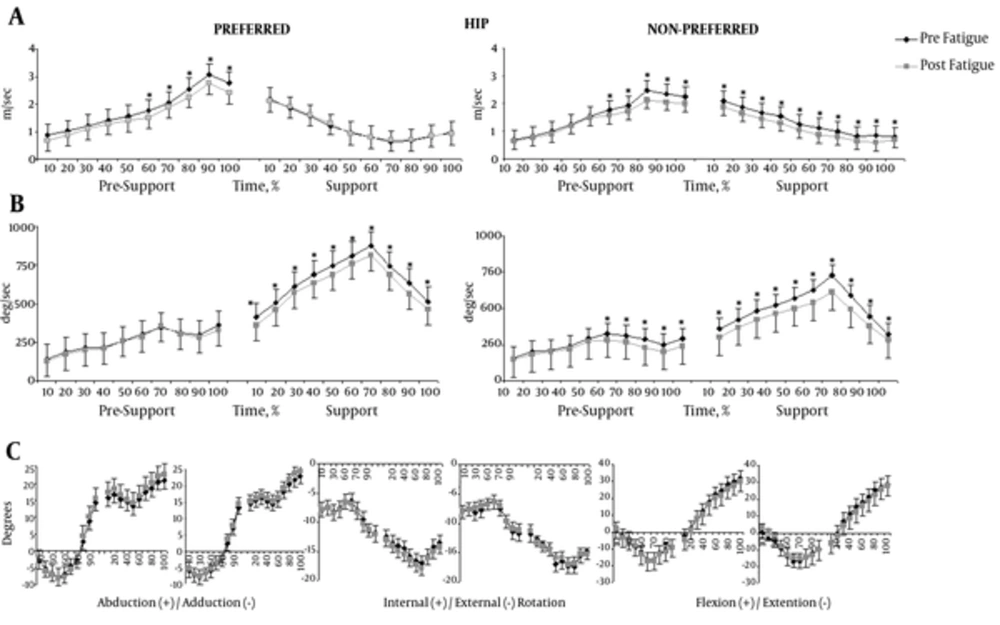
Figure 2.
Upper diagrams A, indicate hip linear velocity, middle diagrams; B, indicate hip angular velocity and lower diagrams; C, indicate hip abduction/adduction; internal/external rotation, and flexion/extension angles for the dominant and the non-dominant leg expressed for every 10% from the toe-off of the swinging leg until ground contact (pre-support phase) and from ground contact to ball impact (support phase). *Significantly different compared with post fatigue kicking trials (P < 0.05).
The knee linear and angular velocity and angular displacement curves are presented in Figure 3. The ANOVA results indicated a significant interaction effect on linear (Figure 3A, P < 0.05) velocities. Post hoc analysis indicated higher pre fatigue linear velocities at the final (70% to 100%) part of the pre-support phase (P < 0.05) and during the entire support phase for both legs. Similarly, a significant interaction effect on angular (Figure 3B, P < 0.05) velocities was observed. Post hoc analysis indicated higher pre fatigue angular velocities during the entire support phase for both legs and higher angular velocities at the final (70% to 100%) part of the pre-support phase (P < 0.05) for the non-preferred leg. Moreover, Post hoc analysis indicated that the knee was more flexed during the entire support phase for both legs (Figure 3C, P < 0.05). In contrast, the ANOVA showed no interaction effects for knee internal/external and abduction / adduction curves (Figure 3C, P > 0.05).
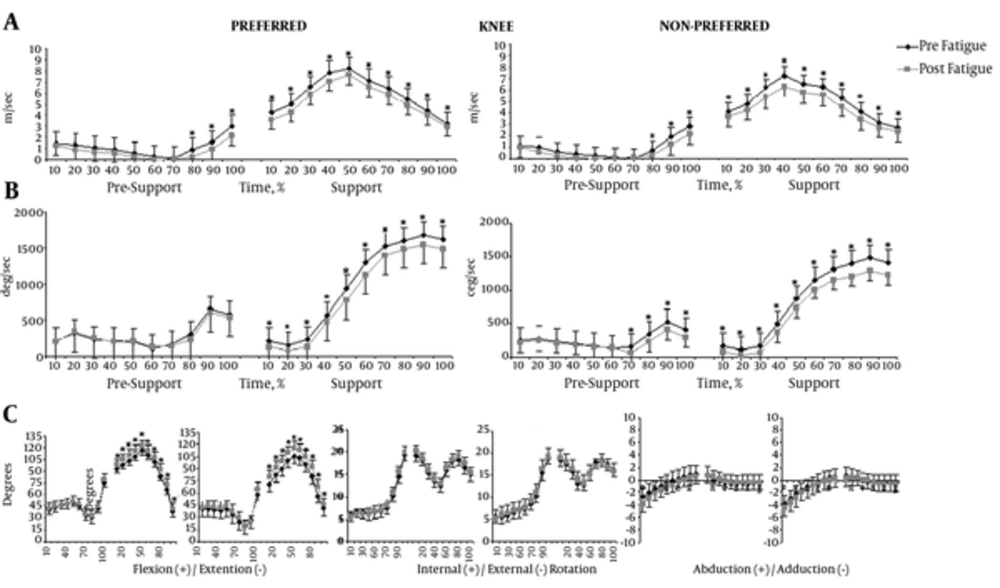
Figure 3.
Upper diagrams A, indicate knee linear velocity, middle diagrams; B, indicate knee angular velocity and lower diagrams; C; indicate knee flexion/extension; internal/external rotation and abduction/adduction angles for the preferred and the non-preferred leg expressed for every 10% from the toe-off of the swinging leg until ground contact (pre-support phase) and from ground contact to ball impact (support phase). *Significantly different compared with post fatigue kicking trials (P < 0.05).
The ankle linear and angular velocity and angular displacement curves are presented in Figure 4. The ANOVA results indicated a significant interaction effect on linear (Figure 4A, P < 0.05) velocities. Post hoc analysis indicated higher pre fatigue linear velocities during the entire support phase for both legs. Similarly, a significant interaction effect on angular (Figure 4B, P < 0.05) velocities was observed. Post hoc analysis indicated higher pre fatigue angular velocities during the entire support phase for both legs and higher angular velocities at the final (80% to 100%) part of the pre-support phase (P < 0.05) for the non-preferred leg. Moreover, Post hoc analysis indicated that the ankle was more dorsi flexed during the final part of the pre-support phase for both legs and more plantar flexed during the entire support phase for both legs (Figure 4C, P < 0.05). In contrast, the ANOVA showed no interaction effects for ankle eversion / invesrsion and supination / pronation angles Figure 4C, P > 0.05).
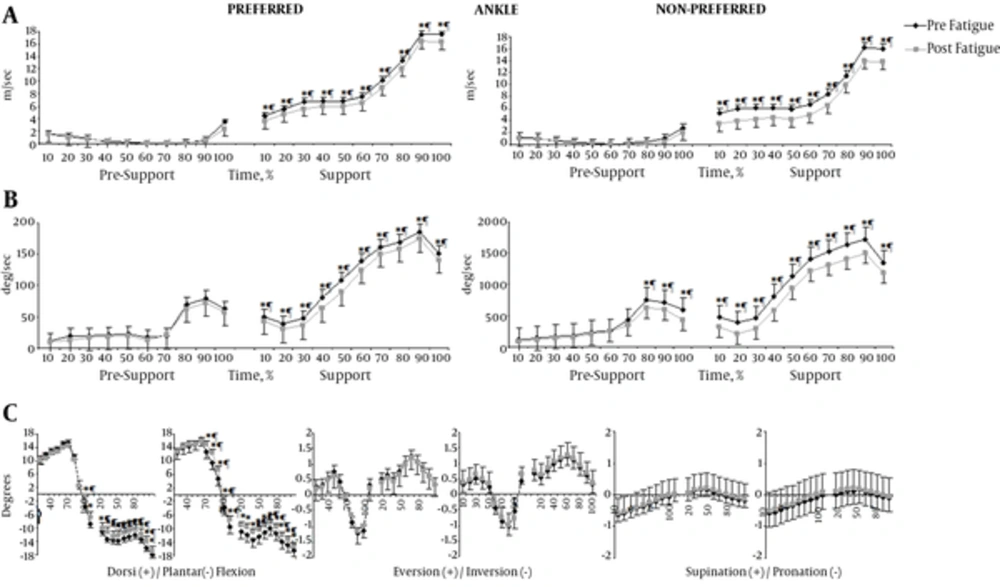
Figure 4.
Upper diagrams A, indicate ankle linear velocity, middle diagrams; B, indicate ankle angular velocity and lower diagrams; C, indicate ankle dorsi/plantar flexion; eversion/inversion and supination/pronation angles for the preferred and the non-preferred leg expressed for every 10% from the toe-off of the swinging leg until ground contact (pre-support phase) and from ground contact to ball impact (support phase). *Significantly different compared with post fatigue kicking trials (P < 0.05).
5. Discussion
The main finding of the present study was that fatigue impairments of maximum performance were higher when kicking with the non-preferred leg compared with preferred leg kicking. To our knowledge, this is the first study that examined bilateral kicking responses to fatigue. Based on these results the research hypothesis of the study is rejected.
Fatigue caused a decline in ball velocity ranging from 6.4% (preferred leg kick) to 14.7% (non-preferred leg kick) (Figure 1). This decline is in agreement with previous studies regarding fatigue effects on kicking with the preferred leg (8-10). Our results extend these findings further as they show that not only players were unable to perform equally powerful kicks after fatigue, but this impairment was more evident when kicking with the non-preferred leg.
Final kicking performance is the result of the velocity and the sequence of segmental movements around the joints (1, 2). The proximal-to-distal segmental movement pattern during kicking aims to generate higher velocity of the end-point segment. The higher the velocity of the joints and the more appropriate the foot-ball collision, the more powerful the kicking trial (1, 2). Any deviation or alteration of this sequence could affect kicking performance. Therefore, detailed comparison of the fatigue effects on kicking kinematics of each leg is necessary.
The decline in powerful kicking performance was accompanied by an almost double decline in maximum joint and segmental velocities when kicking with the non-preferred leg as opposed to the preferred leg (Table 1). This provides an initial explanation for the higher reduction of ball velocity when kicking with the non-preferred leg. This finding is in line to Zago et al. (6) study who reported higher centre of mass, foot and shank velocities when kicking with the preferred compared to the non-preferred leg. In particular, a significant determinant of ball velocity is the velocity of the ankle joint. The higher the ankle joint velocity, the higher the velocity of the ball (1). In turn, the velocity of the foot is also a function of the sagittal linear velocity of the knee and the angular velocity of the shank at impact (5). This suggestion is in line with the current results as a higher reduction after fatigue in the non-preferred versus the preferred leg was found (Table 1).
Joint angular displacement curves of both legs showed similar fatigue responses. In particular, post-fatigue kicks were performed with a lower knee flexion (Figure 3C) and ankle plantar-flexion (Figure 4C). It has been shown that the knee flexion/extension rotation significantly contributes to the final speed of the foot (7, 15). A more extended leg at impact phase is the result of a longer trajectory of the knee joint during the back swing and the forward swing of the leg, which might increase final segmental speed upon impact and affect foot collision with the ball. Such a movement consequence observed in the present study, as participants were able to better flex their knee during the backswing movement (pre-support phase) and afterwards to be able to have a more extended knee in order to perform more powerful kicks. The lower ankle plantar flexion after fatigue had also an effect on the quality of foot-to-ball contact causing impairments in the final velocity imparted to the ball (18-20). Asami and Nolte (20) reported that better performance (faster kick) is achieved when the contact point is located closer to the ankle rather than the metatarsals. In this case, the limb becomes more rigid. It is therefore reasonable to assume that running fatigue might have caused impairments in plantar flexors’ muscle strength, thus limiting active plantar flexion during the impact phase. This might also related to higher knee flexion angle at impact after fatigue, which alters the force potential capacity of the plantar flexors.
Various factors could be responsible for the present findings. First, continuous running on a treadmill mainly involves repetitive movements which have an effect on lower limb muscle performance, such as the hip and knee flexors - extensors and ankle plantar flexor muscles. This is then translated into an impaired maximum muscle performance during the kick which can reduce final kicking velocity. Second, the lower maximum joint and segment velocities post fatigue in combination with the similar duration of the kicking trials indicate that players approached the ball with lower speed, being unable to sustain high speeds as observed during pre-fatigue trials. Previous studies have suggested the importance of a high approach velocity for better kicking trials (21, 22). Therefore, someone would expect that as fatigue led to lower approach velocity, then a lower kicking performance would be present.
However, the aforementioned factors (effects of fatigue) are similar to the difference between kicking with the preferred leg and that with non-preferred leg. Since running involves bilateral leg movement, then we can assume that the fatigue protocol itself caused a similar loading of both extremities. Therefore, factors which may explain differences in responses to fatigue between the two legs may be related to bilateral leg differences in technique and strength, irrespective of fatigue. Previous studies have reported dynamic balance asymmetry during soccer specific tasks that explained differences between the preferred and the non-preferred leg (23). Therefore, our results are in agreement with previous studies indicating that kicking with the preferred leg is generally faster compared with the non-preferred leg (4, 5, 7, 24). This was attributed a lower amount of work done on the shank (5), a lower knee muscle moment and angular impulse (7) and hip and pelvis movement control deficiencies when using the non-preferred leg (24). Further, bilateral leg differences in knee strength have been previously reported (25). Collectively, these results indicate that kicking with the non-preferred leg is characterized by less muscle work and power compared with the preferred leg. It is not clear whether these differences in the pre-fatigue kicking may also explain the higher decline in performance in the non-preferred kick after fatigue.
Another explanation for the highest decline after fatigue might be that kicking with the non-preferred leg is characterized by a less optimal segmental co-ordination than preferred leg kicking. One may suggest that fatigue might have a greater effect on the less coordinated movement, i.e. kicking with the non-preferred leg. Some studies have shown that the non-dominant leg is mainly used for balance demands and the dominant leg for technique and performance demands (26, 27). Others have commented that kicking with the non-preferred leg is characterized by a different inter-segmental motion pattern than the preferred one (4, 5, 24, 25). However, Nunome et al. (7) reported no difference in inter-segmental moments between preferred and non-preferred leg kicking. Consequently, it was suggested that the ability to explosively generate greater knee muscle moment during a kick would make the difference in the final foot velocity between the two legs (7). This indicates that bilateral leg responses to fatigue are likely to be due to muscle strength differences.
Although fatigue effects on kicking co-ordination have not been previously examined, research examining the effect of general fatigue protocols on multi-segmental co-ordination patterns yielded conflicting findings (28-30). Ekblom (28) reported that players were able to juggle the ball on average 64 times consecutively before a hard training bout, compared with 3 times immediately after the training bout, while Kellis et al. (9) have found elevated ammonia concentrations after simulated soccer fatigue protocol which is indicative of altered co-ordination and motor control. Some studies have shown minimal fatigue effects on jump coordination (30), while others reported a significant effect of fatigue on segment coordination patterns during throwing (29). In the present study, kicking with non-preferred leg was characterized by earlier development of maximum joint velocities (relative to ball impact) compared with the preferred leg (Table 1). However, fatigue did not have a severe bilateral leg effect on this pattern (Table 1). Even if significant, these data are insufficient to suggest that sequencing of maximum linear velocity development was differentially altered by fatigue between the two legs.
Someone would expect that fatigue would impair strikers’ ability to score goals, especially when kicking with the non-preferred leg. Defenders may also experience similar fatigue problems as their ability to “defend” their territory is impaired. Taking advantage of such weaknesses displayed by specific players during a game represents a crucial point in team strategy to win the game. Such information is important when designing team strategy for a forthcoming game. The main practical implication of this study is that sport-specific training should aim to enhance kicking ability with both legs under various game simulation conditions, including fatigue. This might also include improvement in kicking technique so that bilateral leg differences are reduced as much as possible. Such training may include specific strength and technique exercises that could benefit players at all playing positions. For example, defenders may improve their capacity to clear the ball from their own area, while strikers can perform kicks inside the opponent area from various directions (not only from the preferred leg side), thus increasing chances to score a goal.
Moreover, the use of specific strength and technique exercises to minimize fatigue effects and to enhance players’ ability to kick with either leg under fatigue conditions is recommended. Coaches should apply general resistance strength exercises to improve muscle strength of both legs and additional load of the aforementioned exercises should be placed on the non-preferred leg. These exercises should permit players to be more explosive when kicking. Moreover, during kicking exercises extra attention should be paid on the appropriate technique of the players. Coaches should guide their players to displace their leg with higher ankle plantarflexion, especially before ball impact and with a greater travel of the knee joint in order to add velocity to the other joints and finally to the ball. This feedback should be more constructive when players are under fatigue effects.
The results of this study should be interpreted within several limitations. First, the fatigue protocol which was selected in this study does not fully replicate actual soccer game conditions. Nevertheless, it was selected for two reasons: first, the purpose of this study was to compare left with right limb soccer performance, not simply the effects of fatigue on performance. Therefore, there was a need for a standardized testing protocol which places equal local muscle loadings on both limbs as opposed to applied soccer fatigue protocols where localized muscle fatigue might have affected the preferred limb over the non-preferred one. Secondly, as already stated, the applied fatigue protocol was an already validated and applied protocol for testing soccer players (12). A second limitation of this study is that we determined better kicking performance as the fastest one. It is known that soccer kick performance is determined by an interplay between accuracy and fast ball speed (1). Future research in investigating bilateral leg differences in kicking performance in relation to kick accuracy and fatigue state is warranted. Finally, in the present study the participants were male amateur soccer players who trained for more than 10 years, with a training frequency of two to three times plus a game per week. Moreover, the fatigue protocol of the study aimed to examine the effects of short and intense periods of continuous running till exhaustion on kicking performance. Therefore, the results are applicable only to players with the same characteristics. Whether professional, more experienced or female players react in a different way during the same or during a different fatigue protocol needs further examination.
High intensity running till exhaustion had a significant effect on both power and technique of the kick and this effect was more obvious when kicking with the non-preferred leg. Linear and angular velocities showed a higher decline during non-preferred leg kicks than preferred ones and similarly alterations on joints’ movements were evident for both legs. The mechanism, therefore, of the appropriate transfer of energy from one segment to the other and the appropriate kicking technique seems to be affected when players are fatigued. Specific training exercises aiming to enhance players’ ability to kick with either leg in fatigue conditions are recommended.