1. Background
Multiple Sclerosis (MS) is undoubtedly one of the most prevalent diseases of the central nervous system and about 2.5 million people are suffering from this disease that is growing fast. The patients are mostly the youth, in general and young women, in particular and due to the chronic nature of the disease, it is a permanent condition. In fact, MS is a chronic inflammatory disease affecting the brain and spine. Although the etiology of the disease is not known, various causes including genetics, autoimmune mechanisms and environmental factors, particularly viral infections are known to be effective in the incidence of the disease (1, 2). The patients are typically young and, in particular, have some degree of performance reduction (3).
Addressing epidemiologic and etiologic issues of MS and indeed treatment aspects of the disease are required considering the substantially increasing trend of the disease in Iran (4). Overall, clinical trials conducted on the topic have shown that proper exercising enhances health status and reduces fatigue and it therefore is an effective step in treating MS patients (3). This is because common physical symptoms of MS are reduced walking ability and balance, increased skeletal muscular weakness and fatigue that lead to physical activity that can cause muscle fiber atrophy, especially type I fibers. These symptoms do not only determine the general health status of the patients, but also play a significant role in one’s ability to perform daily tasks (5). For instance, it is estimated that 65% - 87% of MS patients have a form of balance deficiency or movement and this influences their quality of life. Moreover, fatigue is reported in 70% - 90% of the patients. Generally, reduced physical activity in MS patients causes reduced fitness and ends in weakness due to muscular atrophy as well as reduced cardio-pulmonary capacity (6). Thus, physical and mental exercises besides determining realistic goals can be of great help in the recovery of the patient (2).
There have already been some studies conducted on the impact of common exercises like aerobics and resistance training on walking ability, strength, fatigue, performance ability and quality of life of MS patients; however, the efficacy of the studies have been varying due to structure and content of the selected training programs. Generally, the data show that exercising can enhance the health status of the patients (7-9). For example, it has been demonstrated that MS patients feel less strength in their legs compared to the normal individuals and suffer from loss of balance and this causes falling down; as a result, strength training can be well recommended for these patients (8, 10). On the other hand, a part of fatigue in MS patients is associated with abnormal muscular tension and mental disease-related pressures; this is why those participating in yoga training (YT) classes have reported high satisfaction rates (11). In fact, YT is applied as a successful technique for reducing fatigue and abnormal high muscular tone, increasing muscular relaxation and indirectly enhancing muscular strength (6). There is little information on the response of MS patients to YT and its subcategories. Hatha yoga is one style that directly affects body and mind because the stretching and strengthening exercises improve resistance and strength in muscles and the breathing techniques make the mind and muscles relaxed. Hence, it seems that some indices of fitness can be influenced by such YT or physical activities (11).
Although some MS patients are interested in exercising and try to do that, finding a low-cost group activity by an experienced professional instructor is usually difficult. Moreover, transportation might be difficult for patients with visual problems or paralyzed ones; in such cases exercising at home would be great option provided that the time and intensity are controlled at an acceptable level (10). However, being highly motivated is a requirement and exercise intensities should be designed in a manner that the patient would be able to perform them without the help or supervision of others; consequently, the intensity of the exercises is not usually high. So, as no comprehensive studies have been conducted on the impact of home-based RT and Hatha YT on MS patients’ performance, the present study aimed at determining the effect of 8-week home-based YT and RT on muscle strength, motor capacity and balance in patients with Multiple Sclerosis.
2. Methods
This is a randomized controlled study designed in form of a pre-test and post-test in two experimental and control groups.
The statistical population of the present study include 21 - 54 year-old male and female MS patients who were members of the Iranian MS Society. The subjects were examined by an expert neurologist in MS. The disability criterion of the patients was considered in a range of 1 - 6 according to expanded disability status scale (EDSS). Other inclusion criteria were patients without history of cardiovascular or any other systemic and orthopedic diseases, without history of relapse during the month before entering the study and non participant in regular exercise at least 30 minutes per day for the previous three months.
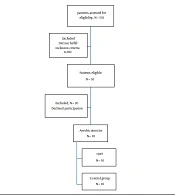
Among 60 patients referring to the Iranian MS Society, 26 patients were selected for the exercise protocol according to inclusion criteria and exercising pre-tests (motor function, muscular strength, balance) and were assigned to control (8 subjects), strength (9 subjects) and Hatha yoga (9 subjects) groups using random sampling according to random digit by a table of random numbers.
The participants completed an informed consent form approved by the local ethical committee before study (IR.TUMS.VCR.REC.1395.1711).
If the participants could not participate in more than two training session with any reason or had a relapse or exacerbation of the symptoms, they were excluded from the study.
It should be noted that there was no intervention in the drug regimen of the subjects and they were allowed to use their drugs including disease modifying therapies.
2.1. Exercise Protocol
2.1.1. Home-Based Hatha Yoga Exercises
Following 2 training sessions with supervision by an experienced yoga teacher, an 8-week Hatha YT program was started.
The training program included three sessions per week of 60 - 70 minutes starting with stretching exercises in standing, prone and sitting positions. YT programs comprise breathing positions, raising hands, eagle position, triangle position, bending forward, side-bending, reaching elbow to knee on sitting position on the chair, warrior position, side rotation in sitting position, tree, fish, dog, cat and infant poses, reaching hands to toes, back bending in protected prone position, waist rotation in sun pose, raising legs against wall and full body relaxation in prone pose with closed eyes. Each pose lasted for approximately 10 - 30 seconds (subjects who could not perform a pose completely, remained in the position for 8 seconds). Every 2 - 3 weeks, a new exercise was added to the first week program with a 30 - 60 seconds rest time; the exercises were performed consecutively. Since the subjects were MS patients, they had wall/chair support for most poses (6, 11).
2.1.2. Home-based RT
Following 2 training sessions with supervision, an 8-week (3 times a week) RT program started. The training program concentrated on exercises designed for increasing strength. Each subject warmed up for 5 - 10 minutes (walking and stretching), exercised RT for 25 - 30 minutes using weights (1% of body weight) fastened to the body; every two weeks, about 0.5% - 1% of body weight was added to the weights. The exercises include chair raises, forward lunges, step-ups, heel-toe raises and leg curls performed in three sets of 10 repetitions. Five to 10 minutes were also allocated to cool down (full-body stretch). In order to prevent fatigue and body temperature increase, 30 - 60 seconds rests were considered between exercises (10).
Training programs of both groups were controlled by a checklist and telephone calls daily and weekly respectively.
All designed exercise protocols were given to patients on a weekly basis with explanations of the type, imagery and number of repetitions.
Control group was advised not to change their routine physical activity habits during the same period.
2.2. Method of Execution and Data Collection
All subjects were examined by a neurologist prior to performing training exercises to determine their expanded disability status score. Training tests were administered prior and following 8 weeks of home-based YT and RT at the laboratory of Physical Training Research Center (measuring height, weight, balance) and the examination center of National Olympics Academy (measuring the strength of leg extensor muscles and time of walking a 10-meter distance). Basic information of the study including age, height and weight were collected and recorded. The subjects were asked to wear casual clothes and shoes. Among the 9 members of home-based RT, 8 could perform the exercises completely and one was omitted following an MS attack. Likewise, one subject in home-based YT left the program due to personal issues and 8 performed it completely. Before the start of training exercises, each subject was evaluated via appropriate tests considering their physical status and an informed consent was taken from the subjects.
2.3. Measuring Indices
2.3.1. Strength Test
Leg extensor muscles strength was determined by performing RM (repetition maximum). A repetition maximum is the most weight you can lift for a defined number of exercise movements. RM test was conducted by using trial and error and estimating sub-maximum repetitions in pre- and post-tests. Leg press exercise (evaluating the strength of quadriceps and back muscles) was used to evaluate leg strength (12). Considering the health status of the patients, they were asked to try moving the weights without applying extra pressure; in the end, the selected weight was the one that could be repeated 6 - 10 times. Then, the moved weight and number of repetitions were put in the Brzycki formula to calculate maximum strength of the subjects (13). According to American College of Sports Medicine guideline, for maximal strength test, the resistance should be at an individual’s 8 to 12 RM so that he or she is at or near maximal exertion at the end of the repetitions.
One repetition maximum (1 RM) is counted by using the following formula (13):
1 RM = weight lifted/1.0 - (number of lifts × 0.025)
2.3.2. Performance Test
This test is used for measuring disability and evaluating the effect of physical therapy interventions aiming at testing and retrieving functional capacity in MS patients (14). The test consists of timing a 10-meter distance. The subject stood behind the start line and following the “Go” command, he started walking the 10-meter distance fast and safely to the finish line and then the time was recorded (14). The test was repeated three times and the mean walking time was documented.
2.3.3. Balance Test
Three 20-second, easy to difficult tests were administered for the subjects using Computerized Biodex. The tests comprised standing on both feet with open eyes, standing on both feet with closed eyes and standing on one foot with open eyes. The support was mobile in all tests and the balance was demonstrated as total balance index through measuring the subject’s ability to keep his center of gravity in the central circle of the machine’s careen (15, 16). In these tests, higher scores show weaker balance (15).
2.4. Statistical Analysis
Equal data with normal distribution (results of Kolmogorov-Smirnov and independent t-test) were expressed as mean and standard deviation. Intra-group and inter-group differences (pretest/posttest) were examined by t-pairs and one-way variance (ANOVA), respectively. The significance level was determined at P ≤ 0.05.
3. Results
Two subjects of the exercise groups left the program in the first week for personal reasons. The other eight subjects in each groups completed the 8-week training program (16 sessions) with no MS-related exacerbations reported.
Findings of the variance analysis test showed a significant difference in leg extensor muscle changes of the subjects of the three control, RT and Hatha YT groups following an 8-week training course (P ≤ 0.05) (Table 2).
Table 1.
Specifications of Subjectsa
| Group, Sex, No. | Age (y) | Height (cm) | Body Mass (kg) |
|---|---|---|---|
| Control | |||
| Male, 4 | 33.5 ± 13.77 | 168.9 ± 9.31 | 65.6 ± 9.89 |
| Female, 4 | 32.5 ± 5.57 | 156.5 ± 6.76 | 66.3 ± 12.49 |
| Total, 8 | 33.0 ± 9.74 | 162.7 ± 10.2 | 66.0 ± 10.44 |
| Strength | |||
| Male, 4 | 34.5 ± 11.24 | 169.4 ± 5.65 | 69.6 ± 16.70 |
| Female, 5 | 31.3 ± 4.57 | 156.8 ± 5.68 | 50.1 ± 7.99 |
| Total, 9 | 32.9 ± 8.13 | 163.1 ± 8.55 | 59.8 ± 15.96 |
| Hatha yoga | |||
| Male, 4 | 29.8 ± 9.22 | 174.0 ± 7.12 | 68.9 ± 10.21 |
| Female, 5 | 32.8 ± 5.12 | 157.8 ± 6.29 | 61.0 ± 10.38 |
| Total, 9 | 31.3 ± 7.09 | 165.9 ± 10.68 | 64.9 ± 10.43 |
aValues are expressed as mean ± SD.
Table 2.
Primary and Secondary Outcome Measures
| Measures | Yoga Training Group | Strength Training Group | Control Group | ||||||
|---|---|---|---|---|---|---|---|---|---|
| Pretesta | Posttesta | P Valueb | Pretesta | Posttesta | P Valueb | Pretesta | Posttesta | P Valueb | |
| Leg extensor muscles’ strength | 126.1 ± 44.88 | 131.7 ± 47.59 | 0.08 | 126.6 ± 55.56 | 148.2 ± 45.78 | 0.003 | 127.9 ± 55.97 | 131.5 ± 60.33 | 0.289 |
| Walking time (10 m distance) | 5.8 ± 0.83 | 5.7 ± 0.87 | 0.459 | 6.8 ± 1.30 | 6.7 ± 1.13 | 0.040 | 6.6 ± 1.45 | 6.6 ± 1.71 | 0.568 |
| Two-leg, open-eye balance test | 2.8 ± 1.27 | 2.1 ± 1.49 | 0.013 | 3.4 ± 2.77 | 3.2 ± 2.64 | 0.225 | 3.1 ± 2.32 | 3.0 ± 2.32 | 0.020 |
| Two-leg, closed-eye balance test | 4.6 ± 1.70 | 4.0 ± 1.83 | 0.071 | 5.2 ± 2.12 | 4.5 ± 2.36 | 0.027 | 6.1 ± 2.04 | 5.9 ± 2.21 | 0.419 |
| Single-leg, open-eye balance test | 4.7 ± 3.20 | 4.1 ± 2.83 | 0.033 | 4.4 ± 2.61 | 4.6 ± 2.13 | 0.645 | 5.1 ± 2.89 | 5.0 ± 2.59 | 0.647 |
aPre-test and post-test are “mean ± SD” except for EDSS which is “median ± SD”.
bOf change between pretest and posttest (by Wilcoxon Signed Rank Test).
Moreover, there is no significant difference in changes of time duration recorded for walking a 10-meter distance observed in the subjects of the three control, RT and Hatha YT groups following an 8-week training course (P > 0.05) (Table 3).
Table 3.
Variance Analysis Test Results of Variables in MS Patients
| Variable | Mean Changes from Pre-Test to Post-Test | F | Pa | ||
|---|---|---|---|---|---|
| Control | RT | Hatha YT | |||
| Two-leg, open-eye balance test | -0.1 | -0.2 | -0.7 | 3.266 | 0.058 |
| Two-leg, closed-eye balance test | -0.2 | -0.7 | -0.6 | 1.065 | 0.363 |
| Single-leg, open-eye balance test | -0.1 | -0.2 | -0.6 | 1.713 | 0.205 |
| Walking time (10m distance) | -0.1 | -0.1 | -0.2 | 0.037 | 0.964 |
| Leg extensor muscles’ strength | +3.6 | +21.7 | +5.6 | 7.436 | 0.004 |
aOf change between groups (by Repeated Measure ANOVA).
Also, the findings demonstrated a near significant difference in open-eye balance changes in the three control, RT and Hatha YT groups following an 8-week training course (P = 0.058) (Table 3).
No significant difference was found in closed-eye balance changes in the three control, RT and Hatha YT groups following an 8-week training course (P > 0.05) (Table 3).
Results obtained from the variance analysis test indicated no significant difference in single-leg and open-eye balance tests in the three control, RT and Hatha YT groups following an 8-week training course (P > 0.05) (Table 3).
4. Discussion
MS patients’ disability causes diminished strength, performance capacity, resistance, cardiopulmonary condition, speed and balance and it seems that training exercises can improve these changes to some extent (17). Therefore, the present study was designed to determine the effect of an 8-week home-based RT and YT program on leg muscle strength, motor capacity and balance. The findings showed that home-based RT could increase the strength of leg extensor muscles; however, home-based YT did not significantly affect the said muscles. Furthermore, neither home-based RT nor YT had a statistically significant impact on motor capacity (10 m distance walking duration) of the subjects. On the other hand, RT and Hatha YT could significantly affect balance through two-leg, open eye test as well as two-leg, open eye and single-leg, open eye tests, respectively.
Unlike the studies of Ahmadi et al. and Moradi et al., differences recorded in 10 m distance walking duration of the subjects of the present study were not statistically meaningful (6, 8).
Nevertheless, Romberg et al. reported a 12% enhancement in 7.62 m distance walking duration of the patients compared to the baseline following a 6-week training program (18). Also, Newman et al. observed a 12% improvement in 10 m distance walking duration after four weeks of training on a conveyor belt (19).
Perhaps, it can be said that one of the reasons causing the very conflicts is the specifications of training because walking patterns and neural timings were not similar in any of the studies. Also, based on the obtained results, studies with longer time ranges can bring about more highlighted meaningful changes in walking duration and motor capacity of the patients with slight to moderate disability criteria. However, findings of all studies confirm that even minor enhancements in motor capacity of MS patients can be indeed significant from the medical point of view (15).
Additionally, increase in leg extensor muscle strength is in line with the studies of Dodd and Taylor et al., Gutierrez et al. and White et al. (12, 15, 20).
However, results of the present study were inconsistent with the findings of Harvey et al. in which no significant change was observed in leg extendor muscle strength (21).
It seems that insignificant strength changes in the home-based Hatha YT group might be due to the type of exercises. In Hatha YT, isometric contraction and cooling down are required to enhance flexibility and reduce muscular tension (4).
These studies along with the findings of our study support the application of RT as an appropriate means for developing and promoting strength in MS patients (12, 20). YT includes stretch and resistance exercises leading to strength enhancement and muscular strength that can affect the mind through breathing techniques impacting cooled down muscles (6). Strength improvement in MS patients is important because they feel different degrees of fatigue that cause declined daily activity and muscular atrophy; RT increases their strength, prevents muscular atrophy and can probably ameliorate their daily activities (10, 12, 22). In fact, all previous studies conducted on RT agree on the point that no disease intensification or reports on increased MS symptoms have been observed following exercise programs (10, 12, 22).
Numerous benefits of RT have been known and increased bone mineral density is one of them (23). RT is recognized helpful in improving neural adaptations like activating motor units and simultaneous firing rate of motor neurons that experience decline following periods of inactivity. Neural adaptations resulting from physical activity can have favorable performance results in MS patients depending on the location and size of the plaques (24). In addition, strength enhancement in muscles capable of adapting with additional loads might be able to improve general physical fitness and motor performance capacity in MS patients with moderate disability criteria (2).
Lack of ability to keep the balance is a concern in MS patients because this increases the possibility of them falling down. Therefore, an interventional strategy can be important in improving their balance (25). Accordingly, Ahmadi et al. observed a significant improvement in balance scores following an 8-week YT but the results were not consistent with the inter-group findings of the present study (6).
However, findings of our study were in line with those of Debolt et al.’s evaluation of the effect of home-based RT on balance in MS patients (10). Also, considering balance changes, our study’s results were consistent with some previous studies like the study of Robmerg et al. in which no balance changes were observed after a six-month RT and water training programs on patients with slight to moderate disability (EDSS 1 - 5.5) (18). Similar to this was the study of Jackson et al. finding no associations between balance keeping capability and knee muscles strength and its range of motion (26). It is noteworthy that due to the weakness in the lower limb muscles of MS patients, muscular strength and sufficient knee joint range of motion can be effective in some balance exercises; as a result, increasing balance is a proper factor reducing the risk of falling down in MS patients. Balance enhancement can be due to improvement in muscular strength (26). Although the cerebellum is the main center of balance, eyes, ears, nerves, hands and feet are also important and deficiency in any of these organs can cause a balance disorder and strengthening each can compensate for the problem (3). Absence of a statistically meaningful change in balance might be associated with insufficient intensity of exercises and different training protocols in studies, tests and measurement devices. The tests require long-term isometric contractions and MS patients usually have difficulty with keeping muscle tension for a specific time that is because of a specific neural-motor disturbance caused by demyelinization (25).
In general, taking into account the findings of the previous studies as well as the present research study, it seems that prescribing regular training programs with controlled intensity and time, particularly RT and Hatha YT can have a positive impact on the leg extensor muscle strength and some degree of balance improvement. The present study has several limitations. The first limitation was small sample size. Secondly, no dynamometer calculation has been used in the our study, and all the improvements are based on the upgoing trend of the loads the participants could handle while exercising. We didn’t use intention to treat in our analysis because of the lack of some following data from two missed cases in exercise group. Some strengths of our study are adherence to ACSM’s resistance-training guidelines and recognized criteria for load assignment in disabled persons and multiple sclerosis patients guideline for strength training, along with assessment of 1 RM of targeted group muscles. We used physical exercise (strength training) and mental-physical training (Yoga training) together in 8 weeks Home-based training only and accordingly, the acceptance of patients was acceptable.
However, in order to accomplish more comprehensive results to suggest YT programs with further emphasis and documentation, conducting similar studies with other age, sex groups while evaluating other factors is recommended.