


1. Context
In almost all combat sports, athletes are classified according to their body weight to be admitted into tournaments (1, 2). Many athletes in combat sports such as boxing, judo, wrestling and karate decrease their body weight over few days (ranging from 5 to 7 days) prior to competition. This weight loss allows them to compete in a lower weight class than their usual weight, thus facing smaller and weaker competitors (3-6). In almost all combat sports, the “official weighing” occurs 3 to 24 hours before the competition, to ensure that athletes are categorized in the same weight class (7). For many athletes around the world, there is a direct relationship between success and low body weight (8). However, various studies have indicated adverse effects of rapid weight loss (RWL) on body health (9-15). Despite the side effects of RWL (such as loss of short-term memory, strength, concentration and self-esteem, as well as increased confusion, anger, fatigue, depression and isolation) (6, 16, 17), there is a high prevalence of aggressive and harmful methods of RWL in many combat sports, such as wrestling (6), judo (3, 18, 19), jujitsu (19), karate (19), taekwondo (19-21) and boxing (22). Although there is no doubt about the negative effects of RWL on physiological and health-related parameters (5), its effects on competitive performance are somewhat ambiguous, since many factors, including time of weight loss, recovery time after the weighing, and diet type, may affect the response to weight loss (23). RWL can be affected by various factors such as coaches, parents, nutritionists, experienced athletes, teammates, and doctors (24).
2. Objectives
As the decision to lose weight quickly can lead to some high-risk behaviors in athletes, the aim of this study was to review the evidence on the prevalence and types of methods for RWL, high-risk behaviors, dietary intake and anthropometric data in combat sports.
3. Methods
This study was designed based on the Preferred Reporting Items for the Systematic Reviews and Meta-Analyses (PRISMA) protocol (25).
3.1. Data Sources
This review article investigated reputable scientific electronic databases such as Scopus, Science Direct, and PubMed to find related publications from 2001 to 2017. Two researchers independently performed literature search using the medical subject headings (MeSH) and non-MeSH keywords “rapid weight loss” OR “combat sports” OR “high-risk behaviors” AND “food intake” OR “anthropometric measurements”.
3.2. Study Selection
For this purpose, descriptive-analytical, case-control, and cross-sectional studies were included in this review study. We excluded review, meta-analysis, randomized clinical trial, letters, comments, short communication, ecological studies and animal studies. We considered studies assessing effects of RWL behaviors on food intake and anthropometric measurements.
A total of 138 articles were found in initial strategic search using the mentioned keywords. Then, 10 duplicated studies were excluded. After screening based on interest topic, 76 irrelevant article were excluded whose hypotheses did not assess effects of RWL behaviors on food intake and anthropometric measurements. We considered other studies (n = 52) for evaluation with more details, among which we did not include any irrelevant study, including animal studies (n = 1), interventional studies (n = 18) and review studies (n = 13). In this regard, 3 articles were excluded, since they did not evaluate the desired effect and outcome. Overall, 17 articles were eligible to be included in this review study (Figure 1).
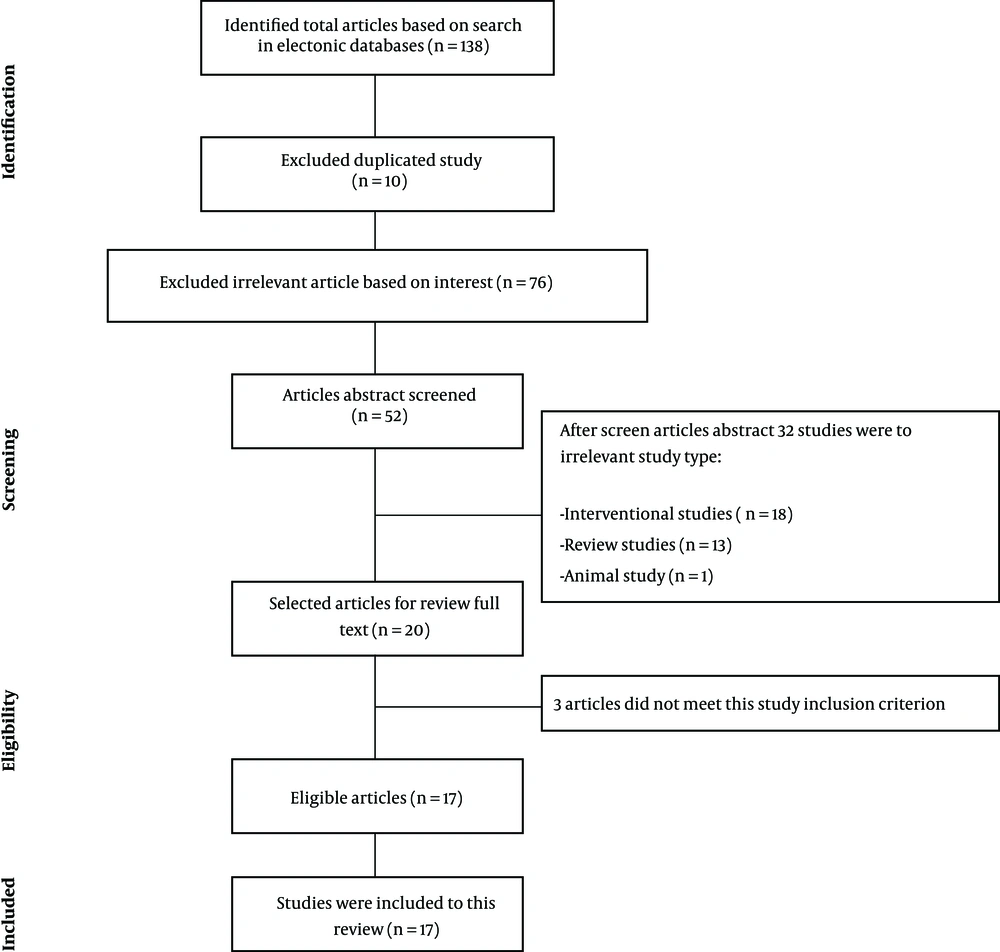
Figure 1.
Flowchart of study selection
3.3. Assessment of the Study Quality
The studies quality was assessed using the STROBE statement, to assess the quality of observational studies. This scale examined 22 points for the title, abstract, introduction, methods, results, and discussion sections of each of observational studies. In this respect, 18 items were common among all observational studies and the other were specific for cohort, case-control, or cross-sectional studies (26). The details of this checklist have been published and are freely available on the websites of PLoS Medicine at http://www.plosmedicine.org/, Annals of Internal Medicine at http://www.annals.org/, and Epidemiology at http://www.epidem.com/. Information on the STROBE Initiative is available at www.strobe-statement.org.
3.4. Data Extraction
The studies information was extracted in the results part, including studies characteristics, prevalence and rate of RWL and common methods used, effects of RWL on physiological status and health-related parameters, anthropometric status, athletic performance, and assessment of dietary intake in RWL periods.
4. Results
4.1. Studies Characteristics
In this literature review, 17 relevant studies were found in which 8 studies were conducted in Europe (8, 9, 14, 15, 27-30), 7 studies in America (3, 19, 31-35) and two of them in Asia (24, 36). The number of participants varied from 7 to 822 among the reviewed studies. The participants of the five studies included both genders (3, 8, 27, 31, 34), five studies included only men (9, 28, 33, 35, 36) and other studies did not determine the type of gender (14, 15, 19, 24, 29, 30, 32). Nine studies were conducted on the adolescents (8, 9, 14, 24, 28, 30, 32, 34, 35), five studies on the adults (15, 19, 27, 31, 33), and the other on both of them, the adolescents and the adults (3, 29, 36). Six studies examined judo (3, 14, 19, 24, 27, 35), five studies taekwondo (19, 30, 31, 34), five studies wrestle (27, 32, 33, 35, 36), four studies box (9, 15, 24, 28), two studies jujitsu (19, 35), two studies mixed marital arts (29, 35), one study karate (19), and one of them considered any type of elite sport (Table 1) (8). In the current study, all reviewed studies were considered high quality based on the STROBE statement.
Table 1.Characteristics of Reviewed Studies
| Authors’ Name | Country | Age, y | Sample Size, N | Kind of Sport | Common Methods Used RWL |
|---|---|---|---|---|---|
| Filaire et al. (14) | France | 10 ± 3.2 | 11 | Judo | Dietary restriction |
| Hall and Lane (15) | United Kingdom | 23.5 ± 4.8 | 16 | Box | - |
| Alderman et al. (32) | Arizona | 15 - 18 | 45 | Wrestle | Exercise, sauna, hot bath and room, warm and plastic suits, diet pills and drug |
| Ransone and Hughes (33) | United Status | 21.3 | 78 | Wrestle | - |
| Artioli et al. (3) | Brazil | 19.3 ± 5.3 | 607 male and 215 female | Judo | Dietary restriction, exercise, sauna, hot bath and room, diet pills and drug, spitting |
| Martinsen et al. (8) | Norway | 15 - 16 | 586 male and 375 female | Any type of elite sport | Dietary restriction, diet pills and drug, spitting |
| Kazemi et al. (34) | Iran | 11 - 42 | 72 male and 36 female | Taekwondo | - |
| Kordi et al. (36) | Canada | 14 - 17 | 436 male | Wrestle | Dietary restriction, diet pills and drug, fluid restriction |
| Brito et al., 2012 (19) | Brazil | 25 - 74 | 580 | Judo, taekwondo, jujitsu, and karate | Dietary restriction, sauna, hot bath and room, warm and plastic suits, diet pills and drug, fluid restriction |
| Reljic et al. 2013 (9) | German | 19.2 ± 9.2 | 17 male | Box | - |
| Pettersson et al. (27) | Sweden | 18 - 36 | 9 male and 5 female | Judo, taekwondo, and wrestle | Exercise, sauna, hot bath and room, warm and plastic suits |
| Mendes et al. (35) | Brazil | 19 - 25 | 18 male | Judo, wrestle, jujitsu, and mixed marital arts | - |
| Reljic et al. (28) | German | 19.2 ± 9.2 | 17 male | Box | - |
| Berkovich et al. (24) | Israel | 12 - 17 | 108 | Judo and box | Dietary restriction, sauna, hot bath and room, warm and plastic suits, diet pills and drug, fluid restriction, spitting |
| da Silva Santos et al. (31) | Brazil | 15 - 30 | 72 male and 44 female | Taekwondo | Dietary restriction, exercise, sauna, hot bath and room, warm and plastic suits, diet pills and drug, fluid restriction, spitting |
| Matthews and Nicholas (29) | United kingdom | 24.6 ± 3.5 | 7 | Mixed marital arts | Dietary restriction, exercise, sauna, hot bath and room, warm and plastic suits, diet pills and drug, fluid restriction, spitting, water loading |
| Dubnov-Raz et al. (30) | Israel | 12 - 21 | 112 | Taekwondo | Dietary restriction, exercise |
4.2. Prevalence of RWL and Common Methods Used
This review study indicated that the prevalence of RWL among the reviewed studies was reported to be 31.25 to 86%. Common methods were used for RWL in the reviewed studies, including dietary restrictions (for example fasting, skipping meal, low calorie diet, low fat diet and low carbohydrates diet) (3, 8, 14, 19, 24, 29-31, 36), exercise (3, 19, 27, 29-32), sauna, hot bath and room (3, 19, 24, 26, 27, 29, 31, 32), warm and plastic suits (19, 24, 27, 29, 31, 32), diet pills and drug (for example fat burner supplements, diuretics, laxatives and vomiting) (3, 8, 19, 24, 29, 31, 32, 36), fluid restriction (19, 24, 29, 31, 36), spitting (3, 8, 24, 29, 31), and water loading (29). Six studies did not mention the used methods for RWL (9, 26, 28, 33-35). (Table 1) The weight loss duration was mentioned between 5 day and one week before competition in some reviewed studies (3, 9, 14, 28, 29, 35).
4.3. Effects of RWL on Physiological Status, Health-Related Parameters, Anthropometric Status, and Athletic Performance
4.3.1. Physiological Status and Health-Related Parameters
Among the reviewed studies, we found that the food restrictions could have adverse effects on physiological status, including dizziness, tension, anger, anger, confusion, anxiety, and fatigue (Table 2) (14, 15, 32, 36).
Table 2.Effects of RWL on Physiological Status, Health-Related Parameters, Anthropometric Status, and Athletic Performance
| Effects of RWL | Authors’ Name | Outcome |
|---|---|---|
| Physiological status and health-related parameters | Filaire et al. (14) | Dietary restrictions can adverse effects on physiological status including dizziness, tension, anger, anger, confusion, anxiety, and fatigue. |
| Hall et al. (15) | ||
| Alderman et al.(32) | ||
| Kordi et al. (36) | ||
| Anthropometric status | Martinsen et al. (8) | Weight loss was showed before the competition among of athletic as well as reduction of body fat, fat free mass and total body water were reported (9, 14, 19, 28, 33, 35, 36). |
| Reljic et al. (9) | ||
| Filaire et al. (14) | ||
| Brito et al. (19) | ||
| Berkovich et al. (24) | ||
| Pettersson et al. (27) | ||
| Reljic et al. (28) | ||
| Ransone and Hughes (33) | ||
| Mendes et al. (35) | ||
| Kordi et al. (36) | ||
| Athletic performance | Filaire et al. (14) | After weight loss, vigor was decreased while in study by Mendes et al. (35), was not show any effects on the performance after weight loss. |
| Hall et al. (15) | ||
| Mendes et al. (35) | ||
| Kordi et al. (36) |
4.3.2. Anthropometric Status
Among anthropometric indices, weight was examined in the all reviewed studies except studies by Martinsen et al. (8) and Pettersson et al. (27). These studies reported weight loss before the competition among athletes. The other anthropometric index was body mass index (BMI), which was measured in studies by Filaire et al. (14), Brito et al. (19) and Berkovich et al. (24). In addition to anthropometric indices, the body composition was evaluated in seven studies (9, 14, 19, 28, 33, 35, 36) in which reduction was observed in body fat (BF), fat free mass (FFM), and total body water (TBW) (Table 2).
4.3.3. Athletic Performance
In this literature review, Filaire et al. (14) and Hall et al. (15) observed that vigor was decreased after weight loss. Kordi et al. (36) reported that weight loss before competitions could cause weakness, muscle crumps, and myalgia. On the contrary, Mendes et al. (35) did not observe any change in the performance after weight loss (Table 2).
4.4. Assessment of Dietary Intake in RWL Periods
In the current study, four studies investigated dietary intake during weight loss (14, 28, 29, 35). Filaire et al. (14), Reljic et al. (28) and Mendes et al. (35) observed reduction in energy, carbohydrates, protein, fat, water, vitamins and minerals intake before competition. Matthews et al. (29) indicated increase of energy, carbohydrates, water and sodium after competition compared to the RWL period.
5. Discussion
As observed, the results of these studies indicate a high prevalence of RWL among athletes, especially one week before the start of competition. Athletes lose this weight to compete in a lower weight level than their usual weight, to face smaller and weaker athletes (3-6). Some studies have observed a direct relationship between weight loss and success of athletes in many sports around the world (8, 37). The results of studies often indicate the use of restrictions on the intake of liquids and foods for RWL within the days before the start of a competition (32, 38). At the same time, athletes at lower levels often use more dangerous methods to perform RWL, such as fasting and skipping meal (39). RWL often affects the amount of TBW (9). Short-term adjustment of body weight leads to a decrease in body water, electrolytes, glycogen and body tissue, which itself affects physiological functions, such as body temperature regulation (10, 11), cardiovascular function, and metabolic rate, which are highly important for exercise performance (12, 13).
Regarding the results, most athletes follow a low-carbohydrate diet to carry out RWL. Considering that the supply of energy and body fluids to provide the fuel required during competition is important, following a low-carbohydrate diet and the use of RWL can have negative effects on athletic performance (40). Sports drinks and carbohydrate supplements are items having benefits for their particular use, and have positive effects on athletic performance (41). If athletes consume adequate energy and body fluids, they will achieve the best results from every training session, and it is better to focus all dietary plans on carbohydrate-rich foods to provide the adequate amount of fuel for muscles (41). Furthermore, moderate amounts of protein and low-fat food sources are required to balance the diet, as well as some fruits and vegetables to provide vitamins and minerals (37). In addition, the deprivation of food and fluids during weight loss can negatively affect the athletes’ mental status and increase tension, anger, fatigue, confusion and reduce their power. Restrictions on energy intake may result in changes in the mood of the individual and lead to an increased risk of developing eating disorders. Adherence to a weight loss regime is considered a trigger for the development and progression of eating disorders. These disorders can exacerbate symptoms, along with other factors such as exercise stress and personal mental impairment of fitness. Moreover, people who are on weight loss diets, do not always feel fully mentally prepared, and do not feel themselves to be in an ideal condition. Even dieting for short periods negatively affects individuals’ mental abilities and mood (14, 15). In addition, some studies indicate that RWL can induce a sense of being a champion in athletes. Psychological aspects of weight regulation that increases concentration, attitude of athletes’ commitment before the tournament, and creation of a psychological advantage over rivals contribute to the success of athletes as much as physical aspects (38). Considering that athletes are more exposed to oxidative damage, it is reported that RWL can have detrimental effects on antioxidant status. This is probably because RWL diets often contain a high proportion of PUFA and fewer carbohydrates. High levels of PUFA, through lipid oxidation and by forming lipid peroxide, cause cell wall destruction and oxidative damage (42). Additionally, some studies have demonstrated the effects of RWL on growth hormone secretion in adolescents, and its negative impacts on puberty, causing a significant reduction in growth hormone during weight loss period in adolescents (43, 44). Overall, reduced energy and micronutrient intakes, inducing a RWL, could be a limiting factor to training adaptations and a threat to athletes’ health if frequently used (45).
Our study had some limitations, so that the results of the study were not expressed in terms of a systematic review and meta-analysis. Furthermore, risk of bias in this study was not assessed.
5.1. Conclusions
Regarding the negative effects of short-term weight adjustment on physiological functions, including as athletes’ body temperature regulation, cardiovascular function, metabolism, and mental status (such as increased tension and fatigue), and since it has been observed that providing adequate energy and body fluids help athletes to achieve the best training results, studies have recommended concentrating all dietary plans on carbohydrate-rich diets. These provide adequate energy while receiving moderate amounts of protein and low-fat food to reach a balanced diet, as well as providing fruits and vegetables to supply vitamins and minerals in athletes. Further studies are necessary to obtain a better understanding of the connection between RWL and performance of athletes. Future studies should consider these issues separately for different types of sports as well as at different ages from adolescence to adulthood.



