
1. Background
Athletes and performance are tightly related. Athletes often experience muscle fatigue through the entire game. A review concluded that football players consistently experienced a decrement in performance in the second half of the match (1). This might limit their work and obviously have a detrimental effect on their achievement. Therefore, football players are required to be able to maintain their performance for a long period during a match.
Nutrition is one of the vital keys to sporting success (2). For instance, carbohydrate ingestion during exercise promotes muscle glycogen stores and carbohydrate oxidation rates, prevents hypoglycemia, and has a positive effect on the central nervous system (2). Consuming an adequate amount of protein may improve training adaptation, recovery, immune function, as well as the growth and maintenance of lean body mass (3). Fluid is also an important component of an overall performance especially maintaining the hydration status during exercise (2).
Many athletes rely on supplements to enhance performance. Citrulline is one of the substances believed to have ergogenic effects. Although a study showed that citrulline was ineffective in improving exercise performance (4), numerous studies have indicated otherwise. Evidence has shown that citrulline or citrulline malate may enhance cycling time trial performance (5), increase athletic anaerobic performance and reduce muscle soreness (6), reduce blood lactate level and postpone fatigue (7), allow faster recovery and training adaptation (8), improve upper and lower body submaximal weightlifting exercise performance (9), and escalate aerobic energy production (10).
Citrulline is also available in natural sources besides supplementation. Watermelon, the second highest in production and harvested fruit in the world (11), is the richest source of citrulline (12). Moreover, a study showed that citrulline bioavailability in the watermelon was greater than those in the pharmacological formulation (13). However, to our knowledge, the potential of watermelon for improving performance especially in relieving muscle fatigue is still not as well-known as supplementation.
2. Objectives
The purpose of this study was to investigate the effect of watermelon beverage ingestion on fatigue index (FI) in young-male, recreational football players.
3. Methods
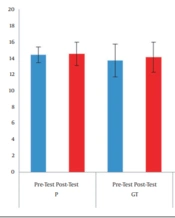
Thirty young-male, recreational football players aged 15 - 17 years were recruited to participate in this study. The study was performed using a randomized, 2-period crossover design (Figure 1). Subjects were divided into two groups to receive watermelon beverage or placebo for 7 days. All subjects received both interventions in a different period. Each period was separated by 7 days of washout. Blinding was not possible in this study considering the differences of the ingredient, color, taste, and consistency between watermelon beverage and placebo. However, the subjects were not informed of the purpose of the different interventions on the outcome to minimize any expectancy effects.

Figure 1.
Study design
The sample size was determined using power calculation based on the result of the previous study that examined the effects of 7 days citrulline supplementation on power output during cycling time-trial (5). This calculation determined the minimum number of subjects for adequate study power. We used 80% of power and 0.05 two-tailed alpha resulting a minimum of 25 samples each group. Because of the crossover design, all subjects were conducted into both interventions hence we needed a minimum total sample size of 25 for this study. We considered a 20% of dropout rate, thus the total sample size of 30 was required. Four subjects dropped out in the middle of the study. As a result, this study involved 26 young-male, recreational football players.
To participate, subjects had to meet the following criteria: were currently training at least 3 times a week for 1 hour per session; and not consuming enhancing supplements such as caffeine, creatine, arginine, and citrulline for 1 week before recruitment. Subjects were excluded if they were: taking medical treatment or were injured; diagnosed with diabetes and/or high/low blood pressure, and were allergic to watermelon. We also instructed the subjects to not consume food containing citrulline i.e. buffalo gourd, cantaloupe, cucumber, pumpkin, as well as watermelon (14) during the study.
In the beginning, we measured the body weight, height, and %fat using bioelectrical impedance analysis (Tanita BC-541). We also assessed the nutritional intake of the subjects i.e. energy, carbohydrate, and protein using 3 × 24 hours recall randomly during the study: 1 × during the first period, 1 × during the washout period, and 1 × during the second period. Daily dietary intake was analyzed using Nutrisurvey 2007 (EBISpro).
Experiments were carried out by ingesting 500 mL of watermelon beverage and 500 mL of placebo. Watermelon beverage was obtained from 520 g of seedless red watermelon. 80 mL of red sucrose syrup was added, then blended until smooth. The placebo was made from 80 mL of red sucrose syrup added to 500 mL of water. Therefore, both interventions contained 80 mL of red sucrose syrup to ensure that the differences were only from watermelon. Red sucrose syrup was processed by boiling 500 grams of sugar into 500 mL of water and stirred until fully dissolved. Afterwards, 1 teaspoon of red food coloring was added to the solution to minimize the difference of the color from the watermelon beverage. The intervention was served in disposable white plastic glasses and ingested by the subjects approximately at 01.30 - 02.30 PM local time consistently.
Running-based anaerobic sprint test (RAST) is a valid, reliable, easily applied, and low-cost method for measuring anaerobic capacity (15). In this study, subjects performed RAST four times. First, all subjects performed RAST before the intervention in the first period. The second RAST was performed on the seventh day of the first period, 60 minutes after the subjects were given the intervention. The third and the fourth RAST were performed in the second period after washout, with the same protocol.
Before doing the test, the subjects’ bodyweight was measured in lightweight clothing without wearing shoes and any accessories. Subjects were required to warm up before the execution of the test. Marker cones were placed at two points with a distance of 35 meters for the running track. The test involved two timekeepers to record the time to run as far as 35 meters 6 × and the 10 seconds rest interval each set. Timekeepers also had a responsibility to deliver a signal to the subjects to move.
A subject stood up at one of the marker cones and ran at maximum speed to the next marker cone after the timekeeper signaled. After arriving, the subject rested and prepared for 10 seconds. After the signal, the subject ran again with maximum speed to the previous marker cone, repeated for six times. FI was measured by calculating the difference between the maximum and minimum power then divided by the total time needed for the 6 × sprints. The lower value gained means the better the muscle ability to maintain performance, and vice versa.
We analyzed the statistical tests using SPSS statistics 20 (IBM). Values were reported as means ± SD. Paired t-test was used to evaluate the significance of any differences of FI before and after the intervention for each group. The statistical significance level was regarded if P values below 0.05.
4. Results
4.1. Body Mass Index, %Fat, and Nutritional Intake
Table 1 showes the characteristics of subjects regarding body mass index (BMI), %fat, and nutritional intake (energy, carbohydrate, and protein). BMI was determined using BMI-for-age percentile by CDC for children and teens (16). Additionally, %fat was categorized using bodyfat curves for children (17). Energy requirement was calculated based on basal metabolic rate, specific dynamic action, and physical activity (18) plus energy expenditure of exercise (19). We categorized the nutritional intake as severe deficit (< 70%), moderate deficit (70% - 79%), mild deficit (80% - 89%), normal (90% - 119%), and over (≥ 120) (20). Most subjects had a healthy weight but underfat. The majority of subjects had good diet pattern considering the nutritional intake showed a normal result in most subjects.
Table 1.
Body Mass Index, %Fat, and Nutritional Intake of Subjects
| Characteristics | No. (%) |
|---|---|
| Body mass index | |
| Underweight | 7 (26.9) |
| Healthy weight | 19 (73.1) |
| %fat | |
| Underfat | 25 (96.2) |
| Normal | 1 (3.8) |
| Energy intake | |
| Moderate deficit | 1 (3.8) |
| Mild deficit | 5 (19.2) |
| Normal | 20 (76.9) |
| Carbohydrate intake | |
| Severe deficit | 1 (3.8) |
| Mild deficit | 7 (26.9) |
| Normal | 18 (69.2) |
| Protein intake | |
| Moderate deficit | 9 (34.6) |
| Mild deficit | 2 (7.7) |
| Normal | 13 (50.0) |
| Over | 2 (7.7) |
4.2. Fatigue Index
The graphic (Figure 2) illustrated a decline of FI in the watermelon beverage group; whilst, the group given placebo did not show any reduction. The statistical analysis (Table 2) showed that watermelon beverage ingestion lowered FI significantly (4.06 ± 1.27 to 2.35 ± 1.09 watts) (P = 0.001) while no significant effects of placebo ingestion on FI decrement (P = 0.495).
Table 2.
Results of Pre and Post Fatigue Index Intervention Between 2 Group (N = 26)
| Group | Mean ± SD | P Value |
|---|---|---|
| Watermelon juice | 0.001 | |
| Before | 4.06 ± 1.27 | |
| After | 2.35 ± 1.09 | |
| Placebo | 0.495 | |
| Before | 3.88 ± 1.35 | |
| After | 4.20 ± 2.47 |
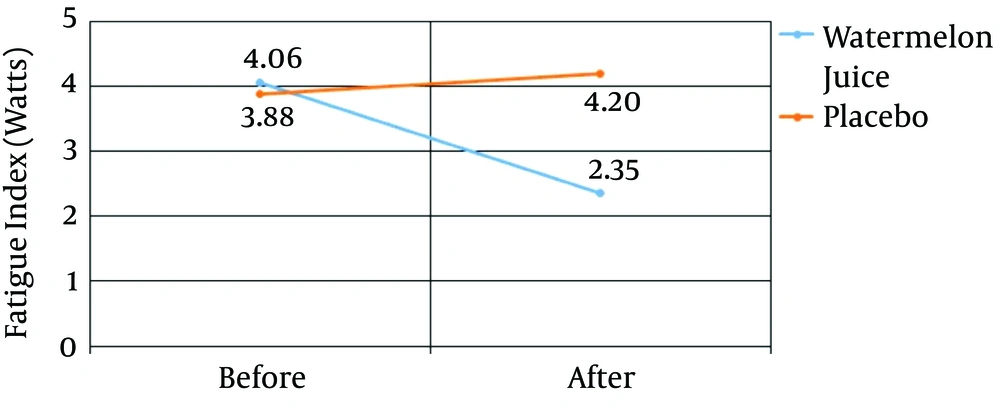
Figure 2.
Changes in fatigue index before and after the intervention
5. Discussion
The main finding of our experiment is that there was a significant difference in FI before and after the intervention of the watermelon beverage (P = 0.001). The potential of watermelon beverage to reduce muscle fatigue is still not well-known. Previous studies investigated the effect of watermelon juice ingestion in VO2max and muscle soreness improvement, but not muscle fatigue. VO2max in football players aged 15 - 17 years increased higher in the group given 750 mL of yellow watermelon beverage for 7 days than those in the group given sucrose syrup at the same duration (21). Another study noticed that there was a reduction on the recovery of heart rate and muscle soreness after 24 hours of exercise in athletes who ingested 500 mL of watermelon juice (both of natural or citrulline-enriched) compared with those in placebo (13).
Football is a high-intensity sport requiring muscle strength and endurance during the game. Although the use of aerobic energy is more dominant during a match, anaerobic energy is essential for jumping, kicking, tackling, turning, sprinting, changing pace, and sustaining forceful contractions (22). High-intensity exercise requires anaerobic energy metabolism from phosphocreatine and glycogen deposits which should be obtained quickly in a short time (23). Executing this activity over a long duration can cause muscle fatigue (24).
Muscle fatigue is a decrease in power production in response to activities requiring contraction (25). Muscle fatigue, in this study, was measured using RAST resulting maximum and minimum power output also FI. We measured FI 4 times and constantly performed at afternoon approximately 3 - 4 PM local time or 1 hour after the intervention. In this study, the average of FI was 4.06 ± 1.27 watts at first then dropped to 2.35 ± 1.09 watts after given watermelon beverage for 7 days. Whereas, there was no significant difference regarding FI before and after in the placebo group (P = 0.495). Thus, the results of this study were aligned with the initial hypothesis that there was an effect of watermelon beverage ingestion on FI.
We used watermelon beverage considering the fact that watermelon is the richest food source of citrulline (12). We were not able to find any published data regarding citrulline content in other foods except Fish (14). Uniquely, the citrulline content in other foods were substantially lower than those in watermelon (14). However, we still instructed the subjects not to consume food containing citrulline aforementioned i.e. buffalo gourd, cantaloupe, cucumber, pumpkin, as well as watermelon during the experiment.
Citrulline is a non-essential amino acid component of the urea cycle along with arginine and ornithine in the liver (26). The citrulline content in watermelon ranges from 2.4 - 3.4 mg/mL fresh sample based on the TLC plate methodology analysis (27). In this study, we gave 500 mL of red watermelon beverage per day. Thus, every single watermelon beverage given contained approximately 1.2 - 1.7 grams of citrulline. Citrulline doses in watermelon in this study were lower than those used in previous studies using supplements (5-9, 28, 29). However, watermelon had greater bioavailability of citrulline than those in synthetic source (13).
Citrulline might have positivity in exercise performance via two mechanisms. Firstly, citrulline increases plasma arginine concentration as a precursor of nitric oxide (30). Nitric oxide improves sports performance by enhancing vasodilatation, modulating blood flow, increasing mitochondrial respiration, regulating glucose uptake and oxidation, and supporting other contractile functions in skeletal muscle during exercise (31). Despite we did not evaluate the plasma arginine concentration, a study showed that the increment level was affected by the amount and length of watermelon intake (32). Plasma arginine concentration increased after the first week and was higher after 1 and 3 weeks of the intervention (32). This was the reason we conducted a 7 day trial in this study.
Secondly, citrulline has been linked with ammonia and lactic acid in the urea cycle. When high-intensity exercise is conducted, an accumulation of ammonia occurs facilitating lactic acid production in the blood plasma (26). The excess of ammonia plasma concentrations during high-intensity exercise may impact performance as fatigue or reduced function (33). Along with this, the accumulation of lactate in the bloodstream during intense exercise also has a contribution in impairing muscle function and exercise performance (8). Citrulline plays an important role in detoxifying ammonia via the urea cycle (26) and lowering blood lactate increment (7, 8, 26) thus, muscle fatigue may be relieved (5, 7).
This study had some limitations. Firstly, we could not entirely control the subjects’ nutritional intake but only assessed with 3 × 24 hours recall randomly during the study. However, we had input this confounding variable (nutritional intake: energy, carbohydrate, and protein) including BMI and %fat using bootstrap method when analyzing the statistic. After adjustment with the confounding variables, significant results persisted indicating that the confounding variable did not attenuate the observed effect of the intervention. This means that watermelon beverage was the main variable in relieving muscle fatigue in this study.
Secondly, watermelon does not only contain citrulline but also arginine (as well as other amino acids) (14), potassium, carbohydrate, and other nutritional content which might have a contribution to the result of the study. In addition, we also did not conduct laboratory analysis of the citrulline dose in watermelon we used. Thus, it seems that we could not clearly discover the effect of citrulline itself alone from the watermelon on muscle fatigue. Interestingly, this also indicated that watermelon contains complete nutritional content needed as a promising ‘natural source’ for enhancing sports performance by relieving muscle fatigue. Future study needs to investigate the effect of various durations and portions of watermelon beverage ingestion on fatigue index or other sports performance variables, in football players or other athletes to verify our findings.
5.1. Conclusions
We recapitulate that 500 mL of watermelon beverage ingestion for 7 days effectively relieved fatigue index in young-male, recreational football players. As a result, football players, coaches, and sports institution are suggested to implement a program of giving 500 mL of watermelon beverage to the players prior and until the end of the match session for 7 consecutive days to help relieve muscle fatigue and reach the highest performance.