1. Background
The performance in soccer depends on many factors (1). Regarding physical demand, soccer players from U12 to U16 age groups from two English professional soccer clubs covered a distance of 6200 - 7000 m during an 11-a-side match (2). Moreover, U14 national-level players covered during a match 500 m walking (0 - 0.4 km/h), 3000 m jogging (0.4 - 3 km/h), 1650 m running at medium-intensity (3 - 8 km/h), 700 m running at high-intensity (8 - 13 km/h) and 250 m sprinting (> 18 km/h) (3). To ensure that the training sessions are in line with the demands of the match, coaches must have the ability to correctly combine several factors that affect soccer performance. In this sense, small-sided games (SSGs) (4) have been popularized in the preparation of soccer players, as an alternative to traditional training based on high-intensity runs (5, 6). There are several factors that affect the intensity of SSGs (4, 7, 8) although it seems that the size of the pitch, especially the relative area per player, can be one of the most determinant factors of the physiological load imposed on the athletes (9, 10). Regardless of the pitch size used, the objective of the game will determine the effective use of the available space, so that the implementation of SSGs with or without directionality (i.e. with or without target goals with goalkeepers) can influence the demand of the task (4). In the first studies that analyzed the manipulation of this variable, a decrease in the heart rate was observed in 4 vs. 4 (11) and 3 vs. 3 (12) tasks when they were performed with goalkeepers vs. without goalkeepers. In the same line, another work that analyzed 2 vs. 2, 3 vs. 3 and 4 vs. 4 observed a decrease in the internal load of the SSGs (i.e. heart rate, blood lactate and perception of effort) with the presence of the goalkeeper (1). In contrast, a session involving 8 vs. 8 was reported to increase the percentage of heart rate reserve in the presence of goalkeepers (13).
Most of these responses have been analyzed in “ideal” and standardized research situations, usually after a specific warm-up, coinciding with the start of the training session (14). However, in real training settings, these tasks are used at different moments throughout the session, to achieve specific objectives (15). The order of presentation of the drills within the session may affect the response of the athlete (16). As far as we know, only one study has analyzed the effect of SSGs according to its allocation in the training session (14). In this study, it was observed that the total distance, the relative distance (m/min) and the distance covered by the players in high-speed ranges (i.e. > 13 km/h) were greater when the SSGs were performed at the beginning of the training session.
2. Objectives
To our knowledge, no study has analyzed the effects of different forms of directionality of the offensive game according to the moment of the training session, on the external load in youth male soccer players. Therefore, considering the relevance of prescribing the adequate SSG format in accordance to its physical demand, and the necessity of taking into account the presence or not of fatigue, the objective of this study was to compare the physical demands of soccer SSGs performed under different formats of the offensive game (with or without directionality) and timing regimens (beginning or end of a training session). Taking into account relevant literature (1, 11, 12, 14) it was hypothesized that SSG formats with directionality would reduce the motion activities of the outfield players compared to SSG without goalkeeper, and that fatigue towards the end of the training session would reduce high-speed activities in all game formats compared to the game performed at the beginning of the training session.
3. Methods
3.1. Participants
The study involved 10 young players (age, 13.5 ± 0.5 years; height, 164.2 ± 5.8 cm; body mass, 58.8 ± 6.2 kg) belonging to a sports academy of a professional Spanish soccer club. For practical reasons (i.e. 5 vs. 5 SSGs are usually employed by the coach of the team where the research was conducted), 10 athletes were considered for the study. The players had a training frequency of 3 weekly sessions, with an approximate duration of 90 minutes each, and a competition game during the weekend. As inclusion criteria, it was considered: be an outfield player (goalkeepers were excluded from the analyses), have a minimum experience of 4 years in the regular practice of soccer and have not suffered any injury in the 4 months prior to the data collection (14). The investigated club gave permission for the development of the investigation. Before the start of the study, the parents or legal guardians of the players were informed about the benefits and risks derived from participating in the study and signed an informed consent giving their approval to the player’s participation. The design and procedures of the investigation met the standards established in the Declaration of Helsinki and the Ethics Committee of the Pontifical University of Salamanca (Annex III, Act 9/1/19).
3.2. Procedures
This is a cross-sectional, randomized, cross-over study, comparing the physical demand of different formats of soccer SSGs in youth players, with special reference to games stressing the possession of the ball (no goalkeeper) and the offensive actions towards goal scoring (presence of goalkeeper). In addition, comparisons were also performed between SSGs performed at the beginning and at the end of the training session to address possible changes induced by soccer-specific fatigue on the physical demand of the games.
Before the start of the study, the players performed 4 familiarization sessions with the investigated SSG formats and with the Global Positional System (GPS) measurement units. Subsequently, 4 training sessions were scheduled (once per week, every Wednesday, 6:00 - 7:30 p.m.), during the competitive period, where each of the 4 analyzed SSG formats was randomly applied. During the aforementioned training sessions, a given SSG format was applied at both the beginning and end of the session. Players participated in SSGs wearing their usual training uniforms and soccer boots to play on the artificial grass pitch on which they normally trained. During the study duration, the players were instructed to maintain their usual habits, which included 8 hours of night-time sleep, before each data collection session and optimal hydration and carbohydrate intake over the 24 hours prior to each experimental SSG. Before the start of the training session, the players performed a standardized 20-minute warm-up consisting of continuous low-intensity running, stretching, joint mobility and ball activities, led by a specialist trainer (17).
3.3. Measurements
The physical demands of the SSGs were obtained using GPS devices (K-Sport®, Italy) with a sampling frequency of 10 Hz, and distances were calculated using dedicated software K-Fitness (K-Sport®, Italy). The 10 Hz GPS technology has been previously considered reliable and valid for monitoring players’ high-intensity and sprinting activities in soccer (18, 19). The GPS devices were inserted in a pocket located in the upper portion of the player’s back, inside a vest specifically designed to carry the measurement unit. The GPS unit was activated 15 minutes before starting the training session. According to previous studies (14), total distance (TD), acceleration and deceleration distance (ACC > 1.5 m/s2 and DEC > -1.5 m/s2) were recorded. In addition, the distances were split into six speed ranges: Dv1 = 0 - 0.4 km/h; Dv2 = 0.5 - 3.0 km/h; Dv3 = 3.1 - 8.0 km/h; Dv4 = 8.1 - 13.0 km/h; Dv5 = 13.1 - 18.0 km/h; and Dv6 ≥ 18.1 km/h. The intraclass correlation coefficient for distance at different velocity ranges [including sprinting (> 20 km/h)] varied between 0.71 - 0.99, with corresponding coefficient of variation of 1.3% - 11.6% (source: K-Sport®, Italy).
3.4. Small-Sided-Games
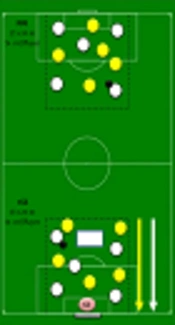
We analyzed 4 formats of SSGs involving 5 vs. 5 played for 10 minutes in a 37 × 20 m length x width pitch, with an average of 74 m2 per player. The teams were established according to player’s minutes played in the competition, playing the position, and subjective evaluation of the coach (10). The SSGs formats used (Figure 1) were (i) without directionality of the attack since the objective of each team was only to maintain the possession of the ball (MAI) without limit of ball touches; (ii) the format involving one goal with goalkeeper (1GK), where the directionality of the attack was centered on a goal and was shared by the two teams, whose players had to pass the ball through a space placed behind the opposite goal line in order to score a goal; (iii) the format with free-directionality (2GKF), allowing the teams to attack any of the two goals defended by goalkeepers and; (iv) the SSG with assigned-directionality (2GKD) in which a team defended a goal with the respective goalkeeper and attacked the opponent in the opposite side of the pitch. All the SSG formats maintained the same conditions (i.e. players forming the teams) when performed at the beginning or at the end of the training session. Before starting the training session, players completed a warm-up that included 5 minutes of dynamic stretching combined with jogging, 5 minutes of injury prevention drills (proprioception, coordination, eccentric strength) and 5 minutes of technique drills. In the condition with SSGs played at the end of the training session, the players performed the same aforementioned warm-up, 10 minutes of SSGs 5 vs. 5 in 37 × 20 m soccer pitch under the MAI, 1GK, 2GKF or 2GKD condition, and 20 minutes of 10 × 10 + goalkeepers technical-tactical drills on an official soccer pitch. After 5 minutes of rest, the athletes started the experimental SSGs.

Figure 1.
Small-sided-games 5 vs. 5 without directionality (MAI), with common directionality and one goalkeeper (1GK), with free-directionality and two goalkeepers (2GKF) with assigned- directionality and two goalkeepers (2GKD)
To minimize interruption when the ball left the field of play (20), spare balls were kept all-round the pitch, and 4 supporting players stood round the edges of the playing area. Moreover, verbal encouragement was given by the coaches throughout the games. Players were allowed to consume water ad-libitium during the short breaks interspersed during the SSGs.
3.5. Data Analysis
The results were expressed as mean ± SD. The normality of the data was verified with the Shapiro-Wilk test and homoscedasticity using Levene’s test. The effects of directionality on physical demand were tested using one-way repeated measures analysis of variance, with Bonferroni post hoc (P < 0.05). To compare SSG at the beginning or at the end of the training session, the Student’s t-test for dependent samples was used. In addition, the effect size (ES) was calculated using Cohen’s d categorized as < 0.2 (trivial); 0.2 - 0.6 (small); 0.6 - 1.2 (moderate); 1.2 - 2 (large); > 2 (very large) (21). Data analysis was performed with the Statistical Software for Social Sciences (SPSS version 18.0; SPSS, Inc., Chicago, IL, USA).
4. Results
4.1. Physical Demands During SSGs as a Function on the Directionality of the Offensive Play
When the SSG formats were played at the beginning of the training session, TD was higher in MAI (P < 0.01, ES = 1.85) and 1GK (P < 0.05, ES = 1.36) than in 2GKD, and DEC was higher in MAI compared with 2GKD (P < 0.05, ES = 1.19) and 2GKF (P < 0.05, ES = 1.17) (Figure 2). In the formats performed at the end of the training session, TD, ACC and DEC were higher (P < 0.01) in MAI compared with 2GKF (ES = 3.54, ES = 1.95, and ES = 1.98, respectively) and 2GKD (ES = 3.92, ES = 1.85, and ES = 2.12, respectively) and higher in 1GK compared with 2GKF (ES = 3.26, ES = 2.12, and ES = 2.66, respectively) and 2GKD (ES = 2.65, ES = 2.12, and ES = 2.66, respectively) (Figure 2).

Figure 2.
Physical demands of small-sided games according to the order of presentation within the session. MAI, small-sided-games 5 vs. 5 without directionality; 1GK, small-sided games 5 vs. 5 with common directionality and one goalkeeper; 2GKF, small-sided games 5vs5 with free directionality and two goalkeeper; 2GKD, small-sided games 5 vs. 5 with directionality assigned and two goalkeeper; TD, total distance; Drel, Relative distance; Vmax, maximum speed; %HI, relative distance covered at high-intensity; ACC, distance in acceleration; DEACC, distance in deceleration; B, at the beginning of the training session; E, at the end of the training session; ES, effect size; * and **, significant differences with the end of the session (P < 0.05 and P < 0.01, respectively); # and ##, significant differences with 2GKF (P < 0.05 and P < 0.01, respectively); $ and $$, significant differences with 2GKD (P < 0.05 and P < 0.01, respectively).
Regarding the distance covered in different speed ranges (Table 1), with the SSG formats performed at the beginning of the session, DV2 was lower in 2GKD compare with MAI (P < 0.01, ES = 1.98), while DV4 was higher in MAI compared with 2GKD (P < 0.01, ES = 1.95), and DV5 was higher in MAI and 1GK compared with 2GKD (P < 0.05, ES = 1.08; P < 0.01, ES = 2.07, respectively). The analysis of the SSG formats made at the end of the training session indicates that DV2 was lower in MAI and 1GK compared with 2GKF (P < 0.01, ES = 2.97; P < 0.01, ES = 3.99, respectively) and 2GKD (P < 0.01, ES = 2.14; P < 0.01, ES = 3.09, respectively). However, DV4 was higher in MAI compared with 2GKF (P < 0.01, ES = 2.87) and 2GKD (P < 0.01, ES = 2.25), and DV5 was higher in MAI compared with 2GKF (P < 0.01, ES = 2.27), and in 1GK compared with 2GKF (P < 0.01, ES = 2.27) and 2GKF (P < 0.01, ES = 1.76).
| DV1, 0 - 0.4 km/h | DV2, 0.5 - 3.0 km/h | DV3, 3.1 - 8.0 km/h | DV4, 8.1 - 13.0 km/h | DV5, 13.1 - 18.0 km/h | DV6, > 18 km/h | |
|---|---|---|---|---|---|---|
| MAI | ||||||
| B | 2.94 ± 1.06 | 39.43 ± 10.48 $$ | 357.38 ± 36.98 | 507.03 ± 90.68 $$ | 151.81 ± 64.21 $ | 19.06 ± 16.36 |
| A | 2.32 ± 1.72 | 51.47 ± 16.31 ## $$ | 374.76 ± 30.31 ## $ | 478.36 ± 105.87 ##$$ | 140.31 ± 42.01 ## | 14.22 ± 13.17 |
| 1GK | ||||||
| B | 3.48 ± 0.89 | 52.10 ± 13.92 | 351.77 ± 33.50 | 416.00 ± 83.51 | 189.81 ± 55.81 $$ | 22.52 ± 16.44 |
| A | 3.50 ± 0.67 | 42.63 ± 13.17 ## $$ | 340.36 ± 34.75 | 473.10 ± 98.78 | 179.71 ± 53.38 ##$$ | 22.48 ± 20.68 |
| 2GKF | ||||||
| B | 3.70 ± 0.74 | 56.87 ± 18.81 ** | 361.12 ± 48.76 * | 406.35 ± 101.98 ** | 156.19 ± 55.68 ** | 19.94 ± 10.52 |
| A | 3.35 ± 0.82 | 95.90 ± 13.52 | 305.24 ± 43.68 | 231.05 ± 60.12 | 75.69 ± 33.81 | 19.30 ± 8.42 |
| 2GKD | ||||||
| B | 3.15 ± 0.76 | 66.85 ± 16.49 * | 364.01 ± 26.04 * | 351.68 ± 66.72 * | 102.94 ± 27.21 | 18.14 ± 16.35 |
| A | 3.55 ± 0.69 | 83.01 ± 12.96 | 325.78 ± 39.08 | 275.11 ± 71.38 | 97.79 ± 29.16 | 13.72 ± 13.30 |
Abbreviations: MAI, small-sided-games 5 vs. 5 without directionality; 1GK, small-sided games 5 vs. 5 with common directionality and one goalkeeper; 2GKF, small-sided games 5 vs. 5 with free-directionality and two goalkeepers; 2GKD, small-sided games 5 vs. 5 with assigned-directionality and two goalkeepers.
aA, the end of the session; B, the beginning of the session.
b# and ##, significant differences with 2GKF (P < 0.05 and P < 0.01, respectively); $ and $$, significant differences with 2GKD (P < 0.05 and P < 0.01, respectively); * and **, significant differences with the end of the session (P < 0.05 and P < 0.01, respectively).
4.2. Physical Demands During SSGs at the Beginning Versus End of Training
Compared to values obtained when SSGs were completed at the end of training, greater TD, ACC and DEC values were observed in 2GKF (P < 0.01, ES = 2.62; P < 0.01, ES = 1.37; P < 0.01, ES = 1.47, respectively) and 2GKD (P < 0.05, ES = 1.44; P < 0.05, ES = 1.02; P < 0.01, ES = 1.35, respectively) when SSGs were performed at the beginning of the session (Figure 2).
The analysis of the distance traveled in the analyzed speed ranges (Table 1) indicates that in 2GKF and 2GKD the variable DV2 was lower (P < 0.01, ES = 2.4, P < 0.05, ES = 1.1, respectively) when the formats were performed at the beginning of the session. On the other hand, DV3 and DV4 achieved higher values at the beginning than at the end of the training session in the 2GKF (P < 0.05, ES = 1.2, P < 0.01, ES = 2.2, respectively) and 2GKD (P < 0.05, ES = 1.2, P < 0.05, ES = 1.1, respectively). Finally, in 2GKF the values of DV5 (P < 0.01, ES = 1.80) and DV6 (P < 0.05, ES = 1.00) were higher when the task was completed at the beginning of the session.
5. Discussion
Main findings indicated that in general the SSGs format without directionality (i.e. MAI) increases the physical demand (i.e. TD, ACC, DEC, DV4 and DV5) compared with SSGs played with directionality of the offensive play (i.e. 2GKD). In addition, players covered greater distance at low-speed and reduced distance at high-speed (i.e. DV5 and DV6) in the SSG formats with directionality of the offensive play performed at the end of the training session.
Our results showed higher values for TD, ACC and DEC in MAI compared with 2GKF and 2GKD. Previous studies also observed that by including goalkeepers (i.e. SSGs with directionality) the physical and physiological response of 2 vs. 2, 3 vs. 3 and 4 vs. 4 tasks decreased (1). Contrary to our results, when the influence of the directionality of the game was analyzed through the presence of goalkeepers in tasks of 8 vs. 8, an increase in the intensity of the task was observed, translated into an increase in the percentage of the heart rate reserve (13). In this study, unlike others that analyzed the influence of the presence of goalkeeper (12) the number of players was higher (8 vs. 8 compared to 3 vs. 3), and could have conditioned the results. It is possible that in the SSGs with fewer players (i.e. less than 5 vs. 5) more shots to the goal take place, thus producing more interruptions in the game, which could cause the reduction of the physical load (1). On the other hand, in this type of tasks the goalkeeper can act as an attacking player, being used by the outfield players of the team with ball possession to generate numerical superiority (4). Previous studies have indicated that the numerical superiority can cause a decrease in the demand of SSGs (17). On the other hand, the introduction of goals and goalkeepers can increase the organization of the teams, with players who assume defense or attack roles occupying a specific area of the playing field, which would limit their movements across the pitch zones, consequently decreasing the physical demand of the task (1, 11, 12). As the player needs to improve the ability to repeat high-speed actions (and resist to fatigue) it is necessary to incorporate alternatives that, without losing the concept of directionality, can increase the conditioning stimuli to the player.
To increase the motion demands of the players without abandoning the concept of directionality, in our work we have introduced the 2GKF format, which forces the teams to attack and defend two goals. In our study, with the exception of DEC, there were no differences between MAI and 2GKF in the analyzed variables, when the format was organized at the beginning of the training session. The options of the player to score in 2GKF are increased, with the consequent increase in motivation, causing greater locomotor activity (13). It has been indicated that the presence of goalkeepers can increase the motivation of the soccer players. In 2GKF after the kick to the goal intercepted by the goalkeeper, the defending team must start the offensive to the opposite goal. This situation appears to increment external load of the soccer players. Therefore 2GKF can be a good option for to train the game demands in specificity.
Players travelled more distance at low-speed (i.e. DV2) and less distance at high-speeds (i.e., DV5 and DV6) when the directionality formats (i.e. 2GKF and 2GKD) were performed at the end of the training session. This coincides with previous studies’ findings, which reported greater TD, relative distance and distance covered by players in high-speed ranges (i.e. > 13 km/h) during the SSGs performed at the beginning of the training session (14). The decrease in the ability to perform high-speed actions during SSGs performed at the end of the session may be due to the fact that participation in specific tasks during the main part of the training may increase the presence of fatigue-related metabolites, limiting the contractile capacity of fast-twitch fibers (22). Although this fatigue can be detrimental to improvements of muscular power (23) and high-speed distance (24), training should improve the ability of players to maintain a high level of intensity during the game, limiting the detrimental effects of the fatigue (1). In this sense, current results show that MAI can be applied at the beginning of the training sessions, as a greater stimulus (i.e. TD, ACC, DEC, DV4, DV5, and DV6) to develop the physical capacity of the players. However, 2GKF and 2GKD applied at the end of the training sessions may be an adequate alternative for the development of high-intensity activity under fatigued state.
Optimization of training methods in youth soccer is a key issue in the long-term athlete development model (25). Traditionally, methods based on high-intensity running have been used, but currently tasks such as SSGs are very popular because they allow the reproduction of the demands of competition, allowing to improve technical, tactical and physical abilities specifically (26). As a practical application, coaches may prefer the use of SSGs with the aim to keep ball-possession in order to provide a greater stimulus of TD, ACC, DEC, and distance covered over a broad range of speeds (8.1 - 18.0 km/h). Current findings suggest that when SSGs are applied without directionality (MAI), greater physical demands are induced. Moreover, current findings suggest that greater high-intensity actions are completed when SSGs are scheduled at the beginning of a regular soccer training session. The application of SSGs early in the session may increase the stimulus on high-speed tasks as compared to SSGs applied toward the end of a regular soccer training session, although its application at the end of the session may be more focused on the development of endurance. Such information may allow coaches to better schedule training sessions with the aim of inducing optimal external loads on youth male soccer players. As a result, the trainer may improve the design of training microcycles. This, in turn, may increase the effectiveness of the training process, increasing the player’s performance and decreasing the incidence of injuries.
5.1. Conclusions
The SSGs emphasizing ball possession (i.e. MAI or 1GK) increase the physical demands of youth male soccer players compared to SSGs formats with 2 goals that develop free or fixed attack. The directionality with free attack rules (i.e. 2GKF: teams can attack any of the two goals defended by goalkeepers) is a good compromise between stimulating physical fitness and technical ability to shoot and score. This format implies less fatigue than games without goals and goalkeepers. However, when it is sought to encourage fatigue behavior, it is possible to place the formats at the end of the training session. Due the reduced physical performance during SSGs with directionality towards the end of the training session due to fatigue, these conditioning games can be used to improve players’ soccer-specific endurance.