1. Background
Small-sided games (SSG) are used in elite soccer as a sports-specific training modality to enhance player performance. Their popularity in elite soccer is based on the premise that technical, tactical and physical components are trained concurrently (1-3). Some authors suggest that SSG are effective in aiding identification of players that are also capable of performing well during full sized 11 aside games (4). Moreover, others have claimed that SSG may generate an appropriate environment to develop technical performance associated to game-related problem solving (5). Although research has investigated the physiological responses to various SSG (2, 6), the temporal change in technical performance parameters during SSG is still unknown.
Research demonstrates that high-intensity running declines from the first to second half of elite senior soccer matches (7, 8). Moreover, Bradley & Noakes (9) revealed that high-intensity running during the second half of matches was impacted by the activity of the first half and that running performances were reduced after intensified periods of match play. Similarly, a reduction across halves has been observed for technical variables during matches such as involvements with the ball and passes (10). In contrast, Carling & Dupont (11) reported that elite players were generally able to maintain skill-related performance throughout games despite declines in high-intensity running distance. To maintain skill related performance during matches, it has been suggested that players employ pacing strategies either consciously or subconsciously (9). A pacing strategy in soccer could reduce low-intensity activities such as walking and jogging in an attempt to preserve energy to perform essential high-intensity running actions (12, 13) and maintain technical performance.
Although pacing may explain the physical performance changes across games and the maintenance of skill-related performance, there is limited data regarding these changes during SSG in elite youth players. Moreover, it is still unknown whether changes in physical performance during SSG deteriorates technical performance in this population, particularly in the last quarter of the SSG as it does in real match play for senior players. This information could have important implications for applied sports scientists given that SSG should not only provide a physical overload stimulus but should also tax players’ technical problem solving capabilities. If the SSG fails to achieve one or both of these elements, then the drill should be optimized to provide the correct physical and technical overload that will enable players to improve their overall performance during games.
2. Objectives
Therefore, the aim of this study was to examine transient changes in technical and physical performances during a SSG in elite soccer players. It was hypothesized that marked declines in physical performance parameters would be evident during the latter stages of the SSG and that these changes would impact on technical performance parameters.
3. Methods
3.1. Subjects
Sixty elite youth soccer players signed to a professional Brazilian club participated (U14 and U15 teams; age 14.8 ± 0.2 yr; stature 177 ± 5 cm; body mass 66.2 ± 4.7 kg). This sample included defenders: central defenders and fullbacks, n = 14; midfielders: central midfielders and wide midfielders, n = 32; and attackers, n = 14). All players underwent a medical prior to the study and their parents were fully informed of the experimental procedures and associated risks before providing informed consent. The players’ typical training schedule comprised of 10 - 12 sessions per week with each session lasting ~ 90 - 120 minutes. The local University Research Ethics Committee approved the research procedures.
3.2. Design
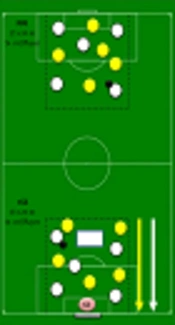
Each player completed a standardized 5 vs 5 SSG using two repetitions of 8 min interspersed by 3 minutes of passive recovery. In order to avoid accumulated fatigue due to the habitual schedule of the participants, the assessed SSG were performed on Monday afternoon, ~ 60 hours after the previous training session. Each SSG was balanced to ensure similar technical and physical performance levels of the players on each side and players received coach encouragement throughout the session. Players were given instruction to play as intensely as possible and to do their best in order to achieve a high level of technical and tactical performance. As each SSG was balanced taking into account the evaluation of the players by coach, it was expected that the technical positional-dependent would not affect the technical results. To evaluate temporal changes in physical and technical performance, data were analyzed across 4 min quarters. Technical performance was quantified using notational analyses while physical performances were monitored using a Global Positioning System. The SSG was played on a pitch dimension of 45 × 60 m using goalkeepers and full sized goals. There was no other specific playing condition or rule (i.e. limited number of touches, position). All players were familiar with this SSG format as it was habitually used during their weekly training sessions.
3.3. Technical Performance Parameters
Video recordings of SSG were collected using two fixed cameras (Panasonic, Brazil; 60 Hz frequency acquisition). One was located 15 m above and to one side of the long axis of the pitch while the other was placed 5 m to one side of the pitch to facilitate player identification. Match analysis software (Gamebreaker©, Sports Code©, USA) was used to code technical performance parameters from this video footage (10, 14). Technical performance parameters were chosen according to previous recommendations and included: 1- total goal attempts, 2- total number of tackles and interceptions (sum of total number of tackles and total number of interceptions), 3- total number of tackles, 4- total number of interceptions, 5- total number of passes, 6- passes effectiveness (correct passes/total number of passes), 7- total number of headers, 8- total involvement with the ball (individual ball possession), and 9- overall involvement (sum of all events). In order to identify the structure of relationships between technical performance parameters and subsequently reduce the number of events without losing information regarding technical performance, a principal component analysis (PCA) was adopted. Results from PCA revealed 8 factors with initial eigenvalues > 1. Those components which demonstrated eigenvalues > 2 and that contribute at least 10% of the total variance of the model were therefore considered for further analysis. Four components, that explained together almost 60% of the variance were retained. The most representative variables extracted from the PCA, for each factor, were then retained for analyses. The retained variables were: goal attempts, total number of tackles, tackles and interceptions, total number of passes.
3.4. Physical Performance Parameters
Each player wore a 15-Hz GPS unit (SPI Elite, GPSports, Canberra, Australia). The GPS units were coupled with a 100 Hz tri-axial accelerometer and was harnessed between the shoulder blades and anchored using an undergarment to minimise movement. Heart rate was recorded during matches using a heart-rate monitor (T14, Polar, Oy, Finland) fitted into the harness. The reliability and validity of these GPS units has been examined (15). Physical performance parameters included the total distance covered (TDC), the frequency of sprints (> 18 km•h-1; high-intensity run), and accelerations and decelerations (> 2.0 m•s2 and -2.0 m•s-2, respectively). The classification of high-intensity running, named as “sprints” in the present study, was in accordance with that previously used with youth players (5, 16). In addition, calculations were provided for average metabolic power (W•kg-1) using instantaneous energy cost equations based on accelerated and decelerated running efforts (17, 18). Raw heart-rate data (b•min-1) were analysed to provide the percentage heart-rate peak (% HRpeak). The maximum HR values reached during a Yo-Yo Intermittent Recovery Test Level 1 conducted during the week before the experiment according to previously described methods (19) was considered as 100%. Edwards’s training impulse (TRIMP) score was calculated as described previously (20). Briefly, the time spent in each of 5 HR predefined zones were calculated (zone 1 ≥ 50% - 60%; zone 2 ≥ 60% - 70%; zone 3 ≥ 70% - 80%; zone 4 ≥ 80% - 90% and zone 5 ≥ 90% - 100%). The sum refers to the magnitude of internal training load (ITL; arbitrary units; AU) and is calculated from the result between the corresponding score (Zone 1 = 1; Zone 2 = 2; Zone 3 = 3; Zone 4 = 4; Zone 5 = 5) for the time spent in each HR zone (e.g., 5 minutes in Zone 2 = 10 AU). Subsequently, ITL quantification is held by the sum of the products of each zone (e.g., 5 minutes in Zone 2 = 10 AU + 3 minutes in Zone 3 = 9 AU, ITL = 19 AU), with the aid of the Excel program (Microsoft Corporation©, USA). The total distance covered (TDC) was divided by the TRIMP score to provide the TDC: TRIMP (21, 22). These ratios represent the integration of ITL and external training load (ETL) with higher values associated with greater exercise economy (22). The number of impacts and body load (BL) were also determined. Player impact measures and body load were gathered from triaxial accelerometer data provided in g force and sampled at 100 Hz. The measure of impacts is determined from the summed accelerations from 3 accelerometer planes. Impacts are derived from the vector of the X-Y-Z axes of the tri-axial accelerometer. According to the manufacture, the vector is calculated as the square root of the sum of the squares of each axis. Impacts are therefore reported as a count of events into each zone (using similar logic to speed zone entries). This variable is analyzed using six pre-defined zones of G force: zone 1 (5.0g - 6.0 g), zone 2 (> 6.0g - 6.5 g), zone 3 (> 6.5g-7.0 g), zone 4 (> 7.0g-8.0 g), zone 5 (> 8.0g - 10.0 g) and zone 6 (> 10.0 g). This zone classification system forms the basis of the analysis performed by the Team AMS (GPSports, SPI Elite, Australia) software and involves the use of the acceleration zone forces provided in “G” force by the accelerometer in the GPS. The impact classification system used in this study was based on methods presented previously in young soccer players (5, 23), rugby league (24, 25), and rugby union (26) and in accordance with manufacturer guidelines (GPSports, Australia). For the purpose of the present study any impact above zone 1 were retained for analysis.
Body load provides a measure of total stress resulting from accelerations, decelerations, changes of direction, and impacts. Body load was calculated automatically using a custom algorithm included in the proprietary software provided by the manufacturers (TeamAMS Version 17, GPSports, Canberra, Australia). The body load is derived from the square root of the sum of the squared instantaneous rate of change in acceleration in each of the 3 vectors (x-, y-, and z-axes). The body load was expressed in arbitrary units (AU).
3.5. Statistical Analysis
Descriptive statistics were calculated on each variable and the Shapiro-Wilk test was used to verify data normality. Analysis of variance (ANOVA) with repeated measures and Friedman tests were used to explore physical and technical performance parameters, respectively, across 4 min periods of the SSG. In the event of a significant difference, a Bonferroni post-hoc test was used to identify any localised effects. Statistical significance was set at P < 0.05. Effect sizes (ES) were calculated to determine the meaningfulness of the difference. ES magnitudes were classified as: 0 - 0.19 trivial; 0.2 - 0.59 small; 0.6 - 1.19 moderate; 1.2 - 1.99 large; > 2 very large (27). All data were analysed using the STATISTICA software (StatSoft Version 12) and presented as means and standard deviations (SD).
4. Results
Table 1 presents the technical and physical performances parameters across 4 min periods of the SSG. Significant changes in TDC (F = 38.50, P < 0.001), accelerations (F = 20.05, P < 0.001; ES = 0.21 - 2.00), decelerations (F = 7.05, P < 0.001; ES = 0.10 - 1.08), number of sprints (F = 18.10, P < 0.001; ES = 0 - 1.86), and MP (F = 41.79, P < 0.0001; ES = 0.53 - 3.30), body load (F = 8.49, P < 0.001), impacts (F = 3.66, P < 0.01) were observed. However, no significant changes were verified for TRIMP (F = 1.27, P = 0.28) or TDC: TRIMP (F = 2.37, P = 0.07). TDC was found to decrease from the 1st quarter to all subsequent quarters of the SSG (P < 0.05; ES = 0.79 - 1.97). Body load decreased from the 1st to 2nd (P < 0.05; ES = 0.98) and 4th quarters (P < 0.05; ES = 1.46), whilst impacts decreased between the 1st and the 4th quarter (P < 0.05; ES = 0.86). Interestingly, there are no substantial changes (no moderate, large or very large ES) when comparing the 2nd to 3rd quarter, suggesting that the 3 minutes of passive recovering was sufficient to provide physical recovery for the assessed players.
Table 1.
Technical and Physical Performance Parameters During the Various Periods of the SSG (mean ± SD)
| Variable | 1st quarter | 2nd quarter | 3rd quarter | 4th quarter |
|---|---|---|---|---|
| Technical performance | ||||
| Goal attempts | 0.5 ± 0.7 | 0.9 ± 0.8 | 0.4± 0.5 | 0.6 ± 0.6 |
| Passes | 5.1± 2.7 | 3.9 ± 2.8 | 3.6 ± 1.7 | 4.4 ± 1.5 |
| Tackles/interceptions | 2.3 ± 2.3 | 2.6 ±1.3 | 2.1 ± 1.1 | 2.6 ± 1.0 |
| Tackles | 4.3 ± 2.1 | 3.6 ± 2.2 | 3.3 ± 1.4 | 4.0 ± 1.3 |
| Physical performance | ||||
| TDC (m) | 596 ± 92a | 489 ± 58b | 543±42c | 462 ± 44 |
| Accelerations (n) | 19.2 ± 3.9d | 13.5 ± 3.9 | 14.3 ± 3.7c | 11.3 ± 4.0 |
| Decelerations (n) | 11.7 ±3.1d | 8.8 ± 3.0 | 9.1 ± 2.4 | 8.5 ± 2.8 |
| Sprints (n) | 13 ±3d | 9.1 ± 2.5c | 9.1 ± 2.7c | 7.6 ± 2.8 |
| Body load (AU) | 14.9± 3.7a | 11.1 ± 4.0 | 12.5 ± 3.1 | 10.3 ± 2.6 |
| Impacts (n) | 69 ±28c | 52 ± 28 | 54 ±21 | 47 ± 23 |
| MP (W•kg-1) | 13.5 ± 0.9d | 10.9 ± 1.5 | 12.1 ± 1.1c | 10.2 ± 1.1 |
| TRIMP (AU) | 13.2 ± 4.5 | 15.0 ± 5.4 | 14.5 ± 4.4 | 15.7 ± 4.5 |
| TDC: TRIMP | 54.8 ± 32.8 | 42.2 ± 30.4 | 43.8 ± 24.2 | 34.9 ± 22.5 |
Abbreviations: TDC, total distance covered; n, number; MP, Average metabolic power; TDC: TRIMP, total distance covered divided by Edward’s training impulse.
asign diff to 2nd and 4th.
bsign. diff. to 1st and 3rd quarters.
csign diff to 4th quarter.
dsign diff to 2nd, 3rd and 4th quarters.
In contrast, none of the technical performance parameters significantly changed across the quarters (P > 0.05). The ES for the five assessed technical parameters ranged from 0.15 to 0.33 when comparing the 1st to the 4th quarter (Table 2).
Table 2.
Effect Sizes (ES) for Technical and Physical Performance Parameters During the 4 Periods of the SSG
| Variable | 1st to 2nd | 1st to 3rd | 1st to 4th | 2nd to 3rd | 2nd to 4th | 3rd to 4th |
|---|---|---|---|---|---|---|
| Technical performance | ||||||
| Goal attempts | - 0.53 | 0.16 | - 0.15 | 0.76 | 0.42 | - 0.36 |
| Passes | 0.43 | 0.68 | 0.33 | 0.13 | - 0.23 | - 0.5 |
| Tackles/Interceptions | - 0.16 | 0.11 | - 0.18 | 0.41 | 0 | - 0.47 |
| Passes effectiveness | 0.19 | 0.77 | 0.17 | 0.42 | - 0.07 | - 0.70 |
| Physical Performance | ||||||
| TDC (m) | 1.42 | 0.79 | 1.97 | - 1.08 | 0.52 | 1.88 |
| Accelerations (n) | 1.46 | 1.28 | 2.00 | - 0.21 | 0.55 | 0.77 |
| Decelerations (n) | 0.95 | 0.94 | 1.08 | - 0.11 | 0.10 | 0.23 |
| Sprints (n) | 1.41 | 1.36 | 1.86 | 0 | 0.56 | 0.54 |
| Body load (AU) | 0.98 | 0.70 | 1.46 | - 0.39 | 0.24 | 0.77 |
| Impacts (n) | 0.60 | 0.61 | 0.86 | - 0.08 | 0.19 | 0.31 |
| MP (W•kg-1) | 2.16 | 1.40 | 3.30 | - 0.92 | 0.53 | 1.72 |
| TRIMP | 0.36 | 0.29 | 0.55 | - 0.10 | 0.14 | 0.26 |
| TDC: TRIMP | 0.39 | 0.38 | 0.72 | - 0.05 | 0.27 | 0.38 |
Abbreviations: TDC, total distance covered; n, number; MP, Average metabolic power; TRIMP, Edwards’ training impulse; TDC: TRIMP, total distance covered divided by Edward’s training impulse; ES, 0 - 0.19 trivial; 0.2 - 0.59 small; 0.6 - 1.19 moderate; 1.2 - 1.99 large; > 2 very large.
5. Discussion
The aim of this study was to examine temporal changes in technical and physical performance during a SSG in elite youth soccer players. The data demonstrate that physical performance parameters during the 5 vs 5 SSG decreased from the first to the last quarter with notable declines in TDC, metabolic power and the frequency of sprints, accelerations and decelerations. In contrast, technical performance parameters did not statistically vary across the four quarters.
SSG are considered effective at distinguishing between players that are capable of performing well during competitive 11 aside games (4). This is understandable as SSG have technical, tactical and physical demands similar to those in real match play and factors that impact on the physical and technical performances within SSG could also influence performance during full sized games. The progressive decline in physical performance parameters across the 4 min periods of the SSG observed in the present study resemble the transient reductions observed in running performance during elite matches (9). The similarity between SSG and match play trends could indicate a positive pacing profile which is evident within team sports such as soccer (23, 24); or the observed transient reductions might be attributed to fatigue mechanisms due to the multiple intense actions during matches (8).
Match-induced fatigue seems evident as physical capacity measures markedly decline after matches compared to baseline measures (25, 26), with the accumulation of muscle metabolites and substrate depletion as the prime candidates. It is unclear what caused the decline in physical performance parameters in the SSG used in the current study, especially given that the duration of the SSG was significantly lower than match-play (16 vs 90 minutes). Research demonstrates that lowering the number of players within a drill (5 vs 5) and adding coach encouragement can increase the physical demands placed on players during SSG (28). Interestingly, the TRIMP, which has been considered as an internal training load indicator (18, 21) did not change over the 4 SSG quarters. This result might indicate that internal load was maintained over the quarters despite the declines in external load related to GPS and accelerometer derived parameters. Thus, it is plausible that fatigue mechanisms were responsible for the external output declines observed in this study across quarters but a lack of other physiological data (e.g., blood lactate concentration) or subjective measures (e.g., RPE) makes confirmation difficult.
In general, it is reasonable to speculate that if fatigue is present during both match-play and SSG then one might have expected a reduction in the technical proficiency of the players. In fact, research has reported a reduction in involvements with the ball and passes in the second half of match-play (10), while others revealed that players were generally able to maintain skill-related performance throughout games despite declines in high-intensity running distance (11). Thus, to maintain skill related performance during matches and the SSG, players could employ conscious or subconscious pacing strategies (9). A pacing strategy in soccer could spare low-intensity activity such as walking and jogging in an attempt to preserve essential high-intensity running (12, 13). Given that technical performance was maintained this is a plausible explanation for the data trends within the present study.
Indeed, as the present data demonstrated that that physical performance parameters during the 5 vs 5 SSG decreased from the first to the last quarter with notable declines in physical outputs which are highly metabolically taxing, this result, in conjunction with the maintenance of the technical performance indicates that a pacing strategy was probably employed by the players. In this regard and taking into account the reports on declines of football players performance towards the end of the match, Alghannam et al. (29) provided a comprehensive review aimed to establish the understanding the metabolic limitations of performance and the related mechanisms for the onset of the fatigue, including the issue of the transient fatigue during the match and fatigue towards the end of the match. Alghannam et al. (29) argue that whilst the causes of fatigue during participation in football remain still ambiguous, it should be highlighted that impaired exercise performance is likely to incorporate numerous factors. Nevertheless, despite this complexity, the current premise behind the likely mechanisms of fatigue during football match may be incorporate the hypothesis that a central metabolic control system may be strongly involved in the peripheral physiological responses (i.e. fluid loss, metabolite accumulation, core temperature). This assumption, in accordance with Alghannam et al. (29) means that players can be adopting pacing strategies during the match to counteract the potential failure of any peripheral physiological system.
Even considering that the technical performance parameters used in the present study are relatively robust and sufficient to monitor technical performance during SSG, it is worth noting that one limitation of the current study was the one-dimensional technical parameters used in the present investigation. For instance, we only included passing frequency and completion rates and not the direction (forward, sideways and backwards) or distribution of passes (passes leading to a goal scoring opportunity), which could have improved understanding of the technical demands of the SSG.
The current study used a relatively novel approach for monitoring physical performance parameters by combining traditional time motion analysis measures such as the total distance covered with contemporary measures such as accelerations/decelerations. Using only traditional measures such as the distances covered in various speed categories to determine the physical demands of SSG or elite match play fails to account for the additional energy cost of demanding activities such as accelerations/decelerations and multi-directional movements. For instance, most maximal accelerations do not result in speeds associated with high-intensity running but are metabolically taxing (30). Interesting, in the present study, both the traditional and contemporary factors illustrated similar findings despite some highlighting that such contemporary measures provide a more valid and sensitive method for monitoring potential changes in physical performance during SSG and match-play (5, 31).
Future studies could assess temporal changes during SSG in youth players, using technical, physiological and metabolic parameters in conjunction with traditional time motion analysis measures such as the total distance covered. In addition, it would be included those proposed as contemporary measures, such as accelerations/decelerations, metabolic power, body load, and impacts, in order to extend the knowledge regarding the associations between these internal and external load responses across the SSG. This approach could be useful to a deeper understanding of the factors related to changes in these measures, notably regarding to whether these changes are induced to fatigue or an employed conscious or subconscious pacing strategies.
Whilst, the present data adds important and new information regarding the technical and physical SSG performances parameters in elite youth players, there are limitations that should be acknowledged. As only one age-category from a single club was investigated, the present study should be considered as a case study. Then, the results may be specific to this team and might be associated, at least in part, with the training philosophy, in particular for technical and tactical approaches adopted by coaching staff of this club. Moreover, as only one type of SSG format and only one game per players was used in the present study, other formats might induce different results and pacing strategies employed by players. Indeed, it is important to recognize that additional factors such as time/duration, quality opposition, among others, are likely to influence physical performance (32) and therefore could also affect technical performance during distinct SSG formats. Future studies could investigate the effects of manipulating these factors on both physical and technical performance of youth players.
The present findings could have implications for sports scientists designing training sessions for elite youth players. For instance, training drills like SSG should overload players’ physical, technical and tactical capabilities sufficiently to prepare players for real match-play. Given that physical performance declined while technical performance was maintained, it could be that the technical requirements could be modified in terms of player number, pitch dimension, rules or coach encouragement to fully tax all elements of a player’s physical and technical capacity (28). Moreover, it seems prudent that practitioners working with youth players are aware of the importance of monitoring both technical and physical performance during SSG in order to increase the likelihood of achieve the main objectives for a given training session. As the results from the present study suggest that technical and physical performance are taxed differently during the proposed SSG format, the modifications (player number, pitch dimensions, rules, coach encouragement) should be included taking into account the main aim of a given session and then focused on overloading physical or technical elements. For instance, it could be that technical elements are prioritized during a given SSG session over physical factors and vice versa based on the coaches’ aim for that session.
In summary, the data demonstrate that physical performance parameters during the SSG decreased from the first to the last quarter with notable declines in TDC, metabolic power and the frequency of sprints, accelerations and decelerations. However, technical performance parameters did not vary across quarters.