
1. Background
In December 2019, COVID-19 emerged and rapidly spread across the globe (1). The pandemic significantly altered lifestyles, affecting citizens, policymakers, and healthcare workers alike (2). One of the major consequences of this crisis has been its impact on mental health (3). Extensive media coverage has further exacerbated the psychological effects of the disease (4).
During the pandemic, stress and anxiety levels surged, and the incidence of post-traumatic stress disorders increased (5, 6). Stress is a physiological response to stressors, and if not managed properly, it can endanger mental health. Effective coping mechanisms are crucial in such situations (7). A study in Brazil revealed that stress, anxiety, and depression symptoms were prevalent among healthcare workers during the COVID-19 pandemic (8). Similarly, a study involving 313 teachers found high rates of depression, anxiety, and stress symptoms among educators (7). These findings underscore the importance of addressing mental health during disease outbreaks (9).
The severe acute respiratory syndrome (SARS) and swine flu epidemics demonstrated that healthcare workers on the frontlines are at a higher risk of psychological distress (2). However, other groups, such as bank employees, also face significant challenges.
2. Objectives
In Iran, bank employees play a critical role in maintaining banking operations and are required to be present at their workplaces even during quarantine periods. This exposes them to psychological pressures that warrant attention from health authorities. Given the lack of research on this group, the present study aimed to investigate the levels of stress and anxiety among Bank Melli Iran employees in Abadan and Khorramshahr.
3. Methods
3.1. Study Design and Participants
This descriptive cross-sectional study included 110 Bank Melli Iran employees from Abadan and Khorramshahr, selected through census sampling. The sample size was determined using a similar study, “Stress and Anxiety among Bank Staffs Facing COVID-19 Outbreak: A Cross-sectional Study” (10). The sample size was calculated using MedCalc software with the following formula:
A significance level of 5% (α = 0.05), test power of 80% (β = 0.2), P = 0.48, and error rate of 0.2, resulting in a required sample size of 105 participants.
3.2. Inclusion and Exclusion Criteria
Inclusion criterion was having work experience of more than one year. Exclusion criteria were: (A) having a history of mental illnesses; and (B) a history of taking anti-stress, anti-anxiety, or anti-depressant medications.
3.3. Data Collection Tools
The data collection tool consisted of two parts:
- Demographic information: Age, gender, education level, marital status, number of children, history of mental illnesses, and history of taking anti-stress, anti-anxiety, or anti-depressant medications.
- Depression, Anxiety, and Stress Scale (DASS-21): Developed by Lovibond et al. in 1995, this 21-item questionnaire measures stress, anxiety, and depression. It was validated for the Iranian population by Sahebi in 2005 (11). Each item is scored from 0 (does not apply to me at all) to 3 (completely applies to me). The normal ranges are stress (0 - 14), anxiety (0 - 7), and depression (0 - 9).
Because this questionnaire is a summarized version of the original 42-question tool, the obtained scores must be multiplied by 2. This adjustment was made before designing the tables, and all presented scores are the result of this multiplication (12).
3.4. Data Collection Procedure
To implement the sampling process, we first contacted the bank managers by phone. After explaining the study, we requested a list of employees, which was provided. The total number of Bank Melli Iran employees in Abadan and Khorramshahr was 118. Given the close proximity between the total number of employees and the required sample size, we decided to use census sampling. Due to the COVID-19 pandemic, in-person visits to the banks were avoided. Instead, the electronic questionnaire link was emailed to bank managers, who then distributed it to all employees. Detailed information about the study, its objectives, and inclusion and exclusion criteria was provided at the beginning of the questionnaire. Employees were asked to complete the questionnaire and email it back if they met the inclusion criteria and were willing to participate. Participants were assured that their information would remain confidential. After 10 days, we received 110 completed questionnaires. Five employees refused to participate, and three did not meet the inclusion criteria. The data were entered into SPSS version 13 software and analyzed using t-tests and one-way analysis of variance (ANOVA).
4. Results
4.1. Demographic Characteristics
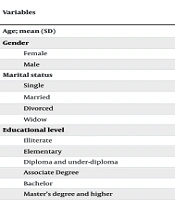
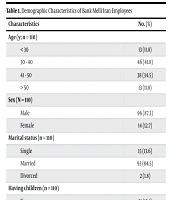
As shown in Table 1, the study included 110 participants, predominantly male (87.3%), over 30 years old (88.2%), married (84.5%), and with children (80.9%). Most participants held a bachelor’s degree (79.1%) and had more than five years of work experience (80%).
Table 1.
Demographic Characteristics of Bank Melli Iran Employees
| Characteristics | No. (%) |
|---|---|
| Age (y; n = 110) | |
| < 30 | 13 (11.8) |
| 30 - 40 | 46 (41.8) |
| 41 - 50 | 38 (34.5) |
| > 50 | 13 (11.8) |
| Sex (n = 110) | |
| Male | 96 (87.3) |
| Female | 14 (12.7) |
| Marital status (n = 110) | |
| Single | 15 (13.6) |
| Married | 93 (84.5) |
| Divorced | 2 (1.8) |
| Having children (n = 110) | |
| None | 21 (19.1) |
| 1 - 3 | 75 (68.18) |
| > 3 | 14 (12.7) |
| Work experience (y; n = 110) | |
| < 5 | 23 (20.9) |
| 5 - 10 | 20 (18.2) |
| 11 - 15 | 24 (21.8) |
| 16 - 20 | 20 (18.2) |
| > 20 | 23 (20.9) |
| Education level (n = 110) | |
| Bachelor | 87 (79.1) |
| Master | 23 (20.9) |
4.2. Psychological Distress Scores
According to Table 2, the mean scores for stress, anxiety, and depression were 18.25 ± 5.92, 15.65 ± 4.87, and 16.61 ± 5.68, respectively, indicating elevated levels of psychological distress among the participants.
Table 2.
Mean Scores and Standard Deviations of Stress, Anxiety, and Depression
| Variables | No. | Range | Mean ± SD |
|---|---|---|---|
| Stress | 110 | 7.00 - 28.00 | 18.2545 ± 5.91598 |
| Anxiety | 110 | 7.00 - 25.00 | 15.6455 ± 4.86814 |
| Depression | 110 | 7.00 - 28.00 | 16.6091 ± 5.67644 |
| Valid No. (listwise) | 110 | - | - |
4.3. Severity of Stress and Anxiety
According to the results in Table 3:
- Stress: 90 (81.8%) participants experienced severe or very severe stress.
- Anxiety: 108 (98.1%) participants experienced severe or very severe anxiety.
Table 3.
Levels of Stress, Anxiety, and Depression Among Bank Melli Iran Employees a
| Variables | Normal | Mild | Moderate | Severe | Extremely Severe | Total |
|---|---|---|---|---|---|---|
| Stress | 7 (6.3) | 3 (2.7) | 10 (9) | 23 (20.9) | 67 (60.9) | 110 |
| Anxiety | 0 (0) | 0 (0) | 2 (1.8) | 13 (11.8) | 95 (86.3) | 110 |
| Depression | 0 (0) | 0 (0) | 16 (14.5) | 18 (16.3) | 76 (69) | 110 |
a Values are expressed as No. (%).
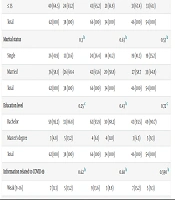
Statistical analyses (t-tests and ANOVA) showed no significant relationship between stress or anxiety and demographic factors (all P-values > 0.05), indicating widespread psychological impact across all groups. The findings of this study also determined the level of depression, which was not part of the research objectives, so it was omitted from the main analysis.
5. Discussion
The COVID-19 pandemic has had a profound psychological impact on employees across various sectors, including banking (13). The present study, which aimed to investigate stress and anxiety levels among employees of Bank Melli branches in Abadan and Khorramshahr during the COVID-19 pandemic, revealed that the majority of participants experienced severe or very severe levels of stress and anxiety. No significant relationship was found between stress or anxiety and demographic factors.
A study on Iranian bank employees reported findings consistent with our research, demonstrating similarly elevated levels of anxiety and stress among bank workers during the COVID-19 pandemic (10). In a study conducted on bank employees in Bangladesh, similar results were observed, with 9 out of 10 employees reporting severe psychological stress during the COVID-19 pandemic (13). Nasirzadeh et al.’s study, conducted on 453 households in Anar city, Rafsanjan, found that 57.7% of participants experienced stress, 51.4% experienced anxiety, and 57.3% experienced depression, highlighting the high prevalence of mental health disorders (14), consistent with the present study. Similarly, Sarboozi-Hoseinabadi et al. assessed depression, anxiety, and stress levels among nurses’ families in Torbat Heydarieh hospitals and reported significant levels of all three conditions (15), again consistent with our results.
However, the level of anxiety reported in this study is higher than that reported among some healthcare workers in Iran who benefited from effective problem-focused coping strategies during the COVID-19 pandemic (16). This discrepancy may be explained by differences in occupational exposure, specialized knowledge, and access to targeted coping mechanisms between bank employees and healthcare workers. Additionally, the lack of specific crisis management training for bank employees, unlike the training often provided to healthcare workers, may have exacerbated mental health disorders during the pandemic, as such training is known to build psychological resilience in high-stress situations (17).
The majority of participants in this study experienced severe or very severe anxiety and stress during the COVID-19 pandemic, which could negatively impact organizational functioning. Given the critical role of bank employees in maintaining banking operations during crises, their required physical presence at work increases their risk of nervous tension, mental pressure, and compromised mental health. Moreover, compared to groups such as healthcare workers, bank employees likely have less knowledge about appropriate health behaviors during critical situations.
Therefore, the following recommendations are proposed: (1) Implement organizational mental health support programs; (2) develop flexible work arrangements, including remote work options; (3) provide regular training on stress and anxiety management; (4) optimize workforce levels to mitigate excessive workloads during peak periods or crises.
5.1. Conclusions
This study highlights the significant psychological toll of the COVID-19 pandemic on Bank Melli Iran employees, with the majority experiencing severe levels of stress and anxiety. These findings contribute to the growing body of literature on the mental health impacts of the pandemic, particularly among non-medical essential workers. The study underscores the need for health authorities and organizations to prioritize the mental well-being of bank employees, especially during crises that require their continuous presence in the workplace. By addressing these challenges, organizations can not only improve the mental health of their employees but also enhance overall productivity and resilience in the face of future crises. The findings have practical implications for policymakers and organizational leaders, suggesting that mental health support should be extended to all essential workers, not just those in the healthcare sector. Future research should explore the long-term effects of the pandemic on mental health and evaluate the effectiveness of interventions aimed at reducing stress and anxiety in the workplace.
5.2. Limitations
This study has two main limitations that should be considered when interpreting the results. First, the cross-sectional design prevents us from establishing causal relationships between the pandemic and the observed stress and anxiety levels. Second, the study was conducted in only two cities and focused on one bank, which may limit the generalizability of the findings to all bank employees in Iran or other countries.