
1. Background
Chronic diseases are among the largest crises for health systems in both developed and developing countries (1). According to World Health Organization (WHO) reports, chronic diseases account for 60% of all deaths worldwide (2, 3). Better patient knowledge impacts the management and prevention of chronic diseases and improves individuals' quality of life (4-6). Studies at Temple University demonstrated that cancer patients using credible websites for information are more inclined toward different treatments (7). Additionally, patients' access to basic information about their diseases helps strengthen their trust in doctors and positively affects the treatment process (8).
In the healthcare context, it is safer to use high-quality resources than to rely on public search engines (8, 9). The average public user lacks the necessary skills to evaluate health information retrieved from the Internet, making this activity challenging (10-12). Therefore, various methods and tools have been developed by international organizations to support users and minimize the risks of applying false information. The use of tools to check the quality of medical information on the web is not limited to a particular country or language (11, 13).
Although there has been some research into evaluating the quality of websites according to country of origin and types of websites (6, 13-16), the findings are contradictory and inconclusive. Research in this area is still in its infancy, and no work has yet investigated website quality in the field of chronic disease care. Today, Persian websites are widely utilized, although less attention is paid to their quality (16-19).
In the present study, Persian websites for chronic diseases were evaluated using the HONcode, Discern, and Silberg tools. Furthermore, the relationship between the results of these tools was examined by determining the correlation between the scores related to the evaluation of Persian websites.
2. Objectives
The results of the study reflect the current situation of Persian information dissemination related to chronic diseases on the Internet and can serve as a guide to direct users to reliable sources of information. Finally, health policymakers can use these results to expand equitable access for all individuals to health information resources through the World Wide Web.
3. Methods
In this quantitative study, samples were selected using a free text search and purposive sampling. Ten keywords, including hypertension, asthma, stomach cancer, lung cancer, myocardial infarction, emphysema, stroke, chronic bronchitis, and leukemia, were searched on Google, retrieving 100 homepages for each search (1,000 sites in total). The search was conducted between July 18 and August 28, 2022. After viewing each site's homepage, its internal links were identified using www.MOZ.com. The formula Au = T/N was applied to identify and introduce main websites, where Au refers to the index identifying the main website, T illustrates the total links to research websites, and N indicates the number of websites.
Following core ratio calculation, websites with numerical coefficients greater than the core ratios were selected as samples. In the second step, each core website was evaluated based on the HONcode, Discern, and Silberg tools. Additionally, the assessment checklist was completed through direct referral by the researcher to the sites, and feedback from five physicians active in the field of chronic disease was applied to ensure the accuracy of the data collected. The researchers have expertise in library and medical information and have previously published articles on the topic of evaluating online health information resources. Only physicians who met the following criteria were invited to participate in this study: (1) Iranian physicians with at least one year of experience in the medical profession, and (2) active Iranian physicians who use the internet and social media to share health information with colleagues or patients.
Next, correlations between chronic disease assessment website scores were determined using the HONcode, Discern, and Silberg tools with SPSS statistical software version 21. In the study, the titles of the websites and the names of the owners were not directly mentioned, and their identities were not revealed to protect their personal information.
4. Results
As shown in Table 1, the in-links of two websites are above one million, accounting for about half of the total in-links. The core ratio of the selected websites was calculated to be 134,130. Comparing the in-links of each website with the core ratio revealed that only 14 websites met the inclusion criteria of the study.
Table 1.
In-link Frequency from Persian Websites that Provide Information About Chronic Diseases
| In-link Frequency | 1 - 132000 | 132001 - 264000 | 264001 - 528000 | 528001 - 660000 | 660001 - 792000 | 792011 - 924051 | More Than 1000000 | Total |
|---|---|---|---|---|---|---|---|---|
| Websites frequency | 79 | 3 | 8 | 0 | 1 | 1 | 2 | 94 |
| Total link | 1060113 | 611513 | 3218988 | 0 | 666641 | 924051 | 6127161 | 12608287 |
| Core website ratio | 134130 |
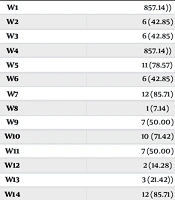
As shown in Table 2, regarding the evaluation using HONcode criteria, the w7 and w14 websites acquired the highest credibility (85.71% of the total score), while the w8 website achieved the least credibility (7.14%). The results related to Discern criteria demonstrated that the maximum and minimum credibility were attained by w14 (80% of the total score) and w12 and w13 (6.66%), respectively. These websites were also determined to be the most and least credible based on the Silberg criteria. Considering the sum of the scores obtained using the HONcode, Discern, and Silberg tools, the maximum and minimum credibility were determined to be w14 and w12, with 81.51% and 10.52% of the total scores, respectively.
Table 2.
Persian Websites Assessment Scores Based on the Honcode, Discern and Silberg Criteria
| Website Code | Score | |||
|---|---|---|---|---|
| Honcode 14% | Dsicern 15% | Silberg 9% | Total 38% | |
| W1 | 857.14)) | 9 (60.00) | 5 (55.55) | 32 (84.21) |
| W2 | 6 (42.85) | 6 (40.00) | 2 (22.22) | 14 (36.84) |
| W3 | 6 (42.85) | 10 (66.66) | 2 (22.22) | 18 (47.36) |
| W4 | 857.14)) | 5 (33.33) | 5 (55.55) | 18 (47.36) |
| W5 | 11 (78.57) | 8 (53.33) | 4 (44.44) | 23 (60.52) |
| W6 | 6 (42.85) | 6 (40.00) | 2 (22.22) | 14 (36.84) |
| W7 | 12 (85.71) | 2 (13.33) | 5 (55.55) | 19 (50.00) |
| W8 | 1 (7.14) | 2 (13.33) | 2 (22.22) | 5 (13.15) |
| W9 | 7 (50.00) | 6 (40.00) | 5 (55.55) | 18 (47.36) |
| W10 | 10 (71.42) | 9 (60) | 5 (55.55) | 24 (63.15) |
| W11 | 7 (50.00) | 7 (46.66) | 4 (44.44) | 18 (47.36) |
| W12 | 2 (14.28) | 1 (6.66) | 1 (11.11) | 4 (10.52) |
| W13 | 3 (21.42)) | 1 (6.66) | 1 (11.11) | 5 (13.15) |
| W14 | 12 (85.71) | 12 (80.00) | 7 (77.77) | 31 (81.57) |
As summarized in Table 3, the Pearson's correlation coefficient between HONcode and Discern criteria is -0.009. given that -1 < r < 1, a partial inverse linear correlation was observed between these criteria for examining Persian websites for chronic diseases. The level of significance for the correlation coefficient between HONcode and Discern criteria was 0.564 (P-value). Therefore, the first hypothesis of the study was rejected, indicating no positive correlation between the criteria.
Table 3.
Correlation Between Honcode, Discern and Silberg Criteria for Persian Core Websites Assessment
| Pearson Correlation | Correlation Coefficient (r) | P-Value |
|---|---|---|
| Honcode | ||
| Discern | -0.009 | 0.977 |
| Silberg | 0.169 | 0.564 |
| Discern and Silberg | 0.597 | 0.024 |
Additionally, the Pearson's correlation coefficient between HONcode and Silberg criteria, as well as between Discern and Silberg criteria, was determined to be 0.169 and 0.597, respectively. Since 0 < r < +1, a partial direct linear correlation was observed between HONcode and Silberg criteria, as well as between Discern and Silberg criteria. The level of significance for the correlation coefficient between HONcode and Silberg was 0.977, and for Discern and Silberg, it was 0.24. Therefore, no significant positive correlation was observed between HONcode and Silberg criteria, while a positive correlation was found between Discern and Silberg criteria.
5. Discussion
The results of the study indicated that HONcode criteria were present in only 10.49% of Persian websites for chronic diseases. Previous research has shown that HONcode indices are less emphasized in Persian health websites (16, 20). For example, none of the Persian language websites on Ebola meet all eight HONcode criteria (16). Additionally, the present study highlighted the difficulty of assessing the true quality of Persian websites for chronic diseases using these criteria. Regarding non-Persian websites, some researchers found that many Internet-based resources do not achieve an acceptable score based on these criteria. For instance, only 35% of Yahoo directory pages meet some of the information evaluation criteria in the HONcode tool (21).
Furthermore, the evaluated websites achieved an average of 39.59% of the Discern criteria. Previous research demonstrated the inappropriateness of using Discern criteria to evaluate the quality of Persian websites. Zahedi et al. found a mean score of 89.41% for Persian addiction websites (19). Some researchers emphasized that ad insertion policies should be clear and distinct from the main content to prevent confusion among ordinary users (16, 22, 23). Additionally, the use of HONcode, Discern, and Silberg tools for examining the quality of information on Persian chronic disease websites was challenging and did not yield convergent results. Previous studies have reported the difficulty of evaluating the quality of health website pages and the lack of efficiency in detecting incorrect information using current health website evaluation tools (12, 24, 25). Despite the high number of health information quality evaluation tools, only a few can be effectively utilized by the public (26, 27).
Based on the results of the present study, the HONcode, Discern, and Silberg tools are not suitable criteria for judging the quality of information on Persian websites for chronic diseases. Some researchers have mentioned that tools for evaluating Internet health information quality are moving towards different and unknown goals, despite developing in the same direction (28). Additionally, the results of the present study showed no significant positive correlation between the HONcode and Discern criteria for examining the intended websites, while the Discern criteria were positively and significantly correlated with the Silberg criteria. Furthermore, a positive correlation was observed between HONcode and Silberg criteria, although it was insignificant. However, some researchers have noted the lack of a significant positive correlation between information quality criteria and appearance indices on Persian web pages related to public health (17, 18, 20). According to Robbins, trust in health websites is not significantly related to their appearance indices (29).
5.1. Conclusions
The results of the present study show that the HONcode, Discern, and Silberg tools are inappropriate for evaluating Persian websites for chronic diseases. Additionally, no significant positive correlation was found between the HONcode and Discern criteria for evaluating the intended websites, while the Discern criteria were significantly and positively related to the Silberg criteria. However, a positive and insignificant correlation was observed between the HONcode and Silberg criteria. It is worth noting that the use of the HONcode, Silberg, and Discern tools for evaluating public health information quality requires necessary expertise, which ordinary users may not possess. Therefore, measures should be taken to train and empower users to enhance their health literacy levels.
5.2. Limitations and Suggestions for Future Studies
This study has several limitations.
(1) The study used the first 100 web pages resulting from a single search term in Google. This method has limitations as the sample of 14 websites was not based on a sample size calculation, but conducting such a calculation would have been extremely time-consuming and beyond the scope of this study.
(2) The Internet constantly changes, so each time a search term is entered into a search engine, the results may vary slightly. However, this method makes our study more generalizable because patients are likely to perform only a single search and are unlikely to use the same search term multiple times to find different websites.
(3) The results of the Google search in this study only produced Persian-language websites, and this study only analyzed websites in Persian (non-Persian-language websites were excluded).
(4) Using ten selected keywords as the search terms, rather than multiple search terms that patients might use, was another limitation.
(5) Using websites from a single search engine could potentially impact the results since other websites of different quality may have been missed. However, this is unlikely as a relatively large sample was used, containing websites that may have appeared in other search engines.
(6) Due to the subjective nature of some criteria in the existing tools, examiner bias could have impacted the results.
Based on the findings of this study, further research should be conducted on evaluating Persian health websites and applying different evaluation checklists, as well as understanding the criteria and indices of health content quality. Users should first be empowered and trained to increase their health literacy levels, and then health organizations can introduce credible resources to the public. The following suggestions are proposed for future research:
(1) Evaluate how Persian language users (and users of other languages) judge health information quality.
(2) Develop codes of conduct to help the authors, owners, and users of health websites.
(3) Define native quality labels for different languages to mark credible websites.