
1. Background
Abortion refers to the spontaneous or intentional termination of pregnancy before the fetus reaches sufficient development to sustain life. Conventionally, abortion is defined as the termination of pregnancy before the 20th week of pregnancy or a birth weight of less than 500 g (1, 2). Spontaneous abortion is the most common complication during pregnancy, with a prevalence of 15 - 20% (1). Additionally, studies using sensitive human chorionic gonadotropin (HCG) measurement methods indicate that the actual rate of pregnancy loss after implantation is 31%. Among clinically identified pregnancies, 15% end in abortion before the 20th week of pregnancy (measured from the last menstrual cycle) (2).
Studies have shown that abortion can result in depression, anxiety, severe post-abortion distress, suicide attempts, drug use, obsessive-compulsive disorder, and marital discord (3-6). This depression exhibits symptoms similar to those of typical depression, including a sad mood, worry, discomfort, impatience, loss of appetite, lack of desire for life, and sleep disturbances. It can also manifest more severe symptoms, necessitating serious and preventive measures (1, 7). Depression is characterized by a persistently depressed mood for at least two weeks, including feelings of emptiness, worthlessness, lack of mastery over the environment, and emotional stimulation. It is often accompanied by sadness, indifference, lack of interest and motivation, motor slowness or agitation, fatigue, impaired concentration and decision-making, feelings of shame or guilt, and death-related thoughts (8).
Recent evidence indicates that more than half of women experience various mental and emotional complications in the weeks and months following abortion (2). While post-abortion grief usually decreases within 3 - 4 months, it can persist for up to a year (1, 9). In some cases, it can lead to clinical depression requiring treatment (10). Symptoms of anxiety and depression following abortion may continue until the next pregnancy. Given that many women become pregnant again within 18 months after abortion, the psychological impact of spontaneous abortion on subsequent pregnancies is significant. Pregnant women with a history of spontaneous abortion within the previous year are more prone to psychological symptoms and pregnancy-related distress, including anxiety, depression, physical disorders, obsession, interpersonal sensitivity, psychoticism, suspicion, and hostility (11, 12). Therefore, the depression, anxiety, and stress caused by abortion can have severe consequences for the health and condition of subsequent pregnancies.
Research has also found an association between antiphospholipid antibodies and headaches or migraines. Some studies have detected antiphospholipid antibodies in the blood and spinal fluid of patients with mental disorders (13).
Given the high prevalence of abortion among women of reproductive age and the critical role of antiphospholipid syndrome (APS) in these abortions, as well as the existence of conflicting findings regarding psychological problems following abortion, including depression, further investigation is essential. Antiphospholipid syndrome is an acquired autoimmune disease that can lead to frequent blood clotting in the body’s vessels and pregnancy complications such as miscarriage, premature birth, and stillbirth. Notably, a pregnant individual may not have a history of thrombosis but may still experience pregnancy complications related to APS. Psychological pathologies diagnosed during pregnancy are key risk factors influencing adverse pregnancy outcomes (14, 15).
Given that high levels of depression and guilt may persist in up to half of women following physical recovery, healthcare providers should recommend follow-up care for all post-abortion women (16). However, few studies have been conducted in this area. The contradictions in previous studies, the high prevalence of depression among pregnant women, and the lack of research on the prevalence of depression due to APS highlight the need for further investigation.
2. Objectives
This study was conducted to examine the relationship between the prevalence of depression caused by APS abortion and related factors in pregnant women.
3. Methods
This research is a descriptive-analytical epidemiological study. The target population included all patients with abortions due to APS who referred to medical centers in Ahvaz city during the academic year from October 2022 to February 2023. Their individual characteristics and disease profiles were investigated and recorded. Additionally, 7 cc of clotted blood was collected from each patient for the antiphospholipid antibody test.
A control group consisting of 40 women with a history of at least two successful deliveries, no history of fetal death, or repeated abortions, and similar characteristics to the examined samples, was also included in the study. Based on the findings, patients with a GPL value of less than 10 were considered healthy in terms of antibody status. Using this criterion, the ratio of antiphospholipid antibodies in the samples was determined, and the actual prevalence in the community was estimated with 95% confidence.
Since this study included all patients with abortions due to APS referred to medical centers in Ahvaz city, there was no need to determine the sample size. The purpose of data collection was to administer a demographic-obstetrical questionnaire followed by a depression questionnaire.
3.1. Demographic-Midwifery Questionnaire
This questionnaire included questions such as age, level of education, gestational age, and a history of depression in the individual or family members (1).
The Beck Questionnaire contains 21 items that measure the physical and cognitive symptoms of depression. Each question has 4 options, scored on a scale of 0 - 3, where each item represents different degrees of depression ranging from mild to severe. The total score ranges between 0 and 63. The reason for using this questionnaire was that research conducted in Iran confirmed the validity and reliability of the Beck Questionnaire (17, 18). The scoring method for the Beck test involves summing the scores for each option selected by the examinee. The results are interpreted as follows: A score of 10 or less indicates a normal state, a score of 11 - 16 reflects mild depression symptoms, a score of 17 - 20 indicates the need to consult a psychologist or psychiatrist, a score of 21 - 30 represents relative depression, a score of 31 - 40 indicates severe depression symptoms, and a score above 40 reflects excessive depression symptoms.
The collected data were analyzed after extraction and coding using SPSS software. A significance level of 0.05 was considered. For descriptive analysis of quantitative variables, the mean and standard deviation were used, while for qualitative variables, percentage tables and graphs were utilized. Kolmogorov-Smirnov and Shapiro-Wilk tests were applied to ensure the normality of the data distribution. Additionally, to examine the relationship between variables and depression, the logistic regression model was used, with a significance level set at less than 0.05.
4. Results
According to Table 1, there is a significant relationship between the mother's education level and the history of depression in both the sick and healthy groups (P < 0.05).
Table 1.
Qualitative Demographic Characteristics of Patients a
| Variables and Groups | Sick | Healthy | P-Value |
|---|---|---|---|
| Mother's education | 0.021 | ||
| University | 36 (51.4) | 20 (50) | |
| Non-academic | 34 (48.6) | 20 (50) | |
| Father's education | 0.143 | ||
| University | 35 (50) | 15 (37.5) | |
| Non-academic | 35 (50) | 25 (62.5) | |
| Mother's job | 0.324 | ||
| Employed | 29 (41.4) | 14 (35) | |
| Housekeeper | 41 (58.6) | 26 (65) | |
| Father's job | 0.421 | ||
| Employed | 57 (81.4) | 34 (85) | |
| Unemployed | 13 (18.6) | 6 (15) | |
| Family income | 0.602 | ||
| Sufficiency | 14 (20) | 5 (12.5) | |
| Low | 50 (71.4) | 31 (77.5) | |
| Savings | 6 (8.6) | 4 (10) | |
| History of depression | 0.000 | ||
| Yes | 55 (78.6) | 17 (42.5) | |
| No | 15 (21.4) | 23 (57.5) |
a Values are expressed as No. (%).
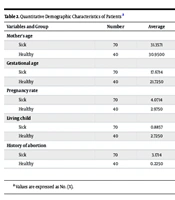
According to Table 2, there is a significant relationship between gestational age, pregnancy grade, number of living children, and history of abortion in the sick and healthy groups (P < 0.05).
Table 2.
Quantitative Demographic Characteristics of Patients
| Variables and Group | Number | Average | Standard Deviation | Error | P-Value |
|---|---|---|---|---|---|
| Mother's age | 0.757 | ||||
| Sick | 70 | 31.3571 | 6.48082 | 0.77461 | |
| Healthy | 40 | 30.9500 | 6.89835 | 1.09072 | |
| Gestational age | 0.023 | ||||
| Sick | 70 | 17.6714 | 8.81817 | 1.05397 | |
| Healthy | 40 | 21.7250 | 8.96142 | 1.41692 | |
| Pregnancy rate | 0.015 | ||||
| Sick | 70 | 4.0714 | 2.66660 | 0.31872 | |
| Healthy | 40 | 2.9750 | 1.14326 | 0.18077 | |
| Living child | < 0.001 | ||||
| Sick | 70 | 0.8857 | 0.90958 | 0.10872 | |
| Healthy | 40 | 2.7250 | 0.98677 | 0.15602 | |
| History of abortion | < 0.001 | ||||
| Sick | 70 | 3.1714 | 2.17343 | 0.25977 | |
| Healthy | 40 | 0.2250 | 0.47972 | 0.07585 |
The linear regression test indicated a significant relationship between maternal age and depression caused by abortion. Additionally, the linear regression test demonstrated a significant relationship between an increase in the mother's education, the husband's education, the husband's occupation, the mother's employment, the number of living children, the history of abortion, family welfare, and a decrease in depression caused by abortion (P < 0.05).
5. Discussion
The results of this study showed a significant relationship between increasing maternal age, pregnancy rate, gestational age, history of depression, and increased depression caused by abortion (P < 0.05). In 2016, Tayyaba et al. investigated the relationship between spiritual intelligence and depression following spontaneous abortion. In the second step of their study, after 7 days, the Edinburgh Depression Questionnaire was completed via a phone call. Their findings indicated that 54% of the women studied exhibited symptoms of depression. Logistic regression analysis, after adjusting for confounding factors, revealed that among demographic characteristics, the mother’s education level and gestational age at the time of abortion, as well as the production of personal meaning within the components of spiritual intelligence, had a significant relationship with post-abortion depression (1).
Kulathilaka et al., in their 2016 study, examined depression and grief following spontaneous abortion, reporting that the rate of depression during 6 - 10 weeks post-abortion was 18.6% (19). In this study, the rate of abortion had a significant relationship with depression. Considering the positive role of midwives in providing emotional care and advice after abortion, which falls within the midwifery field, it is suggested that new counseling-based midwifery care methods be implemented in birthing centers. Furthermore, the children of women experiencing emotional disorders can potentially develop emotional and cognitive problems in the long term (20). However, these possible outcomes are not well addressed in the routine care provided to women experiencing miscarriage.
A study by Lee et al. in 1997 in China examined mental disability after abortion or pregnancy loss. They reported that the rate of depression after abortion among women was approximately 12% (20). Similarly, Janssen et al., in their 1997 study of 227 women who had experienced fetal loss, found that gestational age was strongly associated with postpartum grief, with later-term abortions correlating with more severe depression (21).
Conversely, Neugebauer, in their 1997 study, found no relationship between gestational age and the level of depression after pregnancy loss. They investigated the prevalence of major depressive disorder within six months following abortion or fetal loss (22).
Modabernia et al., in their 2007 Iranian study on the prevalence of depression in the last trimester of pregnancy, reported a statistically significant relationship between depression and education level, employment, and gravidity. However, no significant relationship was observed between depression and age or socio-economic status (23). This finding differs from the present study, where a significant relationship was found between maternal age and depression.
In 2013, Zamani et al. studied depression levels and quality of life among infertile women, fertile women, and those with recurrent miscarriages. Their findings showed that women with recurrent miscarriages had a significantly higher depression score (36.70 ± 14.28) compared to infertile women (24.07 ± 6.16) and fertile women (15.90 ± 11.13). They also found that the quality of life was higher among fertile women (34.67 ± 7.02) than women with recurrent miscarriages (23.03 ± 7.53) and infertile women (21.23 ± 7.05). The differences among the three groups were significant for both indicators. These researchers concluded that women with recurrent miscarriages and infertility have higher depression scores and lower quality of life compared to fertile women (24). In this study, the results also showed a significant relationship between repeated abortions and depression.
Furthermore, recent reports indicate that only 30% of women receive follow-up care after an abortion (25). Thus, it is recommended that midwives, who are in direct contact with women in the community and are responsible for counseling and promoting women's mental health, take necessary measures to prevent abortion-related mental health issues.
One limitation of the present study was the non-cooperation of some patients referred to the hospital at Ahvaz University of Medical Sciences, leading to the exclusion of several participants. Additionally, the lack of an established system to accurately provide information to researchers introduced the possibility of errors in the reports submitted to the research team.
5.1. Conclusions
Considering the significant differences in depression levels between the two groups, it is recommended to implement new counseling-based midwifery care methods in birthing centers. Strengthening follow-up and referral systems could help identify individuals suspected of mood disorders after abortion, allowing them to be referred to specialized centers. The findings of this study should serve as a guide for midwives and healthcare workers to focus more on the mental health challenges faced by women following an abortion.