
1. Background
Substance abuse is a major global issue with serious medical, economic, and social implications. This problem is particularly acute in developing countries, where it contributes to high rates of premature deaths. In 2017, the United Nations Office on Drugs and Crime reported that around 271 million people, or 5.5% of the world’s population, were drug users (1-3). Opioids, the third most commonly used drugs after cannabis and amphetamines, have an estimated 12 to 21 million users worldwide. Southwest Asia, especially Iran, exhibits the highest rates of opioid use due to its central location on the opium trade route. In Iran, over 1.2 million individuals required treatment for addiction, with opium and crystal heroin being the primary substances of abuse (4, 5).
The opium poppy, the source of opioids, has been used for medicinal purposes since ancient times, with records dating back to around 3000 BCE in Sumerian culture (6). Opium's historical significance is evident in its continued widespread use, both legally and illegally. Studies have estimated that between 13 to 22 million people worldwide used opium or its derivatives as illegal drugs, with significant usage across Asia, Europe, the Americas, and other regions (7, 8).
Methadone, a synthetic opioid, has been used since 1965 to treat heroin addiction, particularly in Italy. When administered correctly, methadone maintenance therapy can reduce mortality, curb heroin use, prevent relapse, and aid in social reintegration. It also helps in reducing the risk of HIV and hepatitis infections (9-11). Methadone, which can be taken orally or through other routes, is effective for treating severe pain and is often preferred over morphine for its efficacy at lower doses (12, 13).
Despite its benefits, methadone use can lead to several side effects, including dizziness, fatigue, gastrointestinal problems, and respiratory issues (14, 15). Iran's substance abuse research landscape has undergone substantial transformation, paralleling socioeconomic transitions and urbanization trends. While retrospective investigations have suggested correlations between opium consumption and diverse health complications, there is a notable absence of comprehensive prospective studies regarding mortality implications (16).
2. Objectives
This research aimed to provide a comprehensive assessment of substance abuse patterns in Rasht County. It generated empirical data on methadone and opium syrup usage and developed evidence-based insights for targeted intervention strategies.
3. Methods
In this cross-sectional analytical study, the study population consisted of patient records from individuals who had abused methadone or opium syrup and were under treatment for substance abuse in Rasht County from 2018 to 2022. Data collection was done through a census, selecting patient records that met the inclusion criteria. Ultimately, 149 records were included in the study as a full census of eligible cases. Information was extracted from patient records using a researcher-developed checklist. Inclusion criteria included patients diagnosed with methadone or opium syrup abuse and individuals aged 18 years and older. Exclusion criteria included incomplete or partially completed patient records. Additionally, patients with concurrent psychiatric disorders and those who were simultaneously using multiple substances other than methadone or opium syrup were excluded from the study.
The checklist included demographic characteristics such as age, gender, marital status, occupation, place of residence, and education level. After data collection, this study analyzed and examined the substance abuse patterns among the patients. Quantitative variables were expressed as means and medians, while qualitative variables were presented as frequencies (percentages). The Kolmogorov-Smirnov test was used to assess the normality of the variables. The chi-square test was employed for data analysis at a significance level of 0.05. Data were analyzed using SPSS software version 26.
4. Results
Table 1 presents the demographic characteristics of the study population. The majority of the participants were male (95.3%). The mean age of the participants was 40.2 ± 11.72 years, ranging from 21 to 80 years. A considerable proportion of the individuals were aged between 31 - 40 years (29.5%), followed by those aged 41 - 50 years (26.2%). Participants predominantly resided in rural areas (51.7%). The majority were married (89.3%). Employment was relatively high among the participants, with 73.2% being employed. Educational levels varied, with the highest percentage having a high school education (43.6%).
Table 1.
Background Characteristics of the Individuals Treated for Substance Abuse a
| Variables | Values |
|---|---|
| Gender | |
| Male | 142 (95.3) |
| Female | 7 (4.7) |
| Age (y) | |
| Under 30 | 37 (24.8) |
| 31 - 40 | 44 (29.5) |
| 41 - 50 | 39 (26.2) |
| Over 50 | 29 (19.5) |
| Residence | |
| Urban | 72 (48.3) |
| Rural | 77 (51.7) |
| Marital status | |
| Married | 133 (89.3) |
| Single | 12 (8.1) |
| Divorced | 2 (1.3) |
| Widowed | 2 (1.3) |
| Employment status | |
| Unemployed | 40 (26.8) |
| Employed | 109 (73.2) |
| Education | |
| Illiterate | 9 (6.0) |
| Primary school | 24 (16.1) |
| Middle school | 30 (20.1) |
| High school | 65 (43.6) |
| Diploma and above | 21 (14.1) |
a Values are expressed as No. (%).
Table 2 explores the relationship between the type of substance used (methadone vs. opium syrup) and various demographic characteristics. The data revealed no significant association between gender and the type of substance used. However, age showed a significant relationship with substance type (P = 0.037), with younger individuals under 30 years primarily using methadone (94.6%, n = 35). The mean age of those using opium syrup was significantly higher (47.13 ± 10.59 years) compared to those using methadone (39 ± 11.52 years, P = 0.002). The analysis indicated no significant differences in substance use based on residence, marital status, or employment status. Educational level also did not significantly influence the type of substance used, although a slightly higher percentage of individuals with a diploma or higher education used opium syrup compared to those with lower educational attainment.
Table 2.
Relationship Between Substance Type and Demographic Characteristics a
| Variables | Substance Type | P-Value b | |
|---|---|---|---|
| Methadone | Opium Syrup | ||
| Gender | 0.259 | ||
| Male | 120 (84.5) | 22 (15.5) | |
| Female | 7 (100) | 0 (0) | |
| Age (y) | 0.002 | ||
| Under 30 | 35 (94.6) | 2 (5.4) | |
| 31 - 40 | 31 (79.5) | 8 (20.5) | |
| 41 - 50 | 21 (72.4) | 8 (27.6) | |
| Residence | 0.527 | ||
| Urban | 60 (83.3) | 12 (16.7) | |
| Rural | 67 (87) | 10 (13) | |
| Marital status | 0.376 | ||
| Married | 111 (83.5) | 22 (16.5) | |
| Single | 12 (100) | 0 (0) | |
| Divorced | 2 (100) | 0 (0) | |
| Widowed | 2 (100) | 0 (0) | |
| Employment status | 0.107 | ||
| Unemployed | 31 (77.5) | 9 (22.5) | |
| Employed | 96 (88.1) | 13 (11.9) | |
| Education status | 0.362 | ||
| Illiterate | 7 (77.8) | 2 (22.2) | |
| Primary school | 19 (79.2) | 5 (20.8) | |
| Middle school | 28 (93.3) | 2 (6.7) | |
| High school | 57 (87) | 10 (13) | |
| Diploma and above | 16 (76.2) | 5 (23.8) | |
a Values are expressed as No. (%).
b Chi-square test.
The frequency of methadone and opium syrup use among the study population is illustrated in Figure 1. The data demonstrate a noticeable preference for methadone over opium syrup during the study period, reflecting its widespread use in the treatment of substance abuse in the region. These findings provide valuable insights into the demographic factors associated with substance use in Rasht city, highlighting the need for targeted interventions based on age and education level to improve treatment outcomes.
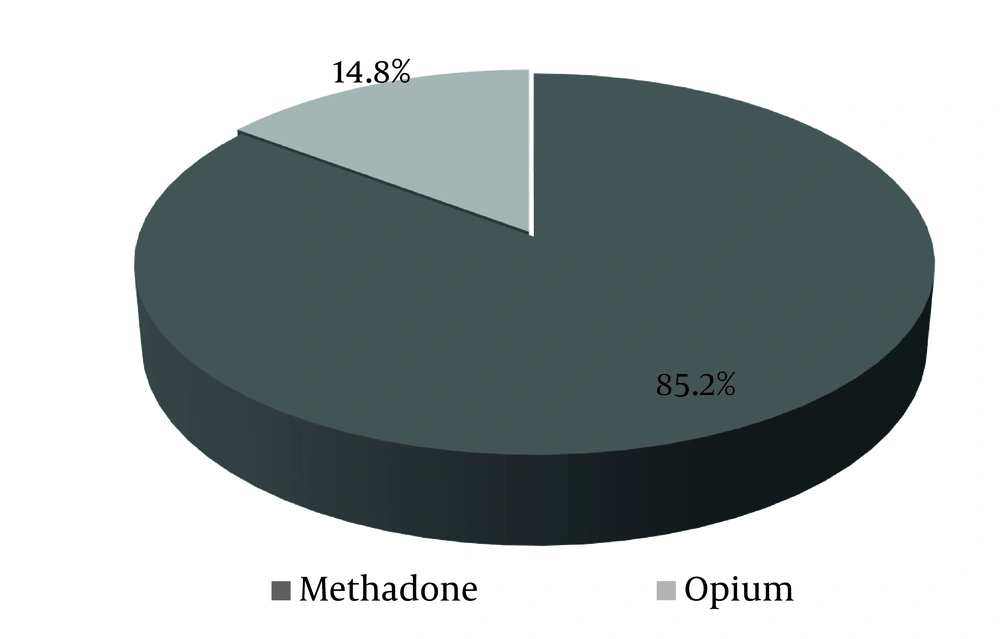
Figure 1.
The frequency of drug use (methadone - opium syrup) by people referring to drug use
5. Discussion
This study examined 149 patient records from Rasht city between 2018 and 2022, focusing on individuals who had abused methadone or opium syrup. Our finding that 85.2% of participants abused methadone aligns with national data highlighting methadone’s central role in Iran’s opioid substitution therapy programs (17, 18). However, this prevalence is notably higher than the 8.4% daily non-prescribed methadone use reported among people who use drugs in Iran, underscoring the need for stricter monitoring in clinical settings to prevent diversion.
No significant statistical association was found between the type of substance abuse (methadone vs. opium syrup) and the gender of the participants. These results align with previous studies that also reported a high prevalence of male substance abusers, without a significant gender-based association with the type of substance abused (16). However, other studies found no significant gender-based differences in substance abuse, contrasting with the findings of this study (19). Additionally, some studies reported a significant gender association, with a higher prevalence of substance abuse among men compared to women, which could be attributed to various social and economic factors influencing individuals, especially those suffering from addiction (20).
The significant association between age and the type of substance abused indicates that younger individuals tend to abuse methadone more frequently than older individuals. These findings are consistent with those of studies that reported a similar mean age among substance abusers, as well as studies that found most substance abusers were in the 25 - 44 age group (20, 21). The results of the present study also align with research that reported younger individuals were more likely to engage in substance abuse, and women started abusing substances at an earlier age than men (17). In contrast, another study reported a younger mean age of 32 years among their study population, without analyzing the significance of age in relation to methadone abuse (22).
Regarding the place of residence, there was no significant association between residence and the type of substance abused. This contrasts with findings that reported most substance abusers resided in urban areas (88%), highlighting a notable difference from this study, where over half of the participants were rural residents (19). Our research findings regarding the relationship between marital status and substance abuse patterns align with previous studies, which similarly documented a substantial proportion of married substance abusers and found no statistically significant correlation between marital status and methadone consumption (19, 22). However, other research observed a significant association between marital status and substance abuse, with most men being single and most women married, indicating that family dynamics might play a role in substance abuse, especially among women (17).
Like previous studies, there was no significant association between employment status and the type of substance abused (21). No significant association between educational level and the type of substance abused was found, which aligns with studies that also reported that most substance abusers had low educational levels, and no significant association was found between educational level and substance abuse (5, 21). However, other research found a significant association between educational level and substance abuse, with men having higher education levels than women, which contrasts with the present study findings (17).
As reported in previous studies, this study, like others, highlights the high prevalence of methadone abuse compared to opium syrup (23). Still, long-term use of opioids, including methadone, was associated with increased mortality from various causes, such as cardiovascular diseases and cancers (24). These findings provide valuable insights for health planners, emphasizing the importance of monitoring programs that focus on methadone and opium syrup consumption and treatment across all demographic groups. Addressing these issues through targeted interventions could significantly improve treatment outcomes and reduce substance abuse within these communities.
Several limitations should be considered when interpreting these results. First, the cross-sectional design limits the ability to infer causality between demographic factors and substance abuse patterns. Second, the study was conducted exclusively in Rasht, which may restrict the generalizability of the findings to other regions with different socio-economic or healthcare contexts. Third, the reliance on patient records may introduce information bias due to incomplete or inaccurate documentation. Additionally, confounding factors such as psychiatric comorbidities and concurrent use of other substances were excluded, which may affect the observed associations.
5.1. Conclusions
Given the high prevalence of methadone use among patients undergoing treatment for substance abuse, particularly in Rasht city, more persistent and targeted efforts are required to control its consumption. The findings of this study indicate that substance abuse spans all age groups, with the highest usage typically occurring around the age of 40. Additionally, men compared to women are disproportionately more affected, highlighting a significant gender-based risk. This underscores the need for gender-specific interventions and preventive strategies to address the unique challenges faced by men in substance abuse contexts.
Moreover, the lack of significant associations between substance type and factors such as marital status, employment, and educational level suggests that substance abuse is a widespread issue, transcending socio-economic boundaries. However, the significant differences in substance use patterns between rural and urban residents, as well as the age-related trends, indicate that tailored interventions are necessary.