
1. Introduction
An intestinal obstruction is a serious condition characterized by the inability of intestinal contents to pass through the small or large intestine (1). This condition can be classified as either complete or partial obstruction (2). Complete obstruction occurs when no contents can pass past the blockage, which poses a significant risk of complications such as dehydration, kidney failure, and perforation of the intestinal wall (3). A partial obstruction allows some movement of the contents, but can still lead to serious symptoms and complications if not treated promptly (4, 5).
The prevalence of intestinal obstruction is remarkable: Approximately 15% of patients are admitted for acute abdominal pain with this condition (6). It is more common in people who have had previous abdominal surgery or certain types of cancer. Understanding the epidemiology of intestinal obstruction is critical for early diagnosis and intervention (1).
Several factors contribute to intestinal obstruction, including tumors, surgical adhesions, inflammatory bowel disease, and motility disorders (7). Patients with this condition face numerous challenges that can significantly impact their physical, mental, and social health (8). These challenges include:
(1) Physiological problems: An intestinal obstruction can cause severe physiological symptoms such as abdominal pain, nausea, vomiting, and constipation. These symptoms not only cause physical discomfort, but also significantly affect the patient's quality of life. Studies suggest that patients may experience a decline in their overall well-being due to these debilitating symptoms (9).
(2) Psychological complications: Patients with intestinal obstruction may experience anxiety, depression, and hopelessness. The inability to carry out everyday activities and concerns about the serious complications of the disease can increase stress and worsen mental health problems. Research has shown that psychological distress can lead to poorer health outcomes and increased healthcare utilization in patients with chronic illnesses (9).
(3) Social challenges: An intestinal obstruction can affect patients' social relationships. Limitations caused by the disease can lead to isolation and reduced social interactions, further exacerbating mental health problems. Social support is crucial for recovery. Therefore, disruptions in social networks can hinder coping mechanisms (8).
(4) Need for specialized care: Patients with intestinal obstruction require specialized care, which includes continuous monitoring of their physiological status, pain management, and psychological support. Diagnostic methods such as imaging tests (CT scans and X-rays) are essential to determine the location and severity of the obstruction. These needs require that nurses adopt appropriate and evidence-based approaches to provide comprehensive care (10).
Previous studies have demonstrated the effectiveness of the Callista Roy adaptation model in various clinical settings, including its application in the care of burn patients (11). This model has been shown to reduce maladaptive behavior and improve patients' psychological well-being (12). The selection of the Roy adjustment model for the present study is based on its ability to identify the multidimensional needs of patients with intestinal obstruction and provide personalized care. By emphasizing the patient's active involvement in the treatment process and conducting a comprehensive needs assessment, this model can improve patient outcomes and reduce disease-related complications (13, 14).
Recurrent intestinal obstruction secondary to postoperative adhesions imposes prolonged physiological stress, severe and persistent abdominal pain, extended hospitalization, significant psychological distress, alterations in social and family roles, and prolonged dependence on medical devices (15). These multifaceted and long-lasting adaptive challenges involve all four modes of Roy’s adaptation model simultaneously (physiological-physical, self-concept, role function, and interdependence), making recurrent adhesion-related bowel obstruction an ideal clinical condition for comprehensive application and evaluation of this nursing framework (16, 17).
Given the multifaceted nature of recurrent intestinal obstruction secondary to postoperative adhesions, patients experience persistent physiological stress, severe abdominal pain, extended hospitalization, psychological distress, altered social and family roles, and prolonged dependence on medical devices. Previous research has demonstrated that Roy’s adaptation model is effective in addressing complex adaptive challenges across diverse conditions, including burns, chronic illnesses, and cancer care, by reducing maladaptive behaviors and enhancing psychological resilience. These findings provide strong support for applying the model in recurrent bowel obstruction, a condition that simultaneously involves all four adaptive modes (physiological-physical, self-concept, role function, and interdependence). Therefore, this study deliberately selected a recurrent case to evaluate the comprehensive applicability of Roy’s adaptation model and to highlight its potential to improve both physiological and psychosocial outcomes in patients with intestinal obstruction.
2. Case Presentation
This case study was conducted on a particular patient with obstructive bowel disease admitted to the General Surgery Ward of Seventeen Shahrivar Hospital, Amol, Iran, between March and April 2024. The study was conducted over a one-month period from March 21 to April 20, 2024.
Data collection tools included clinical history, clinical observation, and semi-structured interviews. Clinical history included collecting information about the patient's health status, symptoms, and previous treatments. A review of the patient's medical history was performed to identify potential risk factors for intestinal obstruction, including previous surgery and underlying medical conditions such as malignancies.
Clinical observations included documenting changes in the patient's condition, pain level, and vital signs during the treatment period. A monitoring device was used to measure quantitative variables such as body temperature, blood pressure, respiratory rate, and pulse. In addition, the Body Mass Index (BMI) was calculated using a calibrated scale and a tape measure. To assess pain, the Numeric Pain Rating Scale (NPRS) was used — a unidimensional instrument that allows patients to rate their pain intensity from 0 to 10, where 0 represents no pain and 10 represents the worst pain imaginable.
Interviews were conducted with the patient, his family members, and the healthcare team to collect their views and experiences regarding the patient's condition and care.
“Semi-structured interviews (15 - 30 minutes) were conducted with the patient (×4), wife and son (×2), and primary nurse and surgeon (×1 each). Interviews focused on perceived stressors, coping strategies, self-concept, role changes, and interdependence needs. Quotations and themes from interviews were incorporated into nursing diagnoses and goal setting in the Self-Concept, Role Function, and Interdependence modes (Tables 1 - 3).
Table 1.
Self-concept Dimension in Nursing Process Based on Roy's Adaptation Model
| Levels | Observations/Interventions |
|---|---|
| Level 1 | Maladaptive behavior: Anxiety, concerns about illness, negative self-image |
| Level 2 | Stimuli identification: (1) Focal: Limitations and dependency caused by illness; (2) Contextual: Psychological stress due to surgical interventions; (3) Residual: Negative experiences with previous treatments |
| Level 3 | Nursing diagnosis: Disturbed self-concept related to chronic illness and surgical procedures |
| Level 4 | Nursing goals: Enhance the patient’s self-efficacy and reduce anxiety |
| Level 5 | Nursing interventions: Provide psychological support and counseling; Educate the patient about their condition and treatment plan; Reinforce positive self-perceptions and encourage patient engagement |
| Level 6 | Educate the patient about their condition and treatment plan |
Table 2.
Role Function Dimension in Nursing Process Based on Roy's Adaptation Model
| Levels | Observations/Interventions |
|---|---|
| Level 1 | Maladaptive behavior: Inability to perform social roles and daily tasks |
| Level 2 | Stimuli identification: (1) Focal: Limited mobility and physical weakness post-surgery; (2) Contextual: Reduced social interactions and feelings of helplessness; (3) Residual: Long-term challenges in fulfilling familial and social roles |
| Level 3 | Nursing diagnosis: Role performance disturbance related to functional limitations |
| Level 4 | Nursing goals: Facilitate return to performing daily roles |
| Level 5 | Nursing interventions: Gradual physical rehabilitation activities; Social support and family education to assist the patient; Plan for a gradual return to social roles |
| Level 6 | Evaluation: Gradual return to daily activities and social role fulfillment |
Table 3.
Interdependence Dimension in Nursing Process Based on Roy's Adaptation Model
| Levels | Observations/Interventions |
|---|---|
| Level 1 | Maladaptive behavior: Dependence on others for personal care |
| Level 2 | Stimuli identification: (1) Focal: Need for care of drains and nasogastric tube; (2) Contextual: Physical weakness and inability to perform self-care; (3) Residual: Emotional dependence on family |
| Level 3 | Nursing diagnosis: Functional dependence related to illness and care needs |
| Level 4 | Nursing goals: Increase patient independence in self-care |
| Level 5 | Nursing interventions: Teach self-care (hygiene, drain, and tube care); Encourage independent activities; Provide family support to promote patient independence |
| Level 6 | Evaluation: Increased ability for self-care and reduced dependence |
The Roy adaptation model was implemented in practice through a nursing process that included six components: Behavioral assessment, stimulus identification, nursing diagnosis, goal setting, implementation of nursing interventions, and evaluation. This structured approach enabled a comprehensive understanding of the patient's needs and initiated tailored interventions.
Diagnostic methods such as abdominal x-rays or CT scans have been used to confirm the diagnosis of intestinal obstruction and assess its severity. The study followed ethical principles, including obtaining informed consent from the patient or family and maintaining the confidentiality of personal information throughout the research process.
Nursing care was provided using the six-step nursing process based on Roy’s adaptation model (assessment, stimulus identification, nursing diagnosis, goal setting, intervention, and evaluation) across the four adaptive modes: Physiological-physical, self-concept, role function, and interdependence.
Data were analyzed descriptively using the Roy adaptation model framework in the four adaptive modes.
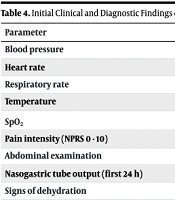
A 56-year-old man with a known history of type 2 diabetes mellitus and hypertension was admitted to the emergency department with severe abdominal pain, persistent nausea, repeated bilious vomiting, and absolute constipation for 48 hours. Two years earlier, he had undergone laparotomy and small-bowel resection due to adhesive intestinal obstruction. On admission, clinical and diagnostic findings were as follows (Table 4).
Table 4.
Initial Clinical and Diagnostic Findings on Admission
| Parameter | Finding |
|---|---|
| Blood pressure | 145/90 mmHg |
| Heart rate | 104 beats/min |
| Respiratory rate | 22 breaths/min |
| Temperature | 37.8°C |
| SpO₂ | 94% on room air |
| Pain intensity (NPRS 0 - 10) | 9/10 |
| Abdominal examination | Marked distension, tympany, absent bowel sounds, generalised tenderness |
| Nasogastric tube output (first 24 h) | 1,200 mL bilious fluid |
| Signs of dehydration | Dry mucous membranes, reduced skin turgor, oliguria |
| Key laboratory results | Na⁺ 132 mmol/L, K⁺ 3.2 mmol/L, BUN 48 mg/dL, Creatinine 1.6 mg/dL, WBC 14,200/mm³ |
| Abdominal X-ray | Multiple air-fluid levels, dilated small-bowel loops |
| Abdominal CT scan | Transition point in mid-ileum, dilated proximal loops (> 4 cm), collapsed distal bowel, no free air |
| Final diagnosis | Complete mechanical small-bowel obstruction secondary to postoperative adhesions |
After confirmation of recurrent complete small-bowel obstruction due to postoperative adhesions, the patient underwent emergency laparotomy and adhesiolysis. Postoperatively, he was initially managed in the intensive care unit and later transferred to the surgical ward with a Foley catheter, two corrugated drains, a Hemovac drain, and a nasogastric tube. Given the complexity of his clinical condition — combining acute physiological crisis with chronic sequelae of repeated surgeries — the Roy adaptation model was deliberately selected as the nursing framework to provide holistic and structured care throughout the one-month study period.
A recurrent case was deliberately chosen because it combines acute exacerbation with chronic sequelae (multiple previous surgeries, fear of recurrence, altered body image due to drains and tubes, and prolonged dependency on family and the healthcare system), thereby allowing simultaneous evaluation of Roy’s Adaptation Model across all four adaptive modes (physiological–physical, self-concept, role function, and interdependence).
3. Results
The results of the study are based on the six stages of the Roy adjustment model and are presented in four dimensions as Table 5.
Table 5.
Physiological Dimension in Nursing Process Based on Roy's Adaptation Model
| Levels | Observations/Interventions |
|---|---|
| Level 1 | Maladaptive behavior: Abdominal pain, symptoms of intestinal obstruction (vomiting, bloating, reduced bowel movements). |
| Level 2 | Stimuli identification: (1) Focal: Intestinal obstruction due to surgical adhesions; (2) Contextual: Elevated blood sugar, hypertension; (3) Residual: History of bowel surgery, genetic predisposition |
| Level 3 | Nursing diagnosis: Acute pain related to intestinal obstruction and surgical interventions |
| Level 4 | Nursing goals: Reduce abdominal pain, improve digestion, and prevent infections |
| Level 5 | Nursing interventions: Administer medications, including analgesics and antibiotics; Care for the drains and nasogastric tube; Monitor vital signs and fluid-electrolyte balance |
| Level 6 | Evaluation: Reduction in abdominal pain, improvement in symptoms of obstruction, stabilized patient condition |
Overall, the findings indicated that the patient exhibited maladaptive behaviors across all four adaptive dimensions, which were reduced following nursing interventions based on Roy’s Adaptation Model.
3. Discussion
The present study demonstrated that nursing interventions guided by Roy’s adaptation model led to improvements in the patient’s physiological condition, self-concept, role performance, and interdependence. These multidimensional outcomes provide evidence of the model’s effectiveness in addressing both physical and psychosocial needs.
These findings directly reflect the patient’s improvements across physiological, self-concept, role function, and interdependence dimensions, confirming the practical impact of the model in this case.
The Callista Roy adjustment model has proven to be an effective framework for patient care, particularly for complex conditions such as burn injuries (11). This model is based on principles that emphasize a comprehensive assessment of patient needs and effective interaction with them. In the present study, the use of this model showed positive results in the patient's physiological, psychological, and social dimensions and demonstrated its ability to improve the patient's overall condition.
The present study demonstrated improvements across physiological, self-concept, role function, and interdependence dimensions. These findings should be interpreted in light of previous studies that have applied Roy’s adaptation model in different clinical contexts.
Previous studies have also shown that the application of the Roy adjustment model can help reduce both physiological and psychological problems in patients. For example, Ghanbari-Afra and Ghanbari-Afra's study showed that applying this model improved breathing and sleeping conditions in patients with COVID-19 (18). In addition, another study showed that this model had a positive impact on reducing fatigue in patients with multiple sclerosis (19). Interpreting these results shows that Roy’s Adaptation Model can address both acute physiological symptoms and long-term psychosocial challenges, which is consistent with the multidimensional improvements observed in the present study.
Together, these studies suggest that the model is effective not only in acute conditions such as COVID-19 and multiple sclerosis, but also in chronic and psychosocial domains, highlighting its adaptability across diverse patient populations. These results are consistent with the results of the present study and suggest that the Roy adjustment model may be effective in various clinical situations. A study by Zheng and Jin in 2022 found in breast cancer patients that using this model can reduce feelings of shame and negative thinking, thereby improving the patients' quality of life (20). The Zheng study further emphasizes the psychological benefits of the model, showing that interventions based on Roy’s framework can reduce stigma and negative self-perceptions, thereby reinforcing the importance of addressing both physical and emotional dimensions of care. This interpretation supports the current findings, where psychological resilience and improved self-concept were achieved alongside physical recovery. These results highlight the positive effects of the Roy adaptation model on the psychological and social aspects of patients and highlight its importance in nursing care.
In contrast to these positive results, some research has reported mixed results. For example, Sadeghnejad's study showed that the application of the Roy adaptation model had no significant impact on the role performance dimensions of diabetics (21). This difference may be due to the unique nature of diabetes and the unique challenges associated with managing this chronic disease.
Overall, the results of the present study and similar studies suggest that implementing a nursing process based on the Roy adaptation model can help improve patients' quality of life. It is recommended that nurses incorporate this model more frequently into their nursing practices. Conducting further studies to examine the impact of the model in other clinical settings could enrich the scientific literature and improve quality of care.
This study also highlighted the importance of environmental and social factors such as family support and effective communication in the success of nursing interventions. This is particularly important for patients with serious injuries or chronic illnesses. Based on the results of this study, it can be concluded that appropriate collaboration between the patient and his family in implementing a care process based on the Roy adaptation model has a significant impact on treatment outcomes.
In addition, although the application of this model requires time and effort, its structured approach allows for a comprehensive understanding of each patient's individual needs. The adaptability inherent in Roy's model allows nurses to effectively tailor interventions to promote both physiological recovery and psychological resilience.
In summary, using Callista Roy's adaptation model not only improves patient care, but also gives healthcare providers the opportunity to provide holistic and individualized support that takes into account all dimensions of health.
Taken together, previous studies demonstrate that Roy’s Adaptation Model has broad applicability, though its impact may vary depending on disease type and patient context. This underscores the need for tailored implementation and further comparative research.
Overall, these interpretations strengthen the evidence that Roy’s adaptation model provides a comprehensive framework, though its effectiveness may vary depending on disease type and patient context.
3.1. Limitations
This study is a single-case report; therefore, the generalizability of the findings is limited. Long-term follow-up after hospital discharge was not performed. Additionally, the principal researcher was directly involved in the routine care of the patient, which may have introduced some degree of bias despite the application of reflexivity measures.
3.2. Conclusions
This study confirmed that Roy’s adaptation model provides an effective framework for the care of patients with intestinal obstruction. The patient’s maladaptive behaviors across physiological, self-concept, role function, and interdependence dimensions were reduced after implementing nursing interventions, highlighting the model’s holistic impact on both physical and psychological recovery.
The results of this study demonstrated that the Callista Roy adjustment model serves as an effective framework for the care of patients with intestinal obstruction. Using this model, nurses could identify patients' multidimensional needs and design appropriate interventions. The results showed that the patient exhibited both adaptive and maladaptive behavior across multiple dimensions, including physiological needs, self-image, role performance, dependence, and independence. After implementing care based on this model, patient maladaptive behaviors decreased. This underlines the positive influence of personalized care on improving the mental and physical condition of patients.
Therefore, it is recommended that the Callista Roy adaptation model be considered as a key tool in nursing education and practice to improve the quality of care and improve patient health. In addition, conducting further studies applying this model to other clinical diseases could contribute to enriching the scientific literature and improving treatment outcomes.
In light of these findings, the following practical recommendations are recommended:
- Integration of Roy’s Adaptation Model into standard nursing care protocols for patients with recurrent or postoperative intestinal obstruction.
- Development of a quick daily assessment checklist based on the four adaptive modes (physiological, self-concept, role function, interdependence) for use in surgical wards.
- Inclusion of training on Roy’s Adaptation Model in postgraduate and continuing education curricula for surgical and gastrointestinal nursing.
- Conducting larger-scale randomized or quasi-experimental studies to evaluate the effectiveness of the model in patients with adhesion-related small-bowel obstruction.