1. Background
While mood disorders are more common in women than in men (1), substance use is more common in men than in women (2). This difference may be partly attributable to sex/gender differences in responses to stressful life events (SLEs) (3). One hypothesis is that women internalize and men externalize when facing SLEs (4). Other mechanisms, such as greater risk aversion among women, may also reduce substance use (5), whereas greater susceptibility to rumination on negative thoughts may increase the risk of depression after loss (6, 7). Sex may modify the mental and behavioral consequences of exposure to SLEs (7).
Exposure to SLEs predicts poor mental health, such as depression (8), and substance use (9-14). Exposure to SLEs, such as the loss of family members, may critically disrupt an individual’s life and increase vulnerability to psychopathology and substance use (15, 16). However, these effects may differ between men and women.
A large body of literature suggests that sex and gender may modify the long-term impact of exposure to SLEs (17, 18). Biological, psychological, and sociocultural differences between men and women may influence emotional responses to stressful life events, coping strategies, and the types of support systems available. However, the literature on sex and gender differences in the impact of stressful life events on substance use is largely based on studies in Western, high-income nations, raising concerns about the broader applicability of these findings.
Theoretical work and empirical evidence suggest that exposure to SLEs increases the risk of substance use differently in men and women (17, 18). Biological and social factors may contribute to sex/gender differences in responses to SLEs. Although sociocultural influences, including gender norms, may play a role, hormonal differences may also alter vulnerability to the effects of SLEs on substance use. Women may experience greater hormonal dysregulation than men in response to SLEs, potentially resulting in increased internalizing symptoms and a reduced risk of engaging in substance use.
Donovan recently showed that SLEs and testosterone may better predict alcohol use in women than in men (19). Another study showed that changes in nucleus accumbens volume (20), which is influenced by SLE exposure (21), better predicted women’s than men’s substance use. Another study (17) found that socioeconomic stressors significantly increased the risk of alcohol, nicotine, and cannabis use among women, whereas SLEs were more predictive of early nicotine and marijuana use among men. Together, these studies suggest that addressing SLEs may have different consequences and sex/gender-specific pathways for men and women (22, 23), through both biological and sociocultural mechanisms (24).
Most existing studies on the psychological and behavioral consequences of SLEs are based on samples from high-income, Western countries, limiting the generalizability of their findings globally. Sociocultural norms, gender roles, economic development, and access to health and social services can all shape how individuals experience and respond to adversity. Therefore, it is crucial to examine these associations across a more diverse range of populations and settings. The current study addresses this gap by using data from the Global Flourishing Study (GFS), which includes more than 200,000 adults across 22 countries spanning multiple world regions. This broad and diverse sample provides a unique opportunity to assess whether sex/gender differences in the impact of SLEs on substance use are consistent across global contexts or vary by cultural and societal factors. The GFS (25-30) offers a valuable platform for examining how SLEs relate to well-being outcomes in a large, diverse international adult population. Drawing on data from more than 200,000 individuals in 22 countries, the GFS tracks multiple dimensions of flourishing over time, including experiences of adversity such as losing a family member to COVID-19.
2. Objectives
In the present analysis, we examined whether the association between exposure to SLEs and subsequent changes in substance use differs by sex/gender. Based on prior literature, we hypothesized that the association between SLE exposure and increased depressive symptoms would be more pronounced in women than in men, whereas the association with increased substance use would be stronger among men.
3. Methods
3.1. Study Design
This project used data from the GFS (25-30), a longitudinal, multinational panel survey of adults across 22 countries. The GFS was designed to investigate factors influencing well-being, psychological health, and human flourishing in diverse cultural and societal settings. Data were collected at 2 time points, approximately 1 year apart, and included measures of demographic characteristics, socioeconomic status, trauma history, and mental health, including depression.
3.2. Exposure Variable
The primary independent variable was self-reported loss of a family member due to COVID-19. This was measured using 1 retrospective question asking participants whether they had lost a family member to the virus, with responses recorded as a binary variable (yes/no).
3.3. Outcome Variable
The primary outcome was change in substance use between baseline and follow-up, assessed using a 2-item self-report measure administered at both time points. To capture longitudinal change, tobacco and alcohol consumption were recorded at baseline and again at follow-up, focusing on relative change rather than absolute levels of substance use.
3.4. Confounders
We adjusted for several covariates, including age, employment status (specifically unemployment), and educational attainment. Educational attainment was stratified into 3 hierarchical tiers: low (no formal education or only primary), medium (secondary education or some postsecondary), and high (college degree or higher), with the low-education tier as the reference category. To account for differences across national contexts, we included country fixed effects in all models. Where appropriate, variables were standardized to facilitate cross-country comparisons.
3.5. Effect Modifier
The moderator of interest was sex/gender (men/male = 1; women/female = 0).
3.6. Data Analysis
To investigate the longitudinal relationship between exposure to SLEs, specifically the loss of a family member due to COVID-19, and changes in substance use over time, we used SEM as the primary analytic approach (31-34). This method allowed us to account for measurement error and model latent variables while incorporating relevant covariates and baseline substance use. SEM also enabled examination of both direct and indirect associations within a complex multivariable framework. To assess whether associations differed by sex/gender, we implemented a multi-group SEM approach, treating men and women as separate analytic groups. This strategy allowed assessment of moderation by sex/gender without imposing equality constraints on structural or measurement paths across groups (35). Specifically, all path coefficients were freely estimated for each group, enabling a flexible test of differences in model parameters between men and women. Substance use was conceptualized as a latent construct indicated by 2 observed behaviors: Self-reported smoking and tobacco use. This latent structure enabled more reliable estimation of the underlying propensity for substance use than analyzing each indicator separately. The measurement model was evaluated for adequacy before examining structural paths.
To evaluate model fit, we used several commonly accepted indices. Model fit was considered good when the Root Mean Square Error of Approximation (RMSEA) was below 0.04 and the Comparative Fit Index (CFI) exceeded 0.95 (36). Because the sample size was exceptionally large, we did not treat a statistically significant chi-square test as evidence of poor fit, because even minor deviations can yield significant results in large samples.
4. Results
4.1. Structural Equation Modeling in Women
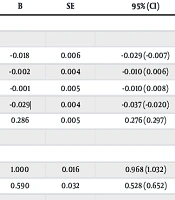
The final analytic sample consisted of 109,331 women and 97,761 men. Findings from the SEM for women are presented in Table 1. The SEM analysis among women identified several significant associations between baseline predictors and latent substance use at follow-up. Higher educational attainment at baseline was associated with significantly lower substance use at follow-up (B = -0.018, SE = 0.006, 95% CI, -0.029 to -0.007; P = 0.002). In contrast, unemployment status (B = -0.002, SE = 0.004, 95% CI, -0.010 to 0.006; P = 0.623) and age (B = -0.001, SE = 0.005, 95% CI, -0.010 to 0.008; P = 0.842) were not significantly associated with substance use at follow-up. Exposure to a COVID-19-related death was significantly associated with lower substance use (B = -0.029, SE = 0.004, 95% CI, -0.037 to -0.020; P < 0.001). As expected, higher substance use at baseline strongly predicted substance use at follow-up (B = 0.286, SE = 0.005, 95% CI, 0.276 to 0.297; P < 0.001).
Table 1.
Summary of the Structural Equation Model in Women
| Variables | B | SE | 95% (CI) | P-Value |
|---|---|---|---|---|
| Structural | ||||
| Substance Use 2 (Latent) | ||||
| Education (1 - 3; Baseline) | -0.018 | 0.006 | -0.029 (-0.007) | 0.002 |
| Unemployed (0/1; Baseline) | -0.002 | 0.004 | -0.010 (0.006) | 0.623 |
| Age (y) (Baseline) | -0.001 | 0.005 | -0.010 (0.008) | 0.842 |
| COVID Loss (0/1; Baseline) | -0.029 | 0.004 | -0.037 (-0.020) | < 0.001 |
| Substance Use (Latent; Baseline) | 0.286 | 0.005 | 0.276 (0.297) | < 0.001 |
| Measurement | ||||
| Smoking 2 | ||||
| Substance Use (Latent Factor) 2 | 1.000 | 0.016 | 0.968 (1.032) | < 0.001 |
| Intercept | 0.590 | 0.032 | 0.528 (0.652) | < 0.001 |
| Drinking 2 | ||||
| Substance Use (Latent Factor) 2 | 0.150 | 0.003 | 0.144 (0.157) | < 0.001 |
| Intercept | 0.861 | 0.005 | 0.850 (0.871) | < 0.001 |
| Smoking 1 | ||||
| Substance Use (Latent Factor) 1 | 0.712 | 0.005 | 0.703 (0.721) | < 0.001 |
| Intercept | 0.173 | 0.010 | 0.153 (0.192) | < 0.001 |
| Drinking 1 | ||||
| Substance Use (Latent Factor) 1 | 0.461 | 0.003 | 0.454 (0.467) | < 0.001 |
| Intercept | 0.573 | 0.004 | 0.564 (0.581) | < 0.001 |
The measurement model confirmed that the latent substance use constructs were reliably represented by observed variables. At follow-up, smoking loaded strongly on the latent factor (B = 1.000, SE = 0.016, 95% CI, 0.968 to 1.032; P < 0.001), whereas drinking also showed a significant but lower loading (B = 0.150, SE = 0.003, 95% CI, 0.144 to 0.157; P < 0.001). At baseline, the factor loadings for smoking (B = 0.712, SE = 0.005, 95% CI, 0.703 to 0.721; P < 0.001) and drinking (B = 0.461, SE = 0.003, 95% CI, 0.454 to 0.467; P < 0.001) were also significant, indicating that both behaviors contributed meaningfully to the latent construct.
4.2. Structural Equation Modeling in Men
As shown in Table 2, the SEM analysis among male participants identified several statistically significant associations between baseline predictors and latent substance use at follow-up. Unlike the model for women, experiencing a COVID-19-related death was associated with higher substance use among men (B = 0.042, SE = 0.005, 95% CI, 0.031 to 0.052; P < 0.001). Educational attainment at baseline was strongly associated with reduced substance use at follow-up (B = -0.111, SE = 0.003, 95% CI, -0.117 to -0.104; P < 0.001), suggesting that higher levels of education may have a protective effect against subsequent substance use. In contrast to the model for women, unemployment at baseline was positively associated with increased substance use at follow-up (B = 0.032, SE = 0.005, 95% CI, 0.024 to 0.041; P < 0.001). Age was also inversely associated with substance use at follow-up (B = -0.039, SE = 0.010, 95% CI, -0.058 to -0.019; P < 0.001), indicating that younger men reported higher levels of subsequent substance use. Substance use at baseline remained a significant predictor of subsequent substance use (B = 0.240, SE = 0.007, 95% CI, 0.227 to 0.254; P < 0.001).
Table 2.
Summary of the Structural Equation Model in Men
| Variables | B | SE | 95% (CI) | P-Value |
|---|---|---|---|---|
| Structural | ||||
| Substance Use 2 (Latent) | ||||
| Education (1 - 3; Baseline) | -0.111 | 0.003 | -0.117 (-0.104) | < 0.001 |
| Unemployed (0/1; Baseline) | 0.032 | 0.005 | 0.024 (0.041) | < 0.001 |
| Age (y) (Baseline) | -0.039 | 0.010 | -0.058 (-0.019) | < 0.001 |
| COVID Loss (0/1; Baseline) | 0.042 | 0.005 | 0.031 (0.052) | < 0.001 |
| Substance Use (Latent; Baseline) | 0.240 | 0.007 | 0.227 (0.254) | < 0.001 |
| Measurement | ||||
| Smoking 2 | ||||
| Substance Use (Latent Factor) 2 | 0.884 | 0.014 | 0.856 (0.912) | < 0.001 |
| Intercept | 0.391 | 0.028 | 0.336 (0.447) | < 0.001 |
| Drinking 2 | ||||
| Substance Use (Latent Factor) 2 | 0.186 | 0.005 | 0.176 (0.195) | < 0.001 |
| Intercept | 0.799 | 0.004 | 0.791 (0.807) | < 0.001 |
| Smoking 1 | ||||
| Substance Use (Latent Factor) 1 | 0.513 | 0.006 | 0.501 (0.524) | < 0.001 |
| Intercept | 0.133 | 0.006 | 0.122 (0.144) | < 0.001 |
| Drinking 1 | ||||
| Substance Use (Latent Factor) 1 | 0.419 | 0.004 | 0.410 (0.427) | < 0.001 |
| Intercept | 0.556 | 0.004 | 0.548 (0.564) | < 0.001 |
The measurement model showed strong and statistically significant loadings for both smoking and drinking indicators on the latent substance use constructs. At follow-up, smoking had a loading of 0.884 (SE = 0.014, 95% CI, 0.856 to 0.912; P < 0.001), whereas drinking had a lower but significant loading of 0.186 (SE = 0.005, 95% CI, 0.176 to 0.195; P < 0.001). At baseline, smoking loaded at 0.513 (SE = 0.006, 95% CI, 0.501 to 0.524; P < 0.001), and drinking loaded at 0.419 (SE = 0.004, 95% CI, 0.410 to 0.427; P < 0.001).
5. Discussion
In this prospective longitudinal study, we analyzed a large, diverse, and globally representative sample and identified a key finding: exposure to SLEs is associated with increased substance use among men, but not women. The overall association between SLE exposure and substance use is well established. However, limited research has examined whether such exposure predicts subsequent changes in substance use, particularly in a multinational context.
The association between SLEs and mental health problems, such as substance use, has been well documented in prior research (37-39). Exposure to SLEs and traumatic events can hinder emotional development, increase vulnerability to stress, and adversely affect long-term psychological functioning (40-42). SLE exposure requires effective and healthy coping mechanisms and emotion regulation, and it may alter stress-response pathways and brain circuits involved in emotion regulation and behavioral control (43-45).
Previous research on the relationship between SLEs and substance use has largely relied on cross-sectional designs, limiting the ability to draw conclusions about changes over time. In contrast, our study adopted a longitudinal approach to examine whether exposure to SLEs, specifically the loss of a family member due to COVID-19, predicts subsequent changes in substance use. By focusing on within-person variation over time rather than static group differences, our analysis provides a more dynamic understanding of how individuals may respond behaviorally and emotionally to significant life stressors. This temporal perspective contributes to the literature by elucidating the potential long-term effects of SLE exposure on substance use trajectories (46).
Research increasingly indicates a strong association between substance use disorder and psychosocial factors such as grief. A systematic review investigating this association among bereaved individuals found consistent evidence that grief can significantly contribute to the development or worsening of substance use. Drawing on 17 eligible studies identified through comprehensive searches of databases including MEDLINE, PsycNET, LILACS, PubMed, EMBASE, CINAHL, and SciELO, and adhering to PRISMA guidelines, the review found that more than 88% of the studies reported a clear association between grief and substance use disorder. Furthermore, nearly 60% of the studies reported that grief-related substance use was also associated with symptoms of depression and anxiety, illustrating the interconnectedness of emotional distress and maladaptive coping behaviors. Alcohol was identified as the most frequently used substance among grieving individuals, suggesting that it may be a particularly common form of self-medication during bereavement. These findings underscore the importance of recognizing grief as a potential risk factor for substance use and support the need for preventive interventions and support systems for individuals experiencing loss (47).
Several studies have begun to clarify the unique psychological toll of bereavement during the COVID-19 pandemic, particularly under conditions of social distancing and lockdown. One such study focused on 104 bereaved Jewish adults who lost relatives during the pandemic, using self-reported questionnaires to assess levels of depression, complicated grief, and suicidal ideation. The results revealed high rates of all 3 indicators, suggesting that grief during COVID-19 may be more intense and psychologically damaging than grief under typical circumstances. Individuals who reported suicidal ideation were more likely to display avoidant attachment styles and to have had particularly close relationships with the deceased, underscoring how both relationship dynamics and pandemic-related disruptions can exacerbate mental health outcomes during the grieving process. These findings contribute to a growing body of literature emphasizing the heightened vulnerability of bereaved individuals during the pandemic and point to the urgent need for mental health support tailored to those who experienced loss in constrained and emotionally isolating contexts (48).
The mental health impact of COVID-19-related loss has received increasing research attention, with a particular focus on its relationship with substance use and psychological distress. A national survey comprising 1,998 participants examined the correlation between COVID-19-related bereavement, defined as the loss of a close contact, and both depressive symptomatology and binge drinking. Using a treatment-weighting strategy to account for nonrandom exposure to bereavement, the study found that individuals who experienced the death of someone close to them due to the virus reported significantly higher levels of depressive symptomatology and more frequent binge drinking. These effects were especially pronounced among essential workers, for whom bereavement intensified both depressive symptoms and alcohol misuse. This study adds to the growing literature demonstrating that pandemic-related loss has serious emotional and behavioral health implications, particularly for those already at increased risk due to occupational exposure or caregiving roles during the crisis (48, 49).
Substance use has emerged as a significant public health concern during the COVID-19 pandemic, with growing attention directed toward individuals experiencing long-term symptoms, known as COVID-19 long haulers. Despite their increased vulnerability, limited research has investigated substance use patterns and related psychosocial factors in this population. One recent study addressed this gap by examining substance use behaviors, including legal drug use, illicit drug use, and nonmedical use of prescription drugs, among 460 COVID-19 long haulers. The findings revealed high rates of substance use, with tobacco (82%) being the most commonly used legal substance, cocaine (53%) the most common illicit drug, and prescription opioids (67%) the most frequently misused prescription medication. Importantly, SEM showed that psychiatric symptoms such as depression, anxiety, and post-traumatic stress disorder were strongly associated with increased substance use, whereas psychosocial factors such as personal mastery and social support were negatively associated. These findings contribute to the literature by highlighting the dual role of mental health challenges and psychosocial resilience in shaping substance use behaviors among long haulers. The study underscores the urgent need for integrated prevention and intervention strategies that not only address psychiatric symptoms but also strengthen psychosocial supports in this high-risk group (49).
The COVID-19 pandemic has been linked to changes in substance use behaviors, particularly among communities facing heightened social and economic stress. A study conducted in Harlem, Northern Manhattan, assessed the prevalence of substance use before and during the pandemic among 437 individuals, along with its associations with depression and social factors. The findings revealed that more than one-third of participants reported using substances before the pandemic and either initiated or increased use during it. Common substances included smoking, marijuana, and vaping, with smaller proportions reporting the use of hard drugs. The study found significant associations between increased substance use and symptoms of depression, as well as housing insecurity, indicating that individuals experiencing mental health challenges or unstable living conditions were more likely to turn to substances as a coping mechanism. Interestingly, employment insecurity was associated with a decreased likelihood of increased substance use, and food insecurity showed no significant correlation. These findings contribute to the growing body of literature emphasizing the role of psychosocial stressors in pandemic-related substance use and highlight the urgent need for accessible, culturally sensitive mental health and substance use services in marginalized urban communities (50, 51).
Our findings add depth to the existing literature by highlighting sex/gender-specific patterns in the association between SLEs and long-term behavioral and mental health outcomes (18, 52). Several mechanisms may help explain why men and women differ in their vulnerability to the lasting effects of such experiences (53-55). From a biological perspective, sex hormones, including estrogen and progesterone, are known to modulate the hypothalamic-pituitary-adrenal axis, a key system involved in stress regulation (56, 57). These hormonal dynamics may render women more susceptible to psychological distress following exposure to SLEs (58). Moreover, neurodevelopmental research has documented sex-based differences in the functioning of brain regions implicated in emotion regulation, particularly the amygdala and prefrontal cortex (59-61).
Sociocultural factors may also shape these differing patterns. Compared with women, men are often socialized to refrain from openly expressing their feelings. Whereas women tend to internalize stress and adversity, men may suppress emotions and turn to substance use when facing stress (62, 63). Emotional suppression and limited emotional expression may contribute to externalizing behaviors such as substance use, as they may help individuals mask or escape the psychological impact of trauma (64-66). Although men are less likely to experience SLEs than women (67, 68), they may have less experience in managing them. Differences in coping styles may also contribute, as men may use substance use for distraction or avoidance (69, 70).
The results of this study highlight the critical role of sex and gender in shaping the long-term psychological and behavioral consequences of exposure to traumatic life events, such as the loss of a family member due to the COVID-19 pandemic. These findings emphasize the need to integrate sex/gender considerations into models of risk and resilience, particularly in understanding how grief-related stress may influence substance use behaviors. Furthermore, the observed differential patterns suggest that interventions and support services for bereaved individuals should be designed with sensitivity to sex and gender differences to better address the distinct emotional and behavioral needs of men and women.
5.1. Strengths
This research advances current knowledge in several important ways. Unlike many previous studies that relied on cross-sectional data, this study used a longitudinal design to investigate changes in depressive symptoms and substance use over time. Drawing on data from the GFS, which includes more than 200,000 participants across 22 countries, we examined patterns in a globally diverse sample that captures broad cultural and demographic variation. The multinational nature of the GFS improves generalizability and provides a unique perspective on how traumatic events, such as pandemic-related bereavement, affect adult mental and behavioral health across varied sociocultural contexts. By linking a specific COVID-related stressor to subsequent changes in substance use, our findings highlight the enduring psychological toll of the pandemic and reinforce the notion that its consequences extend well beyond the period of viral spread.
The use of a global, 22-country dataset is a major strength of this study and enhances the generalizability of our findings. By including participants from a wide range of cultural, economic, and geographic backgrounds, we explored whether sex/gender differences in the behavioral consequences of SLEs hold across diverse global contexts. Whereas much prior research has been restricted to the United States or other Western nations, our findings suggest that the association between exposure to traumatic loss and substance use may follow similar sex/gender patterns internationally. This reinforces the importance of developing globally relevant, sex/gender-sensitive mental health and substance use interventions that are adaptable to local contexts while being informed by shared risk mechanisms. At the same time, further country-specific analyses may help clarify how contextual factors, such as stigma, healthcare infrastructure, or cultural coping norms, modify these associations across settings.
The findings have potential implications for public health policy and clinical intervention strategies. Large-scale crises such as the COVID-19 pandemic can result in widespread bereavement, with psychological and behavioral effects that may persist for years. Our results suggest that particular attention should be paid to the behavioral health needs of bereaved men, who may be at heightened risk for increased substance use after such loss. Tailored prevention and intervention efforts, such as routine screening for substance use among those who have experienced significant loss, could be particularly beneficial. Trauma-informed approaches that integrate grief counseling and substance use treatment may be especially effective if they also account for sex/gender differences in coping styles and vulnerability. Developing culturally and gender-responsive mental health services could enhance support for bereaved individuals and reduce long-term adverse outcomes.
This study has several key strengths. Its longitudinal design allows assessment of within-person change in mental and behavioral health outcomes, offering a more dynamic understanding than cross-sectional snapshots. The use of a large, diverse, international sample enhances the external validity of the findings and enables exploration of patterns that may be consistent or variable across cultures. Additionally, the sample size provided sufficient power to detect modest associations and to explore subgroup differences by sex/gender.
5.2. Limitations
Nevertheless, important limitations should be considered. First, we were unable to account for gender and sexual minority status, which may moderate responses to trauma. Exposure to stressful life events was measured using a single retrospective item, which is subject to recall bias and does not provide details on the type, severity, or timing of the loss. Consequently, we could not assess dose-response relationships or compare the effects of different types of adversity. Likewise, using only 2 self-report items to measure depression may reduce sensitivity and introduce bias due to cultural differences in emotional expression and stigma. Moreover, the relatively brief follow-up period of approximately 1 year may hinder assessment of outcomes over an extended period. In addition, certain demographic and contextual variables, such as race, ethnicity, urban versus rural residence, and sexual orientation, were either unavailable or inconsistently measured across countries, which may introduce unmeasured confounding. Finally, this study focused exclusively on loss due to COVID-19 and did not evaluate other common forms of adversity, such as abuse or economic hardship, which may interact with or compound the observed effects.
5.3. Future Research
Building on these findings, future research should incorporate more nuanced and comprehensive assessments of adversity, including different types, severities, and timings of stressful life events. Prospective data collection would allow better control of recall bias and clearer establishment of temporal relationships between exposures and outcomes. Further exploration is also needed to understand the biological, psychological, and social mechanisms that may explain sex/gender differences in responses to trauma, such as differences in neuroendocrine functioning, stress reactivity, emotion regulation, and cultural expectations regarding coping. Additionally, future studies should consider how intersecting identities, including race, class, culture, religion, sexual orientation, and geographic context, shape the impact of traumatic experiences on health. Research on the effectiveness of trauma-informed, gender-sensitive interventions in diverse global settings could provide valuable insight into strategies for preventing or mitigating the long-term mental and behavioral health consequences of loss and adversity.
5.4. Conclusions
This study contributes to the growing body of evidence suggesting that SLEs, such as the death of a family member due to COVID-19, may have differential effects on behavioral health outcomes depending on sex and gender. Our findings indicate that men may be more vulnerable than women to increased substance use following such losses. This observed disparity underscores the need to integrate sex/gender considerations into both research frameworks and intervention strategies. Failure to account for these differences risks overlooking important pathways through which trauma manifests across populations. Given the global scale of loss brought on by the COVID-19 pandemic, identifying sex/gender-specific responses to bereavement and adversity is critical to informing effective prevention and treatment approaches. Tailored programs that recognize the unique emotional, behavioral, and social needs of men and women are likely to be more effective in mitigating the long-term consequences of traumatic loss. Ultimately, a more nuanced understanding of how SLEs shape mental health and substance use trajectories can help reduce the cumulative burden of trauma across the life course and improve equity in health outcomes worldwide.