1. Background
Manpower is the most important influential factor in the success and progress of every organization (1). The higher education system in every country plays a key role in their development (2). Empowerment is essential to achieving the goals of sustainable development (3). Innovative and competitive global education and research systems are also critical for the sustainable development of organizations and communities (4). As the most obvious manifestation of manpower investment, universities play a pivotal role in training and providing efficient manpower in society (5). Universities must have faculty members who are capable of providing, training, and strengthening human resources in education (6). Faculty members are the basic assets of a university, and the promotion of their educational capability depends on the capability of the educational system and the training of skilled manpower (7). Based on the systematic education design, the teacher is the most basic factor in achieving the desired success regarding educational goals, and the teacher’s performance achieves the highest educational goals and improves the scientific quality of the university (8, 9). Moreover, teachers’ awareness of learners’ educational needs and the review and use of their opinions to improve educational quality are considered to be facilitators in this context (10).
In the teaching and learning process, the teacher offers learning opportunities to students, and their role in improving education and achieving the educational goals of students is considered prominent (11). Learning is influenced by several factors, such as students’ behavior, their motivation to learn, the curriculum content, environmental and physical resources, and effective teaching (12). The study by Abdolmaleki et al. showed six components of effective teaching, including the moral and personality traits of teachers, professional qualities, teaching skills, educational evaluation, psychological action, and the classic leadership of teachers (13). In addition, Franklin and Harrington reported that factors such as the teacher’s mastery of the subject, clear expression of educational expectations, leadership and classroom management, and the active participation of students in the teaching process are associated with effective teaching in medical universities (14). On the same note, the findings of Asikainen et al. indicated that the components of lesson plan design and development, presentation and implementation, human relations, personal characteristics, and evaluation are effective teaching criteria in the educational process (15).
Today, the graph theory is used in various branches of sciences. The mathematical definition of a graph network is a set of nodes that are connected to each other through links, thereby forming clusters. Each graph network has a set of criteria for average path length, centrality, and other factors. Using the graph theory for effective teaching analysis has revealed a correlation between various components of the system (16).
To date, several studies have been focused on the subject of effective teaching from students’ perspective (17, 18). However, the influential factors in teaching must also be determined from the perspective of teachers. Attention to effective teaching and the influential factors will undoubtedly improve the quality of education. Therefore, extensive research is required in this regard so that the findings could be provided to different professors and educational officials to enhance the current teaching methods and increase the quality of teaching.
2. Objectives
The present study aimed to prioritize the influential factors in effective teaching and determine the systematic correlations between these factors from the perspective of faculty members based on the graph theory.
3. Methods
This descriptive-analytical study was conducted on 65 faculty members who were employed in the schools of health and nutrition of Kermanshah University of Medical Sciences in 2019. In total, 45 faculty members were selected from the School of Health, and 20 faculty members were selected from the School of Nutrition (total: 65). The inclusion criterion for the faculty members was at least one year of teaching experience at the university, which was met by all the participants.
Data were collected using two questionnaires. The demographic questionnaire consisted of seven items regarding age, gender, marital status, academic rank, course history, type of employment, and field of education. The questionnaire of effective teaching factors contained various components, including the mastery of the subject (q1), presentation of new and updated materials (q2), eloquent expression/simple and transparent transmission (q3), creating appropriate contexts for students’ participation (q4), facile access to the faculty members outside of class hours (q5), intimate and friendly communication with students (q6), timeliness and timely class attendance (q7), having a lesson plan and presenting the plan to students (q8), and student evaluation (before semester, midterm, and end-of-semester) (q9). Proposals were also classified based on a five-point scale, including absolutely important (score 9), very important (score 7), important (score 5), and slightly important (score 3). The reliability of the questionnaire was confirmed by experts; the validity has been previously confirmed at the Cronbach’s alpha coefficient of 91% in the study by Bahadori et al. (19).
According to the graph theory, the process of systematically structuring a set of existing information provides access to an integrated and defined, hierarchically structured model of clear correlations between different factors or components. In the graph theory, R represents the sequence of the factors that strongly influence other factors, and J represents the hierarchy of the influential factors. The actual location of each factor in the final hierarchy is determined by the RJ and R + J columns, with RJ representing the position of a factor along the supply axis; this position is definitely an influence if RJ is positive. J + R represent the total intensity of a factor along the axis of length both in terms of penetrating and being influenced (19).
The researcher initially explained the objective of the study, how to answer the questions, and the confidentiality of personal information. After obtaining informed consent, questionnaires were completed with full satisfaction. Data analysis was performed using the graph theory in MATLAB software.
4. Results
The mean age of the faculty members was 39 ± 6.4 years; 80% were men, 20% were women, and 41.5% of the participants had less than five years of professional experience, while 30.8% had ≥ 20 years of professional experience. The demographic characteristics of faculty members are presented (Table 1).
Table 1.
Demographic Data of Faculty Members
| Variables | No. (%) |
|---|---|
| Marital status | |
| Single | 16 (24.6) |
| Married | 49 (75.4) |
| Type of employment | |
| Official | 27 (41.5) |
| Contractual | 14 (21.5) |
| Tuition | 10 (15.4) |
| Specific commitment (k coefficient) | 14 (21.5) |
| Academic rank | |
| Instructor | 9 (13.8) |
| Assistant Professor | 36 (55.4) |
| Associate Professor | 8 (12.3) |
| Professor | 2 (3.1) |
| Others | 10 (15.4) |
| Age (y) | |
| 20 - 29 | 2 (3.1) |
| 30 - 39 | 35 (53.8) |
| 40 - 49 | 11 (16.9) |
| ≥ 50 | 17 (26.2) |
| Work experience (y) | |
| < 5 | 27 (41.5) |
| 5 - 9 | 10 (15.4) |
| 10 - 19 | 8 (12.3) |
| ≥ 20 | 20 (30.8) |
The hierarchy of the influential factors in effective teaching from the perspective of the faculty members are shown (Table 2).
Table 2.
Hierarchy of Influential Factors in Effective Teaching from Perspective of Faculty Members
| Components | q1 | q2 | q3 | q4 | q5 | q6 | q7 | q8 | q9 | R | J | R + J | R - J |
|---|---|---|---|---|---|---|---|---|---|---|---|---|---|
| q1 | 0.000 | 0.320 | 0.192 | 0.307 | 0.175 | 0.446 | 0.122 | 0.188 | 0.3434 | 2.0950 | 0.0000 | 2.10 | 2.10 |
| q2 | 0.000 | 0.000 | 0.265 | 0.372 | 0.020 | 0.144 | 0.283 | 0.249 | 0.1891 | 1.525 | 0.0356 | 1.56 | 1.49 |
| q3 | 0.000 | 0.000 | 0.000 | 0.441 | 0.341 | 0.382 | 0.343 | 0.272 | 0.0098 | 1.7904 | 0.0508 | 1.84 | 1.74 |
| q4 | 0.000 | 0.000 | 0.000 | 0.000 | 0.373 | 0.484 | 0.461 | 0.271 | 0.2350 | 1.8263 | 0.1246 | 1.95 | 1.70 |
| q5 | 0.000 | 0.000 | 0.000 | 0.000 | 0.000 | 0.450 | 0.375 | 0.262 | 0.0919 | 1.1795 | 0.1012 | 1.28 | 1.08 |
| q6 | 0.000 | 0.000 | 0.000 | 0.000 | 0.000 | 0.000 | 0.430 | 0.185 | 0.2156 | 0.8316 | 0.2120 | 1.04 | 0.62 |
| q7 | 0.000 | 0.000 | 0.000 | 0.000 | 0.000 | 0.000 | 0.000 | 0.431 | 0.0720 | 0.5033 | 0.2240 | 0.73 | 0.28 |
| q8 | 0.000 | 0.000 | 0.000 | 0.000 | 0.000 | 0.000 | 0.000 | 0.000 | 0.1384 | 0.1384 | 0.2068 | 0.35 | -0.07 |
| q9 | 0.000 | 0.000 | 0.000 | 0.000 | 0.000 | 0.000 | 0.000 | 0.000 | 0.000 | 0.000 | 0.1439 | 0.14 | -0.14 |
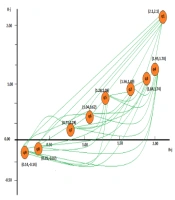
The prioritization and the correlation between the influential factors in effective teaching from the perspective of the faculty members are shown (Figure 1). According to the obtained results, q1 with coordinates “2.1 and 2.1” strongly influenced other factors and q9 with coordinates “-0.14 and 0.14” least influenced the other factors.
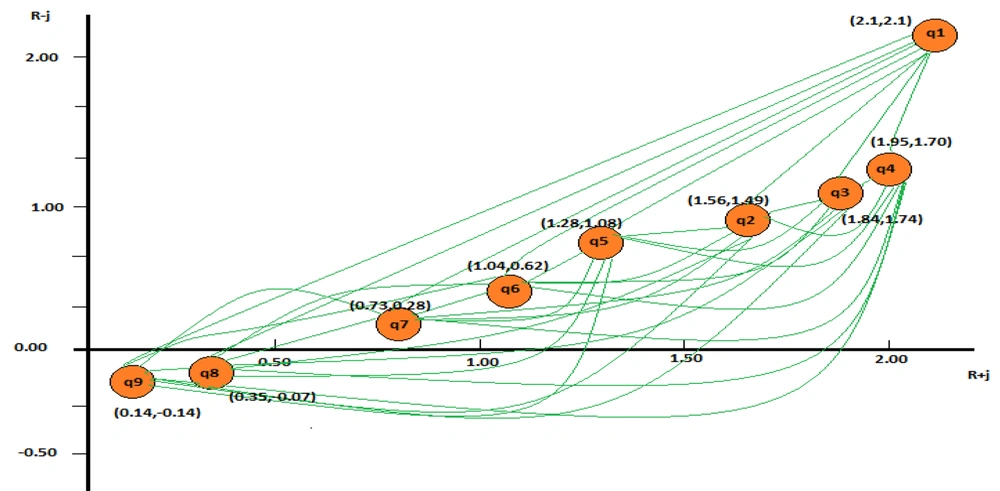
Figure 1.
The prioritization and the correlation between the influential factors in effective teaching from the perspective of the faculty members
5. Discussion
Effective teaching has features that set it apart from many other professions. Teachers often find many components to be of importance for teaching (19). In the current research, factors such as mastering the subject, creating suitable grounds for students’ participation, eloquence, simple expression, and transparent transmission, presenting new and updated materials, facile access to the teacher outside the classroom, intimate communication and friendly with students and punctuality/timely class attendance were definitely influential in effective teaching (cause group). Other factors such as having a lesson plan and presenting it to students and periodical student evaluation were among the influential factors (also cause group).
In a similar study conducted by Bahadori et al. (19) to assess effective teaching based on the graph theory from students’ perspective, mastering the subject, presenting new and updated materials, eloquent expression, simple, and transparent transitions in a different order were such influential factors; regardless of their order, they were consistent with the views of the professors. On the other hand, creating a suitable context for students’ participation, facile access to the teacher outside class hours, intimate and friendly communication with students, and punctuality/timely attendance in class were not among the consistent findings with the present study. Furthermore, factors such as having a lesson plan and presenting it to students and periodical student evaluation in our study were consistent with the mentioned study.
Our findings indicated that the mastery of the subject had the highest coefficient, and evaluation had the lowest coefficient. Bieg et al. also reported that a teacher’s skills, area of knowledge, and educational content are the most important factors involved in effective teaching (20). Also, Torkzadeh and Keshavarzi claimed that effective and strategic teaching is achieved when professors, with their creative methods, are able to respond to students’ conditions, needs, and requirements, creating a strategic environment that meets the needs of all the stakeholders in terms of different components (21). Such examples are the personality traits of professors, students’ readiness and abilities, the quality of teaching and teaching performance, teaching achievements, and the educational environment (21).
In a study on the “Evaluating effective teaching in college level economics using student ratings of instruction: a factor analytic approach”, Agbetsiafa examined the factors that affect students’ evaluation of economics education (22). Factor analysis was used to determine the validity and reliability of the evaluation tools for teacher evaluation or course effectiveness. The obtained results showed a positive correlation between students’ perception of teaching effectiveness, learning facilitation, effective communication, clarity of the course elements, and evaluation and feedback on the course (22). The findings of Molway also indicated that teachers value subject-specific survey feedback for professional learning (23).
5.1. Conclusions
According to the results, teacher’s mastery of the subject matter was the most significant factor affecting proper teaching. Therefore, attention should be paid to the quality of effective teaching to improve the current situation. It is suggested that various educational workshops be held to bring professors’ views closer to students, provide an active environment for effective teaching, and use new educational technologies in the agenda of education policymakers at the ministry of health and universities (Medical Education Studies and Development Center). It is also recommended that scholars review the effectiveness of teaching in faculty members, and the views of learners should be considered to develop a comprehensive package for effective teaching.