
1. Background
The higher education system is a key element of human development in every country. Over the past four decades, an important feature of higher education has been the rapid expansion of institutions in developing countries, including Iran. In other words, higher education represents investment in human resources, which contributes to the comprehensive development of a country by providing and promoting the knowledge, skills, and attitudes required by human resources (1).
Self-esteem has long been a major debate among psychologists. Rogers introduced the concepts of self-ideal and self-perception, exploring the same issues that are currently referred to as self-esteem. The same distinction between self-concept and self-esteem exists between the ideal and the perceived self. Self-esteem is valuable as one’s perception of oneself and leading the individuals toward the image they desire rather than their true self. Therefore, the difference between reality and ideal is the gap between self-concept and self-esteem (2).
Academic self-concept is an indicator by which learners compare their abilities and skills with other learners, and the higher academic self-concept of a learner is associated with their greater motivation to continue education to higher levels (3). In other words, academic self-concept is a set of ideas and attitudes, as well as students' attention to their set of scientific skills and performance (4). Academic self-concept is strongly correlated with academic achievement (5) and is known as an important psychological construct, affecting academic achievement (6).
Previous studies have shown a correlation between the prediction of academic self-concept and self-esteem to determine the rate of academic achievement (7). Students' academic self-concept strongly influences their self-efficacy beliefs, and academic self-concept is a stronger predictor of emotional and motivational variables (8).
2. Objectives
Given the significant effect of these two categories on academic achievement and the lack of studies in this regard on medical students, the present study aimed to investigate the correlation between self-esteem and academic self-concept from the perspective of medical students.
3. Methods
3.1. Study Design
This descriptive-analytical cross-sectional study was conducted on the residents, interns, and clerkships of Shahid Beheshti Hospital in Kashan, Iran who were engaged in educational activities in the academic year 2019. The participants were selected via convenience sampling. Data were collected using self-esteem and academic self-concept questionnaires.
3.2. Self-esteem Questionnaire
This questionnaire consisted of 10 items, which were scored based on a four-point Likert scale (Strongly Agree-Strongly Disagree). In the study by Bahlul and Rajabi (9), 129 students who were selected from all the first-year students living in the dormitories of Shahid Chamran University, were evaluated using the Rosenberg self-esteem scale. According to the findings, the internal consistency coefficient of the entire sample population was 0.84, while it was 0.87 in the male students, and 0.80 in the female students. In addition, the correlation-coefficients of the items in each scale were reported to be 0.56 - 0.72, and all the variables were considered significant at P < 0.001. Factor analysis using the main axis factorization (Promax rotation) in the mentioned scale of these factors included personal competence and self-satisfaction. In the present study, the reliability of the questionnaire was confirmed at the Cronbach's alpha coefficient of 0.883.
3.3. Academic Self-concept Questionnaire
This tool consisted of 15 items, which were scored based on a four-point Likert scale (completely agree-completely disagree). The questionnaire measures self-concept on three levels of general, school, and non-school. In Iran, the questionnaire has been standardized in primary school students by Afsharzadeh et al. (10). Notably, one of the items has been eliminated, and the final version has 14 items. The Cronbach's alpha coefficients of the general subscale, school subscale, and non-school subscale have been estimated at 0.48, 0.72, and 0.47, respectively. In addition, the Cronbach's alpha coefficient for the entire questionnaire has been estimated at 0.78. The validity of the questionnaire has also been confirmed in terms of content, structure, and convergent validity. In the present study, the reliability of the questionnaire was confirmed at the Cronbach's alpha coefficient of 0.783.
3.4. Statistical Analysis
Data analysis was performed in SPSS version 16 using descriptive statistics (frequency distribution and central indicators) and inferential statistics, such as Pearson’s correlation-coefficient to assess the correlation between self-esteem and academic self-concept. In all the statistical analyses, the P-value of less than 0.05 was considered significant.
4. Results
In total, 126 medical students (69 females with the mean age of 27.56 ± 5.35 years) were enrolled in the study, including residents (n = 46), interns (n = 49), and clerkships (n = 30), who were selected from Shahid Beheshti Hospital in Kashan, Iran. Notably, one participant did not specify his educational degree.
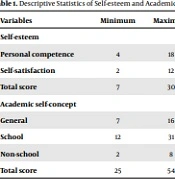
The mean scores of total self-esteem and academic self-concept were 18.48 ± 5.15 and 37.96 ± 4.98, respectively (Table 1). The results of Pearson’s correlation-coefficient also indicated a significant correlation between academic self-concept and self-esteem (r = 0.351; P < 0.001) (Table 2). In other words, the increased score of academic self-concept in the residents, interns, and clerkships of Shahid Beheshti Hospital led to their higher self-esteem.
Table 1.
Descriptive Statistics of Self-esteem and Academic Self-concept
| Variables | Minimum | Maximum | Mean ± SD |
|---|---|---|---|
| Self-esteem | |||
| Personal competence | 4 | 18 | 11.05 ± 3.09 |
| Self-satisfaction | 2 | 12 | 7.43 ± 2.27 |
| Total score | 7 | 30 | 18.48 ± 5.15 |
| Academic self-concept | |||
| General | 7 | 16 | 10.98 ± 1.77 |
| School | 12 | 31 | 21.82 ± 3.19 |
| Non-school | 2 | 8 | 5.16 ± 1.21 |
| Total score | 25 | 54 | 37.96 ± 4.98 |
Table 2.
Matrix of Correlation Coefficients Between Academic Self-concept and Self-esteema a
| Personal Competence | Self-satisfaction | Total Score (self-esteem) | General | School | Non-school | Total Score (Academic Self-concept) | |
|---|---|---|---|---|---|---|---|
| Personal competence | 1 | 0.845 (< 0.001) | 0.972 (< 0.001) | 0.388 (< 0.001) | 0.225 (0.011) | 0.107 (0.232) | 0.308 (< 0.001) |
| Self-satisfaction | 1 | 0.947 (< 0.001) | 0.436 (< 0.001) | 0.295 (0.001) | 0.135 (0.132) | 0.377 (< 0.001) | |
| Total score (self-esteem) | 1 | 0.425 (< 0.001) | 0.265 (0.003) | 0.124 (0.167) | 0.351 (< 0.001) | ||
| General | 1 | 0.501 (< 0.001) | 0.229 (0.010) | 0.733 (< 0.001) | |||
| School | 1 | 0.432 (< 0.001) | 0.925 (< 0.001) | ||||
| Non-school | 1 | 0.601 (< 0.001) | |||||
| Total score (academic self-concept) | 1 |
a Data reported as correlation-coefficients (P-value).
A significant correlation was observed between academic self-concept and self-esteem in the female participants (P < 0.001). Moreover, a significant correlation was denoted between academic self-concept and self-esteem in those aged less than 30 years and those aged 30 years or more (P < 0.05). Among the residents and interns, academic self-concept had a significant correlation with self-esteem (P < 0.01) (Table 3).
Table 3.
Results of Pearson's Correlation-Coefficient on Academic Self-concept and Self-esteem by Gender, Age, and Education Level
| Personal Competence & General | Personal Competence & School | Personal Competence & Non-school | Self-satisfaction & General | Self-satisfaction & School | Self-satisfaction & Non-school | Self-esteem & Academic Self-concept | |
|---|---|---|---|---|---|---|---|
| Gender | |||||||
| Female | 0.402 (0.001) | 0.330 (0.006) | 0.251 (0.038) | 0.473 (< 0.001) | 0.402 (0.001) | 0.238 (0.049) | 0.463 (< 0.001) |
| Male | 0.383 (0.003) | 0.092 (0.496) | -0.081 (0.548) | 0.405 (0.002) | 0.175 (0.193) | 0.012 (0.932) | 0.225 (0.093) |
| Age | |||||||
| < 30 | 0.370 (< 0.001) | 0.202 (0.060) | 0.212 (0.049) | 0.423 (< 0.001) | 0.262 (0.014) | 0.237 (0.27) | 0.333 (0.002) |
| ≥ 30 | 0.402 (0.017) | 0.337 (0.048) | -0.089 (0.611) | 0.462 (0.005) | 0.435 (0.009) | -0.053 (0.761) | 0.428 (0.010) |
| Educational degree | |||||||
| Resident | 0.443 (0.002) | 0.324 (0.028) | -0.031 (0.837) | 0.448 (0.002) | 0.407 (0.005) | 0.012 (0.936) | 0.461 (0.001) |
| Intern | 0.490 (< 0.001) | 0.384 (0.006) | 0.429 (0.002) | 0.557 (< 0.001) | 0.414 (0.003) | 0.489 (< 0.001) | 0.551 (< 0.001) |
| Clerkship | 0.192 (0.310) | 0.010 (0.957) | -0.130 (0.495) | 0.291 (0.119) | 0.101 (0.595) | -0.142 (0.455) | 0.085 (0.654) |
a Data reported as correlation-coefficients (P-value).
5. Discussion
The results of the present study indicated a significant positive correlation between academic self-concept and self-esteem in the residents, interns, and clerkships. In a similar study, Ghaffari and Arfa Balluchi evaluated the correlation between achievement motivation and academic self-concept with exam anxiety in the graduate students of Ferdowsi University of Mashhad (Iran), reporting that a combination of motivation and academic self-concept could predict exam anxiety (11). In the mentioned study, the results of multivariate analysis of variance showed no significant differences between male and female students in terms of academic self-concept, achievement motivation, and test anxiety. Therefore, the researchers concluded that special attention should be paid to the beliefs and perceptions of individuals about themselves and their abilities, as well as the motivational variables that affect their performance in educational situations (11).
In another research, Tamanaifar et al. investigated the correlation between emotional intelligence, self-concept, self-esteem, and academic achievement. The findings demonstrated no significant difference between the emotional intelligence and self-concept of male and female students, while the self-esteem of the female students was higher compared to the male students. To assess the influential factors in academic achievement, it is not possible to only emphasize on cognitive structures such as emotional intelligence, self-concept, and self-esteem (7).
The results of the present study are consistent with the study by Tamanaifar et al. (7). Our findings are also in line with the study by Ghaffari and Arfa Balluchi (11), which indicated no significant differences between the male and female students in terms of academic self-concept, achievement motivation, and test anxiety. Furthermore, the results of the present study are consistent with the findings of Raeisoon et al. (12), which indicated a positive and significant correlation between self-concept and self-esteem with students' academic success.
The results of the present study are inconsistent with the study by Nagy et al. (13), which investigated the self-concept of male and female students, showing that the male students had higher self-concept compared to the female students. This discrepancy may be due to differences in the target population and the research community. In another study, Yousefi assessed the correlation between parenting styles, social skills, and various aspects of self-concept in high school students. The obtained results indicated that in the Iranian culture, the perception of the family as a determinant or authoritarian predicts antisocial behavior, aggression, and impulsive behaviors in individuals. On the other hand, the perception of family as an intimate and supportive unit could predicts all aspects of students' self-concept (14).
Hosseini Dolat Abadi investigated the effects of a creativity education program for teachers on the knowledge creativity, academic achievement, and self-concept of students. Considering the effects of the teachers' creativity education program on the students' academic achievement creativity and self-concept, this program should be used as a suitable model for fostering creativity in students and enhancing academic achievement in schools across the country (15).
In another study, Najarpour Ostadi evaluated the effects of family emotional climate, self-concept, self-esteem, and socioeconomic status on the formation of youth identity, reporting that individuals with a favorable family emotional climate, positive self-concept, high self-esteem, and socioeconomic status were superior in terms of identity formation. Furthermore, the mentioned study indicated that gender and being a student had no effect on identity formation, but increased age was associated with identity in students (16).
Fani and Khalifeh also evaluated the correlation between the perception of teachers' behavior with academic self-concept and academic performance of middle school students in Shiraz (Iran), reporting a significant association between the perception of teachers’ behavior, academic self-concept, and academic performance in general and depending on gender. In the students of the first and third grades, the correlation between the perception of teachers’ behavior and academic performance was not considered significant in the mentioned study (17).
In another study, Michaeli et al. investigated the correlation between self-concept and academic burnout with the academic performance of third and fourth grade female high school students in Ardabil (Iran), reporting a significant association between self-concept, academic burnout, and its subscales with academic performance. According to the results of multivariate regression in the mentioned study, academic apathy and self-concept were the strongest predictors of academic performance. Therefore, the academic performance of the students could be improved by creating interest in the learners (18).
Ferla et al. examined the structural correlation between academic self-efficacy and academic self-concept, concluding that academic self-efficacy and academic self-concept are two completely different concepts. Accordingly, learners' academic self-concept strongly influenced their self-efficacy beliefs, and academic self-concept was also a stronger predictor of emotional-motivational variables, while academic self-efficacy was a better predictor of academic achievement (8).
In another research, Nagy et al. assessed the self-concept of male and female students, observing that the male students had higher self-concept compared to the females. In addition, fundamental differences were reported in competence-based beliefs, which indicated differences in various dimensions of self-concept. It could also be stated that female students are more skeptical about their competence in mathematics, which affects their performance, while male students are skeptical about their ability to read, which leads to their poor reading performance (13).
Ghobari Bonab and Hejazi investigated the correlation between courage and self-esteem with academic achievement in normal and gifted students. According to the obtained results, gifted learners were superior to normal learners in terms of courage, self-esteem, and academic achievement, while no significant differences were observed between these variables in two genders (19).
In another study, Aghajani et al. evaluated and compared the emotional intelligence and self-concept of gifted and normal students. The obtained results indicated that the self-concept of the gifted female students was significantly higher compared to the normal female students. Moreover, the mean self-concept of gifted male students was reported to be significantly higher than normal male students (20).
5.1. Limitations of the Study
Although our study was performed in a teaching hospital, it was only performed on medical students at different levels of education. Therefore, the studied variables in students of other medical sciences should be examined for more accurate results.
5.2. Suggestions
Since other factors could also affect the academic achievement of students and these factors play a key role in the optimal education of graduates, qualitative studies are recommended in this regard.
5.3. Conclusions
The obtained results indicated a positive and significant correlation between the academic self-concept and self-esteem of medical students. Therefore, it is essential for universities and professors to pay attention to students' self-concept and self-esteem to enhance learners' positive attitudes toward themselves and prevent negative attitudes.