
1. Background
Qilla al-Laban is the Unani term for decreased milk production (1, 2). Breast milk is considered the ideal nutrition as it provides a unique biological and emotional basis for the proper development of the infant (3). Maternal perceptions regarding inadequate milk supply are the most common reason reported by mothers for discontinuing breastfeeding prematurely, with prevalence rates ranging from 30% to 80% (4). A mother's inability to produce adequate breast milk to nourish her baby is called lactation insufficiency (1, 4). The perception of inadequate milk supply often leads to reduced breastfeeding frequency, which can actually lower breast milk production (5). The incidence of lactation failure can reach between 5% and 15% during the first month. When considering exclusive breastfeeding for six months, this rate can increase to as much as 40% (6). Insufficient maternal breastfeeding leads to a significant occurrence of malnutrition, increased susceptibility to infections, developmental issues, and a breakdown in the mother-infant bond (7). The World Health Organization (WHO) advises that mothers exclusively breastfeed their infants for the first six months and continue breastfeeding alongside appropriate complementary solid foods until the child is two years old (4). A complex interplay of hormones and neurotransmitters controls milk production. The anterior pituitary gland releases prolactin in response to nipple stimulation; this secretion is suppressed by dopamine produced from the hypothalamus (8). The primary causes of inadequate milk production include anemia, insufficient breast tissue, postpartum hemorrhage, depression, improper feeding practices, hormonal imbalances, as well as factors such as low birth weight, birth asphyxia, and certain medical conditions or defects like cleft palate, which can hinder effective suckling and lactation (5).
Pharmacological therapies, including metoclopramide, oxytocin, and domperidone, are occasionally used; however, safety issues related to these medications have restricted their use (7). Drugs that act on dopamine can affect lactation (8). Herbal galactagogues are gaining popularity as a means to enhance breast milk production (5).
In the Unani system of medicine, Qilla al-Laban is defined as a condition in which a mother is unable to feed her baby to the baby’s satisfaction and nutrition owing to her weakness or the deficiency of blood (9). According to Unani scholars, Qilla al-Laban is caused by an alteration in kayfiyat-i-dam (quality of blood) (10, 11), Qillat-i-dam (anemia) (9, 11-13), Kami Ghidha (decreased intake of nutritive diet) (11, 14, 15), Su’-i-Mizaj sada (simple morbid temperament) or Maddi (morbid temperament with substance) of badan (body) or pistan (breasts) (11, 12, 14, 16), and psychological factors (anger, stress, sorrow) and least affection and love toward the child (13, 16). According to Unani classical texts, the herbs that constitute the properties of Mudirr-i-Mani (agent that increases semen secretion) are also said to have Mudirr-i-Laban (agent that increases milk secretion) property (10, 12, 16).
To enhance milk production, several drugs have been mentioned in classical Unani texts. Badiyan is one among them, which has been used as Mudirr-i-Laban (17-23) since ancient times in India and across the world, but its Mudirr-i-Laban property has not been studied clinically on scientific parameters.
2. Methods
2.1. Study Settings
This single-arm interventional trial was carried out following the approval of the institutional ethics committee BJP/LUMC/PG/IEC/04/2018-2019/IQAN/02 and registered in Clinical Trial Registry India (CTRI/2019/02/017493). This study was conducted at the Department of Amraze Niswan wa Ilmul Qabalat, Luqman Unani Medical College, Hospital and Research Centre Naubag, Vijayapura, Karnataka, India. The participants with insufficient milk supply in lactating mothers fulfilling inclusion criteria were enrolled in the study from November 2019 to March 2021.
2.2. Criteria
2.2.1. Inclusion Criteria
Lactating mothers who had uncomplicated term deliveries and have inadequate milk supply and infants crying immediately after feeding, or painful sensation in breasts during the time of feeding. Baby age between one to six months and baby weight not less than 2.5 kg at birth.
2.2.2. Exclusion Criteria
Participants with a history of breast surgery, breast abscess, breast cancer, breast lump, mastitis, and cracked nipples, and those with epilepsy, psychosis, and tobacco and alcohol addiction. Participants on concomitant medications and oral contraceptive pills, history of systemic illnesses, previous history of breast surgery, and congenital abnormalities in the baby.
2.3. Intervention: Tukhm Badiyān (Foeniculum vulgare)
Drug Tukhm Badiyan (F. vulgare) was procured from a registered herbalist from Bijapur, Karnataka. The drug was cleaned and dried, then powdered in a mixer grinder. A small sachet containing 7 g of powder was made, and a total of 30 sachets were dispensed in a large lock bag to the patient at each follow-up for 60 days, such that the participants received 30 sachets at each of the 4 follow-ups: At baseline, 15th day, 30th day, and 45th day (17-23).
2.4. Treatment Procedure
Participants were instructed to mix 1 sachet in 250 mL of cow milk and take it orally twice a day continuously for 60 days. Compliance to treatment was assessed by checking lock bags in which the drug was dispensed. Participants were asked to bring the lock bags given in the previous visits. Concomitant therapy was not allowed during the course of the trial.
2.5. Outcome Measures
This trial extended over a period of 60 days and comprised four follow-up sessions. From baseline to treatment completion, the treatment response was evaluated by monitoring the baby's weight, which was consistently measured using the same scale during each visit. The volume of supplementary feed, in which mothers were advised to record the amount of milk they gave their babies in a diary and submit it to the researcher at the next visit.
Maternal satisfaction regarding the state of lactation: The response of the mother regarding the state of lactation was assessed with the help of the Likert scale, which was graded as 1 = Very unsatisfactory, 2 = Unsatisfactory, 3 = Fairly satisfactory, 4 = Satisfactory, 5 = Highly satisfactory (Annexure IV). Maternal satisfaction regarding well-being and happiness of the baby was assessed with the help of a Likert scale, which was graded as 1 = Very unsatisfactory, 2 = Unsatisfactory, 3 = Fairly satisfactory, 4 = Satisfactory, 5 = Highly satisfactory.
2.6. Statistical Analysis
Per-protocol analysis, encompassing both descriptive and inferential methods, has been conducted in this trial. Continuous measurement results are expressed as mean ± SD (minimum - maximum), while categorical measurement results are shown as No. (%). A significance level of 5% is employed for assessment. The following assumptions regarding the data are established: (1) Dependent variables must exhibit a normal distribution, (2) samples must be randomly selected from the population, and (3) cases within the samples should be independent. The paired t-test is applied to evaluate the null hypothesis that the mean of the differences between paired observations is zero. The student t-test (two-tailed, dependent) is utilized to determine the significance of study parameters on a continuous scale within each group. The Paired Proportion test is used to evaluate the significance of proportions in paired datasets. Notably, a smaller percentage of improvement is deemed significant at the lower tail compared to the higher tail; for instance, an improvement from 10% to 20% is more challenging than an improvement from 80% to 90%.
3. Results
3.1. Participant Flow
Out of the 101 participants screened, 31 qualified for inclusion in the study. During the study period, only one participant was lost to follow-up, resulting in a total of 30 participants who successfully completed the 60-day treatment protocol. The data were analyzed according to the protocol, excluding the dropout (Figure 1).
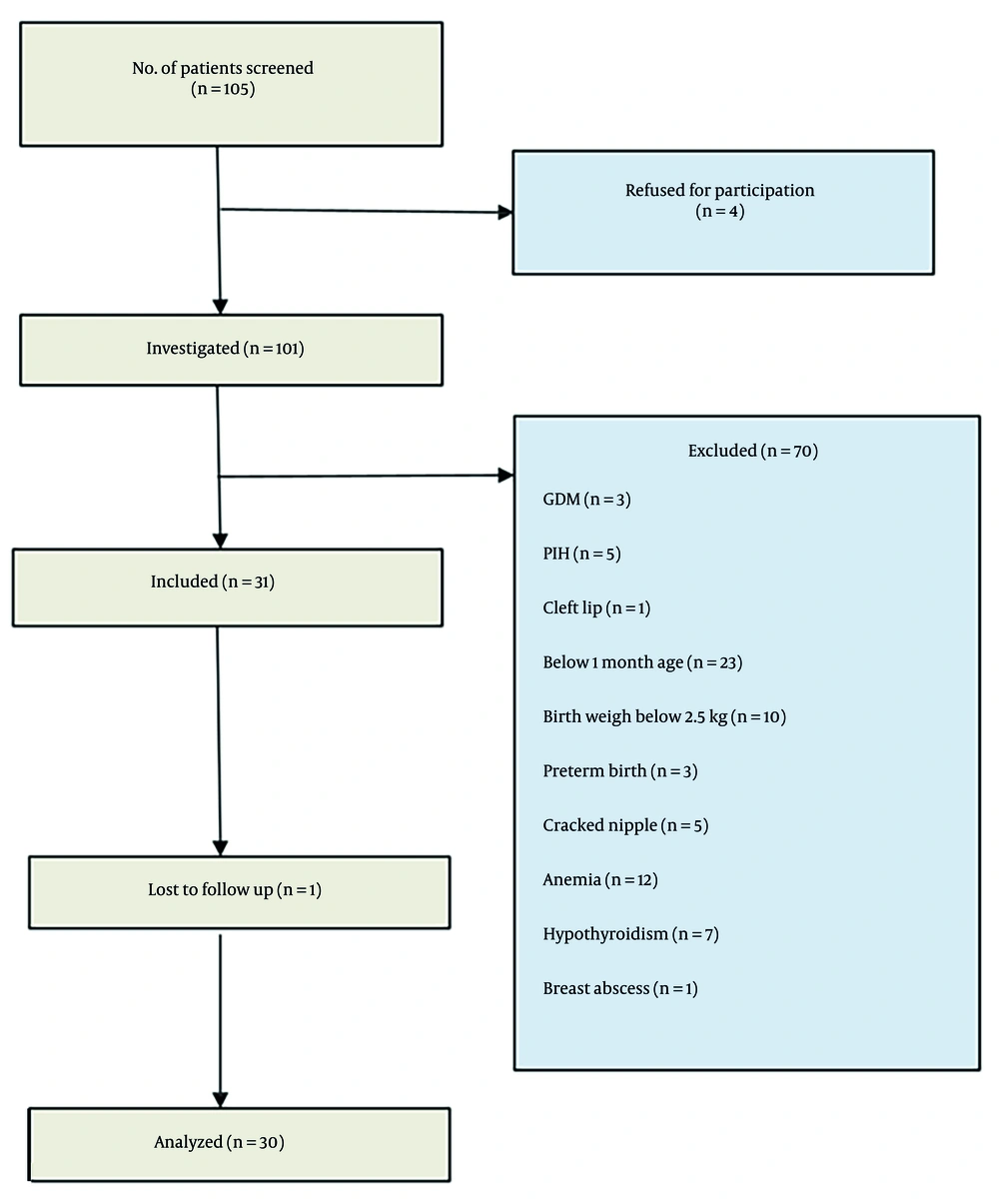
Figure 1.
Flow chart of study
3.2. Clinico-Demographic Characteristics
The mean age of the mothers complaining of inadequate lactation was 25.43 years. 73.4% of mothers were educated up to primary and secondary level, and 26.7% were graduates (Table 1). The majority of participants were housewives. The lower middle class had the highest incidence of lactational insufficiency. The majority of participants in our study had mixed dietary patterns (96.7%). 83.3% were urban. 96.7% of mothers had normal BMI. 90% of mothers had balghami mizaj, followed by safravi mizaj and damvi mizaj (Table 2). The maximum number of mothers were primiparous and did not have experience of previous breastfeeding. In our study, 60% of mothers delivered vaginally, whereas 40% delivered abdominally. Only term deliveries and babies having birth weights above 2500 g were included (Table 3). In our study, 53.3% male babies were delivered and 46.7% female babies were delivered. The maximum number of mothers complaining of insufficiency of lactation-initiated breastfeeding after 24 hours. The maximum number of mothers used pacifiers for their babies. 36.7% of babies were enrolled at the age of > 90 days, 30% of babies were between 30-50 days, 20% were between 51 - 70 days, and 13.3% of babies were enrolled at the age of 71 - 90 days.
Table 1.
Demographic Distribution of the Patients Studied (N = 30)
| Variables | No. (%) |
|---|---|
| Maternal age (y) | |
| 20 - 24 | 15 (50) |
| 25 - 29 | 10 (33.3) |
| 30 - 35 | 5 (16.7) |
| Maternal educational status | |
| Graduate | 8 (26.7) |
| Secondary | 11 (36.7) |
| Primary | 11 (36.7) |
| Maternal occupation | |
| Clerk | 2 (6.7) |
| Housewife | 22 (73.3) |
| Librarian | 1 (3.3) |
| Student | 1 (3.3) |
| Teacher | 4 (13.3) |
| Social economic status | |
| Lower middle | 16 (53.3) |
| Upper lower | 7 (23.3) |
| Upper middle | 7 (23.3) |
| Religion | |
| Hindu | 1 (3.3) |
| Muslim | 29 (96.7) |
| Diet | |
| Mixed | 29 (96.7) |
| Vegetarian | 1 (3.3) |
| Habitat | |
| Rural | 5 (16.7) |
| Urban | 25 (83.3) |
| Body Mass Index (kg/m2) | |
| 18.5 - 24.9 | 29 (96.7) |
| 25.0 - 29.9 | 1 (3.3) |
| Total | 30 (100) |
Table 2.
Distribution of Patients According to Mizaj
| Mizaj | No. (%) |
|---|---|
| Balghami | 27 (90.0) |
| Damvi | 1 (3.3) |
| Safravi | 2 (6.7) |
| Total | 30 (100.0) |
Table 3.
Distribution of Mother According to Obstetric Variables a
| Variables | Values |
|---|---|
| Previous breastfeeding practice | |
| Yes | 12 (40) |
| No | 18 (60) |
| Mode of delivery | |
| Caesarean section | 12 (40) |
| Normal delivery | 18 (60) |
| GA at birth (wk) | |
| 39 - 40 | 8 (26.7) |
| 41 - 42 | 22 (73.3) |
| Mean ± SD | 41.03 ± 0.85 |
| Antenatal care | |
| Regular | 28 (93.3) |
| Irregular | 2 (6.7) |
| Total | 30 (100) |
a Values are expressed as No. (%) unless indicated.
3.3. Change in Efficacy Parameters
3.3.1. Maternal Satisfaction Score Regarding State of Lactation
At baseline, 76.7% of mothers were very unsatisfied and 23.3% of mothers were unsatisfied, while after 60 days of taking the test drug, 73.3% of women were found satisfied and 26.7% of mothers were observed highly satisfied, indicating that the test drug helped in improving lactation, resulting in satisfaction in the lactating mother regarding their state of lactation. At baseline, the mean score regarding the state of lactation was 1.23 ± 0.43, while it was 2.06, 2.80, 3.56, and 4.26 on the 15th day, 30th day, 45th day, and 60th day, respectively (Table 4). These changes in the mean were compared with the baseline mean score by using the student t-test, and the changes were highly significant with a P-value of < 0.001 (Table 4).
Table 4.
Comparison of Maternal Satisfaction Regarding State of Lactation at Various Time Points
| Maternal Satisfaction Regarding State of Lactation | Minimum - Maximum | Mean ± SD | Z-Value | % of Improvement | P-Value |
|---|---|---|---|---|---|
| Base-line | 1.00 - 2.00 | 1.23 ± 0.43 | - | - | - |
| 15th day | 1.00 - 3.00 | 2.06 ± 0.58 | -4.13 | 70.87 | < 0.001 |
| 30th day | 2.00 - 4.00 | 2.80 ± 0.55 | -4.90 | 116.50 | < 0.001 |
| 45th day | 3.00 - 4.00 | 3.56 ± 0.50 | -4.89 | 194.17 | < 0.001 |
| 60th day | 4.00 - 5.00 | 4.26 ± 0.44 | -4.94 | 262.14 | < 0.001 |
3.3.2. Maternal Satisfaction Score Regarding Overall Well-being of the Baby
At baseline, 96.7% of mothers were very unsatisfied and 3.3% of mothers were unsatisfied regarding the overall well-being of the baby, while after 60 days, 73.3% of mothers were found satisfied and 26.7% of mothers were reported highly satisfied. Further, at baseline, the mean score regarding the overall well-being of the baby was 1.03, and on the 15th day, 30th day, 45th day, and 60th day, it was reported as 1.76, 2.23, 3.03, and 3.73, respectively (Table 5). When these changes in the mean score were compared with the baseline mean score by using the student t-test, a highly significant result was observed with a P-value of < 0.001.
Table 5.
Comparison of Maternal Satisfaction Regarding Well-Being of Baby at Various Time Points
| Maternal Satisfaction Regarding Well-Being of Baby | Minimum - Maximum | Mean ± SD | Z-Value | P-Value |
|---|---|---|---|---|
| Base-line | 1.00 - 2.00 | 1.03 ± 0.18 | - | - |
| 15th day | 1.00 - 3.00 | 1.76 ± 0.50 | -4.31 | < 0.001 |
| 30th day | 2.00 - 3.00 | 2.23 ± 0.43 | -4.98 | < 0.001 |
| 45th day | 2.00 - 4.00 | 3.03 ± 0.49 | -5.03 | < 0.001 |
| 60th day | 3.00 - 4.00 | 3.73 ± 0.44 | -5.03 | < 0.001 |
3.3.3. Volume of Supplementary Feed
At baseline, 46.7%, 30%, and 23.3% of babies received 101 - 150 mL, 151 - 200 mL, and 51 - 100 mL of formula milk, respectively, while after the 60th day, 76.7% of mothers stopped the volume of supplementary feed, whereas 23.3% of mothers received between 1 - 50 mL of formula milk. Further, the mean volume of supplementary feed was 135, 102, 67, 34, and 7 mL at baseline, 15th day, 30th day, 45th day, and 60th day, respectively (Table 6). The changes in the mean score, when compared with the baseline mean score by using the student t-test, showed a highly significant result with a P-value of < 0.001.
Table 6.
Comparison of Volume of Supplementary Feed at Different Time Points
| Volume of Supplementary Feed (mL) | Minimum - Maximum | Mean | Standard Deviation | % of Improvement | P-Value |
|---|---|---|---|---|---|
| Base-line | 80.00 - 180.00 | 135.00 | 32.46 | - | - |
| 15th day | 60.00 - 150.00 | 102.00 | 30.10 | 24.44 reduction | < 0.001 |
| 30th day | 30.00 - 100.00 | 67.67 | 24.87 | 50.37 reduction | < 0.001 |
| 45th day | 0.00 - 60.00 | 34.00 | 20.10 | 74.81 reduction | < 0.001 |
| 60th day | 0.00 - 30.00 | 7.00 | 12.91 | 94.81 reduction | < 0.001 |
3.3.4. Baby Weight
In this study, as shown in Table 7, at baseline, the weight of the baby was between 4001 - 5000 g in 50%, between 5001 - 6000 g in 26.7%, and 6000 g in 3%. After 60 days of treatment with the test drug, > 6000 g baby weight was noted in 60% and between 5001 - 6000 g was observed in 40%. Further, the mean baby weight was 4631.90 g at baseline, which improved by 290.43 g on day 15, 662.77 g on day 30, 1129.43 g on day 45, and 1735.43 g on day 60. The changes in the mean score, when compared with the baseline mean score by using the student t-test, showed a highly significant result with a P-value of < 0.001.
Table 7.
Distribution of Mother According to Weight of Baby at Different Time Points
| Weight of the Baby (g) | Minimum - Maximum | Mean ± SD | Mean Differences (g) | t-Value | % of Improvement | P-Value |
|---|---|---|---|---|---|---|
| Base-line | 3650.00 - 6100.00 | 4631.90 ± 746.51 | - | - | - | - |
| 15th day | 3950.00 - 6450.00 | 4922.33 ± 749.76 | 290.43 | -34.81 | 6.3 | < 0.001 |
| 30th day | 4300.00 - 6850.00 | 5294.66 ± 748.91 | 662.77 | -37.21 | 14.3 | < 0.001 |
| 45th day | 4750.00 - 7300.00 | 5761.33 ± 748.49 | 1129.43 | -38.57 | 24.4 | < 0.001 |
| 60th day | 5300.00 - 7850.00 | 6367.33 ± 767.91 | 1735.43 | -39.47 | 37.5 | < 0.001 |
3.4. Safety Evaluation
For safety evaluation, haemogram, liver function test, and renal function test were done. Although no such adverse effects prompted participant withdrawal.
4. Discussion
The findings of the present study indicate that Badiyan is efficacious in lactational insufficiency. Also, there was a significant improvement in baby weight, maternal satisfaction score regarding the state of lactation, and maternal satisfaction score regarding the overall well-being of the baby. Badiyan was found safe and had no side effects. Fennel has been used as a galactagogue to enhance milk production in breastfeeding mothers; the presence of phytoestrogens in fennel is believed to stimulate the growth and development of breast tissue (24). Foeniculum vulgare has been found, through phytochemical studies, to possess a variety of compounds including saponins, flavonoids, cardiac glycosides, sterols, triterpenes, coumarins, proteins, volatile oils, trace elements, and vitamins (25). Fennel contains hydroxyl cinnamic acid derivatives, flavonoids, glycosides, and flavonoid aglycones; flavonoids like rosmarinic acid, quercetin-3-rutinoside, and eriodictyol-7-rutinoside (26). Mradu and Badri have reported that the galactagogue property of Asparagus racemosus is due to the presence of phytoestrogens. The presence of steroidal saponins and sapogenins has been demonstrated to play a direct role in the lactogenic effect of A. racemosus (27).
Similarly, the galactagogue activity of fenugreek and banana flower has been attributed to the presence of phytoestrogens by researchers (28, 29). Research indicates that phytochemicals such as alkaloids, isoflavones, polyphenols, tannins, and saponins have an impact on milk production. These compounds have been shown to promote milk ejection, elevate milk protein content, and boost lactation by raising prolactin levels (30). The researchers have elucidated the mechanism by which phytoestrogens exert their galactagogue effects. These compounds interact with receptors in the mammary glands, promoting the proliferation of alveolar cells (31). Subsequently, phytoestrogens engage with β-estradiol receptors on lactotrophic cells in the anterior pituitary, potentially stimulating the expression of the prolactin gene via the α-isoform of membrane-associated estrogen. Another proposed mechanism involves phytoestrogens functioning as dopamine antagonists, which may inhibit the dopamine receptor pathway and consequently enhance prolactin secretion, thereby facilitating milk production (30, 31). Due to their structural similarity to endogenous estrogen, phytoestrogens can bind to both α and β estrogen receptors, allowing them to function as either estrogen agonists or antagonists, which may influence the structure and operation of the endocrine system30. These actions attributed to this drug might improve mothers' milk production in this study.
Compared with modern pharmaceutical galactagogues, such as domperidone, metoclopramide, chlorpromazine, oxytocin, sulpiride, and medroxyprogesterone, which are effective in increasing milk production but may carry risks like cardiac side effects, Badiyan offers a traditional, plant-based alternative with a favorable safety and tolerability profile when authentic drug is used (32, 33). Unlike many pharmaceutical agents, which require medical oversight due to the potential for serious adverse reactions, some plants have galactagogue content, such as fenugreek (Trigonella foenum-graecum), star anise (Pimpinella anisum), Asparagus (A. racemosus), and milk thistle (Silybum marianum) (32, 33).
Limitations of the present study include a single-arm trial with a small sample size and a short treatment duration. Moreover, further studies are necessary that address these issues and also examine the efficacy of different doses and treatment duration of Badiyan with phytochemical analysis and incorporation of hormonal assays to explore the underlying mechanisms of Badiyan’s action.
4.1. Conclusions
This trial concluded that Badiyan (F. vulgare) is effective in the treatment of Qilla al-Laban. Nevertheless, it is crucial to undertake additional rigorously designed, double-blind, randomized controlled clinical trials using plant extracts, with a larger participant pool and longer treatment periods, while applying validated scientific parameters to strengthen the reliability of the scientific findings.