
1. Introduction
Breast cancer (BC) is the second most prevalent malignancy worldwide. Recent advances in molecular biology have highlighted the contribution of genetic and/or epigenetic alterations in this malignancy (1, 2). The term "epigenetic" pertains to information which is transmitted from the parental genome to the next generation of cells and is not encoded by the original DNA sequence. DNA methylation and histone acetylation are among the most commonly studied epigenetic changes.
Aberrant promoter methylation plays a key role in genetic imprinting, developmental abnormalities, X-chromosome inactivation, and cancer biology (3, 4). Epigenetic silencing of tumor suppressor genes by promoter DNA hypermethylation is a general characteristic of human cancers (5, 6). DNA hypermethylation can inactivate tumor suppressor genes by inducing C-to-T transitions and gene silencing in somatic and germline cells (7).
Apoptosis protease-activating factor-1 (APAF-1) is a central regulator of mitochondria-dependent apoptosis and is an essential component of developmental programmed cell death. Apoptosis or programmed cell death is an important genetic program, required for the appropriate growth of an organism and is recognized as a vital defense mechanism against hyper-proliferation and cancer (8). Recently, there has been a growing interest in APAF-1 due to its methylated DNA, as well as down-regulated expression in various tumors; in fact, APAF-1 appears to act as a tumor suppressor gene.
APAF-1 has been found to be methylated in a number of cancers, including acute lymphocytic leukemia (ALL) (9), metastatic melanomas (10), colorectal cancer (CRC) (11), renal cell carcinoma (RCC) (12), and transitional cell carcinoma (TCC) of the bladder (13). In this regard, Soengas et al. (10) showed that APAF-1 is inactivated in metastatic melanomas, resulting in a defect in the execution of apoptotic cell death. Besides, APAF-1 expression was found to be defective in malignant melanoma (10) or human leukemia cell lines (14), resulting in cancer development.
APAF-1 knockout mice have demonstrated excessive brain growth due to hyper-proliferation of neuronal cells, whereas heterozygous mice seem to lack these alterations. Furthermore, APAF-1 inactivation has been shown to be correlated with disease progression in many cancers, including malignant melanoma (10) or CRC (11). Zlobec et al. showed that APAF-1 expression in CRC reduces during tumor progression and is correlated with tumor grade (11). In malignant melanoma, absence of APAF-1 expression was observed more frequently in metastatic melanomas, whereas cases of primary melanoma rarely showed a decline in APAF-1 level (10).
According to two independent in-vivo studies, treatment of BC (15) or RCC (8) cell lines with 5-Aza-2’deoxycytidine (5-Aza-CdR, a specific inhibitor of DNA methylation) results in a global genomic demethylation and up-regulation of APAF-1 at both mRNA and protein levels, thereby inhibiting the growth of tumor cells possibly through cell apoptosis, induced by APAF-1.
Given the role of APAF-1 in DNA damage–induced apoptosis and its function as a tumor suppressor gene, it is rational to hypothesize that a deficiency in APAF-1 expression plays a role in oncogenesis. With this background in mind, in this study, we analyzed the promoter methylation status of APAF-1 and evaluated its correlation with gene expression in BC. To the best of our knowledge, this is the first population-based study to determine the APAF-1 methylation status in BC.
2. Methods
2.1. Samples and DNA Preparation
This study included 63 paraffin-embedded breast tumors and 63 corresponding normal tissues from the same patients, obtained from operations before chemotherapy. An informed consent was obtained from all the subjects, and the ethics committee of Zahedan University of Medical Sciences approved the study. The demographic and pathological data of the patients are summarized in Table 1.
Table 1.
Clinical and Pathological Characteristics of Breast Carcinoma (BC) Patientsa
| Characteristics | Cases |
|---|---|
| Tumor size, cm | |
| ≤ 2 | 18 (28.6) |
| 2 - 5 | 44 (69.8) |
| > 5 | 1 (1.6) |
| Status of nodal metastasis | |
| 0 | 11 (25.0) |
| 1 - 3 | 29 (65.9) |
| 4 - 9 | 4 (9.1) |
| ≥ 10 | 0 |
| Histological grade | |
| I | 6 (9.5) |
| II | 16 (25.4) |
| III | 11 (17.5) |
| IV | 18 (28.6) |
| Unknown | 12 (19.0) |
| Stage | |
| I | 10 (15.9) |
| II | 31 (49.2) |
| III | 14 (22.2) |
| IV | 8 (12.7) |
| Histology | |
| Ductal carcinoma | 56 (88.9) |
| Others | 7 (11.1) |
| Estrogen receptor | |
| Positive | 34 (54.0) |
| Negative | 27 (42.9) |
| Unknown | 2 (3.1) |
| Progesterone receptor | |
| Positive | 21 (33.3) |
| Negative | 42 (66.4) |
| HER2 | |
| Positive | 26 (41.3) |
| Negative | 37 (58.7) |
aValues are expressed as No. (%).
The inclusion criteria were as follows: 1) female patients with primary BC, 2) availability of paraffin-embedded tissues, and 3) the patient’s clinicopathological data. Patients previously treated with neoadjuvant or adjuvant therapy, as well as those with missing pathological data (e.g., estrogen receptor [ER], progesterone receptor [PR], HER2, and nodal status), were excluded from the study. Slices of formalin-fixed and paraffin-embedded tissues were obtained from each patient.
Diagnosis and differentiation of BC were performed via histopathological examinations, as well as tumor, node, metastasis (TNM) classification. Sample sections were stained in hematoxylin and eosin (H & E) and were examined by two skilled pathologists. DNA was extracted from all tissue samples, using the standard protocol by proteinase K treatment and salting-out extraction method, as previously described (16, 17). The quality and integrity of DNA were examined via electrophoresis on 1% agarose gel, quantified spectrophotometrically, and stored at -20°C till further use.
2.2. Sodium Bisulfite Modification of DNA and Methylation-Specific Polymerase Chain Reaction (MS-PCR)
The DNA samples were treated with sodium bisulfite, which modifies unmethylated C to U, while having no effects on methylated C residues, which resist treatment. We prepared bisulfited DNA, using the method previously described (18, 19). Concisely, NaOH solution was added to 10 μL of DNA (approx. 1 μg) with a final concentration of 0.3 M. Denaturation of DNA strands started efficiently after incubating the mixture at 50°C for 15 minutes.
Afterwards, the mixture was blended with 50 μL of 2% low-melting-point (LMP) agarose and incubated at 50°C for 15 minutes. A 15 μL drop of the mixture was pipetted into 300 μL of cold mineral oil (Sigma). The agarose/DNA drop quickly hardened in the oil, and agarose beads were formed after they were incubated at -4°C for 30 minutes. Aliquots of 700 μL of a 5 M bisulfite reagent (5 M sodium bisulfite, Merck Co.; 125 mM hydroquinone, Merck Co.; pH = 5.0) were added to each reaction tube, containing a single bead. The tube was gently inverted to move the bead into the aqueous phase and was incubated at 55°C in water.
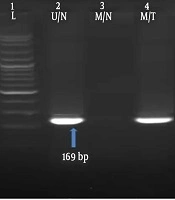
The methylation status of APAF-1 gene was analyzed, using MS-PCR analysis. Two pairs of primers (unmethylated and methylated) were used, as shown in Table 2. PCR cycling conditions were as follows: 95°C for 5 minutes, 30 cycles of 95°C for 45 seconds, 60°C for 30 seconds, 72°C for 30 seconds, and final extension at 72°C for 10 minutes. The PCR products were verified on 2% agarose gel, containing 0.5 μg/mL of ethidium bromide. An image, showing different methylation patterns, was captured (Figure 1). The size of amplicons for the methylated and unmethylated products was 217 bp and 215 bp, respectively.
Table 2.
The Primer Sequences Used for the APAF-1 Methylation (MSP) and Expression (qPCR) Analyses
| Forward Primer (5´ → 3´) | Reverse Primer (5´ → 3´) | |
|---|---|---|
| MSP | ||
| APAF-1 | M: AGGTTTAGTTACGTTTCGTTCG | M: CGTCCACTCGCTACCTCTTC |
| U: AGGTTTAGTTATGTTTTGTTTGTGG | U: CCACTCACTACCTCTTCTTCTCC | |
| qPCR | ||
| GAPDH | TTGCCATCAATGACCCCTTCA | CGCCCCACTTGATTTTGGA |
| APAF-1 | GCTCTCCAAATTGAAAGGTGAAC | ACTGAAACCCAATGCACTCC |
Abbreviations: M, Primers for the methylated genotype; MSP, Methylation-specific PCR; U, Primers for the unmethylated genotype.
![Sample 1: fully unmethylated DNA [UU], 2: semi-methylated DNA [MU], and 3: fully methylated DNA [MM].](https://brieflands.com/journals/gct/articles/13332/figures/gct-4-1-13332-g001-preview-preview.webp "Electrophoresis Pattern of DNA Methylation Analysis of APAF-1 Gene Using Methylation-Specific PCR (MS-PCR)")
Figure 1.
Sample 1: fully unmethylated DNA [UU], 2: semi-methylated DNA [MU], and 3: fully methylated DNA [MM].
2.3. Quantitative Real-Time PCR Analysis (qPCR) of APAF-1
Total RNA was extracted from formalin-fixed paraffin-embedded tissue samples, using the RNeasy® FFPE Kit (QIAGEN), according to the manufacturer’s instructions. Complementary DNA (cDNA) was synthesized, using the RevertAidTM First Strand cDNA Synthesis Kit (Fermentas, LT), based on the manufacturer’s instructions. The qPCR analysis of APAF-1 was performed, using the LightCycler ABI 7500 system (Applied Biosystems Inc., Foster City, CA) and Maxima®SYBR Green/Rox Master Mix (Fermentas, LT), using primers described previously in Table 2 (13).
GAPDH was used as the housekeeping gene, and reaction volumes of 20 μL consisted of 10 μM of the forward primer, 10 μM of the reverse primer, 12.5 μL of the Maxima®SYBR Green/Rox Master Mix, and 3 μL of cDNA as the PCR template. The following program conditions were applied for qRT-PCR running: 95°C for 10 seconds, followed by 40 cycles of 95°C for 10 seconds and 60°C for 1 minute. Gene expression was quantified by the comparative CT method and normalized against the housekeeping gene GAPDH, which was amplified in the same run by following the same procedure described above.
Each qPCR run was performed in duplicate to validate the results, and the mean mRNA expression was used for the analysis of the results. The expression level of APAF-1 was normalized to the transcript level of the housekeeping gene GAPDH, and the ∆∆CT value was calculated for each sample. For the assessment of relative gene expression, we calculated the mean CT for the reference gene in both case and control groups; then, we subtracted the CT of each case from the mean CT (∆∆CT) in the two groups. Finally, the ∆∆CT values were transformed for absolute values (fold), using the formula 2-∆∆CT (20). The mean fold value of breast tumors was compared to that of normal tissues, as shown in Figure 2.
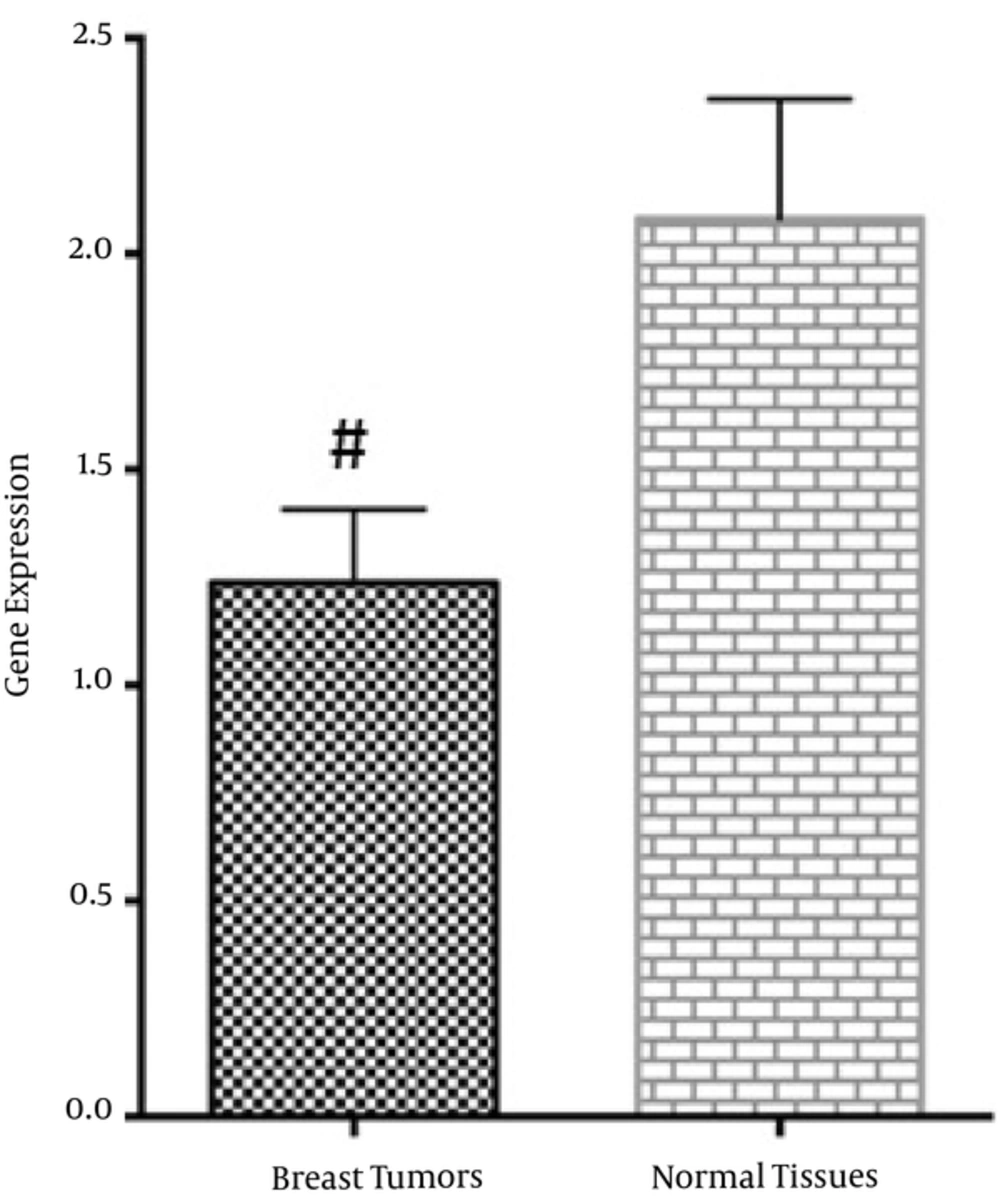
Figure 2.
The APAF-1 mRNA Expression Levels Significantly Reduced in Breast Tumors, Compared to Normal Tissues (#P Value < 0.05 Compared to Normal Tissues).
2.4. Statistical Analysis
All statistical analyses of DNA methylation and gene expression were executed by SPSS version 19. The methylation status was compared between the case and control groups by measuring the odds ratio (OR) and 95% confidence interval (95% CI). One-way ANOVA test was used to compare the mean mRNA levels among groups with different methylation profiles. Probability value less than 0.05 was considered statistically significant.
3. Results
3.1. Detection of Methylation in APAF-1 Gene Using MS-PCR
The promoter methylation status of APAF-1 gene was examined in DNA samples of 63 sporadic breast cancer tumors and 63 adjacent normal tissues from the same patients (average age: 46.2 ± 10.1 years). As presented in Table 3, APAF-1 promoter methylation was associated with the increased risk of BC (OR = 7.27, 95% CI = 3.09 - 17.12; P = 0.001). The methylated phenotype (MM) was more common in breast tumors (36/63 or 57%), compared to the corresponding normal tissues (13/63 or 21%).
Table 3.
Promoter Methylation Frequency of APAF-1 Gene in Breast Tumors and the Corresponding Normal Tissuesa
| APAF-1 Methylation Status | Breast Tumors | Normal Tissues | OR (95% CI) | P Value |
|---|---|---|---|---|
| UU | 16 (25.4) | 42 (66.7) | Ref. | - |
| UM | 11 (17.5) | 8 (12.7) | 3.61 (1.23 - 10.60) | 0.025 |
| MM | 36 (57.1) | 13 (20.6) | 7.27 (3.09 - 17.12) | 0.001 |
Abbreviations: MM, Fully methylated promoter; UM, Semi-methylated promoter; UU, Fully unmethylated promoter.
aValues are expressed as No. (%).
Likewise, the semi-methylated phenotype (MU) was observed more frequently in breast tumors, compared to normal tissues (18% vs. 13%); the difference was found to be statistically significant (OR = 3.61, 95% CI = 1.23 - 10.60; P = 0.025). Additionally, APAF-1 DNA methylation was positively correlated with tumor grade (P < 0.001). According to Table 4, the MM phenotype was present in over 80% of advanced-grade tumors (III and IV), while it was absent in grade I tumors (0%) and present in only 25% of grade II breast tumors (P = 0.001).
Table 4.
The Correlation Between APAF-1 Promoter Methylation and Breast Tumor Gradea
| Methylation Status | Grade I | Grade II | Grade III | Grade IV | P Value |
|---|---|---|---|---|---|
| UU | 4 (66.7) | 9 (56.2) | 2 (18.2) | 0 | 0.001 |
| UM | 2 (33.3) | 3 (18.8) | 0 | 2 (11.1) | |
| MM | 0 | 4 (25.0) | 9 (81.8) | 16 (88.9) |
Abbreviations: MM, Fully methylated promoter; UM, Semi-methylated promoter; UU, Fully unmethylated promoter.
aValues are expressed as No. (%).
Considering other clinicopathological information of the patients, the analysis demonstrated no association between APAF-1 promoter methylation and the patients’ age (P = 0.069), age of menstruation (P = 0.744), menopausal age (P = 0.235), tumor stage (P = 0.092), nodal metastasis (P = 0.119), ER (P = 0.246), PR (P = 0.503), or HER2 (P = 0.197).
3.2. Analysis of Relative APAF-1 Gene Expression
The expression level of APAF-1 gene was determined in all the samples to identify whether hypermethylation of CpG sites in APAF-1 promoter region was correlated with its silenced mRNA expression. The results indicated that the level of mRNA expression was significantly different between breast tumors and the matching normal tissues.
As shown in Figure 2, APAF-1 gene expression was decreased in breast tumors (1.23 ± 0.17), compared to the matching normal tissues (2.08 ± 0.23), and the difference was statistically significant (P = 0.011). Moreover, APAF-1 gene expression level was associated with its DNA methylation status. As demonstrated in Figure 3, the expression level was lower in breast tumors with the methylated phenotype (MM) in comparison with tumors lacking DNA methylation (UU) (P < 0.05).
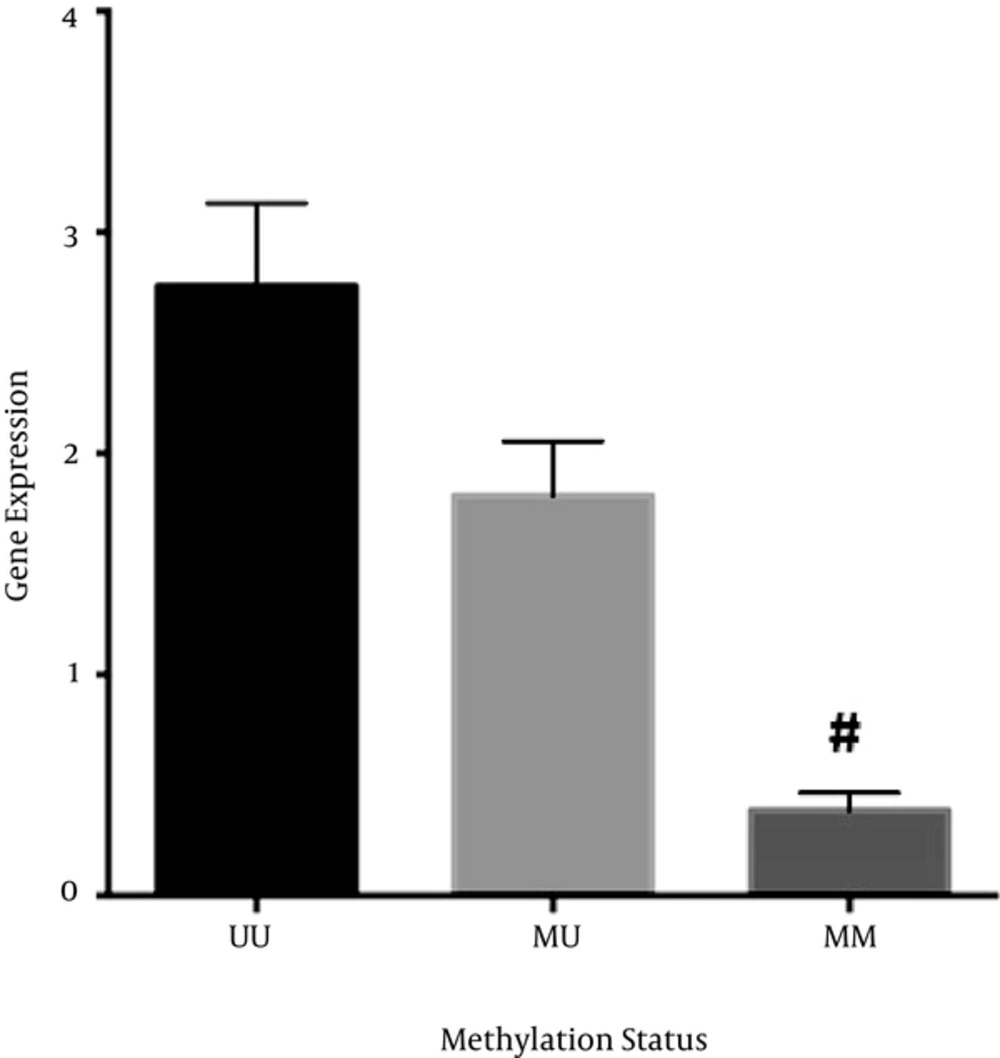
Figure 3.
The APAF-1 mRNA Expression Level was Significantly Lower in the MM Phenotype, Compared to UU (#P Value < 0.05 Compared with the UU Phenotype).
Additionally, APAF-1 gene expression was negatively correlated with tumor grade (P = 0.001). As shown in Figure 4, tumors with higher grades (III and IV) expressed lower levels of APAF-1 transcript, compared to tumors with lower grades (I and II). However, no association was found between APAF-1 expression level and pathological stage, age, ER, PR, or HER2 status of the patients (P > 0.05).
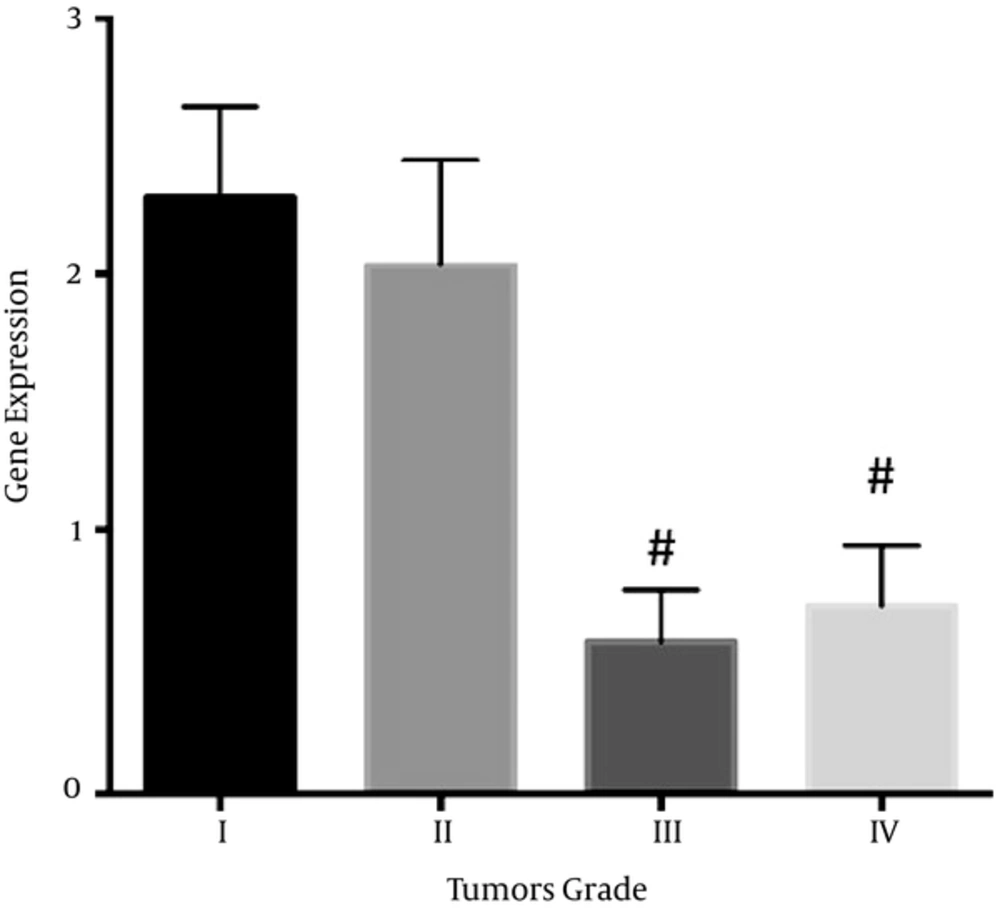
Figure 4.
The APAF-1 mRNA Expression Level Significantly Reduced with Increasing Tumor Grade (#P Value < 0.05 Compared with Grade I or II Tumors).
4. Discussion
The present study demonstrated that the mRNA expression level of APAF-1 gene was decreased in breast tumors, compared to normal breast tissues, and the gene promoter region was subjected to hypermethylation in malignant tissues. Further analysis showed that DNA hypermethylation of APAF-1 gene was correlated with reduced gene expression in breast tumor tissues. The results suggest that epigenetic alterations of APAF-1 gene occur in BC and may affect gene expression, hence the pathogenesis of BC.
In agreement with our findings, several studies have detected APAF-1 hypermethylation in ALL (9), metastatic melanomas (10), CRC (11), RCC (12), and TCC of bladder (13). Soengas et al. (10) showed that APAF-1 is inactivated in metastatic melanomas and impairs the execution of apoptotic cell death. They suggested that APAF-1 is essential for proper apoptosis in melanoma cells. The results showed that returning APAF-1 to physiological levels increases chemosensitivity in malignant melanoma. Besides, Roman-Gomez et al. (9) detected APAF-1 hypermethylation in ALL patients. They found the methylated phenotype of APAF1 DNA in 35% of childhood ALL and 34% of adult ALL patients.
On the other hand, APAF-1 promoter was shown to be unmethylated in several cancers. For instance, Poplawski et al. (21) and Teodoridis et al. (22) identified no methylation for APAF-1 in gastric cancer and advanced ovarian cancer, respectively. Likewise, Chim et al. found no APAF-1 methylation in multiple myeloma or chronic lymphocytic leukemia (23).
In the current study, following the statistical analysis, the expression and hypermethylation of APAF-1 were significantly correlated with the pathological grade (P < 0.05). High-grade tumors (III or IV) more commonly carried the methylated phenotype (80% vs. 25%), compared to low-grade tumors (I or II) and expressed reduced levels of APAF-1 (Figure 4). This finding suggests that APAF-1 inactivation in tumor tissues, caused by DNA methylation, may contribute to breast cancer progression in our population. The present results support the findings of a number of studies on CRC (11), renal cancer (12), malignant melanoma (10), TCC of bladder, and RCC (13).
Christoph et al. observed that APAF-1 methylation levels in TCC of the bladder and RCC increased along with the rise in tumor size, disease stage, and tumor differentiation, suggesting that APAF-1 inactivation by promoter methylation results in the inability of cells to undergo apoptosis (13). A study by Zlobec et al. on CRC revealed that APAF-1 expression is reduced during tumor progression and is correlated with tumor grade (11). Similarly, Ahmad et al. (12) found a significant difference in APAF-1 methylation frequency among four subtypes of renal tumors (P < 0.001) and reported that APAF-1 promoter methylation was directly correlated with a higher tumor stage or higher nuclear grade.
Apoptosis or programmed cell death contributes to the maintenance of cell homeostasis by enabling the removal of physiologically defective cells (4). Dysregulation of apoptosis leads to the survival of defective cells and can contribute to the development of cancer (24). It is well established that cancer cells escape apoptosis through several mechanisms, including loss of function in tumor suppressor genes via mutations or epigenetic alterations (25, 26). As the core of apoptosome complex, APAF-1 is crucial for programmed cell death, and its malfunction may lead to the progress of diverse human neoplasms (27, 28).
APAF-1 in the mitochondrial death machinery (intrinsic pathway) and in the presence of cytochrome c acts as a scaffold and an adapter molecule, which binds to procaspase-9 and promotes its activation. Mature caspase-9 triggers a caspase cascade, necessary for apoptosis (29, 30). APAF-1 was identified as a potential cellular target of FUS1, which is a novel tumor suppressor. Ji et al. (31) indicated that enforced expression of FUS1 in FUS1-deficient tumor cells can induce cytochrome c discharge from mitochondria into cytosol, result in FUS1 binding to APAF-1, and recruit it to vital cellular locations, thereby initiating APAF-1-mediated caspase activation and apoptosis induction. APAF-1 defective cells are unable to activate caspase-9. Once expression is restored by treatment with 5-Aza-CdR, growth of tumor cells is retarded and tumor cells are enabled to trigger the apoptosis pathways (4, 32).
Xiong et al. (32) examined the effects of 5-Aza-CdR on cell proliferation of human BC cell line MCF-7 and expression of APAF-1 gene. They observed that 5-Aza-CdR significantly suppressed the growth of MCF-7 cells and increased mRNA and protein expression of APAF-1 in MCF-7 cells; also, down-regulation of DNA methyltransferase 3b mRNA was observed. They suggested that 5-Aza-CdR might decelerate the growth of tumor cells and induce the apoptosis of MCF-7 BC cells through suppressing the expression of DNA methyltransferase 3b and re-activating APAF-1 gene expression.
Similarly, Zhu et al. (8) demonstrated that 5-Aza-CdR results in a considerable global genomic demethylation and increases the expression of APAF-1 at both mRNA and protein levels in RCC. These studies highlight the crucial function of APAF-1 as a tumor suppressor gene. Overall, the present study indicated that APAF-1 promoter region was subjected to DNA hypermethylation in breast tumor tissues. Also, the methylation status was correlated with APAF-1 expression level and tumor grade.
There was one main limitation in this study. The small sample size might have limited the statistical power. Therefore, further studies on larger sample sizes are required to confirm the precise role of APAF-1 in BC. Besides, further in-depth analyses, such as bisulphite sequencing or CpG site-specific measurements, can help us understand the role of APAF-1 DNA methylation in BC.