
1. Background
The scientific and sports communities believe that genetic factors play a role in sports performance. Since 2009, more than 200 gene variants related to physiological performance have been presented, of which more than 20 genetic variants are associated with athletic talent (1). The athlete's environment (such as nutrition and sports exercises) is also among the important things that affect the athlete's talent. Nutritional supplements such as whey protein, a complex
Milk-derived protein increases cortisol during exercise and resistance training (2). The heritability of a trait is generally taken as an estimate of the importance of genetic factors for that trait. For example, the heritability of athletic performance (regardless of sport) is estimated at 66% (3). For example, height, which is important for success in some sports, is highly heritable, with approximately 80% of its variation due to genetic factors (4).
One of the genes associated with physical performance and health is the gene that encodes angiotensin-converting enzyme (ACE) (3). ACE is a zinc-dependent metallopeptidase that is widely distributed on the surface of endothelial and epithelial cells. ACE converts the decapeptide angiotensin 1 to the active vasoconstrictor octapeptide angiotensin 2.
Angiotensin II is the main active product of the renin-angiotensin system (RAS). Studies have shown that the level of ACE in a person's plasma is constant at different times, while this level varies considerably in different people. These observations indicate the existence of a long-term control system to regulate the amount of this protein in plasma, which seems to have a genetic origin (3).
The ACE gene is located on the long arm of chromosome 17 and is approximately 21 kilobases in length. This gene has 26 exons and 25 introns. This gene encodes the ACE enzyme (3). In 1990, a polymorphism (rs1799752) was discovered in this gene, which was related to deletion (D) or presence (I) of a fragment of 287 base pairs in intron number 16 of the gene (4). ACE I/D is the second most common polymorphism associated with strength training performance after R577X ACTN3. The ACE gene has three genotypes: type II, DD, and ID (3). Most studies show that genotypes with the I allele are associated with better aerobic performance than the DD genotype (4). ACE activity, the D allele (deletion) is associated with higher serum and tissue ACE activity (5).
It has also been suggested that the ACE genotype may affect the metabolic efficiency of muscle during repetitive contractions. It has been shown that the DD genotype of the ACE gene has a strong relationship with cardiovascular disorders, including pathological hypertrophy of the left ventricle, heart infarction, sudden death, and endothelial dysfunction (3).
The ACE II polymorphism has been reported to be associated with improved hand strength and vertical jump performance in Greek adolescent girls but not boys. This contrasts with the typical association of greater strength and power in adults (3). Another study showed an association between the ACE D allele and hand strength in adolescent girls and long jump performance in middle-aged children (4).
Detecting the genotype of bodybuilders and bodybuilders in Ahvaz and comparing it with the control group and foreign studies can help identify and find talents more accurately and reduce errors in the correct selection of talented athletes at a young age in the field of bodybuilding and even similar sports. Finally, it will lead to more success for athletes at the international level. Among the other benefits of such an approach, we can mention the reduction of inappropriate use of financial and human resources. Moreover, based on the study's findings, evaluating genetic markers is also a health monitoring form. The data obtained from the study can be used in the field of public health to prevent and treat diseases using genetic information in the Iranian population.
2. Methods
2.1. Research Subjects
In this research, whole blood was collected from 50 female and 50 male professional athletes and 100 non-athletes with normal BMI with consent.
2.2. Sample Collection and Preparation
Approximately 5 mL of blood was taken from all subjects into Falcon tubes containing 0.5 mL of 0.5 M EDTA solution as an anticoagulant. Then, the DNA of the studied subjects was extracted using the salting method. The quality and quantity of extracted DNAs were evaluated using a nanodrop device and gel electrophoresis.
The PCR reaction was performed using an Applied Biosystems (USA) thermocycler. Amplicon Master Mix was used to perform the reaction. In this research, to design the primers, first, the gene sequence of the human species (Homo sapiens) was prepared from the Ensemble database as a Fasta file, and then primers were designed with the help of the Primer Blast Database and Oligo7 software. The sequence of the primers used is shown in Table 1. PCR was used with the following temperature program: 5 minutes at 95°C and then 35 cycles of 30 seconds at 95°C, 30 seconds at 60°C and 45 seconds at 72°C and finally, 4 minutes at 72°C Centigrade was done for the final elongation. In the final step, three samples with homo-wild/hetero/homo mutant genotypic patterns of PCR products were sent for Sanger sequencing.
Table 1.
Sequence of Primers Designed with Oligo7 Software
| Primer | Sequence |
|---|---|
| Forward | 5’ CTGGAGACCACTCCCATCCTTTCT 3’ |
| Reverse | 5’ GATGTGGCCATCACATTCGTCAGA 3’ |
2.3. Statistical Analysis
After the laboratory procedures were finished and all the people's genotypes were obtained, the results were statistically analyzed using GraphPad Prism Six software and chi-square, t, and logistic regression tests. The significance level of the chi-square test was considered less than 05%. Genotypes and continuous data were compared using ANOVA software, and statistical analyses were also performed using Scheffe post hoc software to identify significant differences between the three genotypes.
3. Results
In this research, the statistical population was selected in the age range between 18 - 30 years, and 50 female and 50 male professional athletes and 100 non-athletes with normal BMI were evaluated. The criteria for selecting professional athletes in this research were athletes with a rank and sports success in winning medals. In this research, the ARMs-PCR method was used after DNA extraction.
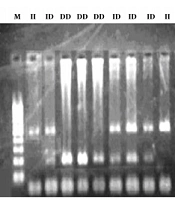
Length of bands obtained for genotype (DD190 bp), genotype ID (190 490 bp), and genotype II (490 bp). To confirm the results of PCR and ARMS-PCR, samples of different genotypes were sequenced (images 1 and 2). The results of the GraphPad Prism 6 statistical analysis related to determining the genotype and allelic frequency of the rs10735810 polymorphism under study in 200 samples are given in Table 2. Among athletes, 28% have the D/D genotype, 24% have the D/I genotype, and 48% have the I/I genotype. The normal distribution of allele frequency in the population of athletes is 40% D allele and 60% I allele. On the other hand, normal people have a 42% D/D genotype, 29% D/I genotype, and 29% I/I genotype.
Table 2.
The Final Results of the Comparison of Genotypes in the ACE Gene in Three Groups a
| Genotype | Female Athlete (n = 50) | Male Athlete (n = 50) | People with Normal BMI, Non-athletes (n = 100) |
|---|---|---|---|
| D/D | 13 (26) | 15 (30) | 42 (42) |
| D/I | 10 (20) | 14 (28) | 29 (29) |
| I/I | 27 (54) | 21 (42) | 29 (29) |
a Values are expressed as No. (%).
The normal distribution of allelic frequency among the people of the control group is 57% D allele and 43% I allele; that difference in allelic frequency among athletes compared to the control group (normal people) is significant with P value < 0.05 (P value: 0.0085). By examining the above data, it seems that insertion mutation in the ACE gene can be related to people's talent in the sports field. And this indicates the possibility of genetic background in athletes. Figure 1 shows the genotypic percentage of people in three groups of men and women, athletes and non-athletes with normal BMI. The frequency of D and I alleles is also shown in Figures 2 and 3.
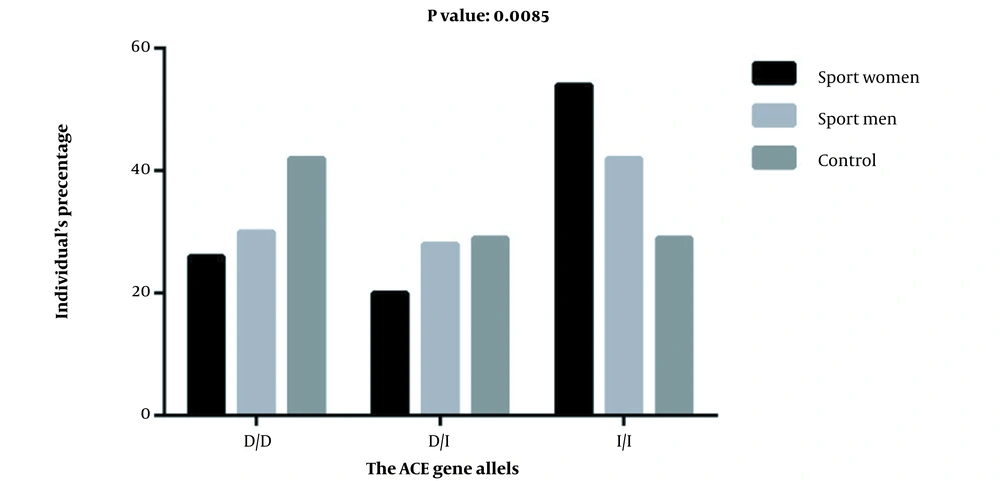
Figure 1.
Genotype frequency percentage of people in three groups of male and female athletes and non-athletes with normal BMI.
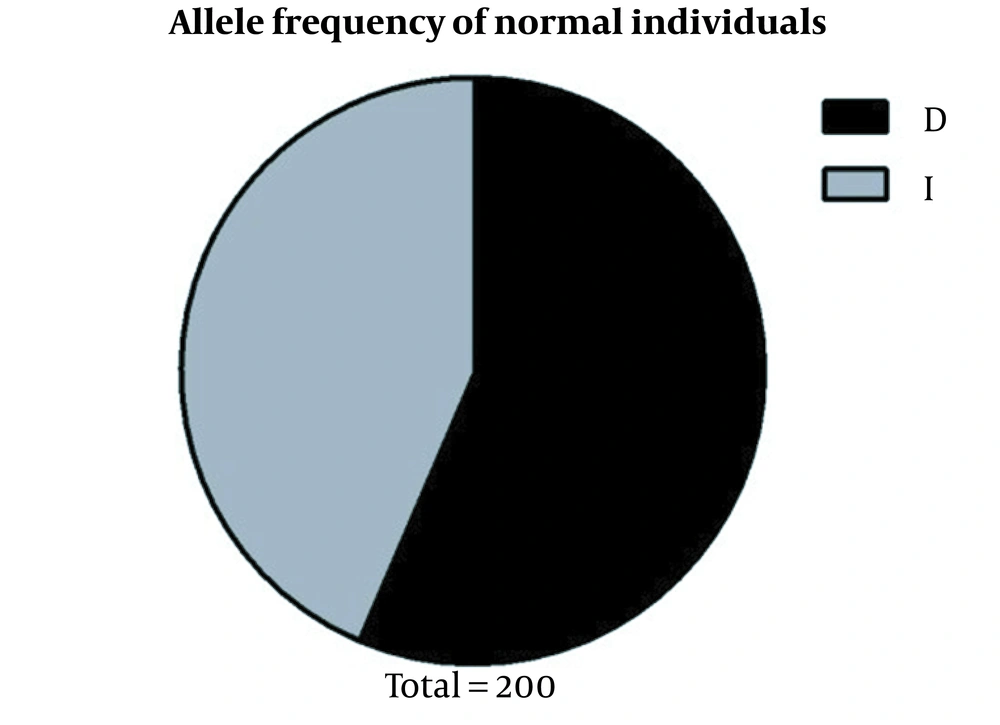
Figure 2.
I allele frequency in normal people
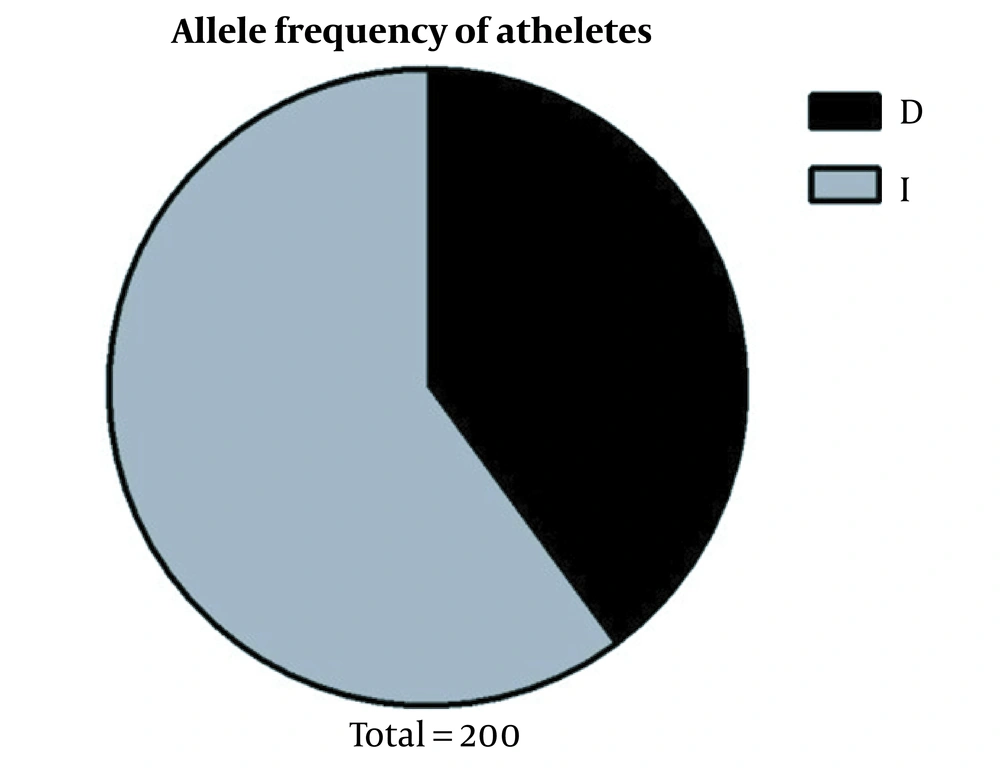
Figure 3.
I allele frequency in athletes
4. Discussion
Physical fitness is a quality characteristic influenced by many components and characteristics of phenotypic changes. Genetic and environmental factors (lifestyle, diet, and education) for a given trait are measured by heritability coefficients that indicate the relative contribution of genetic and non-genetic factors to the overall phenotypic variation of a population (6).
Two genes that have been extensively studied for physical performance are angiotensin-converting enzyme I (ACE) and alpha-actinin-3 (ACTN3). ACE is one of the major components of the renin-angiotensin-aldosterone system and mediates the production of the vasoconstrictor hormone angiotensin II and the breakdown of vasodilator kinins (7). The ACE I/D polymorphism is the first specific genetic variant associated with human physical function (8). Structural alterations in the human ACE gene (17q22-q24) have been reported, with insertions (I) associated with lower ACE levels than deletions (D) (9). Excessive of the I allele is related to particular components of staying power performance (3). The I allele is functionally associated with decreased serum ACE levels and activity.
This allele is considered a favorable mutation because low ACE activity results in less vasoconstriction and an increased supply of oxygenated blood to the muscle. Therefore, individuals with allele I or genotype II are thought to have a greater benefit in patient activities, such as running, cycling, and swimming, where oxygen demand is important to confirm that the ACE D allele is related to increased muscle energy and length at baseline and growth in fast-twitch muscle fibers. Additionally, the D allele has been shown to be associated with elite power status in athletes (10).
In 2021, Qi Wei investigated 243 Chinese rowing athletes and found that the ACE genotype of rowing athletes was 45.8% II, 42.2% ID, and 12% DD for men and 33.6% II, 48% ID, and 18.4% DD for women. They found a significant difference in ACE genotype between male and female athletes. The results of their research show that ACE and ACTN3 gene polymorphisms may be used as characteristic biomarkers in Chinese rowing athletes (11). The results of his research are consistent with the present study.
On the other hand, Ash and his colleagues' studies in 2011 on Kenyan runners had different results. Their research did not show any significant relationship between the ACE gene and the world's best endurance runners who were from Kenya and Ethiopia (12).
The results obtained from a recent study on the Iranian population show that about 50% of the control population have ID genetics, and the other 50% have DD and II genotypes, although the frequency of the DD genotype is slightly higher than II. In fact, there seems to be the same distribution in different areas of the ACE gene in the control population. While the athlete community shows that the DD genotype is almost twice as likely as the II genotype. Considering that the elite athletes selected for this research are mainly from strength and power disciplines, the results obtained align with previous studies that show the higher frequency of the D allele along with elite levels of power performance (13).
A possible mechanism for correlating the DD genotype with elite athletes involves the renin-angiotensin system. ACE is responsible for converting angiotensin-1 to angiotensin-2 and is critically involved in left ventricular hypertrophy, smooth muscle hypertrophy, and skeletal muscle hypertrophy (14).
What emerges from the present study in a small population of the Iranian athlete community, the Iranian race does not have a major difference with other populations in terms of the relationship between the ACE gene genotype and the endurance and strength phenotype. The research results showed that there is no significant difference between the various alleles of the gene in the athlete and control group. The results obtained about CKMM, the presence of more T allele, show that Iranian and non-athletes have more endurance capacities.
In the current study, which was conducted between two groups of 200 healthy professional athletes and non-athletes, the result was that no significant difference was observed in the three gene phenotypes in the two groups, but the distribution and frequency of the D and I alleles in the two groups were significantly different. I allele was more abundant in the athlete group. It is consistent with the results obtained from previous research by other researchers and demonstrates that allele I is associated with endurance and versatility.
Based on the results of this and other research, in the future, by screening and determining the phenotype of school and university students at a young age, we can identify the talent of people who have a special talent in one of the types of sports.
It is also possible to carry out allelic screening in the barracks with similar investigations, and based on the results, difficult and easy tasks can be assigned to them according to the phenotype of the people so that work efficiency increases.
Therefore, our talents are largely dependent on our genetic talents, which are interpreted as polymorphisms or allelic variants that can predispose us to disease or create physiological advantages, as shown in this research. It was paid.
4.1. Conclusions
The present study once again confirmed the results of other researchers that there is a significant relationship between the type of phenotype and the allelic distribution of some genetic polymorphisms. Here, we investigated the ACE gene and showed that the presence of the I allele is associated with an advantage for the athlete group.
In the following, it is recommended to explore additional genes and polymorphic alleles, as well as access to a specific haplotype that identifies genetic talent differences and addresses the special growth and development of these individuals in a targeted manner based on their unique talents.