1. Context
Polycystic ovary syndrome (PCOS) is a disorder that manifests with symptoms including increased androgen levels, menstrual irregularities, and cysts in one or both ovaries. Polycystic ovary syndrome is a complex genetic endocrine disorder with an unknown etiology and intricate pathophysiology (1). Globally, 1.55 million people of reproductive age (15 - 49 years) have been diagnosed with PCOS, and the incidence of this disease increased by 4.47% between 2007 and 2017 (2). A 2020 survey showed that 16% of women between the ages of 20 and 29 have PCOS (3). Its overall prevalence varies between 5 - 15% depending on the diagnostic criteria used (4, 5), and it has been reported to be as high as 19.5% in Iran based on the Rotterdam diagnostic criteria (6). The occurrence of this disease depends on various factors (6). Clinical and biochemical characteristics, such as race and ethnicity, contribute to differences in the prevalence of PCOS among patients (7). The prevalence of PCOS also varies by age and population, with the highest prevalence observed in young women over 35 years of age (8).
Factors such as the interaction between neuroendocrine levels, metabolic dysfunction, and ovarian abnormalities contribute to polycystic ovary syndrome, while weight gain and insulin resistance are among the primary causes of PCOS. Elevated insulin levels in the blood lead to abnormalities in the hypothalamus-pituitary-ovary axis, suppressing the effect of insulin on its receptors and causing an increase in free fatty acids, androgens, and cytokines such as TNF-α and IL-6 (9, 10).
Increased androgen levels inhibit adiponectin in fat cells, reducing insulin sensitivity and further raising insulin levels. This insulin elevation stimulates the synthesis of aldo-keto reductase, leading to the release of androgen from fat cells in women (11). Oxidative stress plays a significant role in several reproductive issues and abnormalities in pregnancy, including infertility, recurrent miscarriages, and pre-eclampsia. Blood amino acid levels in women with PCOS have been shown to be significantly lower compared to healthy women (12).
Vitamin deficiencies are also a factor contributing to the metabolic abnormalities that result in ovarian cysts (13). The main symptoms of PCOS include elevated blood sugar levels, ovarian cysts, obesity, depression, and anxiety (14). Polycystic ovary syndrome raises cholesterol and blood pressure levels, ultimately increasing the risk of heart disease and diabetes (15). Regular monitoring of androgen levels, ultrasound evaluations, and examination of polycystic ovary morphology are key methods for predicting PCOS (16).
2. Evidence Acquisition
Considering the significance of herbal medicines as an alternative to chemical treatments for polycystic ovary syndrome, this study investigated medicinal plants and their active compounds, as well as their effects in treating PCOS. The research was conducted through searches in the Scopus, PubMed, Google Scholar, CrossRef, and Hinari databases.
3. Results
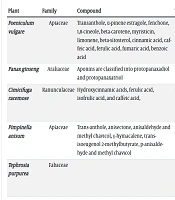
Many herbs are used in the treatment of PCOS (Table 1). Foeniculum vulgare, a plant from the Apiaceae family, contains compounds such as trans-anethole, α-pinene, estragole, fenchone, 1,8-cineole, beta-carotene, myristicin, limonene, beta-sitosterol, cinnamic acid, caffeic acid, ferulic acid, fumaric acid, benzoic acid, p-coumaric acid, vanillic acid, kaempferol, quercetin, rutin, and vanillin (19). Foeniculum vulgare has potent antioxidant activity, protecting cells against oxidative damage. The anethole compound increases menstruation and facilitates childbirth (Table 1) (20, 21).
Table 1.
Medicinal Plants and Their Effect on Polycystic Ovary Syndrome
| Plant | Family | Compound | Treat PCOS |
|---|---|---|---|
| Foeniculum vulgare | Apiaceae | Transanthole, α-pinene estragole, fenchone, 1,8-cineole, beta-carotene, myristicin, limonene, beta-sitosterol, cinnamic acid, caffeic acid, ferulic acid, fumaric acid, benzoic acid | Improving menstruation makes childbirth easier and also creates estrogenic properties in the ovarian follicle (20, 21). |
| Panax ginseng | Araliaceae | Aponins are classified into protopanaxadiol and protopanaxatriol | Getting low plasma LH levels (22) |
| Cimicifuga racemose | Ranunculaceae | Hydroxycinnamic acids, ferulic acid, isofrulic acid, and caffeic acid, | Cimicifuga racemosa to clomiphene could not increase the endometrial thickness and the number of follicles in PCO patients. |
| Pimpinella anisum | Apiaceae | Trans-anthole, anisectone, anisaldehyde and methyl chavicol, γ-hymacalene, trans-isoeugenol 2-methylbutyrate, p-anisaldehyde and methyl chavicol | Getting low oligomenorrhea and reduce pain in women (21) |
| Tephrosia purpurea | Fabaceae | Estrous cycles cause the current cycle and steroid hormone levels (FSH, LH, T, E2) to normalize, and also increases fertility in female mice (23). | |
| Punica granatum | Lythraceae | Phenolic compounds | Reduces complications related to PCOS and improves changes in female sex hormones by reducing the concentration of E2, free T and androstenedione hormones in PCOS (24). |
| Trigonella foenum-graecum | Fabaceae | 4-hydroxyisoleucine, trigonelline, isoorientin, isovitexin, pinitol, and sarsasapogenin | It increases the level of LH and FSH and slightly decreases the LH:FSH ratio, (25). |
| Urtica dioica | Urticaceae | Flavonoid compounds | Its ability to regulate lipid profile and increase insulin sensitivity (26). |
| Corylus avellana | Betulaceae | Phenolic | Regulate gonadotropins, steroids, serum lipid parameters (27). |
| Aloe vera | Asphodelaceae | Increases the number of germ cells in the ovary and has beneficial effects on ovarian tissue and folliculogenesis (28) | |
| Vitex | Lamiaceae | Monoterpenoids, including bornyl acetate, limonene, 1,8-cineole, α-pinene, and beta-pinene | Estrogen level imbalance with menstrual cycle disorders and premenstrual syndrome (29). |
| Licorice | Fabaceae | Glycyrrhizin, glycyrrhizic acid, flavonoids, isoflavonoids, carbohydrates, amino acids and triterpenoid saponins | Lowers blood sugar levels and helps treat PCOS (30). |
| Mentha spicata | Lamiaceae | This plant regulates the ratio of LH/FSH hormones in the blood, which reduces pco disease (31). |
Ginseng (Panax ginseng) lowers plasma LH levels, which is useful in improving fertility rates in anovulatory PCOS patients (22). Ginseng also helps alleviate postmenopausal symptoms such as insomnia, anxiety, and depression. It is sometimes used as a substitute for natural estrogen due to its ability to alter the estrous cycle and its significant estrogenic properties, as evidenced by its reversal of vaginal and uterine atrophy through increased expression of ERα and ERβ in reproductive tissues. These properties contribute to its potential in treating PCOS (32).
Cimicifuga racemosa has been extensively researched for its triterpene glycosides and phenolic acids. Its primary phenolic compounds include hydroxycinnamic acids, ferulic acid, isoferulic acid, and caffeic acid, along with their derivatives, commonly known as simyphogic acids (33) (Table 1).
Pimpinella anisum contains 9% moisture, 35% sugar, 18% protein, 16% lipid, 7% ash, 5% starch, 12 - 25% crude fiber, and 2 - 7% essential oil (34). The main component of anise oil is trans-anethole (90%), along with anisectone, anisaldehyde, and methyl chavicol. Minor components include γ-himachalene (2 - 4%), trans-isoeugenol 2-methylbutyrate (1.3%), p-anisaldehyde (1%), and methyl chavicol (0.9 - 1.5%) (35, 36). It helps reduce oligomenorrhea and alleviate pain in women undergoing PCOS treatment. Its phenolic compounds have phytoestrogenic properties that regulate and improve menstrual cycles, as well as LH/FSH hormone secretion, thereby reducing PCOS complications in women (21).
Tephrosia purpurea, at a dilution of 200 mg/kg across three estrous cycles, normalizes the estrous cycle and steroid hormone levels (FSH, LH, T, E2), increases fertility in female mice, and reduces histopathological, endocrine, and biochemical changes caused by hyperandrogenism (23).
Punica granatum (pomegranate) at dilutions of 100 - 200 and 400 mg/kg reduces the effects of T hormone through its phenolic compounds, minimizing PCOS-related complications. It improves changes in female sex hormones by lowering E2, free T, and androstenedione levels (24).
Trigonella foenum-graecum (fenugreek) reduces left and right ovarian volumes and the number of ovarian cysts with no significant side effects. It increases LH and FSH levels, slightly decreases the LH:FSH ratio, and is effective in reducing PCOS symptoms with wide safety and efficacy (25).
Urtica dioica (nettle) is effective in alleviating symptoms of metabolic syndrome and type 2 diabetes in PCOS patients by regulating lipid profiles and increasing insulin sensitivity, due to its flavonoid compounds. It also reduces liver necrosis and improves inflammation (26).
Corylus avellana (hazelnut) regulates gonadotropins, steroids, and serum lipid parameters, exhibits antioxidant activity, and reduces leptin and glucose concentrations (27).
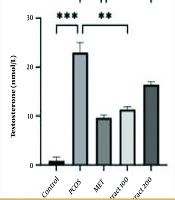
In the study by Dou et al., the effects and mechanisms of cinnamon on polycystic ovary syndrome (PCOS) were examined using a mouse model induced by dehydroepiandrosterone (DHEA). The results showed that cinnamon restored the ovarian cycle and morphology in the DHEA-induced PCOS mouse model. Additionally, there was a significant difference in the total testosterone serum levels between the control group, the DHEA group, and the cinnamon-treated group (0.052 ± 0.011 ng/mL for the cinnamon group, compared to 0.079 ± 0.015 ng/mL for the DHEA group) (37).
Aloe vera is another herb used in the treatment of PCOS. The active ingredients in the gel and leaves of this plant include aloin, aloe-emodin, barbaloin, and polysaccharides like sterols and organic acids (38). Aloe vera has been shown to increase the number of germ cells in the ovary and has beneficial effects on ovarian tissue and folliculogenesis (28).
In Khani's study, which aimed to investigate the therapeutic effect of hydroalcoholic extract of black seed (Nigella sativa) on PCOS in mice induced by DHEA, the results demonstrated that serum levels of testosterone, glucose, insulin resistance, malondialdehyde, insulin, and estrogen increased, while progesterone and antioxidant enzyme levels decreased in the PCOS group (39).
The medicinal plant Vitex agnus-castus is used to balance estrogen levels in cases of menstrual cycle disorders and premenstrual syndrome, including corpus luteum insufficiency, periodic mastalgia, and hot flashes after menopause. Vitex fruits primarily contain monoterpenoids, such as bornyl acetate, limonene, 1,8-cineole, α-pinene, and β-pinene (29, 40, 41).
Curcuma longa contains phenolic compounds such as curcumin, curcuminoids, ferulic acid, eugenol, ascorbic acid, vanillic acid, caffeic acid, syringic acid, protocatechuic acid, and p-coumaric acid, as well as terpenoids like turmerone, α-turmerone, camphene, β-terpinene, and carotene (42, 43).
Licorice, from the Fabaceae family, contains 2 - 9% glycyrrhizin, glycyrrhizic acid, flavonoids, and isoflavonoids. The flavonoids in licorice help reduce blood sugar levels by assisting insulin secretion, thus aiding in the treatment of PCOS (30, 44).
Another plant effective in treating PCOS is peppermint (Mentha piperita), which regulates the LH/FSH hormone levels in the blood. Peppermint also has androgenic properties (31).
Coconut oil contains alpha-tocopherol and lauric acid, while the root of the coconut plant is rich in phenolic compounds such as flavonoids and saponins. Coconut oil regulates FSH/LH hormone levels, helping to alleviate polycystic disease (45). Coconut oil reduces the size and number of cysts in PCOS, leading to improved symptoms (46).
In a study conducted in India among 73 women aged 18 - 31, the prevalence of PCOS was found to be 15% (47). Similarly, Gabrieli and Aquino in Brazil found an 8.5% prevalence of PCOS among 851 women aged 18 - 45 years, based on the Rotterdam criteria (48).
In a review study examining the effects of medicinal plants on polycystic syndrome, Pimpinella anisum (anise) was found to reduce PCOS symptoms in mice by improving the histomorphology of ovarian tissue and the hormonal profile (FSH, LH) (49).
Fatima's study on Linum usitatissimum (flaxseed) showed that it reduced ovarian size, follicle count, and had anti-inflammatory properties that helped reduce the size of the ovaries (50).
Pomegranate extract, at a dose of 100 mg/kg, was shown to reduce the effects of testosterone caused by phenolic compounds. The extract improved PCOS-related complications by reducing concentrations of estradiol (E2), free testosterone, and androstenedione in women with PCOS (51).
4. Conclusions
Medicinal plants in various dilutions have the potential to prevent polycystic ovary syndrome. Therefore, these plants and their active compounds can be utilized in the development of effective pharmaceutical treatments for PCOS.