1. Introduction
Human oculocutaneous albinism (OCA) is an autosomal recessive disorder caused by a deficiency in the melanin biosynthesis pathway that results in a complete or partial loss of melanin in the skin, hair, and eyes. People of all ethnic backgrounds can be affected, and almost one in 17,000 people have some form of albinism (1).
Until now, four genes have been identified for recessively inherited isolated OCA (2). A mutation in the tyrosinase gene (TYR) on chromosome 11q14.3 causes the OCA1 phenotype (TYR, MIM 606933). Oculocutaneous albinism 2 (OCA2, MIM#203200) is caused by mutations in the OCA2 gene, which consists of 24 exons spanning almost 345 kb of genomic DNA in region 15q11.2-q12 and encodes a protein of 838 amino acids. OCA3 (MIM 203290) is associated with mutations in the TYRP1 gene, which spans 17 kb in 9p23, with eight exons. OCA4 (MIM 606574) is associated with mutations in SLC45A2, which spans 40 kb in 5p13.3 and consists of seven exons (2-4).
OCA1 is the most common subtype in most populations, and it is divided clinically into two types: IA (OCA1A), in which tyrosinase enzyme activity is completely absent due to production of an inactive enzyme, and IB, in which some residual activity is retained (5, 6). Pathogenic variants in the TYR gene are known to cause autosomal recessive disease. The TYR gene is located on 11q14.3 and consists of five exons, spanning about 65 kb of the genome (7). It encodes the enzyme tyrosinase, which is a 60-kD glycoprotein composed of 529 amino acids (8). In this study, we report a case of a novel mutation discovered during the direct mutation screening of all exons of the TYR gene in an Iranian patient with OCA1A.
2. Case Presentation
A 2-month-old boy presented with an abnormal face. He was the first child of an Iranian consanguineous couple (first cousins, 27 and 28 years old), who was born in a hospital following a normal gestation and delivery. His weight was 4.2 kg, head circumference was 39 cm, and length was 51 cm. He had gray-blue irises at birth, associated with nystagmus, and an abnormal face with white hair, eyelashes, eyebrows and skin (Figure 1).
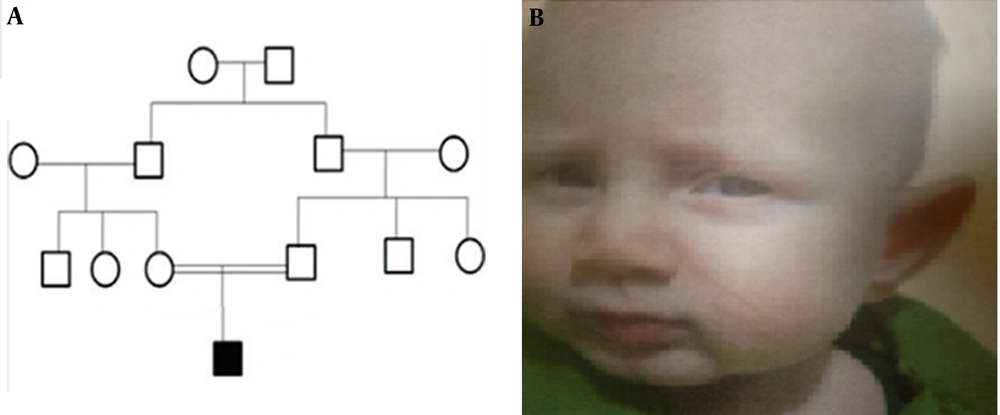
Figure 1.
A, Family pedigree of the affected individual; B, The patient at the age of two months.
An ophthalmologic examination revealed no abnormalities, and the boy had normal mental development. He was carefully tested to eliminate other congenital deformities, and he did not have any abnormalities of the internal organs.
2.1. Molecular Analysis
Genomic DNA was extracted from peripheral leukocytes of the patient, his parents, and other members of his family with the standard salting-out protocol. PCR was conducted under the following conditions: 200 μM of deoxyribonucleotide triphosphates (dNTPs), 100 ng of genomic DNA, 2.5 units of SuperTaq™ polymerase, 1.5 mm of MgCl, and 25 pmol of each primer (Table 1). Amplification was carried out in 25-μL volumes with 35 cycles: 93°C for 1 minute, 62°C for 35 seconds, and 72°C for 45 seconds. Direct sequencing of the exons was performed with the BigDye® terminator cycle sequencing ready reaction kit on an ABI prism 3700 automated genetic analyzer. Finally, the sequencing reactions were carried out and the sequences were compared to the reported gene sequence using the BLASTN program.
Table 1.
Primersa
| Exon | Forward Primer (5'-3') | Reverse Primer (5'-3') | Amplicon Size, bp |
|---|---|---|---|
| 1 | CAAACTGAAATTCAATAACATATAAGG | GTGGACAGCATTCCTTCTCC | 678 |
| 1 | TTCAGAGGATGAAAGCTTAAGATAAA | CGTCTCTCTGTGCAGTTTGG | 521 |
| 1 | CTGGCCATTTCCCTAGAGC | CCACCGCAACAAGAAGAGTC | 605 |
| 1 | CATCTTCGATTTGAGTGCCC | CCCTGCCTGAAGAAGTGATT | 521 |
| 2 | CCAACATTTCTGCCTTCTCC | TCAGCTAGGGTCATTGTCGAT | 442 |
| 3 | AGTTATAAATCAAATGGGATAATCA | ACATTTGATAGGCACCCTCT | 296 |
| 4 | CTGTTTCCAATTTAGTTTTATAC | TACAAAATGGCCTATGTTAAGC | 790 |
| 5 | TGTCTACTCCAAAGGACTGT | GGCACTTAGCTGGATGTGTT | 924 |
aDue to the large size of exon 1, it is divided into four overlapping fragments (9).
2.2. Sequencing Results
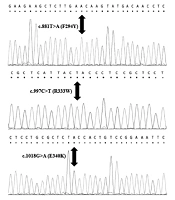
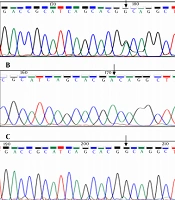
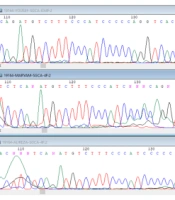
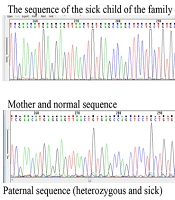
The sequencing analysis of the patient, after comparison with the TYR reference sequence in the 1000 genomes database, showed a novel mutation, an exon 1 - 5 deletion mutation of the TYR gene. The exon 1 - 5 deletion mutation is novel and has not been previously described in OCA1A.
3. Discussion
At least three enzymes are absolutely required for the synthesis of different types of melanin. While tyrosinase is responsible for the critical steps of melanogenesis (including the rate-limiting initial step of tyrosine hydroxylation), tyrosinase-related protein 1 (TYRP1) and DOPA chrome tautomerase (DCT) are further involved in modifying the melanin into different types. TYR (monophenol, 3, 4-dihydroxyphenylalanine oxygen oxidoreductase, EC 1.14.18.1) is a single-chain type I membrane glycoprotein that catalyzes the hydroxylation of tyrosine into 3, 4-dihydroxyphenylalanine (DOPA), which is the initial rate-limiting step in melanogenesis, and the subsequent oxidation of DOPA into dopaquinine (10). At present, approximately 320 mutations of the TYR gene have been described in different ethnic groups, and these are documented in the human gene mutation database (HGMD), which is the largest general mutation database. However, there is no registration in the HGMD for this study’s mutation.
We analyzed an OCA-affected person with PCR and direct sequencing of the coding exons of the TYR gene. Our results showed a genetic variant of TYR in this OCA patient. The mutation identified in our patient involved a novel homozygous mutation, exon 1 - 5 deletion, which results in lack of the tyrosinase enzyme in the FERM domain and tail region of the myosin protein. Exon 1 - 5 deletion (Hom) of the TYR gene is the pathogenic mutation of this patient, and these results are consistent with the clinical diagnosis. According to the clinical features and molecular analysis, the patient was diagnosed with OCA1A. Further analysis of the proband’s parents, in whom the trait was heterozygous, showed that this mutation was inherited from them due to their consanguineous mating.
We expect that the identification of this mutation in the TYR gene will significantly further our knowledge of the molecular basis of OCA1A, and will improve genetic diagnoses and genetic counseling. The patient’s parents were eager to know the risk of passing this condition to any future children, which required genetic counseling and testing of the parents and other members of this family. The proband’s unaffected parents, an aunt, and an uncle were revealed to be carriers of the exon 1 - 5 deletion mutation of the TYR gene. In this pedigree, the heterozygous state of the allele did not show albino phenotypes. Thus, this novel mutation was considered not a polymorphic mutation, but a pathological mutation with recessive inheritance.
The lack of the tyrosinase enzyme can obstruct two specific reactions of melanin synthesis: initially, the absence of hydroxylation of a monophenol, then the absence of the alteration of an o-diphenol to the corresponding o-quinone, so that the other reactions necessary to finally form melanin are blocked.
Mapping the TYR gene will be another step toward understanding the molecular mechanisms that result in OCA1A. A lack of tyrosinase causes changes in several processes, such as the eye pigment biosynthesis process, the melanin biosynthesis process, and visual perception.
Aside from causing non-syndromic OCA1A, polymorphisms in some of the pigmentary pathway genes (OCA2 and SLC45A2) cause an increased risk of melanomatous skin cancer, one of the most common and deadliest malignancies worldwide (11, 12). In summary, a novel deletion mutation (exon 1 - 5 deletion) was identified in the TYR gene of an Iranian OCA pedigree. This study expands the mutational spectrum of the TYR gene, which will be helpful in genetic counseling for affected families.