1. Background
Gastrointestinal cancers, particularly those occurring at younger ages, represent some of the most complex and lethal chronic diseases (1, 2). Although these malignancies are less common in children compared to adults, they often exhibit more aggressive behavior, pose diagnostic challenges in early stages, and show unpredictable therapeutic responses, presenting significant challenges for both researchers and clinicians (3, 4). In addition to well-established genetic and environmental factors, a possible link between metabolic dysregulation and neurological complications — such as encephalopathy — in pediatric gastrointestinal cancer patients has underscored the need for deeper molecular and biochemical investigations (4).
The aldehyde dehydrogenase 18 family member A1 (ALDH18A1) gene, which encodes the delta-1-pyrroline-5-carboxylate synthase enzyme, plays a central role in the biosynthetic pathway of amino acids including proline, arginine, and glutamate (5, 6). This mitochondrial enzyme contributes to maintaining metabolic homeostasis and regulating oxidative stress within the cell. Mutations or altered expression of this gene can lead to the accumulation of toxic metabolites and activation of inflammatory or oncogenic pathways, ultimately promoting tumor progression and neurological complications such as encephalopathy (6). A significant association has been demonstrated between elevated ALDH18A1 expression in gastrointestinal tumor cells and increased drug resistance as well as reduced patient survival (7).
On the other hand, lectins, particularly wheat germ agglutinin (WGA) derived from wheat (Triticum aestivum), have attracted considerable attention in anti-cancer research due to their ability to selectively recognize and bind sugar moieties on the surface of cells (8, 9). The WGA is capable of modulating various signaling pathways in cancer cells, including apoptosis induction, growth inhibition, and immune activation (9). Furthermore, this lectin can bind to intracellular components, thereby influencing autophagy and growth regulation processes (10).
Recent advancements in bioinformatics — including tools for high-precision three-dimensional protein modeling such as SWISS-MODEL and ClusPro for protein-protein docking simulations — have enabled more accurate analysis of protein structure and molecular interactions (11). These computational techniques are especially valuable in cases where no direct sequence-based evidence exists for interaction, as they provide a means to test and validate complex structural and functional hypotheses. Given the critical role of ALDH18A1 in cancer-associated metabolic regulation, and the glycan-binding and apoptosis-inducing capacity of WGA, it is hypothesized that a meaningful structural or functional interaction may exist between these two proteins despite the lack of direct sequence similarity. Therefore, three-dimensional modeling and protein-protein docking simulations could help uncover such potential interactions and provide a theoretical foundation for future experimental studies (12, 13).
2. Objectives
The present study aimed to conduct a comprehensive in silico analysis to predict a possible interaction between WGA from wheat and human ALDH18A1, focusing on their relevance to gastrointestinal cancers and neurological symptoms in pediatric patients. The study involved sequence retrieval, three-dimensional structural modeling, quality assessment, and docking simulations to evaluate the likelihood and biological implications of this molecular interaction.
3. Methods
3.1. Protein Sequence Retrieval
The amino acid sequences of the WGA protein (Figure 1) from T. aestivum and the human ALDH18A1 protein (Figure 2; delta-1-pyrroline-5-carboxylate synthase) were retrieved from the UniProt database. The UniProt accession number for WGA was P10968, and for ALDH18A1, it was P54886. UniProt is considered a reliable and standardized source for obtaining structural and functional information on proteins (14).
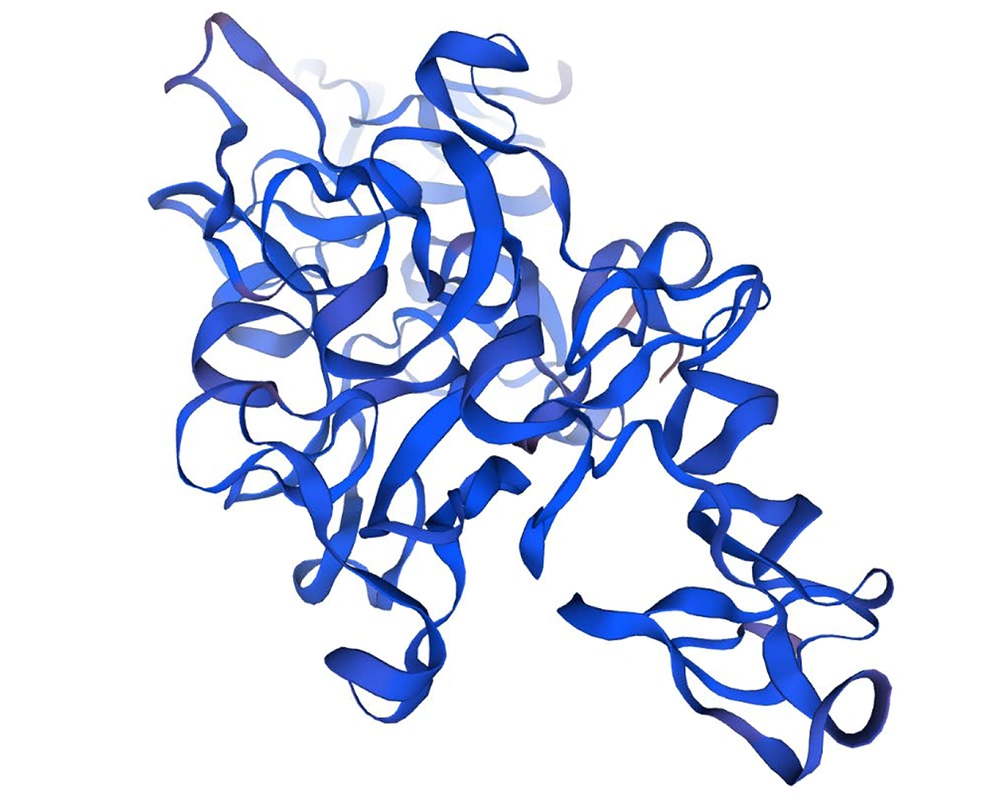
Figure 1.
Three-dimensional structure of wheat germ agglutinin (WGA) protein (UniProtKB/Swiss-Prot: P10968)
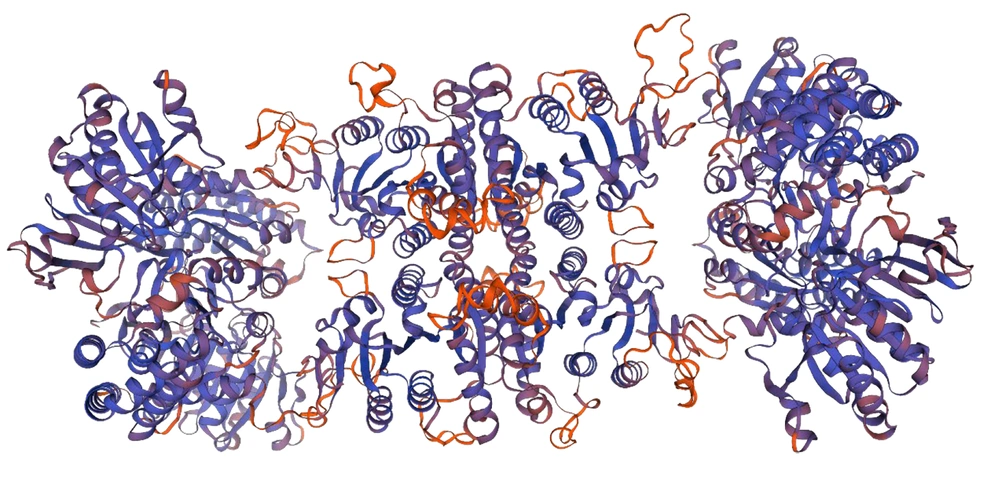
Figure 2.
Three-dimensional structure of aldehyde dehydrogenase 18 family member A1 (ALDH18A1) protein (UniProtKB/Swiss-Prot: P54886)
3.2. Sequence Alignment Using Basic Local Alignment Search Tool for Proteins
To assess the degree of similarity and homology between the two selected proteins, basic local alignment search tool for proteins (BLASTp) from the NCBI database was employed. The alignment was performed using default settings. Statistical parameters including sequence identity, E-value, alignment length, and bit score were extracted and analyzed to evaluate the similarity between the amino acid sequences of WGA and ALDH18A1 (6).
3.3. Retrieval and Evaluation of Three-Dimensional Structures
The three-dimensional structure of WGA was retrieved from the Protein Data Bank (PDB) with the structural identifier PDB ID: 2UVO. Similarly, the three-dimensional structure of human ALDH18A1 was obtained from the PDB under PDB ID: 2H5G. Both structures were experimentally determined using X-ray diffraction, ensuring high-resolution quality suitable for molecular interaction analysis (15).
3.4. Structural Quality Assessment
To evaluate the structural integrity and reliability of the predicted protein models, several computational tools were employed, including the Ramachandran Plot, QMEAN, and QMEANDisCo. These tools assess geometrical accuracy, backbone dihedral angles, and local residue quality. All analyses were performed via the SWISS-MODEL server, which is widely accepted for protein structure validation (16).
3.5. Protein-Protein Docking Simulation
To investigate the potential for direct spatial interaction between WGA and ALDH18A1, ClusPro was used for protein-protein docking simulations. In this simulation, WGA was designated as the receptor, and ALDH18A1 as the ligand. ClusPro applies a fast Fourier transform (FFT)-based algorithm to simulate various possible binding orientations and reports docking results in clusters ranked by the number of members and lowest binding energy. The top-ranked clusters with the most favorable energy scores were selected for further analysis (17).
4. Results
4.1. Docking Analysis
The resulting docking models were analyzed for binding energy, the location and number of hydrogen bonds, as well as electrostatic and van der Waals interactions. These features were visualized and interpreted using PyMOL molecular graphics software. Docked complexes with high structural stability were prioritized as top conformations for subsequent functional analysis and further exploration of the potential regulatory effect of WGA on ALDH18A1 in the context of pediatric gastrointestinal cancers and associated encephalopathic symptoms (18).
4.2. Basic Local Alignment Search Tool for Proteins Analysis Between Wheat Germ Agglutinin and Human Aldehyde Dehydrogenase 18 Family Member A1
To evaluate the sequence similarity between WGA from T. aestivum and human ALDH18A1, a protein-protein BLAST (BLASTp) analysis was performed. The amino acid sequence of WGA (212 residues, Query) was compared with that of ALDH18A1 (795 residues, subject). The summary of this sequence alignment is presented in Table 1.
Table 1.
Summary of Basic Local Alignment Search Tool for Proteins Alignment Results Between Wheat Germ Agglutinin and Human Aldehyde Dehydrogenase 18 Family Member A1
| Parameters | Values | Descriptions/Interpretations |
|---|---|---|
| Sequence length (query subject) | 212/795 amino acids | Lengths of the WGA and ALDH18A1 protein sequences |
| Sequence identity (%) | No significant similarity | No meaningful alignment observed between sequence regions |
| E-value | Not statistically significant | Indicating the alignment lacks statistical significance |
| Alignment length | No defined alignment | No overlapping regions found between the sequences |
| Bit score | Very low | Reflecting a very weak and unreliable alignment between the sequences |
Abbreviations: WGA, wheat germ agglutinin; ALDH18A1, aldehyde dehydrogenase 18 family member A1.
4.3. Structural Quality Assessment of Wheat Germ Agglutinin Three-Dimensional Model
4.3.1. Ramachandran Plot Analysis
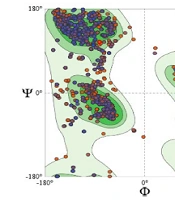
According to the results obtained from the MolProbity server, 88.76% of the residues in the three-dimensional model of WGA were located in favored regions, while 10.06% were in allowed regions. Only 1.18% of the residues were found in disallowed (outlier) regions. These outlier residues included A174-SER, B196-ASP, A34-SER, and A119-ALA. This minimal percentage of outliers falls within the acceptable range for homology models of medium to high quality and indicates satisfactory model reliability in terms of main-chain dihedral angles (Figure 3).
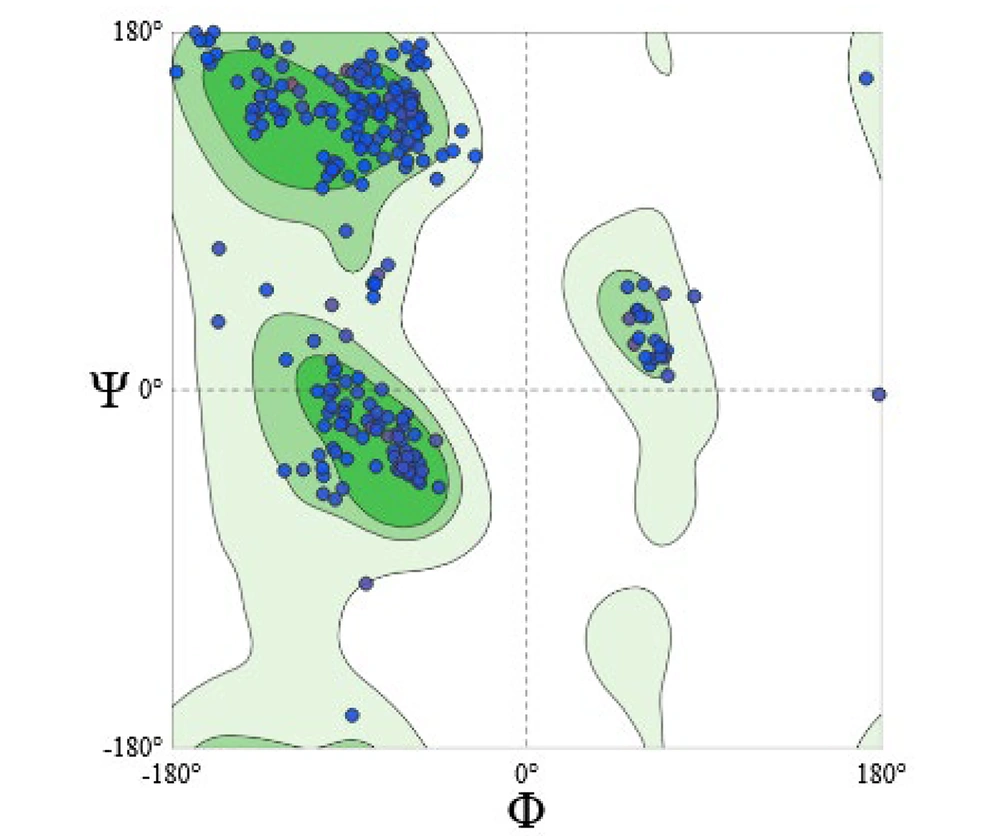
Figure 3.
Ramachandran chart for three-dimensional structure of ConA protein of AGI1-WHEAT protein (UniProtKB/Swiss-Prot: P10968)
4.3.2. QMEAN Score Evaluation (QMEAN Z-Score)
The predicted three-dimensional model achieved a strong global QMEAN score of +3.54, indicating high structural reliability compared to experimental PDB structures. Detailed sub-scores further validated model quality: Cβ interactions (+4.80) and torsion angles (+3.14) demonstrated excellent geometric accuracy and spatial stability. While all-atom interaction energy (-0.12) and solvation energy (-1.19) were slightly negative, they remained within acceptable limits for homology-based models. Collectively, these QMEAN metrics confirm the model’s robust structural integrity, supporting its use in advanced computational applications including structural analyses, molecular dynamics simulations, and protein-protein docking studies. The comprehensive evaluation underscores the model’s suitability for investigating molecular interactions and dynamic behaviors.
4.3.3. Local Quality Assessment Using QMEANDisCo
The WGA model achieved an excellent global QMEANDisCo score of 0.93 ± 0.05, showing strong agreement with experimental PDB structures. Most residues scored above 0.7, indicating widespread stability, with only minor dips in flexible loop regions — all within acceptable limits for homology models. This high-quality validation confirms the model’s reliability for docking studies, ligand design, and interaction research.
4.4. Evaluation of the Three-Dimensional Structural Quality of Human Aldehyde Dehydrogenase 18 Family Member A1 Protein
4.4.1. Ramachandran Plot Analysis
The Ramachandran plot analysis of human ALDH18A1 (P54886) showed 2.37% of residues in disallowed regions, slightly above typical thresholds but acceptable given its large, multi-domain structure. These outliers — including Pro, Val, Arg, Glu, Ser, Thr, and Gln — were distributed across chains A-D, likely due to flexibility or structural features. Despite this, 90.58% of residues occupied favored regions, supporting the model’s validity in main-chain dihedral angles (Figure 4). While the disallowed residues suggest localized imperfections, the overall geometry remains suitable for structural studies.
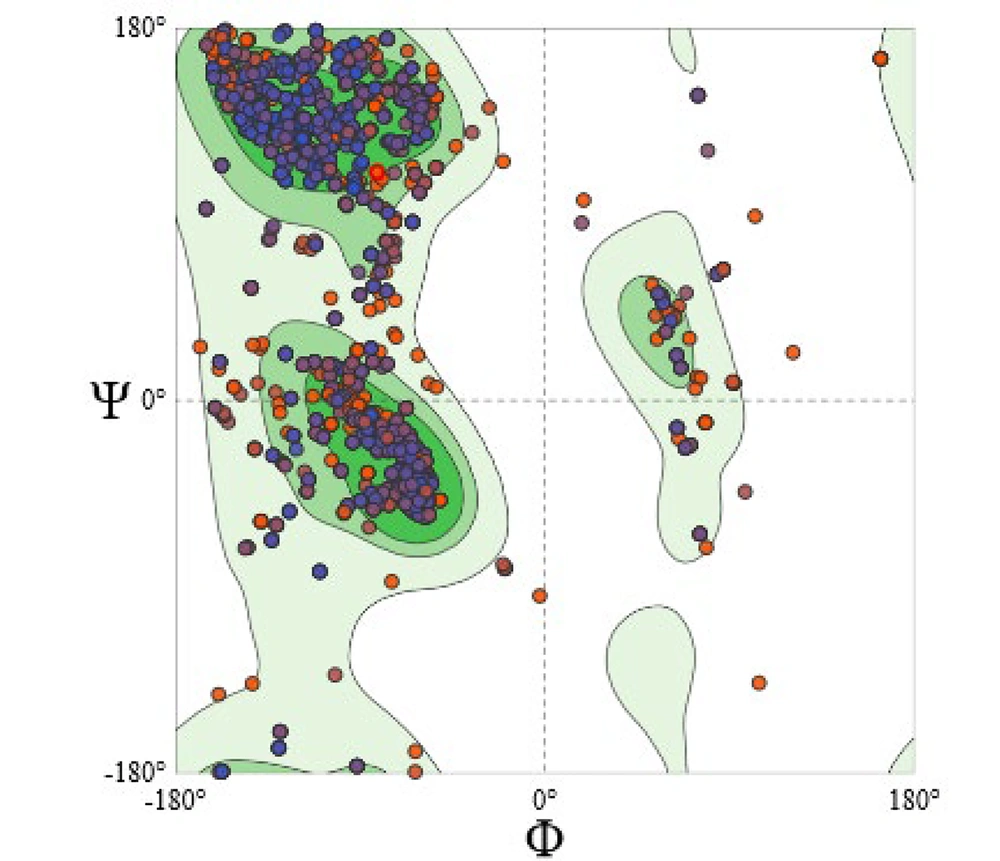
Figure 4.
Ramachandran chart for three-dimensional structure of ConA protein of aldehyde dehydrogenase 18 family member A1 (ALDH18A1) protein (UniProtKB/Swiss-Prot: P54886)
4.4.2. QMEAN Score Assessment (QMEAN Z-Score)
The human ALDH18A1 model showed a QMEAN Z-score of -2.98, slightly below optimal but expected given its large, multi-domain structure with inherent flexibility. Component analysis revealed acceptable scores for Cβ interactions (-0.63), all-atom energy (-0.16), and solvation energy (-0.06), though torsion angles (-2.80) showed greater deviation. Despite these localized imperfections, the overall model quality remains suitable for structural studies, docking simulations, and molecular investigations. The results reflect the challenges of modeling complex proteins while confirming its utility for downstream applications.
4.4.3. Local Quality Assessment Using QMEANDisCo
The global QMEANDisCo score for the model was 0.72 ± 0.05, indicating a relatively good agreement with experimental structures from the PDB. Analysis of the local scores revealed that the central regions of the protein, particularly around residues 180, 360, and 540, exhibited high scores (≥ 0.7), reflecting good structural stability in these areas. Conversely, regions with lower scores (≤ 0.4) were also identified, notably near residues approximately 270 and 630, which may correspond to flexible loops or poorly structured segments. These insights can aid in pinpointing regions that require further refinement.
4.5. Docking Simulation Results Between Wheat Germ Agglutinin and Aldehyde Dehydrogenase 18 Family Member A1 Proteins
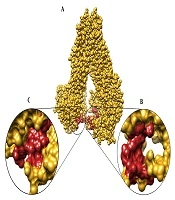
Docking simulations on the ClusPro server explored potential interactions between WGA and human ALDH18A1, with WGA as the receptor and ALDH18A1 as the ligand. Using a FFT-based approach, 28 interaction clusters were generated, each evaluated for stability based on cluster size, center score, and binding energy. Cluster 21 emerged as the most stable, with a binding energy of -1162.7 kcal/mol, followed closely by Clusters 18, 4, 7, 8, 11, and 12, all exhibiting highly negative binding energies. The strong binding affinity in multiple clusters suggests a high likelihood of spatial interaction between WGA and ALDH18A1. PyMOL-rendered visualizations confirmed stable binding at the proteins’ active sites in Cluster 21. The consistency of low-energy interactions across independent clusters indicates not only a robust binding tendency but also potential flexibility in the binding interfaces, supporting further investigation into their functional interplay (Figure 5).
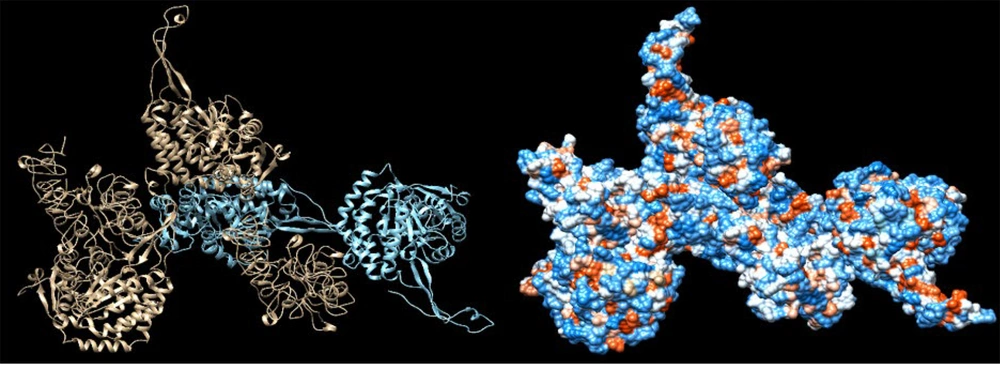
Figure 5.
Molecular docking of wheat germ agglutinin (WGA) on aldehyde dehydrogenase 18 family member A1 (ALDH18A1) protein
5. Discussion
The sequence alignment results of WGA and ALDH18A1 proteins revealed no statistically significant amino acid sequence similarity between these two proteins. This finding indicates that, from the perspective of primary structure and evolutionary origins, these proteins are non-homologous, and any direct functional overlap based solely on sequence similarity is highly unlikely. However, the absence of sequence homology does not necessarily preclude the possibility of biological or functional interaction (6).
The WGA, as a well-characterized plant lectin, exerts its biological effects primarily through specific recognition and binding to carbohydrate residues such as N-acetylglucosamine and sialic acid on the surface of cellular glycoproteins. Through these interactions, WGA can modulate various biological pathways in pediatric gastrointestinal cancer, including induction of apoptosis, immune regulation, and even inhibition of tumor cell proliferation. These functions are mediated not by enzymatic activity, but rather by selective carbohydrate recognition and subsequent activation of signaling pathways (19).
The ALDH18A1 is a crucial mitochondrial enzyme in proline biosynthesis, maintaining redox balance and amino acid metabolism. Its dysfunction is linked to encephalopathy and cancer drug resistance. Though structurally distinct from WGA, potential indirect interactions — via hydrogen bonds, electrostatic forces, or van der Waals contacts — could occur, especially given WGA’s carbohydrate recognition and ALDH18A1’s metabolic role. This highlights emerging interest in non-homologous protein interactions within specific cellular contexts (19).
Despite no sequence similarity, structural modeling and molecular dynamics can reveal interactions between WGA and ALDH18A1. Analyzing electrostatic charges, three-dimensional structures, and docking may identify interaction sites, offering insights into cross-kingdom mechanisms with biomedical and biotech applications. Three-dimensional protein structure modeling plays a vital role in understanding biological function, molecular interactions, drug design, and overall structure-function studies.
In this study, two key proteins, WGA from wheat and ALDH18A1 from humans, were homology-modeled and subjected to rigorous structural evaluations (20). The Ramachandran plot confirmed the WGA model’s high geometric validity, with 98% of residues in favored/allowed regions and only 1.18% disallowed, meeting quality standards. The QMEAN score (+3.54) and strong Cβ (+4.80) and torsion angle (+3.14) metrics, despite slightly negative solvation energy (-1.19), indicate robust structural integrity.
A QMEANDisCo score of 0.93 ± 0.05 further validates consistency with experimental structures. These results confirm the model’s suitability for molecular dynamics and ligand design, supported by stable local scores across sequence regions (21). The human ALDH18A1 three-dimensional model showed structural challenges, with 90.58% of residues in favored Ramachandran regions but 2.37% disallowed — expected given its large, multidomain structure. The QMEAN Z-score (-2.98) and subpar torsion angles (-2.80), Cβ interactions (-0.63), and solvation energy (-0.16) suggest some regions need refinement. However, the QMEANDisCo score (0.72 ± 0.05) indicates reasonable agreement with experimental data. Core regions remain stable, while lower-scoring areas correspond to flexible loops and unstructured segments, highlighting the need for targeted improvements (21). The WGA model shows superior structural quality over ALDH18A1, attributed to its smaller size, single-domain structure, and better homology data. Both models remain usable for preclinical studies and docking, though complex proteins require careful optimization.
The docking simulation results between the WGA protein and the ALDH18A1 enzyme indicate that, despite the lack of significant sequence similarity between these two proteins, there exists a considerable potential for stable spatial interactions. The observed low binding energy values across several clusters, particularly in clusters 21 (-1162.7 kcal/mol) and 18 (-1110.8 kcal/mol), suggest the formation of molecular complexes with acceptable stability (17). These interactions are likely mediated by non-covalent forces such as hydrogen bonds, van der Waals interactions, and electrostatic contacts at the protein interface. It is important to note that the ClusPro server utilizes advanced statistical and physical modeling methods, including DARS, and a weighted combination of repulsive (Erep), attractive (Eatt), and electrostatic (Eelec) energy terms, which enhance the computational reliability of the predicted clusters (17).
From a biological perspective, these findings are intriguing. The WGA, a well-known plant lectin, possesses a high affinity for recognizing glycoprotein structures and regulating cellular pathways related to apoptosis and inflammation. Conversely, ALDH18A1 plays a pivotal role in oxidative balance and metabolic pathways and is implicated in diseases such as gastrointestinal cancers and pediatric neurological disorders. The potential interaction between these proteins may induce structural, functional, or regulatory changes at the cellular level, positioning this complex as a plausible therapeutic target (22). In conclusion, the conducted docking simulation provides a rational basis for subsequent experimental validation (in vitro and in vivo) to verify the functional relevance of this interaction. The results not only confirm the structural interaction potential between WGA and ALDH18A1 but also pave the way for the development of plant lectin-based therapeutic models aimed at treating resistant cancers and related neurological symptoms (18).
5.1. Conclusions
Pediatric gastrointestinal cancers are aggressive and hard to diagnose. This study explores interactions between WGA and ALDH18A1, revealing stable binding with potential metabolic and neurological impacts. Findings may guide therapies for these cancers and related neurological symptoms, warranting further experimental validation.